Utilization of Biomass in Sustainable Integrated Dairy and Coffee Farming: CaseStudy Boyolali, Central Java, Indonesia
Article Sidebar
-
agricultural biomass, biogas, circular economy, Cost-Benefit Analysis, smallholder resilence
Abstract
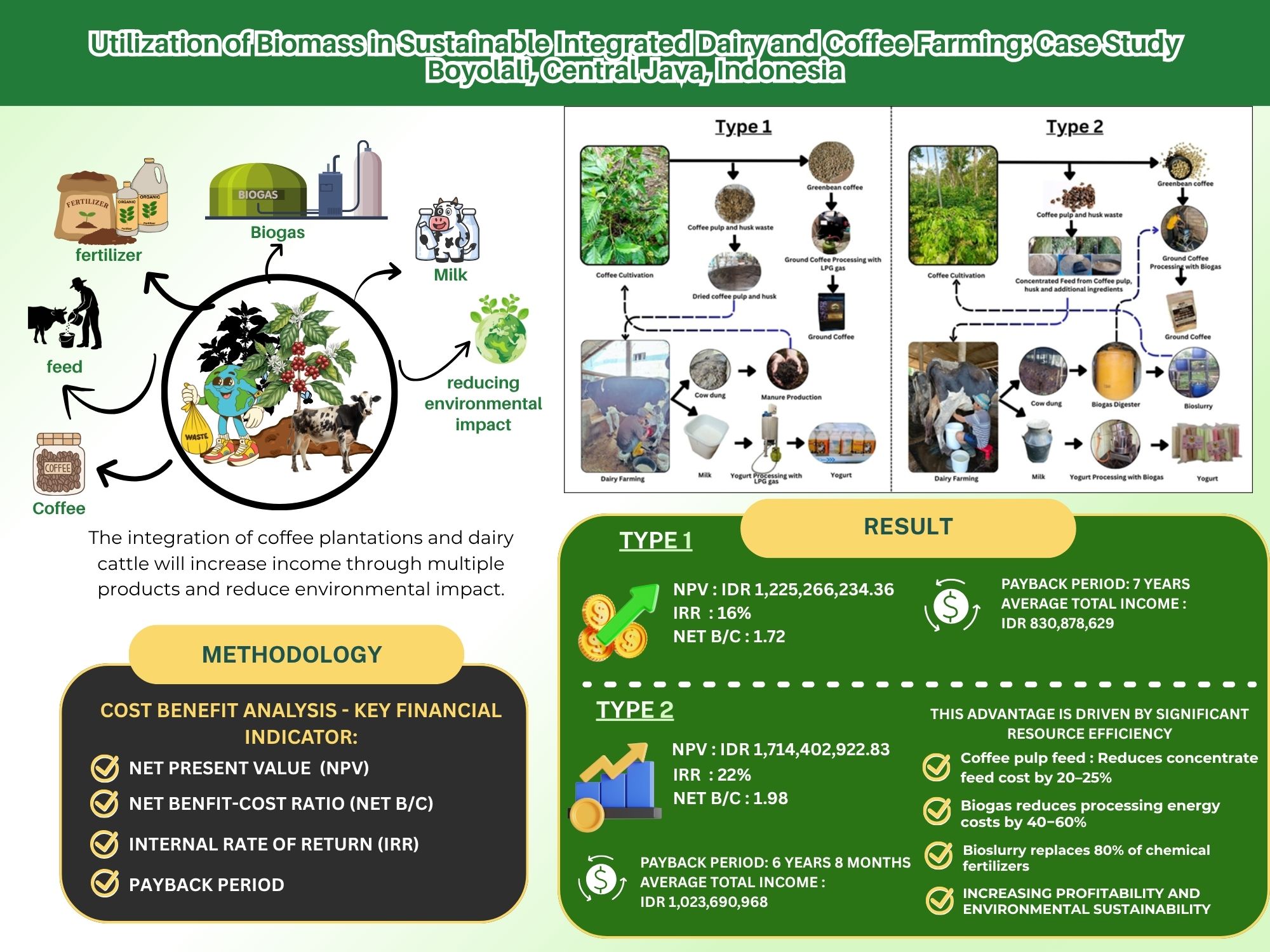
The agricultural sector plays a strategic role in improving economic sustainability and responding to environmental challenges. A sustainable agricultural approach based on the integration of coffee and dairy cattle is a potential solution to these challenges. This study aims to analyze financial feasibility by comparing two types of coffee and dairy cattle integration farming systems, namely
type 1 (existing coffee-dairy cattle integration) and type 2 (improved integration). The difference between the two types lies in the connectivity of input and output use in the integration system. The method used is financial feasibility analysis with investment criteria indicators in the form of NPV, IRR, Net B/C, and payback period. The research was conducted in Boyolali Regency. The results
of the financial feasibility analysis show that the improved coffee and dairy cow integration type (type 2) is financially superior to type 1, with an NPV of IDR 1,714,402,922.83 and an IRR of 22%, far exceeding type 1 (IRR of 16%), with a payback period of 6 years and 8 months. This financial benefit came from lower costs for feed, energy, and fertilizer, as well as big economic gains from diversifying
products that came from making better use of waste. Using biodigester technology to turn biomass into energy is another way to cut down on greenhouse gas emissions from manure waste. These findings provide a strong basis for encouraging the implementation of improved coffee and dairy cow integration through a series of fiscal incentive policies and farmer assistance.
Full text article
References
2. Abdeshahian P, Lim J S, Ho W S, Hashim H, Lee C T 2016 Potential of biogas production from farm animal waste in Malaysia. Renewable and Sustainable Energy Reviews, 60, 714–723, from https://doi.org/10.1016/j.rser.2016.01.117
3. Alderkamp L M, Klootwijk C W, Schut A G T, van der Linden A, van Middelaar, C E, Taube F 2025 Integrating crop and dairy production systems: Exploring different strategies to achieve environmental targets. Science of the Total Environment, 958(November 2024), 177990, from https://doi.org/10.1016/j.scitotenv.2024.177990
4. Al-Yousef H M, Amina M 2018 Essential oil of Coffee arabica L Husks A brilliant source of antimicrobial and antioxidant agents. Biomedical Research (India), 29(1), 174–180, from https://doi.org/10.4066/biomedicalresearch.29-17-867
5. Amjid S S, Bilal M Q, Nazir M S, Hussain A 2011 Biogas, renewable energy resource for Pakistan. Renewable and Sustainable Energy Reviews, 15(6), 2833–2837, from https://doi.org/10.1016/j.rser.2011.02.041
6. Barbieri R S, Calvalho J B de, Sabbag O J 2016 Economic viability analysis of feedlot beef cattle. Interações (Campo Grande), 17, 357–369, from https://doi.org/10.20435/1984-042X-2016-v.17-n.3(01)
7. Babu S, Das A, Singh R, Mohapatra K P, Kumar S, Rathore S S, Yadav S K, Yadav P, Ansari M A, Panwar A S, Wani O A, Singh M, Ravishankar N, Layek J, Chandra P, Singh V K. 2023 Designing an energy efficienct, economically feasible, and environmentally robust integrated farming system model for sustainable food production in the Indian Hymalayas. Sustainable Food Technology, 1, 126-142, from https://doi.org/10.1039/D2FB00016D
8. Bekalo S A, Reinhardt H W 2010 Fibers of coffee husk and hulls for the production of particle board. Materials and Structures, 43:1049–1060, from https://doi.org/10.1617/s11527-009-9565-0
9. Bell L W and Moore A D 2012 Integrated crop-livestock systems in Australian agriculture: Trends, drivers and implications. Agricultural System, 111, 1-12, from https://doi.org/10.1016/j.agsy.2012.04.003
10. Ben Abdallah S, Gallego-Elvira B, Popa D C, Maestre-Valero J F, Imbernón-Mulero A, Popa R A, Bălănescu M 2024 Environmental Performance of a Mixed Crop–Dairy Cattle Farm in Alexandria (Romania). Agriculture (Switzerland), 14(3), 1–18, from https://doi.org/10.3390/agriculture14030462
11. Bouafou K G M, K B A, Zannou-Tchoko V, Kati-Coulibally S 2011 Potential Food Waste and By-products of Coffee in Animal Feed. Electronic J. Biol., 7(4): 74-80, from https://ejbio.imedpub.com/articles/potential-food-waste-and-byproducts-of-coffee-in-animal-feed.php?aid=5928
12. Carmen M T, Lorena Z C, Alexander VA, Amandio V, Raul S 2020 Coffee pulp: an industrial by-product with uses in agriculture, nutrition and biotechnology. Reviewss in Agricultureal Science, Volume 8, 323-342, from https://dx.doi.org/10.7831/ras.8.0_323
13. Desai B K, Satyanarayana R, S A B, U P, M S, U N S, Jagannath 2014 Development of Sustainable Integrated Farming Systems for Small and Marginal Farmers and Ecosystem Services -A Comprehensive Review. International Journal of Agriculture, Environment and Biotechnology, 6(4), 617–622, from https://doi.org/10.5958/j.2230-732X.6.4.040
14. Hasballah K, Lestari W, Listiawan M Y, Sofia S 2022 Coffee by-products as the source of antioxidants: A systematic review. F1000Research, 11, 1–13. https://doi.org/10.12688/f1000research.107811.1
15. Gouvea B M, Torres C, Franca A S, Oliveira LS Oliveira, E S 2009 Feasibility of ethanol production from coffee husks. Biotechnol. Letter, 31:1315–1319, from https://doi.org/10.1007/s10529-009-0023-4
16. Karki A B, Shrestha J N, Bajgain S, Sharma I 2015 Biogas as renewable source of energy in Nepal: Theory and development. In Khatmandu: BSP-Nepal (Nomor December 2015).
17. Lee Y G, Cho E J, Maskey S, Nguyen D T, Bae H J 2023 Value-Added Products from Coffee Waste: A Review. Molecules, 28(8), 1–19, from https://doi.org/10.3390/molecules28083562
18. Lombardi B, Dynes R A, Dennison C, Taylor A L, van der Weerden T J 2024 Exploring potential dairy and arable farm system integration to enhance nutrient circularity: A case study analysis from the Oamaru coastal plains. Journal of New Zealand Grasslands, 86, 335–346, from https://doi.org/10.33584/JNZG.2024.86.3711
19. Mana A A, Allouhi A, Ouazzani K, Jamil A 2021 Feasibility of agriculture biomass power generation in Morocco: Techno-economic analysis. Journal of Cleaner Production, 295, 126293, from https://doi.org/10.1016/j.jclepro.2021.126293
20. Martha R, Desspal, Toharmat T, Retnani Y 2025 Supplementation of protected oilseeds in dairy cattle rations to improve productivity and profitability of small scale farms in the tropics. Livestock Research for Rural Development, 37(1), 1-9, from http://www.lrrd.org/lrrd37/1/3702desp.html
21. Martins Maciel A, Henrique Otenio M, Romário de Paula V, Mendonça Lourenço Benhami V, Moro Piekarski C, Marçal da Rocha C, Oliveira Barros N 2022 Life cycle assessment of milk production system in Brazil: Environmental impact reduction linked with anaerobic treatment of dairy manure. Sustainable Energy Technologies and Assessments, 54(November), 102883, from https://doi.org/10.1016/j.seta.2022.102883
22. Nikzaad R M, Nusrathali N 2016 Integrating Livestock and Crop Systems for Enhanced Productivity and Grassland Conservation in Developing Countries. IntechOpen, 11(tourism), 13, from https://www.intechopen.com/books/advanced-biometric-technologies/liveness-detection-in-biometrics
23. Oliveira L S, Franca A S 2015 An Overview of the Potential Uses for Coffee Husks. In Coffee in Health and Disease Prevention. Elsevier Inc, from https://doi.org/10.1016/B978-0-12-409517-5.00031-0
24. Oropeza-Mariano E, Ortega Cerrilla M E, Herrera-Haro J G, Ramírez-Bribiesca E J, Salinas-Ríos T 2022 Use of pulp and husk of coffee in animal feed. Agro Productividad, 149–158, from https://doi.org/10.32854/agrop.v15i9.2171
25. Pedraza-Beltrán P, Estrada-Flores J G, Martínez-Campos A R, Estrada-López I, Rayas-Amor A A, Yong-Angel G, Figueroa-Medina M, Avilés N F and Castelán-Ortega O A 2012 On-farm evaluation of the effect of coffee pulp supplementation on milk yield and dry matter intake of dairy cows grazing tropical grasses in central Mexico. Trop. Anim. Health Prod., 44 (2): 329–336, from https://doi.org/10.1007/s11250-011-0025-9
26. Saleem M 2022 Possibility of utilizing agriculture biomass as a renewable and sustainable future energy source. Heliyon, 8(2), e08905, from https://doi.org/10.1016/j.heliyon.2022.e08905
27. Tamilselvan K, Sundarajan S, Ramakrishna S, Amirul A A A, Vigneswari S 2024 Sustainable valorisation of coffee husk into value added product in the context of circular bioeconomy: Exploring potential biomass-based value webs. Food and Bioproducts Processing, 145(March), 187–202, from https://doi.org/10.1016/j.fbp.2024.03.008
28. Trivelin G A, Andrighetto C, Mateus G P, Luz P A da, Bernardes E M, Lupatini G C, Aranha H S, Santana E A R, Aranha A S, Sekiya B M S, Santos J M de F, Eufrade-Junior H de J 2020 Animal production and economic viability of integrated crop livestock systems. International Journal for Innovation Education and Research, 8(8), 530–540, from https://doi.org/10.31686/ijier.vol8.iss8.2559
29. Vinholis M de M B, Filho H M de S, Shimata I, Oliveira P P A, Pedroso A de F 2020 Economic viability of a crop-livestock integration system. Ciencia Rural, 51(2), 1–13, from https://doi.org/10.1590/0103-8478cr20190538
30. Walekhwa P N, Lars D, Mugisha J 2014 Economic viability of biogas energy production from family-sized digesters in Uganda. Biomass and Bioenergy, 70, 26–39, from https://doi.org/10.1016/j.biombioe.2014.03.008
31. Wogderess A S 2016 Available information on the feeding value of coffee waste and ways to improve coffee waste for animal feed. African Journal of Biology, 3(6), hal. 243–257, from www.internationalscholarsjournals.org.
32. Yazan D M, Cafagna D, Fraccascia, L, Mes M, Pontrandolfo P, Zijm H 2018 Economic sustainability of biogas production from animal manure: a regional circular economy model. Management Research Review, 41(5), 605–624, from https://doi.org/10.1108/MRR-02-2018-0053
Authors
Copyright (c) 2026 Lintje Hutahaean, Ernan Rustiadi, Anas Miftah Fauzi, Rita Nurmalina, Rubiyo

This work is licensed under a Creative Commons Attribution 4.0 International License.
Authors who publish with this journal agree to the following terms:
- Authors retain copyright and grant the journal right of first publication with the work simultaneously licensed under a Creative Commons Attribution License that allows others to share the work with an acknowledgement of the work's authorship and initial publication in this journal.
- Authors are able to enter into separate, additional contractual arrangements for the non-exclusive distribution of the journal's published version of the work (e.g., post it to an institutional repository or publish it in a book), with an acknowledgement of its initial publication in this journal.
- Authors are permitted and encouraged to post their work online (e.g., in institutional repositories or on their website) prior to and during the submission process, as it can lead to productive exchanges, as well as earlier and greater citation of published work (See The Effect of Open Access).
Article Details
How to Cite



