
Role of Insect Pests in Minapadi Systems as Natural Feed for Catfish and Their Impact on Pest Control
Article Sidebar
-
insects, natural feed, catfish, minapadi
Abstract
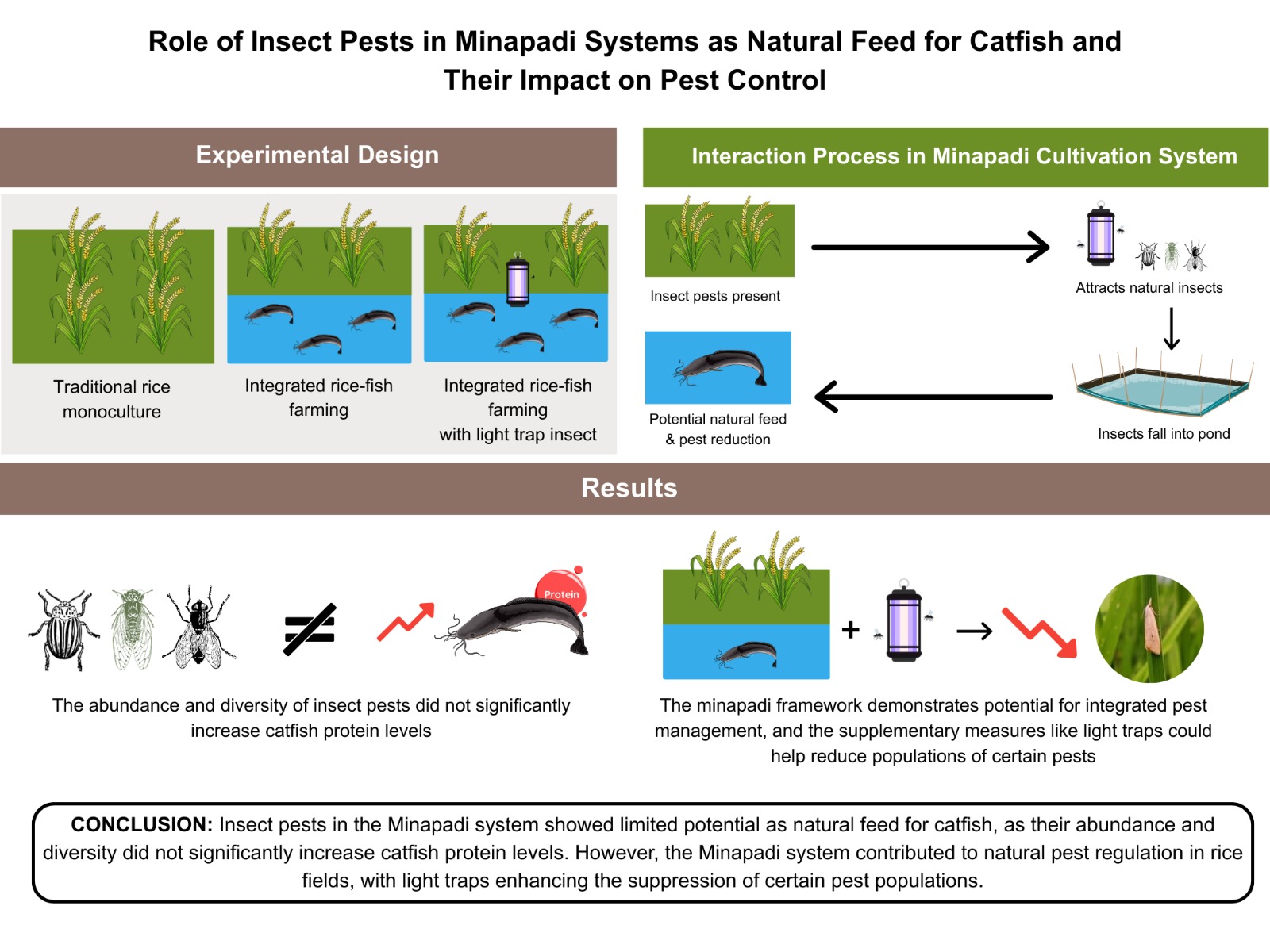
Minapadi is a term for the integrated cultivation of rice and fish. This study aimed to: (1) determine the potential of insect pests from the rice field ecosystem as a natural feed source for catfish in a Minapadi system; and (2) analyze the system's effectiveness in naturally controlling insect pest populations in rice. Three experimental plots were established: Plot A combined a rice field with a
catfish pond equipped with a light trap; Plot B combined a rice field with a catfish pond without a light trap; and Plot C was a rice field alone, serving as a control. The methodology encompassed land preparation and plot layout, maintenance of rice and catfish, insect sampling, measurement of rice plant growth parameters, assessment of catfish weight and protein content, and statistical data analysis. The potential of insects as feed was indicated by the significant abundance of captured insects, categorized as either pests or natural enemies. Insect abundance across all plots increased weekly during observations. The insect pest diversity index was moderate in the integrated plots (A and B) and low in the control plot (C). The diversity index for natural enemies was moderate across
all three plots. Statistical analysis revealed that the variation in insect pest abundance and diversity did not significantly influence the protein content levels measured in the catfish. Over all, Minapadi framework demonstrates promise as a component of integrated pest management however supplemental strategies such as light traps may be necessary to enhance control of specific pest
populations.
Full text article
References
2. Ihfitasari, T., Siregar, A. Z., & Pinem, M. I. (2019). Indeks Kerapatan Mutlak, Kerapatan Relatif, Frekuensi Mutlak dan Frekuensi Relatif Serangga pada Tanaman Padi (Oryza sativa L.) Fase Vegetatif dan Fase generatif di Percut, Sumatera Utara. Jurnal Agroekoteknologi, 7(2), 472–481.
3. Prabhakar, P., Ramesh, M., & Santosh, S. (2021). Preliminary Survey of Major Insect Pests of Rice (Oryza sativa L.) from Panvel, Navi Mumbai, India. International Journal of Zoological Investigations, 7(1), 22–31. https://doi.org/10.33745/ijzi.2021.v07i01.003
4. Melfa Aisyah Hutasuhut, Kartika Manalu, & Icha Aurelia Ahmad, 2021)
5. Hong-xing, X., Ya-jun, Y., Yan-hui, L., Xu-song, Z., Jun-ce, T., Feng-xiang, L., … Zhong-xian, L. (2017). Sustainable Management of Rice Insect Pests by Non-Chemical-Insecticide Technologies in China. Rice Science, 24(2), 61–72. https://doi.org/10.1016/j.rsci.2017.01.001
6. Ahmadian, I., Yustiati, A., & Andriani, Y. (2021). Produktivitas Budidaya Sistem Mina Padi Untuk Meningkatkan Ketahanan Pangan Di Indonesia: a Review. Jurnal Akuatek, 2(1), 1–6.
7. Apasha, S. R., Yanti, N. D., & Rifiana. (2015). Preferensi Konsumen Terhadap Ikan Tawar Dan Ikan Laut Dipasar Tradisional Bauntung Kota Banjar Baru. Jurnal Agribisnis Perdesaan, 05(April), 89–104.
8. Lindell, N. (2021). Habitat Preference and Activity Pattern of Wels Catfish (Silurus glanis) at its Northernmost Distribution Area (PhD Thesis). Retrieved from http://urn.kb.se/resolve?urn=urn:nbn:se:liu:diva-178407
9. Asyari, A. (2006). Peran Serangga Air Bagi Ikan Air Tawar. BAWAL, 1(2), 12–19. https://doi.org/10.15578/bawal.1.2.2006.53-60
10. Siregar, A. Z. (2013). Mina Padi: Kombinasi Dwi Fungsi Protein Bagi Petani. Skripsi, 1–10.
11. Lantarsih, R. (2016). Pengembangan “Minapadi Kolam Dalam” di Kabupaten Sleman. AGRARIS: Journal of Agribusiness and Rural Development Research, 2(1), 17–27. https://doi.org/10.18196/agr.2122
12. Akbar, A. (2017). Peran Intensifikasi Mina Padi Dalam Menambah Pendapatan Petani Padi Sawah Digampong Gegarang Kecamatan Jagong Jeget Kabupaten Aceh Tengah. Jurnal S. Pertanian, 1(1), 28–38. Retrieved from https://www.neliti.com/publications/210823/peran-intensifikasi-mina-padi-dalam-menambah-pendapatan-petani-padi-sawah-digampong
13. Mahendra, Saputra, F., Febrina, C. D., & Islama, D. (2019). Teknologi Milenial (Minapadi Legowo dengan Ikan Lokal) Secara Berkelanjutan di Kecamatan Beutong Nagan Raya. Jurnal Karya Abdi Masyarakat, 3(2), 286–298.
14. Kurniallah, W. (2018). Analisis Produktivitas Budidaya Ikan Nila Oreochromis niloticus dalam Rice-Fish Culture System pada Area Bekas Tambang Industri Semen di Kabupaten Tuban.
15. Dibble, E. D., & Harrel, S. L. (2000). Microhabitat selection by three stream-dwelling cyprinids: Blacktail shiner (cyprinella venusta), bluntface shiner (c. camura), and striped shiner (luxilus chrysocephalus). Journal of Freshwater Ecology, 15(4), 455–463. https://doi.org/10.1080/02705060.2000.9663767
16. Stansby, M. E. (1963). Industrial fishery technology. Reinhold Publishing Corporation.
17. Manopo R , C.L. Salaki, J.E.M Mamahit , E. Senewe. (2013). Padat Populasi Dan Intensitas Serangan Hama Walang Sangit (Leptocorisa Acuta Thunb.) Pada Tanaman Padi Sawah Di Kabupaten Minahasa Tenggara. Skripsi Fakultas Pertanian Universitas Sam Ratulangi Manado.
18. Sidim, F. (2009). Penyebaran Hama Walang sangit Leptocorisa oratorius F. (Hemiptera ; Alydidae) Pada Tanaman Padi di Kabupaten Minahasa. Skripsi Fakultas Pertanian Universitas Sam Ratulangi Manado.
19. Kristiaga, Z. C. J., & Agastya, I. M. I. (2020). Kelimpahan Serangga Musuh Alami dan Serangga Hama pada Ekosistem Tanaman Cabai Merah (Capsicum Annum L.) pada Fase Vegetatif di Kecamatan Dau Kabupaten Malang. Jurnal penelitian pertanian terapan, 20(3), 230-236.
20. Mukhlis. (2016). Penerapan Lampu Perangkap (Insect Light Trap) dan Ekstrak Akar Tuba Untuk Pengembalian Hama Penggerek Batang Kuning (Scirpophaga spp) Pada Tanaman Padi (Oryza sativa L). Agrohita, 1(1), 1–5. http://jurnal.umtapsel.ac.id/index.php/agrohita/article/download/194/178
21. Mulyani, Y., Maulina, I., Bagaskhara, P.P., Rahmadianto, A.P., Riyanto, A.Z & Nurfadhillah, R. (2021).Edukasi Manajemen Pemberian Pakan Dalam Budidaya Ikan Lele Di Pekarangan Sempit Bagi Masyarakat Desa Raharja, Kecamatan Tanjungsari, Kabupaten Sumedang. Farmers : Journal of Community Service, 2(2). 1 – 7
22. Tamsil, A., Ghufran, M,. Yasin, H., Ibrahim, T.A., (2019). Biologi Perikanan. Penerbit Lily
23. Tran, G., Heuze, V., & Makkar, H.P.S., (2015). Insect in Fish Diets. Food and Agriculture Organization of The United Nation, Animal Production and Health Division. Italy
24.Simamora SD, Febri SP, Rosmaiti R. (2021). Pengaruh Dosis Probiotik Em-4 (Effective Mikroorganisme-4) Dalam Pakan Komersil Terhadap Peningkatan Pertumbuhan Dan Kelangsungan Hidup Ikan Patin Siam (Pangasisus hypophthalmus). Acta Aquatica: Aquatic Sciences Journal, 8 (3): 131-137
25. Toar, W.L., Laurentius, J.M., Rumokoy., (2020). Strategi Ketahanan Pangan Masa New Normal Covid-19. Seminar Nasional dalam Rangka Dies Natalis Ke – 44 UNS.
26. Djarijah, A.S., (1995). Pakan Ikan Alami. Penerbit Kanisius. Yogyakarta
27. Miftahuddin, (2016). Analisis Unsur-unsur Cuaca dan Iklim Melalui Uji Mann-Kendall Multivariat. Jurnal Matematika, Statistika & Komputasi. Vol.13 , No. 1, p.26-38. DOI: https://doi.org/10.20956/jmsk.v13i1.3476
28. White, S.M., C. J. Sanders, C.J. Shortall and B.V. Purse, (2017). Mechanistic model for predicting the seasonal abundance of Culicoides biting midges and the impacts of insecticide control. Parasites & Vectors. Vol. 10, No. 162. p. 1-14
29. Masum, S. M., Malek, M., Mandal, M. S. H., Haque, M. N., & Akther, Z. (2013). Influence of Plant extracted Pyroligneous Acid on transplanted Aman rice. J. Exp. Biosci., 4(2), 31–34
30. Adiwilaga, E. M., S. Hariyadi dan N. T. M. Pratiwi, (2009). Perilaku Oksigen Terlarut Selama 24 Jam Pada Lokasi Keramba Jaring Apung di Waduk Saguling Jawa Barat. Jurnal Limnotek. Vol. XIV, no. 2, p. 109-118.
31. Patriono E, R Amalia, M Sitia. (2021). Kualitas air kolam budidaya dan kolam terpal untuk pertumbuhan ikan Lele Sangkuriang (Clarias gariepinus) pada kelompok pembudidaya ikan Lele di Kabupaten PALI Sumatera Selatan. Sriwijaya Bioscientia 2 (3), 83-8
Authors
Copyright (c) 2026 Tien Aminatun, Budiwati, Suhartini, Rizka Apriani Putri, Arsyad Sujangka, Fardan Yusuf Ibrahim, Hasna Kamila Hanum, Genius Abid Karunia, Syfa Trinandita

This work is licensed under a Creative Commons Attribution 4.0 International License.
Authors who publish with this journal agree to the following terms:
- Authors retain copyright and grant the journal right of first publication with the work simultaneously licensed under a Creative Commons Attribution License that allows others to share the work with an acknowledgement of the work's authorship and initial publication in this journal.
- Authors are able to enter into separate, additional contractual arrangements for the non-exclusive distribution of the journal's published version of the work (e.g., post it to an institutional repository or publish it in a book), with an acknowledgement of its initial publication in this journal.
- Authors are permitted and encouraged to post their work online (e.g., in institutional repositories or on their website) prior to and during the submission process, as it can lead to productive exchanges, as well as earlier and greater citation of published work (See The Effect of Open Access).
Article Details
How to Cite



