
Developing a Decision Tree Algorithm for Detecting Agroforestry and Monoculture Coffee Plantations Using Landsat 8 Imagery: A Case Study inBandung Regency, Indonesia
Article Sidebar
-
brute force, coffee agroforestry, coffee monoculture, decision tree, landsat 8, machine learning
Abstract
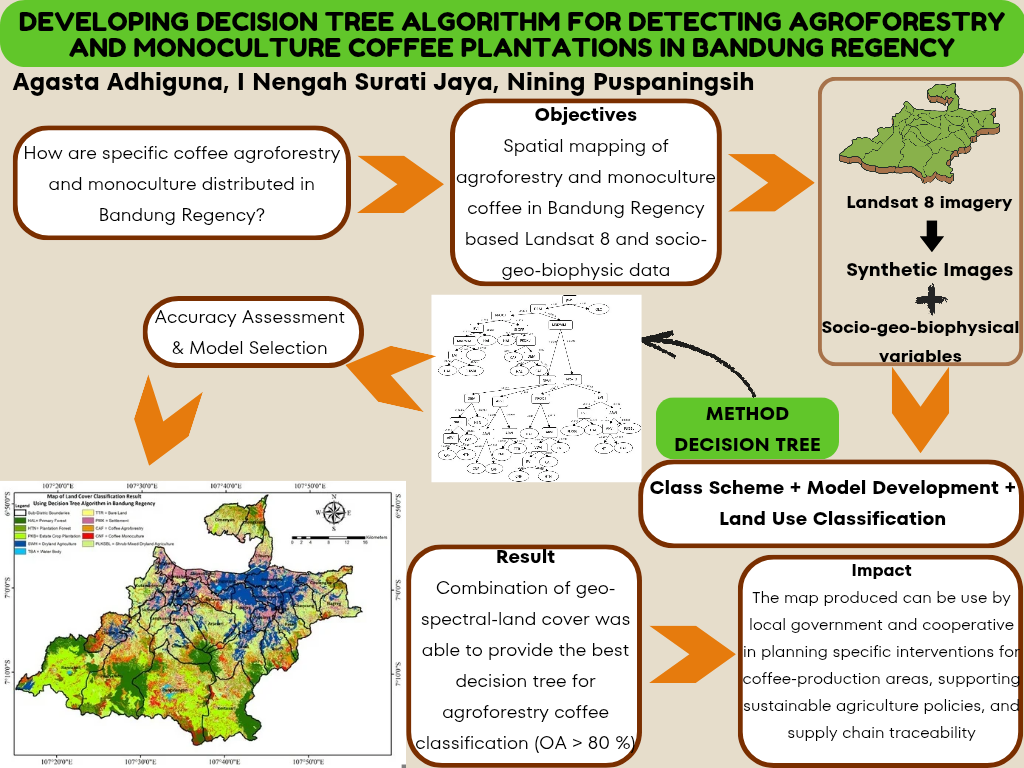
Data on the potential of coffee commodities in Bandung Regency is still mixed with data on other commodities. Therefore, the study aims to develop an algorithm that provides accurate spatial information through maps for both coffee plantations in agroforestry and monoculture systems. This study integrates the data derived from remotely sensed data and data derived using socio-geobiophysical aspects, such as elevation, slope, distance from the road and rivers, proximity of the settlements, population density, proximity of villages, and a visually-based land-use-land cover map. The importance value for each variable was computed using several criteria, such as information gain, Gini index, and gain ratio. Meanwhile, the brute force method was applied to select the most significant variables in the model. The study found that the most significant variables for identifying coffee agroforestry and monoculture were ARVI, EVI, GARI, NRGI, and VDVI, as well as DEM, slope, proximity to roads, and visual-based LULC, using the criterion of information gain. The use of existing land-use and cover maps was the most influential variable in the model. The algorithm achieved an overall accuracy (OA) of 84.65% and a kappa accuracy (KA) of 82.60%. Based on overall accuracy and high kappa accuracy, the maps produced facilitate local governments and cooperatives in planning specific interventions for coffee-producing areas, supporting policies related to sustainable agriculture, climate-smart agroforestry expansion, and supply chain traceability.
Full text article
References
1. Agricultural Data and Information Center. Outlook for Coffee Plantation Commodities; Directorate General of Agriculture: Jakarta, 2023.
2. Indonesian Central Bureau of Statistics. Indonesian Coffee Statistics 2021; BPS Republic of Indonesia: Jakarta, 2021.
3. Pendrill, F.; Gardner, T. A.; Meyfroidt, P.; Persson, U. M.; Adams, J. M.; Azevedo, T. R. de; Lima, M. G. B.; Baumann, M.; Curtis, P. G.; Sy, V. D.; Garrett, R. D.; Godar, J.; Goldman, E. D.; Hansen, M. C.; Heilmayr, R.; Herold, M.; Kuemmerle, T.; Lathuillière, M. J.; Ribeiro, V.; West, C. Disentangling the Numbers Behind Agriculture-Driven Tropical Deforestation. Science. 2022. https://doi.org/10.1126/science.abm9267. DOI: https://doi.org/10.1126/science.abm9267
4. Winara, A.; Fauziyah, E.; Suhartono, S.; Widiyanto, A.; Sanudin, S.; Sudomo, A.; Siarudin, M.; Hani, A.; Indrajaya, Y.; Achmad, B.; Diniyati, D.; Handayani, W.; Suhaendah, E.; Maharani, D.M.; Swestiani, D.; Murniati, M.; Widyaningsih, T.S.; Sulistiadi, H.B.S., Azmi, C., Diana, M. Assessing the Productivity and Socioeconomic Feasibility of Cocoyam and Teak Agroforestry for Food Security. Sustainability. 2022. doi.org/10.3390/su141911981. DOI: https://doi.org/10.3390/su141911981
5. Gunawan, B.; Abdoellah, O.S.; Aisharya, I.Y.; Gunawan, W. From Laborers to Coffee Farmers: Collaborative Forest Management in West Java, Indonesia. Sustainability. 2023. doi.org/10.3390/ su15097722. DOI: https://doi.org/10.3390/su15097722
6. Anasrul, A.; Nooraeni, R. Pan-Sharpening Analysis for Improved Detection Accuracy and Estimation of Coffee Plantation Land Area (Case Study: South OKU Regency, South Sumatra Province). J. Tek. Pertanian Lampung. 2025, 14(2), 424-436. http://dx.doi.org/10.23960/jtep-l.v14i2.424-436. DOI: https://doi.org/10.23960/jtep-l.v14i2.424-436
7. Barus, B.J.A.; Razali, S.; Sitanggang, G. The Evaluation of Land Suitability Coffea Arabica (Coffea arabica L.) in Muara Subdistrict of North Tapanuli District. Jurnal Online Agroekoteknologi. 2015, 3(4), 1459–1467. doi:10.32734/jaet.v3i4.11797.
8. Nigussie, W.; Al-Najjar, H.; Zhang, W.; Yirsaw, E.; Nega, W.; Zhang, Z.; Kalantar, B. Enhancing Coffee Agroforestry Systems Suitability Using Geospatial Analysis and Sentinel Satellite Data in Gedeo Zone, Ethiopia. Sensors (Basel). 2024, 24(19):6287. doi: 10.3390/s24196287.
9. Escobar-López, A.; Castillo-Santiago, M. Á.; Mas, J. F.; Hernández-Stefanoni, J. L.; López-Martínez, J. O. Identification of Coffee Agroforestry Systems Using Remote Sensing Data: A Review of Methods and Sensor Data. Geocarto International. 2024, 39(1). doi: 10.1080/10106049.2023.2297555
10. Hehn, T.M.; Kooij, J.F.P.; Hamprecht, F.A. End-to-End Learning of Decision Trees and Forests. Int. J. Comput. Vis. 2020, 128, 997–1011. doi:10.1007/s11263-019-01237-6. DOI: https://doi.org/10.1007/s11263-019-01237-6
11. Nigussie, W.; Al-Najjar, H.A.H.; Zhang, W.; Yirsaw, E.; Nega, W.; Zhang, Z.; Kalantar, B. Enhancing Coffee Agroforestry Systems Suitability Using Geospatial Analysis and Sentinel Satellite Data in Gedeo Zone, Ethiopia. Sensors. 2024. https://doi.org/10.3390/s24196287. DOI: https://doi.org/10.3390/s24196287
12. Gaitán-Cremaschi, D.; van Evert, F.K.; Jansen, D.M.; Meuwissen, M.P.M.; Lansink, A.G.J.M.O. Assessing the Sustainability Performance of Coffee Farms in Vietnam: A Social Profit Inefficiency Approach. Sustainability. 2018, 10, 4227. doi:10.3390/su10114227. DOI: https://doi.org/10.3390/su10114227
13. Breiman, L.; Friedman, J. H.; Olshen, R. A.; & Stone, C. J. Classification and Regression Trees. Belmont, CA: Wadsworth International Group, 1984.
14. Pal, M.; Mather, P. M. An Assessment of the Effectiveness of Decision Tree Methods for Land Cover Classification. Remote Sensing of Environment. 2003, 86(4), 554–565. https://doi.org/10.1016/S0034-4257(03)00132-9. DOI: https://doi.org/10.1016/S0034-4257(03)00132-9
15. Jaya, I.N.S. Digital Image Analysis: A Remote Sensing Perspective for Natural Resource Management, 3rd ed.; IPB University: Bogor, 2015.
16. Amiri, F.; Shariff, A.R.B.M. Using Remote Sensing Data for Vegetation Cover Assessment in Semi-Arid Rangeland of Center Province of Iran. World Appl. Sci. J. 2010, 11(12), 1537–1546.
17. Xue, J.; Su, B. Significant Remote Sensing Vegetation Indices: A Review of Developments and Applications. J. Sensors. 2017, doi:10.1155/2017/1353691. DOI: https://doi.org/10.1155/2017/1353691
18. Gao, B.C.; Li, R.R. FVI—A Floating Vegetation Index Formed with Three Near-IR Channels in the 1.0–1.24 µm Spectral Range for the Detection of Vegetation Floating over Water Surfaces. Remote. Sens. 2018, 10(1421), 1-10. doi:10.3390/rs10091421. DOI: https://doi.org/10.3390/rs10091421
19. Justino, S.T.P.; Silva, R.B.; Guerrini, I. A.; Silva, R.B.G.da; Simões, D. Monitoring Environmental Degradation and Spatial Changes in Vegetation and Water Resources in the Brazilian Pantanal. Sustainability. 2024. https://doi.org/10.3390/su17010051.
20. Hu, Y.; Raza, A.; Syed, N.R.; Acharki, S.; Ray, R.L.; Hussain, S.; Dehghanisanij, H.; Zubair, M.; Elbeltagi, A. Land Use/Land Cover Change Detection and NDVI Estimation in Pakistan’s Southern Punjab Province. Sustainability. 2023. https://doi.org/10.3390/su15043572. DOI: https://doi.org/10.3390/su15043572
21. Kaufman, Y. J., & Tanré. Atmospherically resistant vegetation index (ARVI) for EOS-MODIS. IEEE Transactions on Geoscience and Remote Sensing. 1992. https://doi.org/10.1109/36.134076.
22. Kaufman, Y. J., & Tanré. Atmospherically resistant vegetation index (ARVI) for EOS-MODIS. IEEE Transactions on Geoscience and Remote Sensing. 1992. https://doi.org/10.1109/36.134076. DOI: https://doi.org/10.1109/36.134076
23. Justino, S.T.P.; Silva, R.B.; Guerrini, I. A.; Silva, R.B.G.da; Simões, D. Monitoring Environmental Degradation and Spatial Changes in Vegetation and Water Resources in the Brazilian Pantanal. Sustainability. 2024. https://doi.org/10.3390/su17010051. DOI: https://doi.org/10.3390/su17010051
24. Kwan, C.; Gribben, D.; Ayhan, B.; Li, J.; Bernabe, S.; Plaza, A. An Accurate Vegetation and Non-Vegetation Differentiation Approach Based on Land Cover Classification. Remote Sensing. 2020. https://doi.org/10.3390/RS12233880. DOI: https://doi.org/10.3390/rs12233880
25. Viña, A.; Henebry, G.M.; Gitelson, A.A. Satellite monitoring of vegetation dynamics: Sensitivity enhancement by the wide dynamic range vegetation index. Geophysical Research Letters. 2004. https://doi.org/10.1029/2003GL019034. DOI: https://doi.org/10.1029/2003GL019034
26. Selvam, N.; Saranya, R. Analysis of Decision Tree Algorithm in Machine Learning. Int. J. Adv. Res. Innov. Ideas Educ. 2018, 4, 281-286.
27. Mertes, C.M.; Schneider, A.; Sulla-Menashe, D.; Tatem, A.J.; Tan, B. Detecting change in urban areas at continental scales with MODIS data. Remote Sensing of Environment. 2015. 158, 331–347. doi: 10.1016/j.rse.2014.09.023. DOI: https://doi.org/10.1016/j.rse.2014.09.023
28. Quinlan, J.R. C4.5: Programs for Machine Learning; Morgan Kaufmann: Los Altos, 1993.
29. Kumar, A.; Choudhary, T. A Machine Learning Approach for Land-Type Classification. Innovations in Electrical and Electronic Engineering. 2021, 647–656. doi:10.1007/978-981-16-0749-3_51. DOI: https://doi.org/10.1007/978-981-16-0749-3_51
30. Huo, Z.; Martínez-García, M.; Zhang, Y.; Yan, R.; Shu, L. Entropy Measures in Machine Fault Diagnosis: Insights and Applications. IEEE Transactions on Instrumentation and Measurement. 2020, 69, 2607-2620. doi:10.1109/TIM.2020.2981220. DOI: https://doi.org/10.1109/TIM.2020.2981220
31. Petrović, M.S., Dragićević, S., Bajat, B., Kovačević, M. Exploring The Decision Tree Method for Modelling Urban Land Use Change. Geomatica. 2015. 69(3), 313-325. doi: 10.5623/cig2015-305. DOI: https://doi.org/10.5623/cig2015-305
32. Tangirala, S. Evaluating the Impact of GINI Index and Information Gain on Classification using Decision Tree Classifier Algorithm. International Journal of Advanced Computer Science and Applications. 2020, 11(2), 612-619. doi: 10.14569/IJACSA.2020.0110277. DOI: https://doi.org/10.14569/IJACSA.2020.0110277
33. Brunello, A.; Marzano, E.; Montanari, A.; Sciavicco, G. Decision Tree Pruning via Multi-objective Evolutionary Computation. Int J Mach Learn Comput. 2017, 7(6), 167–175. doi: 10.18178/ijmlc.2017.7.6.641. DOI: https://doi.org/10.18178/ijmlc.2017.7.6.641
34. Amro, A.; Al-Akhras, M.; Hindi, K.; Habib, M.; Shawar; B. Instance Reduction for Avoiding Overfitting in Decision Trees. Journal of Intelligent Systems. 2021, 30(1), 438-459. doi:10.1515/jisys-2020-0061. DOI: https://doi.org/10.1515/jisys-2020-0061
35. Mijwil, M.M.; Abttan, R.A. Utilizing the Genetic Algorithm to Pruning the C4.5 Decision Tree Algorithm. Asian. J. App. Sci. 2021, 9(1), 45-52. DOI: https://doi.org/10.24203/ajas.v9i1.6503
36. Witten, I.H.; Frank, E.; Hall, M.A. Data Mining: Practical Machine Learning Tools and Techniques 3rd edition.; Morgan Kaufmann: Massachusetts, 2011. DOI: https://doi.org/10.1016/B978-0-12-374856-0.00001-8
37. Lefkovits, S.; Lefkovits, L. Gabor Feature Selection Based on Information Gain. Procedia Eng. 2017, 181, 892–898. doi:10.1016/j.proeng.2017.02.482. DOI: https://doi.org/10.1016/j.proeng.2017.02.482
38. Rohitha, A. A Comparative Study of the Brute Force Approach with the Hungarian Method of Solving the Travel Distance Problem of Travelling Salesman Problem from Vijayawada to Mangalagiri (Via Tadepalli) to Reach within the Allotted Time. International Journal of Science and Research. 2023, 12(3), 63-66. doi:10.21275/sr23228200317. DOI: https://doi.org/10.21275/SR23228200317
39. Park, Y.; Ho, J. Tackling Overfitting in Boosting for Noisy Healthcare Data. IEEE Transactions on Knowledge and Data Engineering. 2021, 33, 2995-3006. doi:10.1109/TKDE.2019.2959988. DOI: https://doi.org/10.1109/TKDE.2019.2959988
40. Budiarti, W.; Gravitani, E.; Mujiyo. Analysis of Biophysical Aspects for Floods Vulnerability Assessment in Samin Sub-Watershed, Central Java Province. Journal of Natural Resources and Environmental Management. 2018, 8(1), 96–108. doi:10.29244/jpsl.8.1.96-108. DOI: https://doi.org/10.29244/jpsl.8.1.96-108
41. Kumar, U.; Dasgupta, A.; Mukhopadhyay, C.; Ramachandra, T. Examining the Effect of Ancillary and Derived Geographical Data on Improvement of Per-Pixel Classification Accuracy of Different Landscapes. J Indian Soc Remote Sens. 2018, 46, 407-422. doi:10.1007/s12524-017-0698-2. DOI: https://doi.org/10.1007/s12524-017-0698-2
42. Dikdayan, G.A.; Ariffin, A. Kajian Iklim Mikro Tanaman Kopi Sistem Agroforestri Di UB Forest. Produksi Tanaman. 2022. https://doi.org/10.21776/ub.protan.2022.010.07.01. DOI: https://doi.org/10.21776/ub.protan.2022.010.07.01
43. Andriyani, I.; Ubaidillah, M.M. Penilaian Indikasi Geografis Pegunungan Hyang Argopuro dan Kesesuaian Lahannya untuk Budidaya Kopi. Agritech. 2022. https://doi.org/10.22146/agritech.60195. DOI: https://doi.org/10.22146/agritech.60195
44. Sundari, Y.; Asdak, C.; Dwiratna, S. Analisis Karakteristik Fisik Kondisi Lahan di Kabupaten Bandung Barat.Prosiding Seminar Nasional Pembangunan Dan Pendidikan Vokasi Pertanian. 2023. https://doi.org/10.47687/snppvp.v4i1.686. DOI: https://doi.org/10.47687/snppvp.v4i1.686
45. Chairani, E.; Supriatna, J.; Koestoer, R.H.; Moeliono, M. Physical Land Suitability for Civet Arabica Coffee: Case Study of Bandung and West Bandung Regencies, Indonesia. IOP Conference Series: Earth and Environmental Science. 2017, 98. https://doi.org/10.1088/1755-1315/98/1/012029. DOI: https://doi.org/10.1088/1755-1315/98/1/012029
46. Ferreira, G.R.; Ferreira, W.P.M.; Barbosa, T.K.M.; Luppi, A.S.L.; Silva, M.A.V. Zoneamento Térmico Para o Cultivo do Café de Montanha na Região das Matas de Minas (Thermal Zoning for Mountain Coffee Crops in the Matas de Minas Region, Brazil). Revista Brasileira de Geografia Física. 2018, 11(4), 1176-1185. https://doi.org/10.26848/RBGF.V11.4.P1176-1185. DOI: https://doi.org/10.26848/rbgf.v11.4.p1176-1185
47. Siahaan, Ir. A. Identification of Arabica Coffee Production in Altitude Places in Lintong Ni Huta of Humbang Hasundutan. International Journal of Environment, Agriculture and Biotechnology. 2018, 1(3), 249-255. https://doi.org/10.22161/IJEAB/3.1.31. DOI: https://doi.org/10.22161/ijeab/3.1.31
48. Somvanshi, S.; Kumari, M. Comparative Analysis of Different Vegetation Indices with Respect to Atmospheric Particulate Pollution Using Sentinel Data. Applied Computing and Geosciences. 2020, 7, 1-10. doi:10.1016/j.acags.2020.100032. DOI: https://doi.org/10.1016/j.acags.2020.100032
49. Cano, D.; Pizarro, S.; Cacciuttolo, C.; Peñaloza, R.; Yaranga, R.; Gandini, M. Study of Ecosystem Degradation Dynamics in the Peruvian Highlands: Landsat Time-Series Trend Analysis (1985–2022) with ARVI for Different Vegetation Cover Types. Sustainability. 2023, 15, 15472. doi:10.3390/su152115472. DOI: https://doi.org/10.3390/su152115472
50. Ticehurst, C., Teng, J., & Sengupta, A. Development of a Multi-Index Method Based on Landsat Reflectance Data to Map Open Water in a Complex Environment. Remote. Sens. 2022. 14, 1158. doi:10.3390/rs14051158. DOI: https://doi.org/10.3390/rs14051158
51. Rehman, A.; Ullah, S.; Shafique, M.; Khan, M.; Badshah, M.; Liu, Q. Combining Landsat-8 Spectral Bands with Ancillary Variables for Land Cover Classification in Mountainous Terrains of Northern Pakistan. Journal of Mountain Science. 2021, 18, 2388 - 2401. doi:10.1007/s11629-020-6548-7.. DOI: https://doi.org/10.1007/s11629-020-6548-7
52. Johnnerie, R.; Siregar, V.P.; Nababan, B.; Prasetyo, L.B.; Wouthuyzen. Random Forest Classification for Mangrove Land Cover Mapping Using Landsat 5 TM and ALOS PALSAR Imageries. Procedia Environ. Sci. 2015, 24, 215–221. doi:10.1016/j.proenv.2015.03.028. DOI: https://doi.org/10.1016/j.proenv.2015.03.028
53. Wardhani, A.K.; Nugraha, E.; Ulfiana, Q. Optimization of the Decision Tree Method using Pruning on Liver Disease Classification. J. Appl. Informatics Comput. 2022, 6(2), 136–140. DOI: https://doi.org/10.30871/jaic.v6i2.4350
54. Chern, C.C.; Chen, Y.J.; Hsiao, B. Decision Tree-Based Classifier in Providing Telehealth Service. BMC Med. Inform. Decis. Mak. 2019, 19(1), 1–15. doi: 10.1186/s12911-019-0825-9. DOI: https://doi.org/10.1186/s12911-019-0825-9
55. Lopez, A.E.; Santiago, M.A.C.; Mas, J.F. Identification of Coffee Agroforestry Systems using Remote Sensing Data: A Review of Methods and Sensor Data. Geocarto International. 2024, 39(1), 1-23. doi: 10.1080/10106049.2023.22975. DOI: https://doi.org/10.1080/10106049.2023.2297555
56. Supriadi, H.; Pranowo, D. Prospects of Agroforestry Development based on Coffee in Indonesia. Perspektif. 2015, 14(2), 135–150. DOI: https://doi.org/10.21082/p.v14n2.2015.135-150
57. Verhaeghe, H.; Nijssen, S.; Pesant, G.; Quimper, C.; Schaus, P. Learning Optimal Decision Trees Using Constraint Programming. Constraints. 2020, 25, 226 - 250. doi:10.1007/s10601-020-09312-3. DOI: https://doi.org/10.1007/s10601-020-09312-3
58. Reiners, M.; Klamroth, K.; Stiglmayr, M. Efficient and Sparse Neural Networks by Pruning Weights in a Multiobjective Learning Approach. Comput. Oper. Res. 2022, 141, 1-13. doi:10.1016/j.cor.2021.105676. DOI: https://doi.org/10.1016/j.cor.2021.105676
59. Lee, D.; Kim, H.; Park, J. UAV, a Farm Map, and Machine Learning Technology Convergence Classification Method of a Corn Cultivation Area. Agronomy. 2021, 11(8), 1-21. doi:10.3390/agronomy11081554. DOI: https://doi.org/10.3390/agronomy11081554
60. Magnussen, S. Calibration of a Confidence Interval for a Classification Accuracy. Open Journal of Forestry. 2021 11(1), 14-36. doi:10.4236/OJF.2021.111002. DOI: https://doi.org/10.4236/ojf.2021.111002
61. Löw, F.; Duveiller, G.; Conrad, C.; Michel, U. Impact of Categorical and Spatial Scale on Supervised Crop Classification using Remote Sensing. Photogrammetrie Fernerkundung Geoinformation. 2015, 1. https://doi.org/10.1127/PFG/2015/0252. DOI: https://doi.org/10.1127/pfg/2015/0252
62. Awuah, T. K. Effects of spatial resolution,land-cover heterogeneityand different classification methods on accuracy of land-cover mapping. 2017. DOI: 10.13140/RG.2.2.24174.31040.
63. Gaertner, J.; Genovese, V.; Potter, C.; Sewake, K.; Manoukis, N.C. Vegetation classification of Coffea on Hawaii Island using WorldView-2 satellite imagery. Journal of Applied Remote Sensing. 2017, 11(4), 1-13 . https://doi.org/10.1117/1.JRS.11.046005. DOI: https://doi.org/10.1117/1.JRS.11.046005
64. Yu, X.; Lu, D.; Jiang, X.; Li, G.; Chen, Y.; Li, D.; Chen, E. Examining the Roles of Spectral, Spatial, and Topographic Features in Improving Land-Cover and Forest Classifications in a Subtropical Region. Remote Sensing. 2020, 12(8), 1-24. https://doi.org/10.3390/RS12182907. DOI: https://doi.org/10.3390/rs12182907
65. Wang, Y.; Liu, H.; Sang, L.; Wang, J. Characterizing Forest Cover and Landscape Pattern Using Multi-Source Remote Sensing Data with Ensemble Learning. Remote Sensing. 2022, 14(21). https://doi.org/10.3390/rs14215470. DOI: https://doi.org/10.3390/rs14215470
66. Lu, M.; Chen, B.; Liao, X.; Yue, T.; Yue, H.; Ren, S.; Li, X.; Nie, Z.; Xu, B. Forest Types Classification Based on Multi-Source Data Fusion. Remote Sensing. 2017, 9(11). https://doi.org/10.3390/RS9111153. DOI: https://doi.org/10.3390/rs9111153
67. Ebrahimy, H.; Mirbagheri, B.; Matkan, A.; Azadbakht, M. Effectiveness of the Integration of Data Balancing Techniques and Tree-Based Ensemble Machine Learning Algorithms for Spatially-Explicit Land Cover Accuracy Prediction. Remote Sensing Applications: Society and Environment. 2022, 27. DOI: 10.1016/j.rsase.2022.100785. DOI: https://doi.org/10.1016/j.rsase.2022.100785
68. Zulfajri, D.; Danoedoro, P.; Murti, S.H. Land Cover Classification of Landsat-8 OLI Data using Random Forest Method. J. Penginderaan Jauh Indonesia. 2021, 3(1), 1–7. DOI: https://doi.org/10.12962/jpji.v3i1.266
69. Torrez, V.; Benavides-Frias, C.; Jacobi, J.; Ifejika Speranza, C. Ecological Quality as a Coffee Quality Enhancer. A review. Agronomy for Sustainable Development. 2023, 43. DOI: 10.1007/s13593-023-00874-z. DOI: https://doi.org/10.1007/s13593-023-00874-z
70. Cassamo, C.T.; Draper, D.; Romeiras, M.M.; Marques, I.; Chiulele, R.; Rodrigues, M.; Stalmans, M.; Partelli, F.L.; Ribeiro-Barros, A.; Ramalho, J.C. Impact of Climate Changes in the Suitable Areas for Coffea arabica L. Production in Mozambique: Agroforestry as an Alternative Management System to Strengthen Crop Sustainability. Agriculture, Ecosystems & Environment. 2023, 346. https:// doi.org/10.1016/j.agee.2022.108341.
71. Koutouleas, A.; Sarzynski, T.; Bordeaux, M.; Bosselmann, A. S.; Campa, C.; Etienne, H.; Turreira-García, N.; Rigal, C.; Vaast, P.; Ramalho, J. C.; Marraccini, P.; Ræbild, A. Shaded-Coffee: A Nature-Based Strategy for Coffee Production Under Climate Change? A Review. Frontiers in Sustainable Food Systems. 2022. https://doi.org/10.3389/fsufs.2022.877476.
72. Rigal, C.; Vaast, P.; Xu, J. Using Farmers' Local Knowledge of Tree Provision of Ecosystem Services to Strengthen the Emergence of Coffee-Agroforestry Landscapes in Southwest China. PLOS ONE. 2018, 13(9). https://doi.org/10.1371/journal.pone.0204046. DOI: https://doi.org/10.1371/journal.pone.0204046
73. Cassamo, C.T.; Draper, D.; Romeiras, M.M.; Marques, I.; Chiulele, R.; Rodrigues, M.; Stalmans, M.; Partelli, F.L.; Ribeiro-Barros, A.; Ramalho, J.C. Impact of Climate Changes in the Suitable Areas for Coffea arabica L. Production in Mozambique: Agroforestry as an Alternative Management System to Strengthen Crop Sustainability. Agriculture, Ecosystems & Environment. 2023, 346. https://doi.org/10.1016/j.agee.2022.108341. DOI: https://doi.org/10.1016/j.agee.2022.108341
74. Koutouleas, A.; Sarzynski, T.; Bordeaux, M.; Bosselmann, A. S.; Campa, C.; Etienne, H.; Turreira-García, N.; Rigal, C.; Vaast, P.; Ramalho, J. C.; Marraccini, P.; Ræbild, A. Shaded-Coffee: A Nature-Based Strategy for Coffee Production Under Climate Change? A Review. Frontiers in Sustainable Food Systems. 2022. https://doi.org/10.3389/fsufs.2022.877476. DOI: https://doi.org/10.3389/fsufs.2022.877476
75. Acosta-Alba, I.; Boissy, J.; Chia, E.; Andrieu, N.; Andrieu, N. Integrating Diversity of Smallholder Coffee Cropping Systems in Environmental Analysis. International Journal of Life Cycle Assessment. 2020. https://doi.org/10.1007/S11367-019-01689-5. DOI: https://doi.org/10.1007/s11367-019-01689-5
76. Bertrand, B.; Vaast, P.; Alpizar, E.; Etienne, H.; Davrieux, F.; Charmetant, P. Comparison of Bean Biochemical Composition and Beverage Quality of Arabica Hybrids Involving Sudanese-Ethiopian Origins with Traditional Varieties at Various Elevations in Central America. Tree Physiology. 2006. https://doi.org/10.1093/TREEPHYS/26.9.1239. DOI: https://doi.org/10.1093/treephys/26.9.1239
77. Mayorga, I.; Mendonça, J.L.V.de; Hajian-Forooshani, Z.; Lugo-Pérez, J.; Perfecto, I. Tradeoffs and Synergies among Ecosystem Services, Biodiversity Conservation, and Food Production in Coffee Agroforestry. Frontiers in Forests and Global Change. 2022. https://doi.org/10.3389/ffgc.2022.690164. DOI: https://doi.org/10.3389/ffgc.2022.690164
78. Farfán-Valencia, F. Sistemas Agroforestales con Café: Establezca Cultivos Productivos Bajo Sombrío. Memorias Seminario Científico Cenicafé. 2022. https://doi.org/10.38141/10795/71121. DOI: https://doi.org/10.38141/10795/71121
79. Prayogo, L.; Widyantoro, B.; Yuliardi, A.; Hanif, M.; Spanton, P.; Joesidawati, M. Land Cover Classification Assessment Using Decision Trees and Maximum Likelihood Classification Algorithms on Landsat 8 Data. Journal of Computer and Information Technology. 2023, 6(2), 69-76. doi:10.25273/doubleclick.v6i2.10606. DOI: https://doi.org/10.25273/doubleclick.v6i2.10606
80. Hua, L.; Zhang, X.; Chen, X.; Yin, K.; Tang, L. A Feature-Based Approach of Decision Tree Classification to Map Time Series Urban Land Use and Land Cover with Landsat 5 TM and Landsat 8 OLI in a Coastal City, China. Int. J. Geo Inf. 2017, 6(11), 331-349. doi:10.3390/ijgi6110331. DOI: https://doi.org/10.3390/ijgi6110331
81. Yang, C.; Wu, G.; Ding, K.; Shi, T.; Li, Q.; Wang, J. Improving Land Use/Land Cover Classification by Integrating Pixel Unmixing and Decision Tree Methods. Remote. Sens. 2017, 9(12), 1222-1238. doi:10.3390/rs9121222. DOI: https://doi.org/10.3390/rs9121222
82. Phiri, D.; Simwanda, M.; Nyirenda, V.; Murayama, Y.; Ranagalage, M. Decision Tree Algorithms for Developing Rulesets for Object-Based Land Cover Classification. Int. J. Geo Inf. 2020, 9(5), 329-337. doi:10.3390/ijgi9050329. DOI: https://doi.org/10.3390/ijgi9050329
83. Hailu, B.T.; Maeda, E.E.; Pellikka, P.; Pfeifer, M. Identifying Potential Areas of Understorey Coffee in Ethiopia’s Highlands Using Predictive Modelling. Int J Remote Sens. 2015, 36(11), 2898–2919. doi: 10.1080/ 01431161.2015.1051631. DOI: https://doi.org/10.1080/01431161.2015.1051631
Authors
Copyright (c) 2025 Agasta Adhiguna, I Nengah Surati Jaya, Nining Puspaningsih

This work is licensed under a Creative Commons Attribution 4.0 International License.
Authors who publish with this journal agree to the following terms:
- Authors retain copyright and grant the journal right of first publication with the work simultaneously licensed under a Creative Commons Attribution License that allows others to share the work with an acknowledgement of the work's authorship and initial publication in this journal.
- Authors are able to enter into separate, additional contractual arrangements for the non-exclusive distribution of the journal's published version of the work (e.g., post it to an institutional repository or publish it in a book), with an acknowledgement of its initial publication in this journal.
- Authors are permitted and encouraged to post their work online (e.g., in institutional repositories or on their website) prior to and during the submission process, as it can lead to productive exchanges, as well as earlier and greater citation of published work (See The Effect of Open Access).
Article Details
How to Cite



