Mocaf Flour for Food Security, Stunting Alleviation, and Creative Economy: ASystem Thinking Approach
Article Sidebar
-
mocaf flour, food security, stunting alleviation, creative economy, system thinking
Abstract
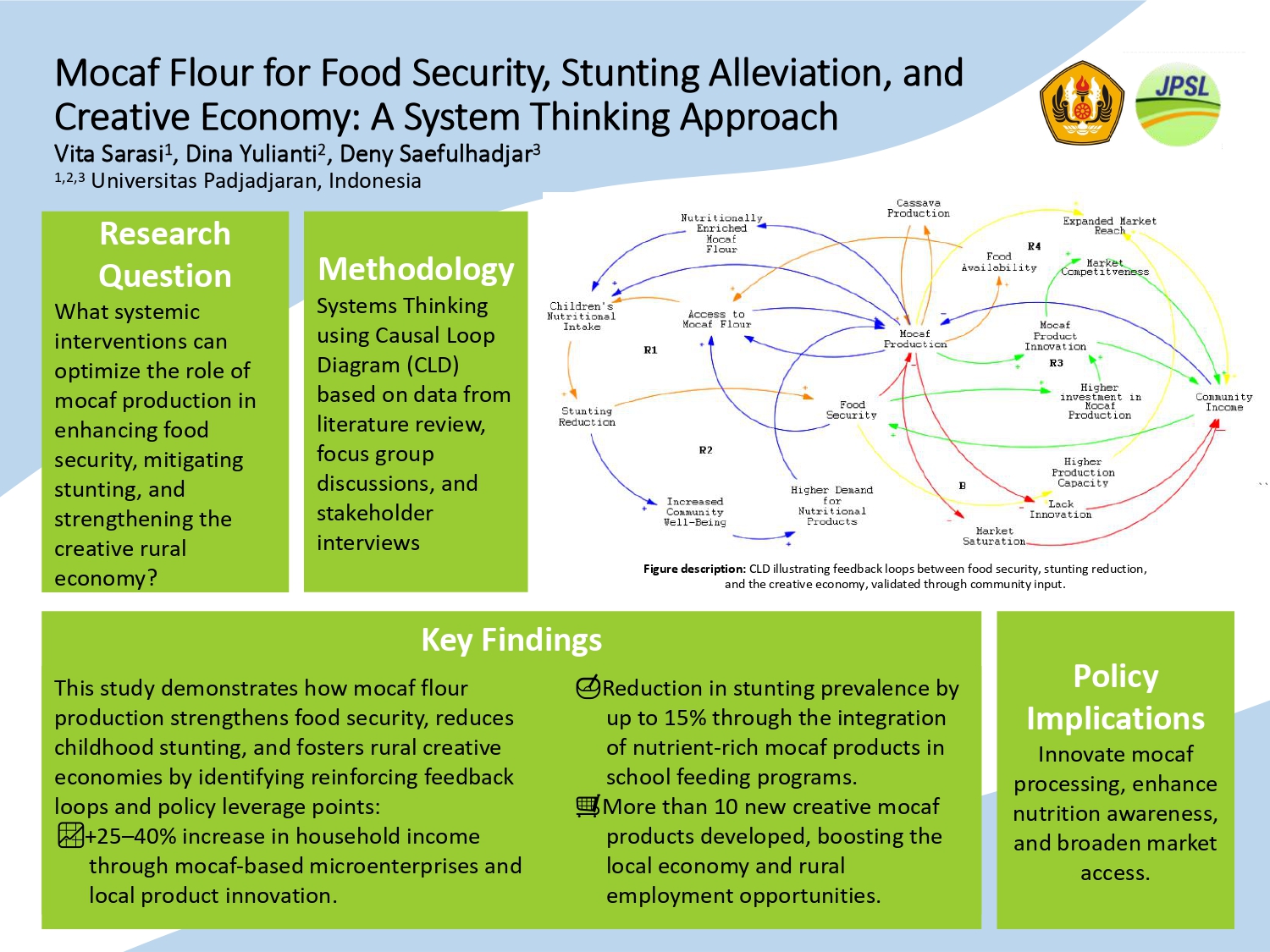
The rising dependence on imported wheat flour in Indonesia highlights the need for local alternatives such as Mocaf (modified cassava flour). This study explores the potential of Mocaf production in Sindangsuka Village, Garut, to strengthen food security, reduce childhood stunting, and promote the creative economy. A systems thinking approach was employed using a Causal Loop
Diagram (CLD) to map and analyze the dynamic interconnections among these three domains. Data was gathered through literature review, focus group discussions (FGDs), and interviews with key local stakeholders. InsightMaker software was used to construct and simulate the CLD. The model identified reinforcing loops showing how increased Mocaf production improves local food access, supports child nutrition, and enhances household income through Mocaf-based enterprises. Triangulated validation confirmed key causal pathways linking innovation, nutrition programs, and creative economic activity. Policy leverage points include supporting agroecological practices, promoting maternal education, and expanding market access. Findings suggest that Mocaf
production can simultaneously address public health and economic development goals. By integrating Mocaf into school feeding and micro-enterprise programs, communities can reduce stunting and boost income. The updated CLD also highlights potential risks such as market saturation and environmental degradation, underscoring the need for adaptive policies. This study contributes a validated systems model for rural development, offering practical insights for policymakers. It underscores that food system resilience requires coordinated strategies that address interconnected challenges across nutrition, agriculture, and livelihoods.
Full text article
References
2. Nahwan, D.; Deri, R.R.; Srimurni, R.R.; Nugroho, I.S.; Nur, S. Peningkatan PDB (Produk Domestik Bruto) Melalui Peningkatan Usaha Mikro, Kecil, Dan Menengah (UMKM) Di Desa (Studi Proyek Perencanaan Bisnis Dalam Mengembangkan Produk Unggulan Desa Tepung Mocaf Di Desa Cikahuripan). Media Nusantara 2023, 20, 37–51.
3. Oktini, D.R.; Effendi, R.; Nugraha, Y.D.; Permana, R.M.T. Peningkatan Ekonomi Melalui Pengolahan Tepung Mocaf Pada Masa Pandemi Covid-19. ETHOS: Jurnal Penelitian dan Pengabdian kepada Masyarakat 2022, 10, 101–113, doi:10.29313/ethos.v10i1.8264.
4. Hadistio, A.; Fitri, S. Tepung Mocaf (Modified Cassava Flour) Untuk Ketahanan Pangan Indonesia. Jurnal Ilmiah Pangan Halal 2019, 1, doi:10.30997/jiph.v1i1.2005.
5. Julita, J.; Marwan, A.R.; Anggraini, D.; Vianto, I.M.; Isnaini, I.; Lestari, L.M.; Rizky, M.N.; Fitri, N.H.; Amalia, N.; Febriyani, Q.; et al. Upaya Pencegahan Stunting Dengan Pemanfaatan Singkong Sebagai Sumber Pangan Lokal. COMSEP: Jurnal Pengabdian Kepada Masyarakat 2023, 4, 178–182, doi:10.54951/comsep.v4i2.349.
6. Muslim, A.F.R.; Widari, E.A.; Abdullah, H.Q.; Astuti, M.; Arrohman, Muh.Y.; Zamromi, M.; Mutmainah, M.; Prasetia, R.A.; Rizki, S.A.; Saloko, S. Pembuatan Nugget Berbahan Tepung Mocaf Sebagai Upaya Pencegahan Stunting Di Kelurahan Geres. Prosiding Seminar Nasional Gelar Wicara 2023, 1.
7. Jayantini, H.E.; Adi, A.C.; Isaura, E.R. Formulasi Cookies Tinggi Protein Dan Zat Besi Dengan Substitusi Tepung ISP Dan MOCAF Untuk Balita Stunting. Jurnal Keperawatan 2024, 16, 581–590, doi:https://doi.org/10.32583/keperawatan.v16i2.1735.
8. Sarasi, V.; Yulianti, D.; Farras, J.I. Pengantar Berpikir Sistem Dan Dinamika Sistem ; 1st ed.; Penerbit Yayasan Sahabat Alam Rafflesia, 2021;
9. Putri, T.D.; Sulaeman, A.; Willihelm, Y. Gambaran Sifat Organoleptik Dan Nilai Gizi Cookies Formula Tepung Mocaf (Manihot Esculenta), Tepung Kacang Hijau (Vigna Radiata), Dan Tepung Ubi Jalar Ungu (Ipomoea Batatas L) Sebagai Makanan Tambahan Untuk Balita Stunting. Diploma Thesis, Politeknik Kesehatan Kemenkes Bandung: Bandung, 2021.
10. Qoyimah, D.; Sakir, S.; Abhipraya, F.A. Analisis Upaya Muhammadiyah Dalam Meningkatkan Pertumbuhan Ekonomi Melalui Ekspor Tepung Mocaf Ke Inggris. Jurnal Ilmu Politik dan Pemerintahan 2022, 8, doi:10.37058/jipp.v8i1.3085.
11. Verawati, N.; Aida, N.; Sibuea, B.P.; Muttaqin, K. Pengembangan Bahan Pangan Lokal Berbasis Tepung Mocaf; Penerbit P4I, 2023;
12. Prahasta, E. Pengantar Systems Thinking & Permodelan System Dynamic; Penerbit XYZ: Bandung, 2024;
13. Blair, C.; Gralla, E.; Wetmore, F.; Goentzel, J.; Peters, M. A Systems Framework for International Development: The Data‐Layered Causal Loop Diagram. Prod Oper Manag 2021, 30, 4374–4395, doi:10.1111/poms.13492.
14. Yulianti, D.; Elmin, M.; Prahasta, E. Food Insecurity during a Pandemic: System Thinking-Based Analysis. Jurnal Ekonomi Pembangunan: Kajian Masalah Ekonomi dan Pembangunan 2021, 22, 181–191, doi:10.23917/jep.v22i2.15394.
15. Pandin, M.G.R.; Waloejo, C.S.; Sunyowati, D.; Rizkyah, I. The Potential of Mocaf (Modified Cassava Flour) as Disaster Emergency Food. IOP Conf Ser Earth Environ Sci 2022, 995, 012006, doi:10.1088/1755-1315/995/1/012006.
16. Mahmudah, N.A. Quality Characteristics of Modified Cassava Flour (Mocaf) Cookies Incorporated with Chicken Meat and Carrot Puree as Nutritious Snack towards Children. J Food Sci Technol 2024, 21, 64–75, doi:10.22034/FSCT.21.150.64.
17. Keylovly, A.; Aminah, S. The Impact of a Creative Economy Rooted in Local Cultural Values on Increasing Income. International Journal of Humanities and Social Sciences Reviews 2024, 1, 13–19, doi:https://doi.org/10.62951/ijhs.v1i1.8.
18. Wardana, I.P.; Purwani, E.Y.; Dermoredjo, S.K.; Mutaqin; Sayaka, B.; Pasaribu, S.M.; Rochani, R.; Ginting, E.; Elisabeth, D.A.A. Business Model Strategy for Utilization of Pregelatinized Cassava Flour (PCF) by Micro-Small-Medium Enterprise (MSME). In; 2024; pp. 211–218.
19. Roobab, U.; Maqsood, S. Recent Developments on Utilising Diverse Plant Seed Flours as Novel Functional Ingredients for Noodle Formulation and Their Impact on Quality Attributes. Int J Food Sci Technol 2024, 59, 1082–1093, doi:10.1111/ijfs.16737.
20. Santos, A.D.; Bandeira e Sousa, M.; Alves, A.A.C.; Oliveira, E.J. de Environmental Factors Influence the Production of Flowers and Fruits of Cassava. Sci Hortic 2024, 323, 112498, doi:10.1016/j.scienta.2023.112498.
21. Gorain, S.; Kuriachen, P.; Kumar, C.V.; Suresh, A. Land Degradation and Its Impact on Agricultural Productivity: The Case of India. Land Degrad Dev 2024, 35, 196–212, doi:10.1002/ldr.4909.
22. Sukanya, R. Global Trade and Food Security. In Food Security in a Developing World; Springer Nature Switzerland: Cham, 2024; pp. 229–258.
23. Edo, G.I.; Itoje-akpokiniovo, L.O.; Obasohan, P.; Ikpekoro, V.O.; Samuel, P.O.; Jikah, A.N.; Nosu, L.C.; Ekokotu, H.A.; Ugbune, U.; Oghroro, E.E.A.; et al. Impact of Environmental Pollution from Human Activities on Water, Air Quality and Climate Change. Ecological Frontiers 2024, doi:10.1016/j.ecofro.2024.02.014.
24. Yuniarti, E.; Raharini, H. The Relationship between Healthy Behavior and Environmental Sanitation with Water Quality in Stunting Occurrence Work Area of Sikabu Community Health Center Padang Pariaman. IOP Conf Ser Earth Environ Sci 2024, 1317, 012020, doi:10.1088/1755-1315/1317/1/012020.
25. Vhawal, V.; Kapale, R.J.; Kanase, N.V. The Role of Maternal Education in Enhancing Child Health: Focus on Vaccination and Nutritional Status. Obstetrics and Gynaecology Forum 2024, 34, 586–593.
26. Ramakrishna, S.; Ramasubramanian, B. Circular Supply Chain Management for High-Tech Materials. In Handbook of Materials Circular Economy; Springer Nature Singapore: Singapore, 2024; pp. 199–225.
27. Krzyżostan, M.; Wawrzyńczak, A.; Nowak, I. Use of Waste from the Food Industry and Applications of the Fermentation Process to Create Sustainable Cosmetic Products: A Review. Sustainability 2024, 16, 2757, doi:10.3390/su16072757.
28. Dallocchio, M.; Lambri, M.; Sironi, E.; Teti, E. The Role of Digitalization in Cross-Border E-Commerce Performance of Italian SMEs. Sustainability 2024, 16, 508, doi:10.3390/su16020508.
29. Supriyanto, E.E.; Suparto, D.; Rachmawati, M.; Saputra, J. Collaboration of Multi-Stakeholder in Integrated Aid Model for Creative MSMEs in the Tourism Sector. Indonesian Tourism Journal 2024, 1, 29–45, doi:10.69812/itj.v1i1.16.
30. Simón, E.; Molero-Luis, M.; Fueyo-Díaz, R.; Costas-Batlle, C.; Crespo-Escobar, P.; Montoro-Huguet, M.A. The Gluten-Free Diet for Celiac Disease: Critical Insights to Better Understand Clinical Outcomes. Nutrients 2023, 15, 4013, doi:10.3390/nu15184013.
Authors
Copyright (c) 2025 Vita Sarasi, Dina Yulianti, Deny Saefulhadjar

This work is licensed under a Creative Commons Attribution 4.0 International License.
Authors who publish with this journal agree to the following terms:
- Authors retain copyright and grant the journal right of first publication with the work simultaneously licensed under a Creative Commons Attribution License that allows others to share the work with an acknowledgement of the work's authorship and initial publication in this journal.
- Authors are able to enter into separate, additional contractual arrangements for the non-exclusive distribution of the journal's published version of the work (e.g., post it to an institutional repository or publish it in a book), with an acknowledgement of its initial publication in this journal.
- Authors are permitted and encouraged to post their work online (e.g., in institutional repositories or on their website) prior to and during the submission process, as it can lead to productive exchanges, as well as earlier and greater citation of published work (See The Effect of Open Access).
Article Details
How to Cite



