
Spatial Patterns and Environmental Influences on Soil Surface Collembola in Forest and Non-Forest Ecosystems
Article Sidebar
-
Association, distribution pattern, ecosystem, soil surface Collembola
Abstract
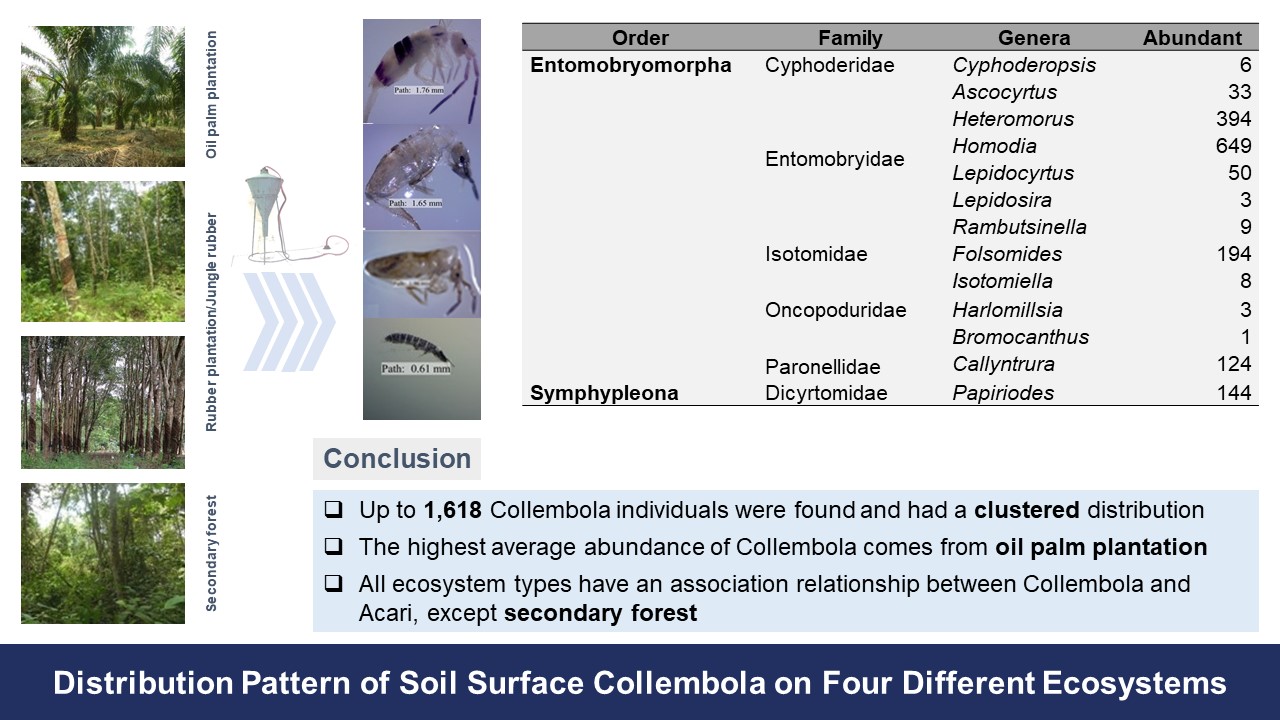
Forests are one of the ecosystems with different habitat characteristics for certain species. The transition from forest to non-forest will affect the ecosystem and its resident species. The study aims to determine the presence of soil surface Collembola within various ecosystems, identify the types of soil surface Collembola present and their locations, analyze the impact of environmental conditions on their distribution, and identify the association between soil surface Collembola and Acari. The field procedures comprise the setup of litter traps, litter harvesting and extraction, measurement of environmental factors, and identification of soil surfaces in Collembola and Acari. Collembula is found in oil palm plantations. A total of 1,618 individuals were found in all ecosystem types, including 13 genera and 6 families: Cyphoderidae, Entomobryidae, Isotomidae, Oncopoduridae, Paronellidae, and Dicyrtomidae, along with 2 orders, Entomobyromorpha and Symphypleona, which showed grouped patterns in each ecosystem types. Several environmental factors, both biotic and abiotic,strongly influence the soilsurface of Collembola. From all ecosystem types, only secondary forest ecosystems lack an association between soil surface Collembola and Acari.
Full text article
References
Margono, B.A.; Potapov, P.V.; Turubanova, S.; Stolle, F.; Hansen, M.C. Primary forest cover loss in Indonesia over 2000-2012. Nature Clim. Change. 2014, 4, 730735, doi:10.1038/nclimate2277. DOI: https://doi.org/10.1038/nclimate2277
Escribano-Álvarez, P.; Pertierra, L.R.; Martínez, B.; Chown, S.L.; Olalla-Tárraga, M. Á. Half a century of thermal tolerance studies in springtails (Collembola): A review of matrics, spatial, and temporal trends. Current Res. in Insect Sci. 2022, 2, 100023, doi:10.1016/j.cris.2021.100023. DOI: https://doi.org/10.1016/j.cris.2021.100023
Jatiningsih, H.; Atmanto, T.; Darma, IGP. S. Keanekaragaman Collembola (ekorpegas) Gua Groda, Ponjong, Gunung Kidul, Daerah Istimewa Yogyakarta. Jurnal Edukasi Biologi 2018, 7, 407419, doi:10.21831/edubio.v7i6.13914.
Borror, D.J.; Charles, A.T.; Norman, F.J. Pengenalan Pelajaran Serangga. In An Introduction to Study of Insect; Partosoedjono, S., Translator; Gadjah Mada University Press: Yogyakarta, ID, 1996;
Suhardjono, Y.R.; Deharveng, L.; Bedos, A. Biologi Ekologi Klasifikasi Collembola (Ekorpegas); Vegamedia: Bogor, ID, 2012;
González, G.; Barberena-Arias, M.F.; Huang, W.; Ospina-Sanchez, C.M. Sampling methods for soil and litter fauna. In Measuring Arthropod Biodiversity; Santos, J.C., Fernandes, G.W., Eds.; Springer: Champ, Switzerland, 2020; pp. 495522. DOI: https://doi.org/10.1007/978-3-030-53226-0_19
Kuncahyo, I.; Pribadi, R.; Pratikto, I. Komposisi dan tutupan kanopi vegetasi mangrove di perairan Bekauheni, Kabupaten Lampung Selatan. Journal of Marine Research 2020, 9, 444452, doi:10.14710/jmr.v9i4.27915. DOI: https://doi.org/10.14710/jmr.v9i4.27915
Amaral, M.K.; Pellico, N.S.; Lingnau, C.; Figueiredo, F.A. Evaluation of the Morisita for determination pf the spatial distribution of species in a fragment of araucaria forest. Applied Ecology and Environmental Research 2015, 13, 361372, doi:10.15666/aeer/1302_361372. DOI: https://doi.org/10.15666/aeer/1302_361372
Potavov, A.; Bruno, C.B.; Steven, L.C.; Deharveng, L.; Janssens, F.; Kováč, L.; Kuznetsova, N.; Ponge, J.; Potapov, M.; Querner, P.; et al. Towards a global synthesis of Collembola knowledge - challenges and potential solutions. Soil Organism 2020, 92, 161188, doi:10.25674/so92iss3pp161.
Sékou, F.M.; Bruna, R.W.; Marthe, A.; Laurent, M.; Marc, L. Functional assemblages of Collembola determine soil microbial communities and associated functions. Front. Environ. Sci. 2019, 7, 112, doi:10.3389/fenvs.2019.00052. DOI: https://doi.org/10.3389/fenvs.2019.00052
Basna, M.; Koneri, R.; Papu, A. Distribusi dan diversitas serangga tanah di Taman Hutan Raya Gunung Tumpa Sulawesi Utara. Jurnal MIPA Unsrat Online 2017, 6, 3642, doi:10.35799/jm.6.1.2017.16082. DOI: https://doi.org/10.35799/jm.6.1.2017.16082
Macdonald, D.W.; Johnson, D.D.P. Patchwork planet: The resource dispersion hypothesis, society, and the ecology of life. Journal of Zoology 2015, 295, 75107, doi:10.1111/jzo.12202. DOI: https://doi.org/10.1111/jzo.12202
Santi, R.; Kusmiadi, R.; Pratama, D.; Robiansyah. Diversity relation between soil mesofauna and C-organic content in Pepper plantation area, Petaling, Bangka Belitung Islands. Proceedings of the International Conference on Maritime and Archipelago 2019, 167, 220225, doi:https://doi.org/10.2991/icoma-18.2019.47. DOI: https://doi.org/10.2991/icoma-18.2019.47
Arista, N.I.D.; Natalia, C.E.; Sinaga, I.L.; Lestari, W.; Undari, D.; Andryan, R.; Putri, A.H.; Alimatul, M.M. The potential of circular economy in the oil palm plantation to indutry. Journal of Sustainability, Society, and Eco-Welfare 2024, 1, 94110, doi:10.61511/jssew.v1i2.2024.311. DOI: https://doi.org/10.61511/jssew.v1i2.2024.311
Trianto, M.; Marisa, F. Studi kelimpahan dan pola sebaran Collembola pada tiga tipe penggunaan lahan di Kabupaten Banjar, Kalimantan Selatan. BIO-EDU: Jurnal Pendidikan Biologi 2020, 5, 107117, doi:10.32938/jbe.v5i3.606. DOI: https://doi.org/10.32938/jbe.v5i3.606
Akhila, A.; Entoori, K. Role of earthworms in soil fertility and its impact on agriculture: A review. International Journal of Fauna and Biological Studies 2022, 9, 5563. DOI: https://doi.org/10.22271/23940522.2022.v9.i3a.907
Oktavianti, R.; Nurdin, J.; Herwina, H. Komunitas Collembola pada Hutan Konservasi dan Perkebunan Sawit di Kawasan PT. Tidar Kerinci Agung (TKA), Sumatera Barat. Jurnal Biologi Universitas Andalas 2017, 5, 1624, doi:10.25077/jbioua.5.1.16-24.2017. DOI: https://doi.org/10.25077/jbioua.5.1.16-24.2017
Winkler, D.; Mateos, E.; Traser, G.; Lakantos, F.; Toth, V. New insight into the systematics of European Lepidocyrtus (Collembola: Entomobryidae) using molecular and morphological data. Insects 2020, 11, 115, doi:10.3390/insects11050302. DOI: https://doi.org/10.3390/insects11050302
Salmon, S.; Ponge, J.F.; Gachet, S.; Deharveng, L.; Lefebvre, N.; Delabrosse, F. Linking species, traits and habitat characteristics of Collembola at European scale. Soil Biology and Biochemistry 2014, 75, 7385, doi:10.1016/j.soilbio.2014.04.002. DOI: https://doi.org/10.1016/j.soilbio.2014.04.002
Budiaman, A.; Haneda, N.F.; Syaidah, K.H. Temporal effects of forest thinning on spring tails (Entomobryomorpha: Collembola) assemblages at pulai (Alstonia scholaris) forest plantation in Banten. IOP Conf. Ser.: Earth Environ. Sci. 2020, 528, 012027, doi:10.1088/1755-1315/528/1/012027. DOI: https://doi.org/10.1088/1755-1315/528/1/012027
Putri, K.; Santi, R.; Aini, S.N. Keanekaragaman Collembola dan serangga permukaan tanah di berbagai umur perkebunan kelapa sawit (Elaeis guineensis Jacq.). J. Il. Tan. Lingk. 2019, 21, 3641, doi:10.29244/jitl.21.1.36-41. DOI: https://doi.org/10.29244/jitl.21.1.36-41
Islam, M.S.; Hosain, M.; Hossain, M.; Yasmin, M. Impact of climatic factors and soil quality on the abundance and population density of Collembola in the Rajshahi University Campus, Bangladesh. Journal of Entomology and Zoology Studies 2018, 6, 11191125.
Moningka, D.S.; Ganjari, L.E.; Nugroho, C.A. Keanekaragaman dan kemelimpahan Collembola di sekitar rizosfer tanaman pisang yang diberikan mulsa jerami dan pupuk anorganik. Jurnal Biologi 2022, 1, 107116.
Coleman, D.C.; Geisen, S.; Wall, D.H. Soil fauna: Occurrence, biodiversity, and roles in ecosystem function. In Soil Microbiology, Ecology and Biochemistry, 5th ed.; Paul, E., Frey, S., Eds.; Elsevier, Amsterdam, 2024; pp. 131159. DOI: https://doi.org/10.1016/B978-0-12-822941-5.00005-3
Safitri, R.; Zulaikha, S.; Bahri, S.; Rokhim, S.; Jariyah, I.A.; Firdhausi, N.F. Struktur komunitas Collembola pada habitat Gua Lowo dan Kebun Warga di Desa Melirang Kabupaten Gresik, Jawa Timur. Jurnal Pro-Life 2022, 9, 570582. DOI: https://doi.org/10.33541/pro-life.v9i3.4060
Vincent, Q.; Leyval, C.; Beguiristain, T.; Auclerc, A. Functional structure and composition of Collembola and soil macrofauna communities depend on abiotic parameters in derelict soils. Applied Soil Ecology 2018, 130, 259270, doi:10.1016/j.apsoil.2018.07.002. DOI: https://doi.org/10.1016/j.apsoil.2018.07.002
Kayiranga, A.; Li, Z.; Isabwe, A.; Ke, X.; Simbi, C. H.; Ifon, B. E.; Yao, H.; Wang, B.; Sun, X. The effects of heavy metal poluttion on Collembola in urban soils and associated recovery using biochar remediation: a review. Int. J. Environ. Res. Public Health 2023, 20, 118, doi:10.3390/ijerph20043077. DOI: https://doi.org/10.3390/ijerph20043077
Haneda, N.F.; Irfani, E. Spread of Collembola at different altitudes and their response to the environment at Gunung Halimun-Salak National Park. IOP Conf. Ser.: Earth Environ. Sci. 2019, 394, 012017, doi:10.1088/1755-1315/394/1/012017. DOI: https://doi.org/10.1088/1755-1315/394/1/012017
Han, Q.; Ma, Q.; Chen, Y.; Tian, B.; Xu, L.; Bai, Y.; Chen, W.; Li, X. Variation in rhizosphere microbial communities and its association with the symbiotic efficiency of rhizobia in soybean. ISME J. 2020, 14, 19151928, doi:10.1038/s41396-020-0648-9. DOI: https://doi.org/10.1038/s41396-020-0648-9
Shaukat, S.S.; Hussain, F.; Zafar, H.; Rao, T.A.; Mahmood, K.; Raza, A. Species composition, spatial heterogenity, interspecific association and diversity of an early seccessional plant community: A comparison of some species association indeces. Int. J. Biol. Biotech 2014, 11, 677691.
Menta, C.; Remelli, S. Soil health and Arthrops: From complex system to worthwhile investigation. Insects 2020, 11, 121, doi:10.3390/insects11010054. DOI: https://doi.org/10.3390/insects11010054
Seniczak, S.; Graczyk, R.; Seniczak, A.; Faleńczyk-Koziróg, K.; Kaczmarek, S.; Marquardt, T. Microhabitat preferences of Oribatida and Mesostigmata (Acari) inhabiting lowland beech forest in Poland and the trophic interactions between these mites. European Journal of Soil Biology 2018, 87, 2532, doi:10.1016/j.ejsobi.2018.04.004. DOI: https://doi.org/10.1016/j.ejsobi.2018.04.004
Manu, M.; Bancila, R.I.; Birsan, C.C.; Mountford, O.; Onete, M. Soil mite communities (Acari: Mesostigmata) as indicators of urban ecosystems in Bucharest, Romania. Sci. Rep. 2021, 11, 114, doi:10.1038/s41598-021-83417-4. DOI: https://doi.org/10.1038/s41598-021-83417-4
Heiniger, C.; Barot, S.; Ponge, J.; Salmon, S.; Meriguet, J.; Carmignac, D.; Suillerot, M.; Dubs, F. Collembolan preferenfes for soil and microclimate in forest and pasture communities. Soil Biology & Biochemistry 2015, 86, 181192, doi:10.1016/j.soilbio.2015.04.003. DOI: https://doi.org/10.1016/j.soilbio.2015.04.003
Azevedo, L.H.; Leite, L.G.; Chacon-Orozco, J.G.; Moreira, M.F.P.; Ferreira, M.P.; González-Cano, L.M.; Borges, V.; Rueda-Ramírez, D.; de Moraes, G.J.; Palevsky, E. Free living nematodes as alternative prey for soil predatory mites: an interdisciplinary case study of conservation biological control. Biological Control 2019, 132, 128134, doi:10.1016/j.biocontrol.2019.02.007. DOI: https://doi.org/10.1016/j.biocontrol.2019.02.007
Gonçalves, F.; Carlos, C.; Crespo, L.; Zina, V.; Oliveira, A.; Salvação, J.; Pereira, J. A.; Torres, L. Soil arthropods in the Deuro Demarcated Region Vineyards: general characteristics and ecosystem services provided. Sustainability 2021, 13, 135, doi:10.3390/su13147837. DOI: https://doi.org/10.3390/su13147837
Authors
Authors who publish with this journal agree to the following terms:
- Authors retain copyright and grant the journal right of first publication with the work simultaneously licensed under a Creative Commons Attribution License that allows others to share the work with an acknowledgement of the work's authorship and initial publication in this journal.
- Authors are able to enter into separate, additional contractual arrangements for the non-exclusive distribution of the journal's published version of the work (e.g., post it to an institutional repository or publish it in a book), with an acknowledgement of its initial publication in this journal.
- Authors are permitted and encouraged to post their work online (e.g., in institutional repositories or on their website) prior to and during the submission process, as it can lead to productive exchanges, as well as earlier and greater citation of published work (See The Effect of Open Access).
Article Details
How to Cite



