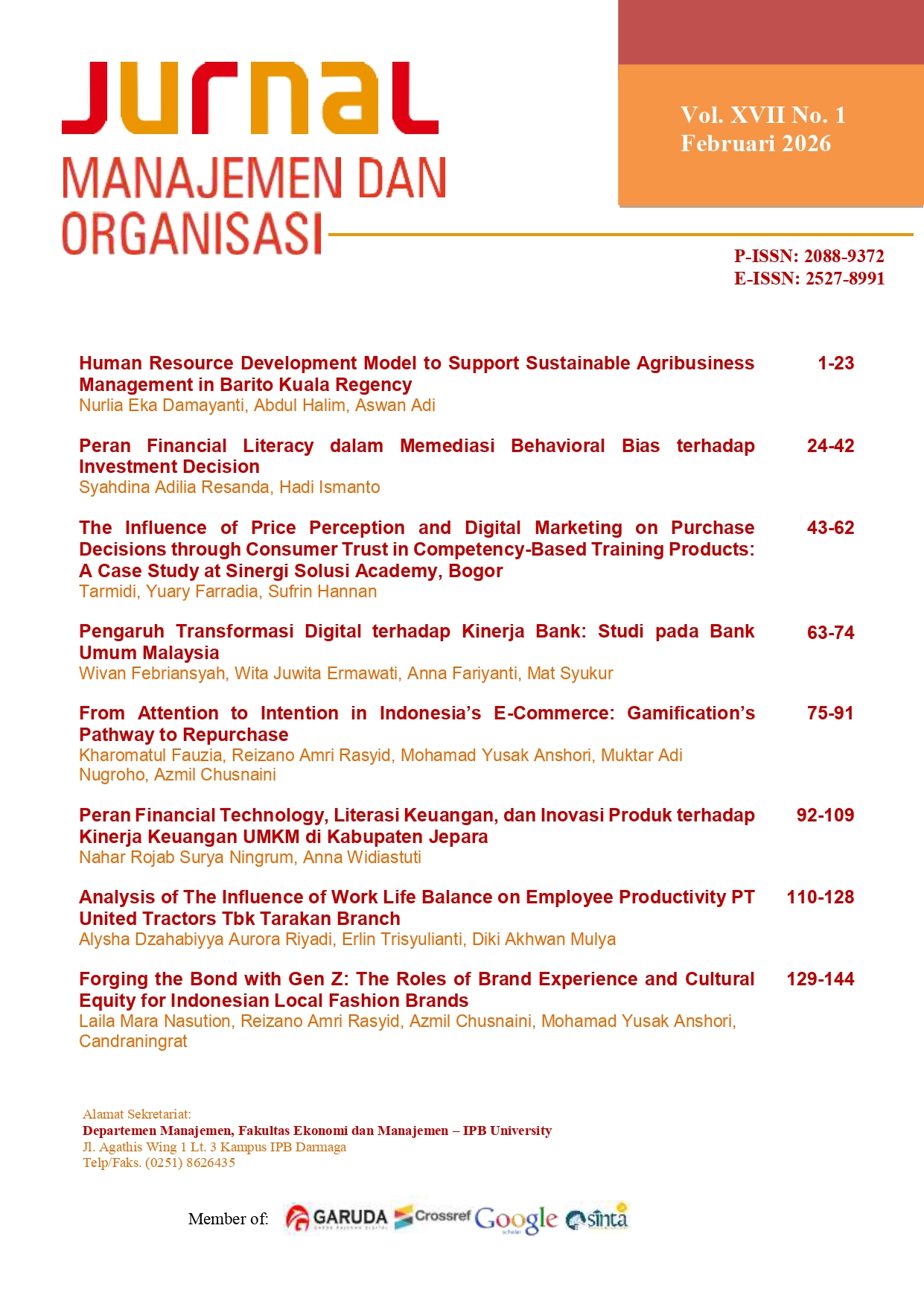
From Attention to Intention in Indonesia’s E-Commerce: Gamification’s Pathway to Repurchase
DOI:
https://doi.org/10.29244/jmo.v17i1.67298Keywords:
Customer engagement, customer experience, e-commerce, gamification, repurchase intentionAbstract
This study aims to examine the mechanism through which gamification influences repurchase intention in the e-commerce context. Specifically, it investigates the dual mediating roles of customer experience (CEX) and customer engagement (CE) based on the stimulus-organism-response (S-O-R) theoretical framework." Data were collected from e-commerce platform users who engage with gamified features. The proposed hypotheses were tested using a quantitative approach with partial least squares structural equation modeling (PLS-SEM). The analysis revealed that gamification does not have a direct significant effect on repurchase intention. Rather, its influence is fully mediated by internal consumer variables. Gamification positively and significantly affects both customer experience (β = 0.562) and customer engagement (β = 0.477). These mediators, customer experience (β = 0.449) and customer engagement (β = 0.230), significantly drive repurchase intention. This confirms full mediation, with customer experience being the more dominant predictor. Theoretically, this study strengthens the validity of the S-O-R framework within digital environments and highlights the critical role of internal processes as bridges between stimulus and response. In practice, it advises e-commerce managers to design gamification strategies that focus on enhancing experience quality and engagement rather than directly pushing transactions. This research provides clear empirical evidence of the indirect pathways through which gamification fosters loyalty, demonstrating that its value lies in cultivating superior user experiences and deeper customer relationships rather than in its gaming features.
Downloads
Downloads
Published
License
Copyright (c) 2026 Jurnal Manajemen dan Organisasi

This work is licensed under a Creative Commons Attribution-ShareAlike 4.0 International License.