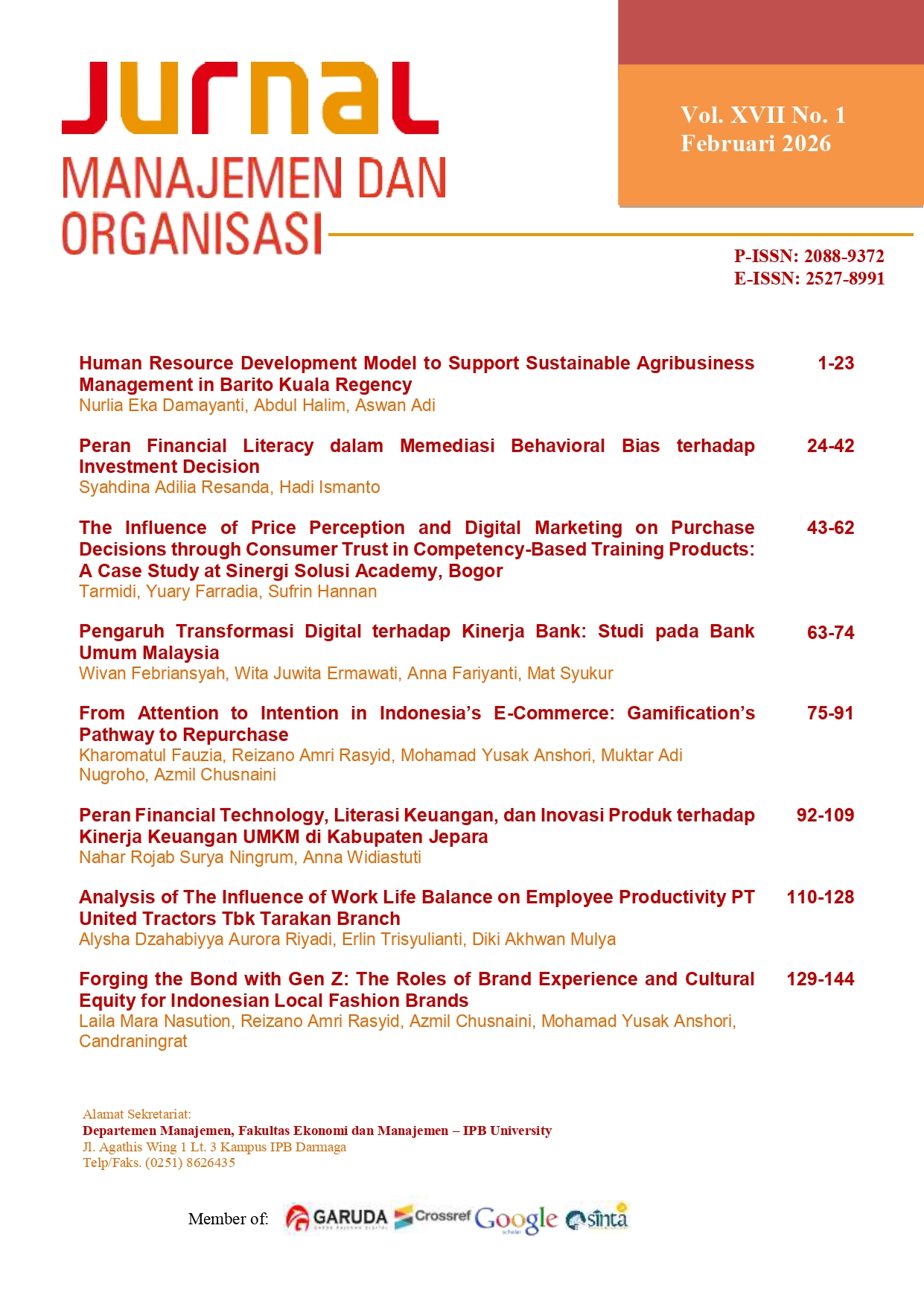
Pengaruh Transformasi Digital terhadap Kinerja Bank: Studi pada Bank Umum Malaysia
DOI:
https://doi.org/10.29244/jmo.v17i1.66572Keywords:
Digital transformation, Malaysian banking, Net Interest Margin, risk, z-scoreAbstract
The rapid advancement of digital technology has significantly transformed the global banking industry, including in Malaysia. Digital transformation has become a key strategy for banks to improve operational efficiency, expand service outreach, and meet the evolving expectations of increasingly digital-savvy customers. Amid this trend, the adoption of technologies such as mobile banking, internet banking, and artificial intelligence serves as a critical indicator of a bank’s digital readiness. However, behind its promising potential, digital transformation also presents new challenges, especially for banks with less stable financial conditions. Large-scale investments in technology may impose additional pressure on profitability, particularly if not accompanied by adequate risk management.This study aims to analyze the effect of digital transformation on the financial performance of commercial banks in Malaysia and examine the moderating role of bankruptcy risk (Z-Score). A quantitative approach was used with secondary data from eight commercial banks during the 2019–2023 period. Panel data regression with the Common Effect Model was employed. The results indicate that digital transformation has a positive effect on Net Interest Margin (NIM), and that Z-Score significantly moderates this relationship. These findings highlight that the success of digitalization is highly dependent on a bank’s internal financial stability.
Downloads
Downloads
Published
License
Copyright (c) 2026 Jurnal Manajemen dan Organisasi

This work is licensed under a Creative Commons Attribution-ShareAlike 4.0 International License.