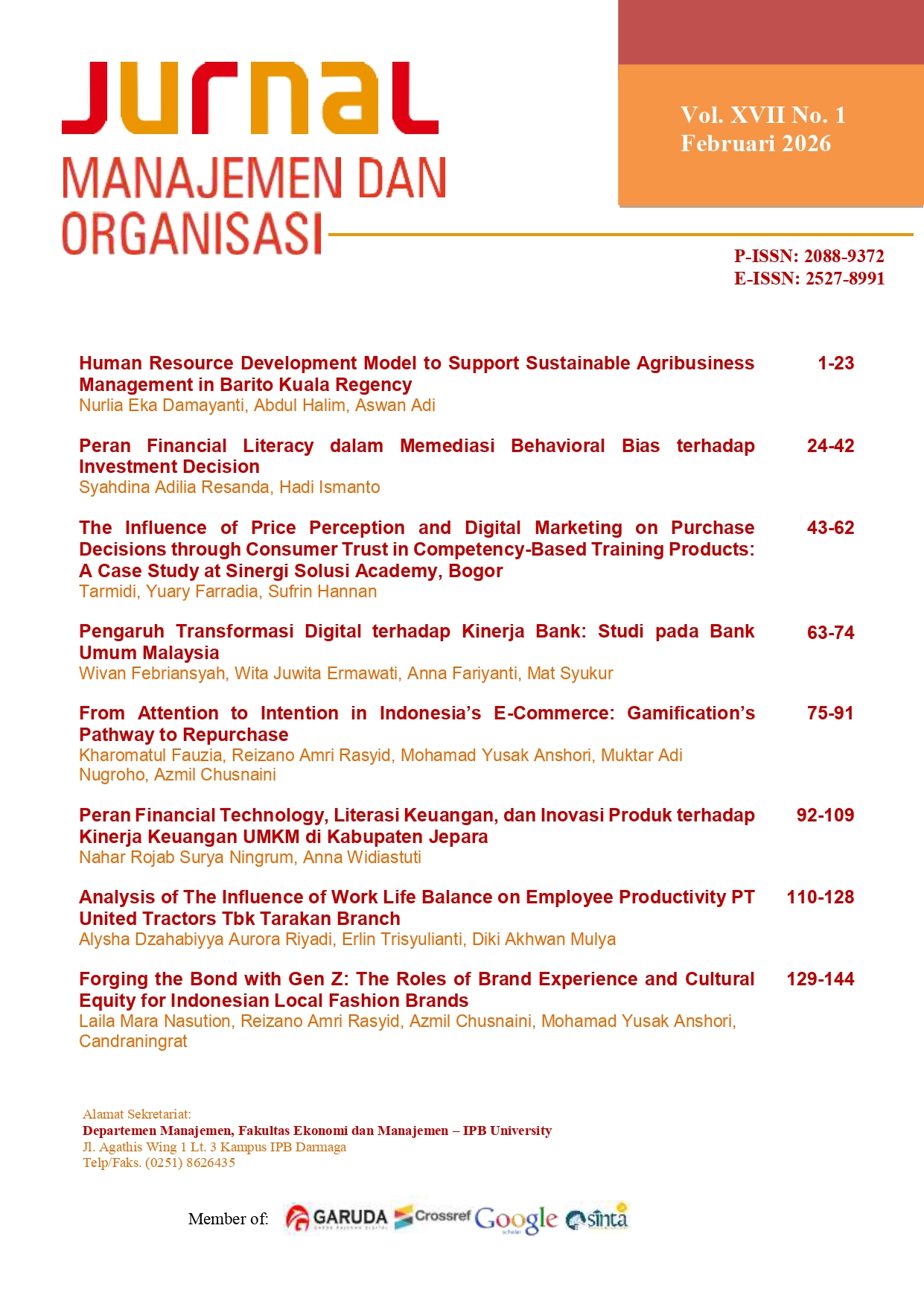
Human Resource Development Model to Support Sustainable Agribusiness Management in Barito Kuala Regency
DOI:
https://doi.org/10.29244/jmo.v17i1.66423Keywords:
Human resource development, local institutions, sustainable agribusinessAbstract
This study aims to formulate a human resource development (HRD) model that supports sustainable agribusiness management in Barito Kuala Regency. A descriptive–qualitative approach was employed using secondary data obtained from official publications, regional policy documents, and previous studies. The findings indicate that the success of sustainable agribusiness is strongly influenced by the quality of human resources who are adaptive to local ecological, social, and economic conditions. A three-layer development model is proposed, consisting of: (1) locally tailored training aligned with agroecological characteristics; (2) strengthening community-based institutions such as farmer groups, cooperatives, and village-owned enterprises (BUMDes); and (3) integrating HRD initiatives with financing schemes and market access systems. This model positions human resources not merely as training recipients but as active agents in agribusiness development. The study provides several policy recommendations for local governments, including: establishing village-based Agribusiness Training Centers; developing contextual training curricula that reflect Barito Kuala’s agroecological landscape; fostering multi-actor partnerships involving government agencies, BUMDes, cooperatives, universities, NGOs, and the private sector; providing incentive schemes for training participants; and promoting digitalized learning through online modules, webinars, and virtual mentoring.
Downloads
Downloads
Published
Issue
Section
License
Copyright (c) 2026 Jurnal Manajemen dan Organisasi

This work is licensed under a Creative Commons Attribution-ShareAlike 4.0 International License.