
Tree Structure and Turnover in a Peruvian Premontane Amazon Forest

Article Sidebar
-
beta diversity, fire evidence, importance value index, species composition, BRUNAS
Abstract
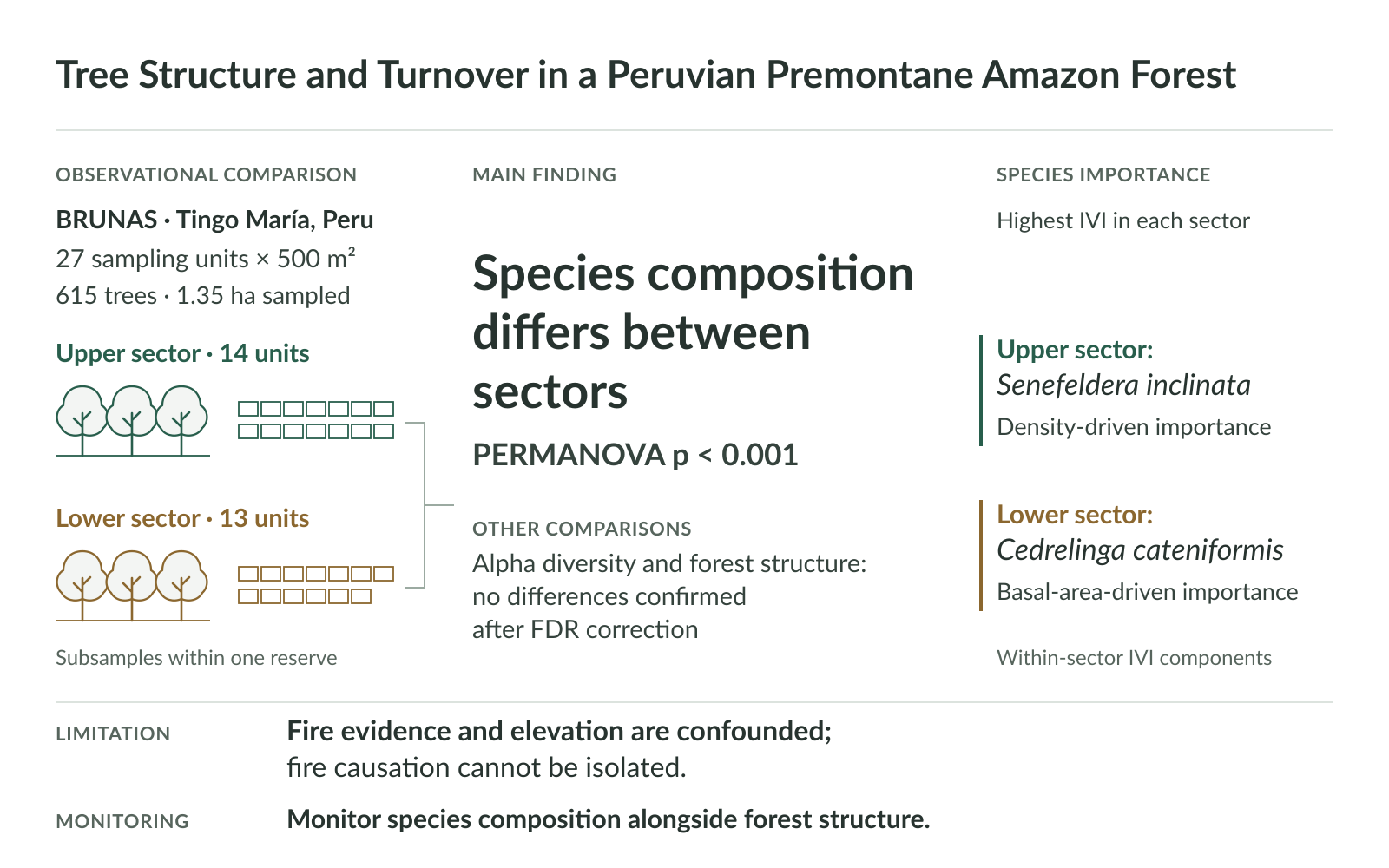
Humid tropical forests are increasingly exposed to fire, yet local diversity, stand structure, and species composition may respond differently. We compared tree communities in lower and upper sectors of a university reserve near Tingo María, Peru, using 27 rectangular 500 m² sampling units (13 lower, 14 upper). The upper sector showed field evidence of fire, although fire history was confounded with elevation and no pre-fire inventory was available. We assessed alpha and beta diversity, diameter and height structure, and species and family importance values at the sampling-unit level. Species composition differed robustly between sectors for presence-absence and abundance data (PERMANOVA, p-value < 0.001), whereas multivariate dispersion did not. After false-discovery-rate correction, alpha-diversity and structural variables showed no confirmed differences. Nevertheless, medium-to-large effect sizes indicated trends toward lower mean height and emergent-tree representation, and larger crown diameter and understory representation, in the upper sector; these trends were not confirmed at this sample size. Dominance shifted: upper-sector importance was density-driven for Senefeldera inclinata, whereas lower-sector importance was basal-area-driven for Cedrelinga cateniformis. The data therefore demonstrate taxonomic turnover but cannot attribute sector differences specifically to fire rather than elevation-associated conditions. Repeated integrated monitoring is needed to distinguish these effects.
Full text article
References
Alencar, A. A., Brando, P. M., Asner, G. P., & Putz, F. E. (2015). Landscape fragmentation, severe drought, and the new Amazon forest fire regime. Ecological Applications, 25(6), 1493–1505. https://doi.org/10.1890/14-1528.1
Anderson, M. J. (2001). A new method for non-parametric multivariate analysis of variance. Austral Ecology, 26(1), 32–46. https://doi.org/10.1111/j.1442-9993.2001.01070.pp.x
Anderson, M. J. (2006). Distance-based tests for homogeneity of multivariate dispersions. Biometrics, 62(1), 245–253. https://doi.org/10.1111/j.1541-0420.2005.00440.x
Aragão, L. E. O. C., Anderson, L. O., Fonseca, M. G., Rosan, T. M., Vedovato, L. B., Wagner, F. H., Silva, C. V. J., Silva Junior, C. H. L., Arai, E., Aguiar, A. P., Barlow, J., Berenguer, E., Deeter, M. N., Domingues, L. G., Gatti, L., Gloor, M., Malhi, Y., Marengo, J. A., Miller, J. B., …., & Saatchi, S. (2018). 21st Century drought-related fires counteract the decline of Amazon deforestation carbon emissions. Nature Communications, 9, Article 536. https://doi.org/10.1038/s41467-017-02771-y
Barlow, J., Lennox, G. D., Ferreira, J., Berenguer, E., Lees, A. C., Mac Nally, R., Thomson, J. R., Ferraz, S. F. B., Louzada, J., Oliveira, V. H. F., Parry, L., Solar, R. R. C., Vieira, I. C. G., Aragão, L. E. O. C., Begotti, R. A., Braga, R. F., Cardoso, T. M., de Oliveira Jr, R. C., Souza Jr, C. M., …, & Gardner, T. A. (2016). Anthropogenic disturbance in tropical forests can double biodiversity loss from deforestation. Nature, 535(7610), 144–147. https://doi.org/10.1038/nature18326
Barlow, J., & Peres, C. A. (2008). Fire-mediated dieback and compositional cascade in an Amazonian forest. Philosophical Transactions of the Royal Society B: Biological Sciences, 363(1498), 1787–1794. https://doi.org/10.1098/rstb.2007.0013
Benjamini, Y., & Hochberg, Y. (1995). Controlling the false discovery rate: A practical and powerful approach to multiple testing. Journal of the Royal Statistical Society: Series B (Methodological), 57(1), 289–300. https://doi.org/10.1111/j.2517-6161.1995.tb02031.x
Berenguer, E., Lennox, G. D., Ferreira, J., Malhi, Y., Aragão, L. E. O. C., Barreto, J. R., Espírito-Santo, F. D. B., Figueiredo, A. E. S., França, F., Gardner, T. A., Joly, C. A., Palmeira, A. F., Quesada, C. A., Rossi, L. C., de Seixas, M. M. M., Smith, C. C., Withey, K., & Barlow, J. (2021). Tracking the impacts of El Niño drought and fire in human-modified Amazonian forests. Proceedings of the National Academy of Sciences, 118(30), Article e2019377118. https://doi.org/10.1073/pnas.2019377118
Brando, P. M., Balch, J. K., Nepstad, D. C., Morton, D. C., Putz, F. E., Coe, M. T., Silvério, D., Macedo, M. N., Nóbrega, C. C., Alencar, A., & Soares-Filho, B. S. (2014). Abrupt increases in Amazonian tree mortality due to drought-fire interactions. Proceedings of the National Academy of Sciences, 111, 6347–6352. https://doi.org/10.1073/pnas.1305499111
Bray, J. R., & Curtis, J. T. (1957). An ordination of the upland forest communities of southern Wisconsin. Ecological Monographs, 27(4), 325–349. https://doi.org/10.2307/1942268
Chave, J., Coomes, D., Jansen, S., Lewis, S. L., Swenson, N. G., & Zanne, A. E. (2009). Towards a worldwide wood economics spectrum. Ecology Letters, 12(4), 351–366. https://doi.org/10.1111/j.1461-0248.2009.01285.x
Chazdon, R. L. (2014). Second growth: The promise of tropical forest regeneration in an age of deforestation. University of Chicago Press.
Cliff, N. (1993). Dominance statistics: Ordinal analyses to answer ordinal questions. Psychological Bulletin, 114(3), 494–509. https://doi.org/10.1037/0033-2909.114.3.494
Cochrane, M. A. (2003). Fire science for rainforests. Nature, 421, 913–919. https://doi.org/10.1038/nature01437
Dauber, E. (1995). Guía práctica y teórica para el diseño de un inventario forestal de reconocimiento. Proyecto de Manejo Forestal Sostenible, BOLFOR.
Hill, M. O. (1973). Diversity and evenness: A unifying notation and its consequences. Ecology, 54(2), 427–432. https://doi.org/10.2307/1934352
Jaccard, P. (1901). Étude comparative de la distribution florale dans une portion des Alpes et des Jura. Bulletin de la Société Vaudoise des Sciences Naturelles, 37, 547–579.
Jakovac, C. C., Meave, J. A., Bongers, F., Letcher, S. G., Dupuy, J. M., Piotto, D., Rozendaal, D. M. A., Peña-Claros, M., Craven, D., Santos, B. A., Siminski, A., Fantini, A. C., Rodrigues, A. C., Hernández-Jaramillo, A., Idárraga, A., Junqueira, A. B., Zambrano, A. M. A., de Jong, B. H. J., Pinho, B. X., …, & Poorter, L. (2022). Strong floristic distinctiveness across Neotropical successional forests. Science Advances, 8(26), Article eabn1767. https://doi.org/10.1126/sciadv.abn1767
Lapola, D. M., Pinho, P., Barlow, J., Aragão, L. E. O. C., Berenguer, E., Carmenta, R., Liddy, H. M., Seixas, H., Silva, C. V. J., Silva-Junior, C. H. L., Alencar, A. A. C., Anderson, L. O., Armenteras, D., Brovkin, V., Calders, K., Chambers, J., Chini, L., Costa, M. H., Faria, B. L., …, & Walker, W. S. (2023). The drivers and impacts of Amazon forest degradation. Science, 379(6630), Article eabp8622. https://doi.org/10.1126/science.abp8622
Legendre, P., & Legendre, L. (2012). Numerical ecology (3rd ed.). Elsevier.
Malizia, A., Blundo, C., Carilla, J., Osinaga Acosta, O., Cuesta, F., Duque, A., Aguirre, N., Aguirre, Z., Ataroff, M., Baez, S., Calderón-Loor, M., Cayola, L., Cayuela, L., Ceballos, S., Cedillo, H., Ríos, W. F., Feeley, K. J., Fuentes, A. F., Álvarez, L. E. G., …, & Young, K. R. (2020). Elevation and latitude drives structure and tree species composition in Andean forests: Results from a large-scale plot network. PLOS ONE, 15(4), Article e0231553. https://doi.org/10.1371/journal.pone.0231553
Mann, H. B., & Whitney, D. R. (1947). On a test of whether one of two random variables is stochastically larger than the other. The Annals of Mathematical Statistics, 18(1), 50–60. https://doi.org/10.1214/aoms/1177730491
Matricardi, E. A. T., Skole, D. L., Costa, O. B., Pedlowski, M. A., Samek, J. H., & Miguel, E. P. (2020). Long-term forest degradation surpasses deforestation in the Brazilian Amazon. Science, 369(6509), 1378–1382. https://doi.org/10.1126/science.abb3021
Miyamoto, K., Sato, T., Arana Olivos, E. A., Clostre Orellana, G., & Rohner Stornaiuolo, C. M. (2018). Variation in tree community composition and carbon stock under natural and human disturbances in Andean forests, Peru. Forests, 9(7), Article 390. https://doi.org/10.3390/f9070390
Mueller-Dombois, D., & Ellenberg, H. (1974). Aims and methods of vegetation ecology. Wiley.
Nepstad, D. C., Veríssimo, A., Alencar, A., Nobre, C., Lima, E., Lefebvre, P., Schlesinger, P., Potter, C., Moutinho, P., Mendoza, E., Cochrane, M., & Brooks, V. (1999). Large-scale impoverishment of Amazonian forests by logging and fire. Nature, 398, 505–508. https://doi.org/10.1038/19066
Pielou, E. C. (1966). The measurement of diversity in different types of biological collections. Journal of Theoretical Biology, 13, 131–144. https://doi.org/10.1016/0022-5193(66)90013-0
Poorter, L., Bongers, F., Aide, T. M., Almeyda Zambrano, A. M., Balvanera, P., Becknell, J. M., Boukili, V., Brancalion, P. H. S., Broadbent, E. N., Chazdon, R. L., Craven, D., De Almeida-Cortez, J. S., Cabral, G. A. L., de Jong, B. H. J., Denslow, J. S., Dent, D. H., DeWalt, S. J., Dupuy, J. M., Sandra M. Durán, S. M., …, & Rozendaal, D. M. A. (2016). Biomass resilience of Neotropical secondary forests. Nature, 530(7589), 211–214. https://doi.org/10.1038/nature16512
Poorter, L., Craven, D., Jakovac, C. C., van der Sande, M. T., Amissah, L., Bongers, F., Chazdon, R. L., Farrior, C. E., Kambach, S., Meave, J. A., Muñoz, R., Norden, N., Rüger, N., van Breugel, M., Zambrano, A. M. A., Amani, B., Andrade, J. L., Brancalion, P. H. S., Broadbent, E. N., …, & Hérault, B. (2021). Multidimensional tropical forest recovery. Science, 374(6573), 13701376. https://doi.org/10.1126/science.abh3629
Prestes, N. C. C. S., Massi, K. G., Silva, E. A., Nogueira, D. S., de Oliveira, E. A., Freitag, R., Marimon, B. S., Marimon-Junior, B. H., Keller, M., & Feldpausch, T. R. (2020). Fire effects on understory forest regeneration in southern Amazonia. Frontiers in Forests and Global Change, 3, Article 10. https://doi.org/10.3389/ffgc.2020.00010
Puerta, R. H., & Cárdenas, P. J. (2012). El Bosque Reservado de la Universidad Nacional Agraria de la Selva (UNAS). Xilema, 25(1), 18–21.
Rozendaal, D. M. A., Bongers, F., Aide, T. M., Álvarez-Dávila, E., Ascarrunz, N., Balvanera, P., Becknell, J. M., Bentos, T. V., Brancalion, P. H. S., Cabral, G. A. L., Calvo-Rodriguez, S., Chave, J., César, R. G., Chazdon, R. L., Condit, R., Dallinga, J. S., de Almeida-Cortez, J. S., de Jong, B, de Oliveira, A., …, & Poorter, L. (2019). Biodiversity recovery of Neotropical secondary forests. Science Advances, 5(3), Article eaau3114. https://doi.org/10.1126/sciadv.aau3114
Shannon, C. E. (1948). A mathematical theory of communication. Bell System Technical Journal, 27, 379–423, 623-656. https://doi.org/10.1002/j.1538-7305.1948.tb01338.x
Simpson, E. H. (1949). Measurement of diversity. Nature, 163, Article 688. https://doi.org/10.1038/163688a0
Zanne, A. E., Lopez-Gonzalez, G., Coomes, D. A., Ilic, J., Jansen, S., Lewis, S. L., Miller, R. B., Swenson, N. G., Wiemann, M. C., & Chave, J. (2009). Data from: Towards a worldwide wood economics spectrum [Dataset]. Dryad. https://doi.org/10.5061/dryad.234
Authors
Copyright (c) 2026 Jurnal Manajemen Hutan Tropika

This work is licensed under a Creative Commons Attribution 4.0 International License.
Jurnal Manajemen Hutan Tropika is an open access journal which means that all contents is freely available without charge to the user or his/her institution. Users are allowed to read, download, copy, distribute, print, search, or link to the full texts of the articles in this journal without asking prior permission from the publisher or the author. This is in accordance with the Budapest Open Access Initiative (BOAI) definition of open access.Article Details