
Linking Agroecology, Livelihoods, and Sustainability in Community Forests: Insights from Bukit Daun and Bukit Balai Rejang Protected Forest, Bengkulu, Indonesia

Article Sidebar
-
community forests, agroecology, livelihoods, sustainability, forestry governance
Abstract
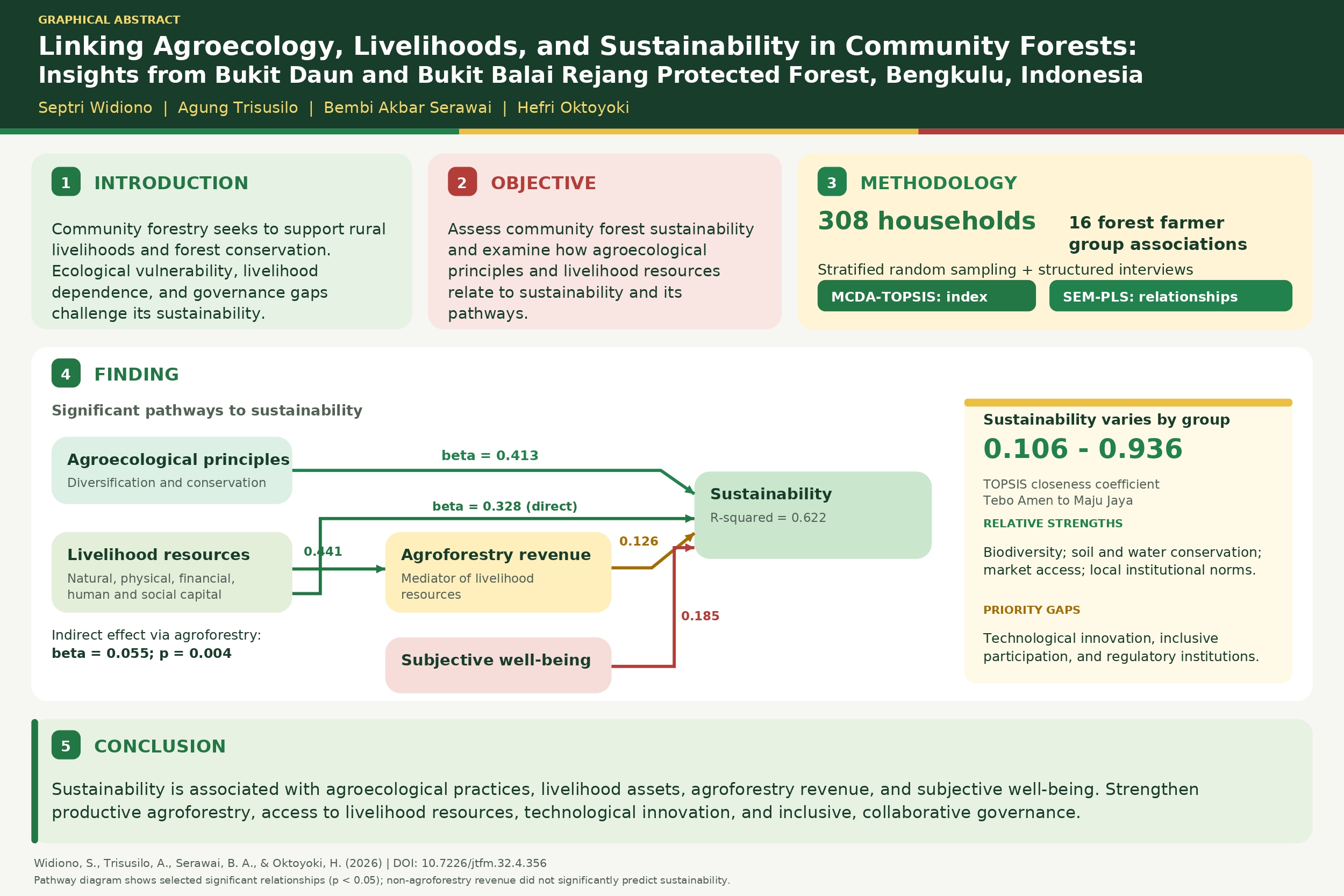
Community forestry in Indonesia has been promoted to strengthen rural livelihoods while conserving forest ecosystem. However, its sustainability remains uncertain due to ecological vulnerabilities and socio-economic dependence. This study analyzes the sustainability of community forestry in the Bukit Daun and Bukit Balai Rejang Protected Forests, Bengkulu Province, by linking agroecological principles with the Sustainable Livelihoods Approach. Primary data were collected from 308 households across 16 Forest Farmer Group Associations through structured interviews. A composite sustainability index was developed using MCDA, and causal relationships were examined through SEM-PLS. The findings show that its sustainability is primarily driven by economic, ecological, and institutional dimensions, while technological innovation and social participation contribute more marginally. Agroecological principles and livelihood resources significantly enhance sustainability, both directly and indirectly, with agroforestry revenue serving as a key mediator. Subjective well-being exerts a direct positive effect on sustainability, underscoring the psychosocial aspects of resilience. This study demonstrates that sustaining community forestry requires not only ecological practices and livelihood diversification but also stronger regulatory institutions, technological innovation, and inclusive participation. The findings contribute to global debates on community-based forestry by demonstrating how local agroecological practices and livelihood assets can secure both community welfare and ecological integrity.
Full text article
References
Altieri, M. A. (1996). Agroecology: The Science of Sustainable Agriculture (2nd ed.). CRC Press. https://doi.org/https://doi.org/10.1201/9780429495465
Bezner-Kerr, R., Liebert, J., Kansanga, M., & Kpienbaareh, D. (2022). Human and social values in agroecology: A review. Elementa, 10(1). https://doi.org/10.1525/elementa.2021.00090
Bilal, M., Khan, R., Tayyab, M., Ikhlaq, M., & Aslam, T. (2024). The Potential of Agroforestry to Enhance Rural Livelihoods in Punjab, Pakistan: A Socioeconomic Viewpoint. 8. https://doi.org/10.3390/eesp2024031008
BPS. (2024). Angka Deforestasi (Netto) Indonesia di Dalam dan di Luar Kawasan Hutan Tahun 2013-2022 (Ha/Th). https://www.bps.go.id/id/statistics-table/1/MjA4MSMx/angka-deforestasi--netto--indonesia-di-dalam-dan-di-luar-kawasan-hutan-tahun-2013-2021--ha-th-.html
Castellini, M., Diacono, M., Gattullo, C. E., & Stellacci, A. M. (2021). Sustainable agriculture and soil conservation. In Applied Sciences (Switzerland) (Vol. 11, Issue 9). MDPI AG. https://doi.org/10.3390/app11094146
Cavaye, J., Palaniappan, G., Nicetic, O., Concepcion, S., Abamo, A., Aspera, B., & Nuevo, P. (2016). The development of vegetable value chains integrated with community capacity - an initial study in the southern Philippines. 1121, 109–115. https://doi.org/10.17660/ACTAHORTIC.2016.1121.16
Cradduck, L., & Wharton, N. (2011). The Adoption of residential sustainability programs: Lessons from the commercial sector. Pacific Rim Property Research Journal, 1–14.
Ellis, F. (2000). Rural Livelihood and Diversity in Developing Countries. Oxford University Press.
Erktan, A., Blanchart, E., Pulleman, M., & Trap, J. (2024). Soil biodiversity and ecological intensification for sustainable agriculture. In Plant and Soil (Vol. 503, Issues 1–2, pp. 1–12). https://doi.org/10.1007/s11104-024-06961-8
Folke, C. (2006). Resilience: the emergence of a perspective for social-ecological systems analyses. Global Environmental Change, 16(3), 253–267. https://doi.org/10.1016/j.gloenvcha.2006.04.002
Gunawan, H., Yeny, I., Karlina, E., Suharti, S., Murniati, Subarudi, Mulyanto, B., Ekawati, S., Garsetiasih, R., Pratiwi, Sumirat, B. K., Sawitri, R., Heriyanto, N. M., Takandjandji, M., Widarti, A., Surati, Desmiwati, Kalima, T., Effendi, R., … Nurlia, A. (2022). Integrating Social Forestry and Biodiversity Conservation in Indonesia. In Forests (Vol. 13, Issue 12). MDPI. https://doi.org/10.3390/f13122152
Hair, J. F., Ringle, C. M., & Sarstedt, M. (2011). PLS-SEM: Indeed a silver bullet. Journal of Marketing Theory and Practice, 19(2), 139–152. https://doi.org/10.2753/MTP1069-6679190202
Hair, J., Hult, T., Ringle, C., & Sarstedt, M. (2022). A Primer on Partial Least Squares Structural Equation Modeling (PLS-SEM) (3rd ed.). SAGE Publications.
Harbi, J., Cao, Y., Thomas Erbaugh, J., Rafi Almay Widagdo, F., Mauri, J., & Milantara, N. (2020). Three Generations of Forest Peoples’ Empowerment in Indonesia: Process Towards Sustainable and Equitable Forest Management. Jurnal Manajemen Hutan Tropika, 26(2), 91–104. https://doi.org/10.7226/jtfm.26
Kim, J. (2018). Social dimension of sustainability: From community to social capital. Journal of Global Scholars of Marketing Science: Bridging Asia and the World, 28(2), 175–181. https://doi.org/10.1080/21639159.2018.1436982
Latifah, S., Yonariza, & Purwanto. (2023). Study of Community Forest Management (HKm) on Socio-Economic Sustainability in Several Regions of Indonesia. IOP Conference Series: Earth and Environmental Science, 1188(1). https://doi.org/10.1088/1755-1315/1188/1/012026
Ma, W., Rahut, D. B., Sonobe, T., & Gong, B. (2024). Linking farmers to markets: Barriers, solutions, and policy options. Economic Analysis and Policy, 82, 1102–1112. https://doi.org/10.1016/j.eap.2024.05.005
Makkarennu, Irnasari, & Muhammad Alif, K. S. (2024). Community Forestry as Livelihood Assets: Household Perspectives and Sustainable Practices. IOP Conference Series: Earth and Environmental Science, 1430(1). https://doi.org/10.1088/1755-1315/1430/1/012015
Maring, P. (2022). Conflict transformation and collaboration in developing social forestry in Flores, Indonesia. Forest and Society, 6(1), 40–66. https://doi.org/10.24259/fs.v6i1.13199
Martin, A., Coolsaet, B., Corbera, E., Dawson, N. M., Fraser, J. A., Lehman, I., & Rodriguez, I. (2016). Justice and conservation: The need to incorporate recognition. In Biological Conservation (Vol. 197, pp. 254–261). Elsevier Ltd. https://doi.org/10.1016/j.biocon.2016.03.021
Maryudi, A. (2022). Holding social forestry hostage in Indonesia: Contested bureaucracy mandates and potential escape pathways. Environmental Science and Policy, 128, 142–153. https://doi.org/10.1016/j.envsci.2021.11.013
Meijaard, E., Santika, T., Wilson, K. A., Budiharta, S., Kusworo, A., Law, E. A., Friedman, R., Hutabarat, J. A., Indrawan, T. P., Sherman, J., St. John, F. A. V., & Struebig, M. J. (2021). Toward improved impact evaluation of community forest management in Indonesia. In Conservation Science and Practice (Vol. 3, Issue 1). Blackwell Publishing Inc. https://doi.org/10.1111/csp2.189
Mensah, J. (2021). Social Sustainability: A Dwarf among giants in the Sustainable Development Pillars?. Asian Journal of Management, 12(2), 127–128.
Octavia, D., Murniati, Suharti, S., Hani, A., Mindawati, N., Suratman, Swestiani, D., Junaedi, A., Undaharta, N. K. E., Santosa, P. B., Wahyuningtyas, R. S., & Faubiany, V. (2023). Smart agroforestry for sustaining soil fertility and community livelihood. In Forest Science and Technology (Vol. 19, Issue 4, pp. 315–328). Taylor and Francis Ltd. https://doi.org/10.1080/21580103.2023.2269970
OECD. (2013). OECD Guidelines on Measuring Subjective Well-being. OECD Publishing. https://doi.org/10.1787/9789264191655-en
Oktoyoki, H., Pratama, B., & Himawan, R. (2023). Performansi Kelompok Tani Hutan (KTH) dalam Pengelolaan Hutan Kemasyarakatan: Dimensi Kelola Kelembagaan, Kawasan, dan Usaha. Jurnal Hutan Pulau-Pulau Kecil, 7(2), 210–220. http://ojs3.unpatti.ac.id/index.php/
Ostrom, E. (2000). Collective Action and the Evolution of Social Norms. Journal of Economic Perspectives, 14(3), 137–158. http://www.indiana.edu/workshop/wsl/wsl.html
Padmaningrum, D., Julian Santosa, F., Widiyanto, Roro Ilma Kusuma Wardani, R., Purwanto, D., & Fathinah Maharani, R. (2024). Local knowledge in forest management: A case study in java forest, indonesia. IOP Conference Series: Earth and Environmental Science, 1317(1). https://doi.org/10.1088/1755-1315/1317/1/012015
Pambudi, A. S. (2020). The Development of Social Forestry in Indonesia: The Journal of Indonesia Sustainable Development Planning, 1(1), 57–66. https://doi.org/10.46456/jisdep.v1i1.11
Patnaik, J., & Bhowmick, B. (2022). Determining appropriateness for management of appropriate technology: an empirical study using factor analysis. Technology Analysis and Strategic Management, 34(2), 125–137. https://doi.org/10.1080/09537325.2021.1890013
Paudel, D. (2019). Community Forestry and Sustainability in Nepal. In A. J. Nightingale (Ed.), Environment and Sustainability in a Globalizing World (1st ed.). Routledge.
Pokharel, R. K., Neupane, P. R., Tiwari, K. R., & Köhl, M. (2015). Assessing the sustainability in community based forestry: A case from Nepal. Forest Policy and Economics, 58, 75–84. https://doi.org/https://doi.org/10.1016/j.forpol.2014.11.006
Porter-Bolland, L., Ellis, E. A., Guariguata, M. R., Ruiz-Mallén, I., Negrete-Yankelevich, S., & Reyes-García, V. (2012). Community managed forests and forest protected areas: An assessment of their conservation effectiveness across the tropics. Forest Ecology and Management, 268, 6–17. https://doi.org/https://doi.org/10.1016/j.foreco.2011.05.034
Pratama, A. A. (2019). Lessons Learned from Social Forestry Policy in Java Forest: Shaping the Way Forward for New Forest Status in ex-Perhutani Forest Area. Jurnal Ilmu Kehutanan, 13, 127–136. https://jurnal.ugm.ac.id/jikfkt
Pribadi, T. A., Afiyanti, M., & Hakim, L. (2023). Vegetation Structure and Composition of Coffee Agroforestry in Kalibaru District. Jurnal Biodjati, 8(1), 139–150. https://doi.org/10.15575/biodjati.v8i1.23826
Rachmawan, D., Seda, F. S. S. E., & Siburian, R. (2021). Complementing The Access Theory by Collaborative Approach in Indonesia Social Forestry Context. Jurnal Masyarakat Dan Budaya, 23(2). https://doi.org/10.14203/jmb.v23i2.1344
Ragandhi, A., Hadna, A. H., Setiadi, S., & Maryudi, A. (2021). Why do greater forest tenure rights not enthuse local communities? An early observation on the new community forestry scheme in state forests in Indonesia. Forest and Society, 5(1), 159–166. https://doi.org/10.24259/fs.v5i1.11723
Rhodes, R. A. W. (2017). Network Governance and the Differentiated Polity: Selected Essays (Vol. 1). Oxford University Press.
Rochmayanto, Y., Nurrochmat, D. R., Nugroho, B., Darusman, D., Satria, A., Casse, T., Erbaugh, J. T., & Wicaksono, D. (2023). Devolution of forest management to local communities and its impacts on livelihoods and deforestation in Berau, Indonesia. Heliyon, 9(5). https://doi.org/10.1016/j.heliyon.2023.e16115
Rosset, P. M., & Altieri, M. A. (2021). Agroecology: Science and Politics (ebook edition). Practical Action Publishing. https://doi.org/http://dx.doi.org/10.3362/ 9781780449944
Sahide, M. A. K., Fisher, M. R., Erbaugh, J. T., Intarini, D., Dharmiasih, W., Makmur, M., Faturachmat, F., Verheijen, B., & Maryudi, A. (2020). The boom of social forestry policy and the bust of social forests in Indonesia: Developing and applying an access-exclusion framework to assess policy outcomes. Forest Policy and Economics, 120. https://doi.org/10.1016/j.forpol.2020.102290
Said, M., & Misana, S. (2023). Does institutionalisation of community participation promise sustainability in governance of community forests? JOURNAL OF THE GEOGRAPHICAL ASSOCIATION OF TANZANIA, 43(2), 24–46. https://doi.org/10.56279/jgat.v43i2.228
Samek, J. H., Anhar, A., Maimunah, S., & Skole, D. (2022). Measuring forest ecosystem services in Aceh Province for inclusion to local forest resource management plans. APN Science Bulletin, 12(1), 90–101. https://doi.org/10.30852/sb.2022.1910
Santika, T. (2019). Heterogeneous impacts of community forestry on forest conservation and poverty alleviation: Evidence from Indonesia. People and Nature, 1(2), 204–219. https://doi.org/10.1002/pan3.25
Santosa, I., Muslihudin, M., & Adawiyah, W. R. (2019). Current form of Reciprocity between Land Owners Peasant and Peasant Laborer in Central Java-Indonesia. Journal of Arts and Humanities, 8(8), 53–59. https://doi.org/10.18533/journal.v8i8.1725
Scoones, I. (2015). Sustainable Livelihood and Rural Development. Fernwood Publishing and Practical Action Publishing.
Scott, W. R. (2008). Institutions and Organizations: Ideas and Interests. Sage Publication.
Sehgal, S., & Batool, I. (2024). Economic Development: A Study of the Holistic Examination of Sustainable Agriculture’s Substantial Impact on Developing Nations. South Asian Journal of Social Studies and Economics, 21(7), 241–248. https://doi.org/10.9734/sajsse/2024/v21i7858
Somashekar, K. S., Abhishek, G. J., Kumar, V., Tiwari, A., Lakra, T. S., Sangeeta, ManishKapoor, & Chauhan, B. (2024). Agroecology Principles, Practices and their Impact on Sustainable Food Systems. European Journal of Nutrition & Food Safety, 16(9), 249–260. https://doi.org/10.9734/ejnfs/2024/v16i91544
Sudomo, A., Leksono, B., Tata, H. L., Rahayu, A. A. D., Umroni, A., Rianawati, H., Asmaliyah, Krisnawati, Setyayudi, A., Utomo, M. M. B., Pieter, L. A. G., Wresta, A., Indrajaya, Y., Rahman, S. A., & Baral, H. (2023). Can Agroforestry Contribute to Food and Livelihood Security for Indonesia’s Smallholders in the Climate Change Era? In Agriculture (Switzerland) (Vol. 13, Issue 10). Multidisciplinary Digital Publishing Institute (MDPI). https://doi.org/10.3390/agriculture13101896
Tambo, J. A., & Wünscher, T. (2018). Building farmers’ capacity for innovation generation: Insights from rural Ghana. Renewable Agriculture and Food Systems, 33(2), 116–130. https://doi.org/DOI: 10.1017/S1742170516000521
Tega, M., & Bojago, E. (2023). Farmer’s Perceptions of Agroforestry Practices, Contributions to Rural Household Farm Income, and Their Determinants in Sodo Zuria District, Southern Ethiopia. International Journal of Forestry Research, 2023. https://doi.org/10.1155/2023/5439171
Thompson, P. B., & Norris, P. E. (2021). Sustainability: What Everyone Needs to Know. Oxford University Press.
Tittonell, P., Elmutajar, V., Felix, G., Kebede, Y., Laborda, L., Soto, R. L., & deVente, J. (2022). Regenerative agriculture—agroecology without politics? Frontiers in Sustainable Food Systems, 6(844621). https://doi.org/10.3389/fsufs.2022.844261
Tripathi, N., Singh, R., & Singh, R. (2015). Agroecology and Sustainability of Agriculture in India: An Overview. https://consensus.app/papers/agroecology-and-sustainability-of-agriculture-in-india-an-singh-singh/4144da9f39a65cb4acbe8ed07dfa2fd6/
Vikas, & Ranjan, R. (2024). Agroecological approaches to sustainable development. In Frontiers in Sustainable Food Systems (Vol. 8). Frontiers Media SA. https://doi.org/10.3389/fsufs.2024.1405409
Wetzels, M., Odekerken-Schröder, G., & Van Oppen, C. (2009). Using PLS path modeling for assessing hierarchical construct models: Guidelines and empirical illustration. MIS Quarterly: Management Information Systems, 33(1), 177–196. https://doi.org/10.2307/20650284
Widiono, S. (2024). Dinamika Sistem Jaminan Sosial Lokal: Studi Kasus Penghidupan Masyarakat Sekitar Taman Nasional Kerinci Seblat di Kabupaten Lebong Provinsi Bengkulu. Institut Pertanian Bogor.
Widiono, S., Wahyuni, E. S., Kolopaking, L. M., & Satria, A. (2024a). Livelihood Diversity of Rural Communities Without Legal Access to Forest Resources: The Case of Kerinci Seblat National Park in Bengkulu Province. Forest and Society, 8(1), 249–270. https://doi.org/10.24259/fs.v8i1.30947
Widiono, S., Wahyuni, E. S., Kolopaking, L. M., & Satria, A. (2024b). Livelihood vulnerability of indigenous people to climate change around the Kerinci Seblat National Park in Bengkulu, Indonesia. Regional Sustainability, 5(4), 100181. https://doi.org/10.1016/j.regsus.2024.100181
Widiyanto, A., Ridho Nurrochmat, D., Trison, S., & Nurfatriani, F. (2025). Social forestry institutional transformation under the Forest Areas with Special Management (KHDPK) policy. Asian Journal of Forestry, 9(2). https://doi.org/10.13057/asianjfor/r090203
Wijayanti, A. R. Y., Sila, S. A. R., Zamzam, N., Saharuddin, Supratman, & Arafat, A. (2025). Strategies for strengthening social bonding in a forest farmer group: an FFA and AHP approach. Gorontalo Journal of Forestry Research, 8(2), 77–88.
Wijayanto, H. W., Lo, K. A., Toiba, H., & Rahman, M. S. (2022). Does Agroforestry Adoption Affect Subjective Well-Being? Empirical Evidence from Smallholder Farmers in East Java, Indonesia. Sustainability (Switzerland), 14(16). https://doi.org/10.3390/su141610382
Zhang, M. (2022). Design Empowerment: Participatory Design Towards Social Sustainability. In P.-L. P. Rau (Ed.), Cross-Cultural Design. Interaction Design Across Cultures (pp. 274–287). Springer International Publishing.
Zlaugotne, B., Zihare, L., Balode, L., Kalnbalkite, A., Khabdullin, A., & Blumberga, D. (2020). Multi-Criteria Decision Analysis Methods Comparison. Environmental and Climate Technologies, 24(1), 454–471. https://doi.org/10.2478/rtuect-2020-0028
Authors
Copyright (c) 2026 Jurnal Manajemen Hutan Tropika

This work is licensed under a Creative Commons Attribution 4.0 International License.
Jurnal Manajemen Hutan Tropika is an open access journal which means that all contents is freely available without charge to the user or his/her institution. Users are allowed to read, download, copy, distribute, print, search, or link to the full texts of the articles in this journal without asking prior permission from the publisher or the author. This is in accordance with the Budapest Open Access Initiative (BOAI) definition of open access.Article Details