
Dynamics of the Debate on Thoughts on the Log Export Ban Policy in Indonesia

Article Sidebar
-
advocacy coalition, ban policy, log export, policy subsystem
Abstract
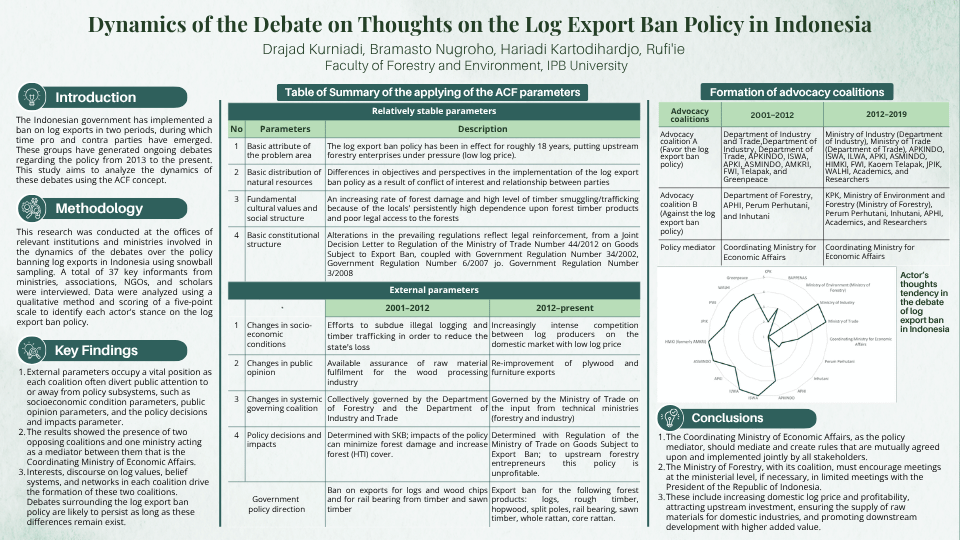
The Indonesian government has implemented a ban on log exports in two periods, during which time pro and contra parties have emerged. These groups have generated ongoing debates regarding the policy from 2013 to the present. This study aims to analyze the dynamics of these debates using the ACF concept. A total of 37 key informants from ministries, associations, NGOs, and scholars were interviewed using snowball sampling. Data were analyzed using a qualitative method and scoring of a five-point scale to identify each actor’s stance on the log export ban policy. The results showed the presence of two opposing coalitions and one ministry acting as a mediator between them. Interests, discourse on log values, belief systems, and networks in each coalition drive the formation of these two coalitions. Debates surrounding the log export ban policy are likely to persist as long as these differences remain. Therefore, the Coordinating Ministry of Economic Affairs, as the policy mediator, should mediate and create rules that are mutually agreed upon and implemented jointly by all stakeholders. The Ministry of Forestry, with its coalition, must encourage meetings at the ministerial level, if necessary, in limited meetings with the President of the Republic of Indonesia.
Full text article
References
Arshanti, L., Kartodihardjo, H., & Khan, A. (2017). Masalah dan kebijakan sertifikasi pengelolaan hutan alam produksi lestari: Penerapan advocacy coalition framework. Jurnal Analisis Kebijakan Kehutanan, 14(2), 137148. https://doi.org/10.20886/jakk.2017.14.2.137-148.
Badan Pusat Statistik. (2018). Statistik Indonesia 2018. Jakarta: BPS.
Barbier, E. B., & Rauscher M. (1998). Trade, tropical deforestation and policy intervention. In E. B. Barbier (Ed.), The economics of environment and development: Selected essays (pp. 427–43). Cheltenham: Elgar.
Begemann, A., Dolriis, C., Onatunji, A., Chimisso, C., & Winkel, G. (2025). The politics of sustainable finance for forests: Interests, beliefs and advocacy coalitions shaping forest sustainability criteria in the making of the EU taxonomy. International Journal of Sociology and Social Policy, 45(1112), 11371152. https://doi.org/10.1108/IJSSP-04-2025-0249
Bungin, B. (2009). Penelitian kualitatif: Komunikasi, ekonomi, kebijakan publik, dan ilmu sosial lainnya. Jakarta: Kencana Prenada Media Grup.
Chen, P. (2003). Advocating online censorship. Australian Journal of Public Administration, 62(2), 4164. https://doi.org/10.1111/1467-8497.00324
Creswell, J. W. (2016). Research design: Pendekatan metode kualitatif, kuantitatif, dan campuran [Research design: Qualitative, quantitative, and mixed methods approaches] (A. Fawaid & R. K. Pancasari, Trans.; 4th ed.). Pustaka Pelajar. (Original work published 2014)
Chu, V. H. Y., Law, W. W. Y., & Williams, J. M. (2022). Advocacy coalitions in rural revitalization: The roles of policy brokers and policy learning. Environmental Science & Policy, 136, 918. https://doi.org/10.1016/j.envsci.2022.05.006
Dean, J. M. (1995). Export bans, environment, and developing country welfare. Review of International Economics, 3(31), 929. https://doi.org/10.1111/j.1467-9396.1995.tb00074.x
Dean, J. M., & Gangopadhyay, S. (1997). Export bans, environmental protection, and unemployment. Review of Developing Economics, 13(1), 32436. https://doi.org/10.1111/1467-9361.00022
Doggan, M. (1975). The mandarins of western erope. New York: Wiley.
Environmental Investigation Agency & Telapak. (2002). Timber trafficking: Illegal logging in Indonesia, South East Asia, and international consumption of illegally sourced timber. Washington DC: Environmental Investigation Agency & Telapak.
Fischer, F., Miller, G. J., & Sidney, M. S. (2014). Handbook of public policy analysis: Theory, politics, and methods. (I. Baihaqi, Trans, Rizal, Ed.). Bandung.
Fitzgerald, B. (1986). An analysis of Indonesian trade policies: Countertrade, downstream processing, import restrictions, and the deletion program [CPD discussion paper no. 1986-22]. Washington DC: World Bank.
Gellert, P. K. (2005). Oligarchy in the timber markets of indonesia: From APKINDO to IBRA to the future of the forests. In B. P. Resosudarmo (Ed.), The politics and economics of Indonesia’s natural resources (pp. 145161). ISEAS Publishing.
Institute of Development Studies. (2006). Understanding policy processes: A review of ids research on the environment. Brighton: University of Sussex.
Ingold, K., & Varone, F. (2011). Treating policy brokers seriously: Evidence from the climate policy. Journal of Public Administration Research Theory, 22, 319346. https://doi.org/10.1093/jopart/mur035
Johns, P. (2003). Is there life after policy streams, advocacy coalitions, and punctuations: Using evolutionary theory to explain policy change? Policy Studies Journal, 31(4), 481498.
Kartodihardjo, H. (2008). Diskursus dan aktor dalam pembuatan dan implementasi kebijakan kehutanan: Masalah kerangka pendekatan rasional. Jurnal Manajemen Hutan Tropika, 14(1), 1927.
Kartodihardjo, H. (2017). Analisis kebijakan pengelolaan sumber daya alam: Diskursus-politik-aktor-jaringan. Bogor: Sajogyo Institute.
Kementerian Lingkungan Hidup dan Kehutanan. (2019). Statistik lingkungan hidup dan kehutanan tahun 2018. Jakarta: KLHK.
Lantera, K. G. (2017). Strategi peningkatan nilai tambah perdagangan kayu di indonesia [thesis]. Bogor: IPB University.
Lantera, K. G., Nurrochmat, D. R., & Bakhtiar, T. (2018). Strategies to increase the value added of wood trading in indonesia. European Journal of Agriculture and Forestry Research, 6(5), 3446.
Litfin, K. T. (2000). Advocacy coalitions along the domestic‐foreign frontier: Globalization and canadian climate change policy. Policy Studies Journal, 28(1), 236252. https://doi.org/10.1111/j.1541-0072.2000.tb02026.x
Manurung, E. G. T. (1995). Economic impacts of the log export ban policy on the development of forest products industries of iIndonesia [disertation]. Wisconsin: University of Wisconsin.
Manurung, E. G. T., & Buongiorno, J. (1997). Effects of the ban on tropical log exports on the forestry sector of Indonesia. Journal of World Forest Resources Management, 8, 2149.
Marchand, S. & Zerbo, M. (2025). Enhancing employment through log export ban: Insights from wood-processing firms in developing countries. Forest Policy and Economics, 174, Article 103491. https://doi.org/10.1016/j.forpol.2025.103491
May, P. J. (1989). Reconsidering policy design: Polices and public. Journal of Public Policy, 11(2), 187206.
Malmborg, F. V. (2023). Advocacy coalitions and policy change for decarbonisation of international maritime transport: The case of FuelEU maritime. Maritime Transport Research, 4, Article 100091. https://doi.org/10.1016/j.martra.2023.100091
Malkamaki, A., Yla-Anttila, T., Brockhaus, M, Toppinen, A, & Wagner, P. M. (2021). Unity in diversity? When advocacy coalitions and policy beliefs grow trees in South Africa. Land Use Policy, 102, Article 105283. https://doi.org/10.1016/j.landusepol.2021.105283
Mintrom, M., & Vergari, S. (1996). Advocacy coalitions, policy entrepreneurs, and policy change. Policy Studies Journal, 24(3), 420434.
Munro, J. F. (1993). California water politics: Explaining policy change in cognitively polarized subsystem. In P. A. Sabatier & H. C. Jenkins-Smith (Eds.), Policy change and learning: an advocacy coalition approach (pp. 105127). Colorado: Westview Press.
Nurrochmat, D. R. (2017). Strategi kebijakan pembangunan kehutanan dan lingkungan berkelanjutan. Bogor: Institut Pertanian Bogor.
Nurrochmat, D. R, Jaya, I. N. S., Massijaya, M. S., & Ekayani, M. (2017). Strategi kebijakan zonasi replanting untuk meningkatkan nilai ekonomi limbah batang sawit dan mengurangi risiko kebakaran lahan. Laporan Penelitian Unggulan Perguruan Tinggi (PUPT). Bogor: Institut Pertanian Bogor.
Parnala, M., Siregar, H., & Hartoyo, S. (2004). Dampak kebijakan larangan ekspor log terhadap illegal logging [thesis]. Bogor: IPB University.
Perez-Garcia, J., Lippke, B., & Baker, J. (1997). Trade barriers in the pacific forest sector: Who wins and who loses. Contemporary Economic Policy, 15(1), 87–103. https://doi.org/10.1111/j.1465-7287.1997.tb00457.x
Qarakhani, M., & Mirzaie, A. (2025). Advocacy coalitions and social policy making in Iran: The education 2030 agenda. International Journal of Sociology and Social Policy, 45(1112), 11371152. https://doi.org/10.1108/IJSSP-04-2025-0249
Resosudarmo, B. P., & Yusuf, A. A. (2006). Is the log export ban an efficient instrument for economic development and environmental protection? The case of Indonesia. Asian Economic Papers. 5(2), 75104. https://doi.org/10.1162/asep. 2006.5.2.75
Ruysschaert, S. & Hufty, M. (2020). Building an effective coalition to improve forest policy: Lessons from the coastal Tripa peat swamp rainforest, Sumatra, Indonesia. Land Use Policy, 99, Article 103359. https://doi.org/10.1016/j.landusepol.2018.04.034
Sabatier, P. A. (1988). An advocacy coalition framework of policy change and the role of policy-oriented learning therein. Journal of Policy Science, 21, 129168.
Sabatier, P. A. & Pelkey, N. W. (1987). Incorporating multiple actors and guidance instruments into models of regulatory policymaking: An advocacy coalition framework. Administration and Society, 19(2), 236263.
Sabatier, P. A. & Pelkey, N.W. (1990). Land development at Lake Tahoe. California: Institute of Ecology.
Sabatier, P. A. & Jenkins-Smith, H. C. (1993). Policy change and learning: An advocacy coalition approach. Colorado: Westview Press.
Sabatier, P. A. & Jenkins-Smith, H. C. (1999). The advocacy coalition framework: An assessment. Colorado: Westview Press.
Sabatier, P. A., & Weible, C. M. (2005). Innovations in the advocacy coalition framework [Paper presentation]. American Society for Public Administration Meeting, Milwaukee, WI, United States.
Sabatier, P. A. (2007). Theories of policy process (2nd ed). Oxford: Westview Press.
Schlager, E. (1995). Policy making and collective action: defining coalition within the advocacy coalition framework. Policy Science, 28, 242270.
Schlager, E., & Blomquist, W. (1996). A comparison of three emerging theories of the policy process. Political Research Quaterly, 49(9), 651672.
Sidabutar, H. P. (1988). An investigation of the impacts of domestic log processing and log export restrictions on Indonesia’s export earning from logs [thesis]. Seattle: University of Washington.
Simangunsong, B., & Nugroho, B. (2013). Kajian pencabutan larangan ekspor dan pengenaan pajak ekspor kayu bulat hutan tanaman industri Indonesia (Paper prepared for Direktorat Jenderal Bina Usaha Kehutanan Kementerian Kehutanan). Jakarta: APHI.
Simon, H. (1985). Human nature in politics: The dialogue of psychologyc with political science. American Political Science Review, 79(6), 293304.
Stewart, J. (1991). Policy models and equal educational opportunity. Political Science and Politics, 24(2), 167173. https://doi.org/10.2307/419925
Sugiyono. (2007). Memahami pnelitian kualitatif. Bandung: Penerbit Alfabet.
Weible, C. M. (2005). Beliefs and perceived influence in a natural resources conflict: An advocacy coalition framework approach to policy network. Political Research Quarterly, 58(3), 461475. https://doi.org/10.2307/3595615
Weible, C. M. (2006). An advocacy framework approach to stakeholder analysis. Journal of Public Administration Research and Theory, 17, 95117. https://doi.org/10.10 93/jopart/muj015
Weible, C. M., & Sabatier, P. A. (2005). Comparing policy networks: Marine protected areas in California. Policy Studies Journal, 33(2), 181202. https://doi.org/10.1111/ j.1541-0072.2005. 00101.x
Weiss, C. H. (1977). Research for policy sake: The enlightenment function of social research. Policy Analysis, 3(4), 531545.
Zafonte, M., & Sabatier, P. A. (1998). Shared beliefs and imposed interdependencies as determinants of ally networks in overlapping subsystems. Journal of Theoretical Politics, 10(4), 473–505.
Zartman, I. W. (1991). Conflict and resolution: Contest, cost, and change. Annals of the American Academy of Political and Social Science, 518(1), 1122. https://doi.org/10.1177/0002716291518001002
Zhang, Q., Cheng, B., Diao, G., Tao, C., & Wang, C. (2005). Does China's natural forest logging ban affect the stability of the timber import trade network? Forest Policy and Economics, 152, Article 102974. https://doi.org/10.1016/j.forpol.2023.102974
Authors
Copyright (c) 2026 Jurnal Manajemen Hutan Tropika

This work is licensed under a Creative Commons Attribution 4.0 International License.
Jurnal Manajemen Hutan Tropika is an open access journal which means that all contents is freely available without charge to the user or his/her institution. Users are allowed to read, download, copy, distribute, print, search, or link to the full texts of the articles in this journal without asking prior permission from the publisher or the author. This is in accordance with the Budapest Open Access Initiative (BOAI) definition of open access.Article Details
How to Cite



