
Integration of Traditional Ecological Knowledge and Community-Based Forest Resource Utilization Practices in Central South Timor Regency

Article Sidebar
-
utilization practices, forest resources, traditional knowledge, ecosystem sustainability
Abstract
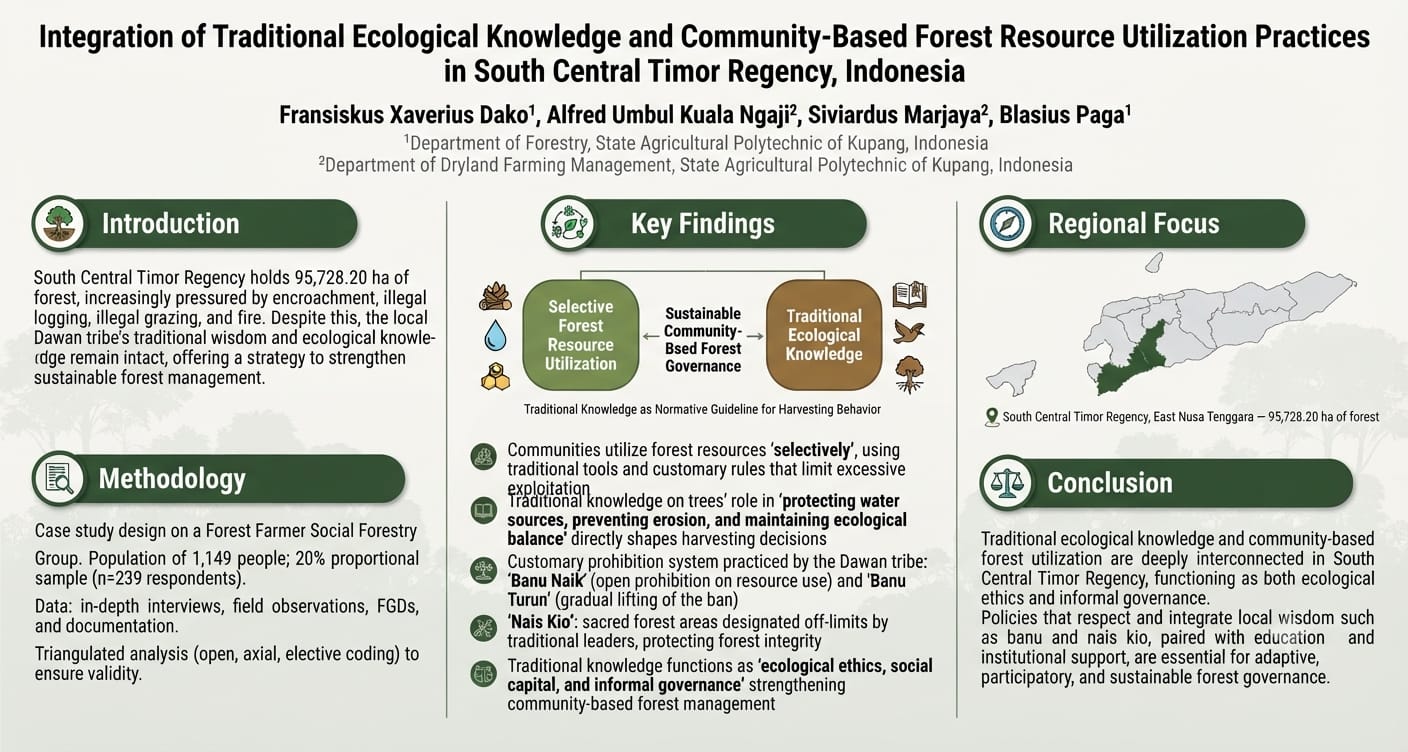
Forests in Indonesia are under significant pressure due to deforestation and degradation resulting from human activities. However, in several areas, traditional practices of forest utilization based on local knowledge have proven capable of maintaining ecosystem sustainability. This study aims to investigate the practices of forest resource utilization and the traditional knowledge of communities regarding forests and ecosystems, as part of their local knowledge system in South Central Timor Regency. This study uses a case study strategy on members of the social forestry group for forest farmers, with a population of 1,149 people and a sample of 20% of the population (n = 239). Data were obtained through in-depth interviews, field observations, focus group discussions, and documentation, then analyzed triangulatively to ensure the validity of the findings. The study's results show that communities utilize forest resources selectively, using traditional tools and adhering to customary rules that serve to limit excessive exploitation. Traditional ecological knowledge regarding the role of trees in maintaining water sources, preventing erosion, and maintaining environmental balance serves as a normative guideline that directly influences harvesting decisions and regulates utilization intensity. These findings confirm that traditional knowledge plays a crucial role not only as a basis for ecological ethics but also as social capital and an informal governance mechanism that strengthens sustainable community-based forest management systems.
Full text article
References
Adella, N., Shalsabillah, R., Mellani, M., Saputri, I., Refki, O., Yansyah, F., & Setyanto, A. (2024). Nilai ekonomi dan kontribusi hasil hutan bukan kayu (HHBK) terhadap pendapatan masyarakat Kampung Cikupa Desa Baru Ranji Kecamatan Merbau Mataram. Hidroponik: Jurnal Ilmu Pertanian dan Teknologi dalam Ilmu Tanaman, 1(3), 40–53. https://doi.org/10.62951/hidroponik.v1i3.144
Angelsen, A., Jagger, P., Babigumira, R., Belcher, B., Hogarth, N. J., Bauch, S., Borner, J., Smit-Hall, C., & Wunder, S. (2014). Environmental income and rural livelihoods : A global-comparative analysis. World Development, 64, 12–28. https://doi.org/10.1016/j.worlddev.2014.03.006
Anggraini, D., Havifi, I., Sari, L. P., & Gunawan, A. (2024). Analyzing the effectiveness of 30% gender affirmative action policy in Indonesia. 2nd International Conference on Gender, Culture and Society, 2024(3), 305–315. https://doi.org/10.18502/kss.v9i23.16731
Bowen, G. A. (2009). Document analysis as a qualitative research method. Qualitative Research Journal, 9(2), 2740. https://doi.org/10.3316/QRJ0902027
Carter, N., Bryant-lukosius, D., Dicenso, A., Blythe, J., & Neville, A. (2014). The use of triangulation in qualitative research. Oncology Nursing Forum, 41(5), 545–547. https://doi.org/10.1188/14.ONF.545-547
Crowe, S., Cresswell, K., Robertson, A., Huby, G., Avery, A., & Sheikh, A. (2011). The case study approach. BMC Medical Research Methodology, 11, Article 100. https://doi.org/10.1186/1471-2288-11-100
Dako, F. X., Purwanto, R. H., Faida, L. R. W., & Sumardi. (2019). Kerusakan antropogenik kawasan hutan lindung Mutis Timau dan upaya penanggulangannya di Pulau Timor Bagian Barat. Journal of Natural Resources and Environmental Management, 9(2), 437–455.https://doi.org/10.29244/jpsl.9.2.437-455
Dako, F. X., Purwanto, R. H., Rahayu, L., & Faida, W. (2018). Firewood and carpentry wood contribution to the communities of Mutis Timau Protected Forest, Timor Island. Jurnal Manajemen Hutan Tropika, 24, 166–174. https://doi.org/10.7226/jtfm.24.3.166
Danial., Adijaya, S., Laxmi., Koodoh, E. E., Jalil, A., & Zainal. (2025). Traditional ecological knowledge system of the Tolaki People in forest classification and management in Pamandati Village, South Konawe, Southeast Sulawesi. Sengkuni Journal, 6(1), 35–48. https://doi.org/10.37638/sengkuni.6.1.35-48
Denzin, N. K., & Lincoln, Y. S. (2021). The Sage handbook of qualitative research (4th ed.). California: Sage Publication Inc.
Derebe, B., & Alemu, A. (2023). Non-timber forest product types and its income contribution to rural households in the Horn of Africa: A systematic review. Forest Science and Technology, 19(3), 210–220. https://doi.org/10.1080/21580103.2023.2231963
Diniyati, D., & Achmad, B. (2015). Kontribusi pendapatan hasil hutan bukan kayu pada usaha hutan rakyat pola agroforestry di Kabupaten Tasikmalaya. Jurnal Ilmu Kehutanan, 9(1), 2331.
Donkoh, S., & Mensah, J. (2023). Application of triangulation in qualitative research. Journal of Applied Biotechnology & Bioengineering, 10(1), 6–9. https://doi.org/10.15406/jabb.2023.10.00319
Gunawan, H., Yeny, I., Karlina, E., Suharti, S., Murniati, Subarudi, Mulyanto, B., Ekawati, S., Garsetiasih, R., Pratiwi, Sumirat, B. K., Sawitri, R., Heriyanto, N. M., Takandjandji, M., Widarti, A., Surati, Desmiwati, Kalima, T., Effendi, R., …, & Nurlia, A. (2022). Integrating social forestry and biodiversity conservation in Indonesia. Forests, 13(12), Article 2152. https://doi.org/10.3390/f13122152
Harbi, J., Cao, Y., Milantara, N., & Mustafa, A. B. (2023). Assessing the sustainability of NTFP-based community enterprises: A viable business model for Indonesian rural forested areas. Forests, 14(6), Article 1251. https://doi.org/10.3390/f14061251
Iskandar, J. (2016). Etnobiologi dan keragaman budaya di Indonesia. Umbara: Indonesian Journal of Anthropology, 1(1), 27–42. https://doi.org/10.24198/umbara.v1i1.9602
Kasoki, L. M., Essouman, P. F. E., Musavandalo, C. M., Wamba, F. R., Makanua, I. D., Nguba, T. B., Mavakala, K., Mweru, J. -P. M., Tsakem, S. C., Babale, M., Nzuzi, F. L., & Michel, B. (2025). Indigenous knowledge and sustainable management of forest resources in a socio-cultural upheaval of the Okapi Wildlife Reserve landscape in the Democratic Republic of the Congo. Forests, 16(10), Article 1523. https://doi.org/10.3390/f16101523
Khosravi Mashizi, A., & Escobedo, F. (2025). The role of traditional ecological knowledge and ecosystem quality in managing ecosystem services. Scientific Reports, 15(1), Article 31510. https://doi.org/10.1038/s41598-025-17611-z
Korstjens, I., & Moser, A. (2021). Series: Practical guidance to qualitative research. Part 4: Trustworthiness and publishing. European Journal of General Practice, 24(1), 120–124. https://doi.org/10.1080/13814788.2017.1375092
Lubega, G., Falcão, M. P., Ssekandi, J., & Ribeiro, N. S. (2022). Characterizing the dependence on non-timber forest products among communities living around forest conservation areas in Marrupa-Mecula Corridor, Niassa Special Reserve, Niassa Province of Mozambique. Frontiers in Forests and Global Change, 5, Article 924959. https://doi.org/10.3389/ffgc.2022.924959
Luswaga, H. (2023). Non-timber forest products benefits for community groups and conservation motivation in mountains of Tanzania. Environmental and Sustainability Indicators, 18, Article 100238. https://doi.org/10.1016/j.indic.2023.100238
Mai, T., Tran, A., Gagnon, V. S., & Schelly, C. (2025). A review of traditional ecological knowledge in resilient livelihoods and forest ecosystems: Lessons for restoration sciences and practices. Forests, Trees and Livelihoods, 34(1), 27–53. https://doi.org/10.1080/14728028.2024.2408725
Mengie, T., & Szemethy, L. (2025). The practice of community-based forest management in Northwest Ethiopia. Land, 14(7), Article 1407. https://doi.org/10.3390/land14071407
Min, S., Kim, E., Dayandante, P. B., & Sun, M. (2024). Diagnosing the status and trend of research on traditional knowledge related to non-timber forest products as food. Trees, Forests and People, 17, Article100646. https://doi.org/10.1016/j.tfp.2024.100646
Ouedraogo, I., Eugenie Maiga, W. H., & Esbjerg, L. (2025). The role of non-timber forest products in reducing rural poverty in Burkina Faso. Journal of Agriculture and Environment for International Development, 119(1), 149–172. https://doi.org/10.36253/jaeid-16428
Padmaningrum, D., Santosa, F. J., Widiyanto, Wardani, R. R. I. K., Purwanto, D., & Maharani, R. F. (2024). Local knowledge in forest management: A case study in java forest, indonesia. IOP Conference Series: Earth and Environmental Science, 1317, Article 012015. https://doi.org/10.1088/1755-1315/1317/1/012015
Salim, J. M., Anuar, S. N., Omar, K., Mohamad, T. R. T., & Sanusi, N. A. (2023). The impacts of traditional ecological knowledge towards indigenous peoples: A systematic literature review. Sustainability, 15(1), Article 824. https://doi.org/10.3390/su15010824
Sheppard, J. P., Chamberlain, J., Agúndez, D., Bhattacharya, P., Chirwa, P. W., Gontcharov, A., Sagona, W. C. J., Shen, H. -L, Tadesse, W., & Mutke, S. (2020). Sustainable forest management beyond the timber-oriented status quo: Transitioning to co-production of timber and non-wood forest products—A global perspective. Current Forestry Reports, 6(1), 26–40. https://doi.org/10.1007/s40725-019-00107-1
Shrestha, H., Sharma, S., Khadka, B., Koju, U., & Zhang, J. (2024). The utilization and management of forest resources in South and Southeast Asia. Frontiers in Forests and Global Change, 6, Article 1288088. https://doi.org/10.3389/ffgc.2023.1288088
Sinthumule, N. I. (2025). The role of traditional ecological knowledge in managing the collection of non-timber forest products in Limpopo, South Africa: A community-based resource governance approach. Human Ecology, 53, 959–971. https://doi.org/10.1007/s10745-025-00641-6
Thammanu, S., Han, H., Marod, D., Zang, L., Jung, Y., Soe, K. T., Onprom, S., & Chung, J. (2021). Non-timber forest product utilization under community forest management in northern Thailand. Forest Science and Technology, 17(1), 1–15. https://doi.org/10.1080/21580103.2020.1862712
Timis-gansac, V., Dinca, L., Constantin, N., Constandache, C., Murariu, G., Cheregi, G., & Melinda, L. (2025). Community-based conservation in mountain forests: Patterns, challenges, and policy implications. Trees, Forests and People, 22, Article 101041. https://doi.org/10.1016/j.tfp.2025.101041
Yeny, I., Yuniati, D., & Khotimah, H. (2016). Local wisdom and practice of bamboo forest management in Bali Community. Jurnal Penelitian Sosial dan Ekonomi Kehutanan, 13(5), 63–72.
Yin, R. K. (2018). Case study research and applications: Design and methods (6th ed.). Sage Publications, Inc.
Zvobgo, L., Johnston, P., Olagbegi, O. M., Simpson, N. P., & Trisos, C. H. (2023). Role of indigenous and local knowledge in seasonal forecasts and climate adaptation: A case study of smallholder farmers in Chiredzi, Zimbabwe. Environmental Science and Policy, 145, 13–28. https://doi.org/10.1016/j.envsci.2023.03.017
Authors
Copyright (c) 2026 Jurnal Manajemen Hutan Tropika

This work is licensed under a Creative Commons Attribution 4.0 International License.
Jurnal Manajemen Hutan Tropika is an open access journal which means that all contents is freely available without charge to the user or his/her institution. Users are allowed to read, download, copy, distribute, print, search, or link to the full texts of the articles in this journal without asking prior permission from the publisher or the author. This is in accordance with the Budapest Open Access Initiative (BOAI) definition of open access.Article Details
How to Cite



