
Carbon Content and Economic Value of “Lamtoro” Biomass for the Co-Firing Control Plant on Timor Island, Indonesia

Article Sidebar
-
biomass, carbon value, economic value, power plant, Timor, Indonesia
Abstract
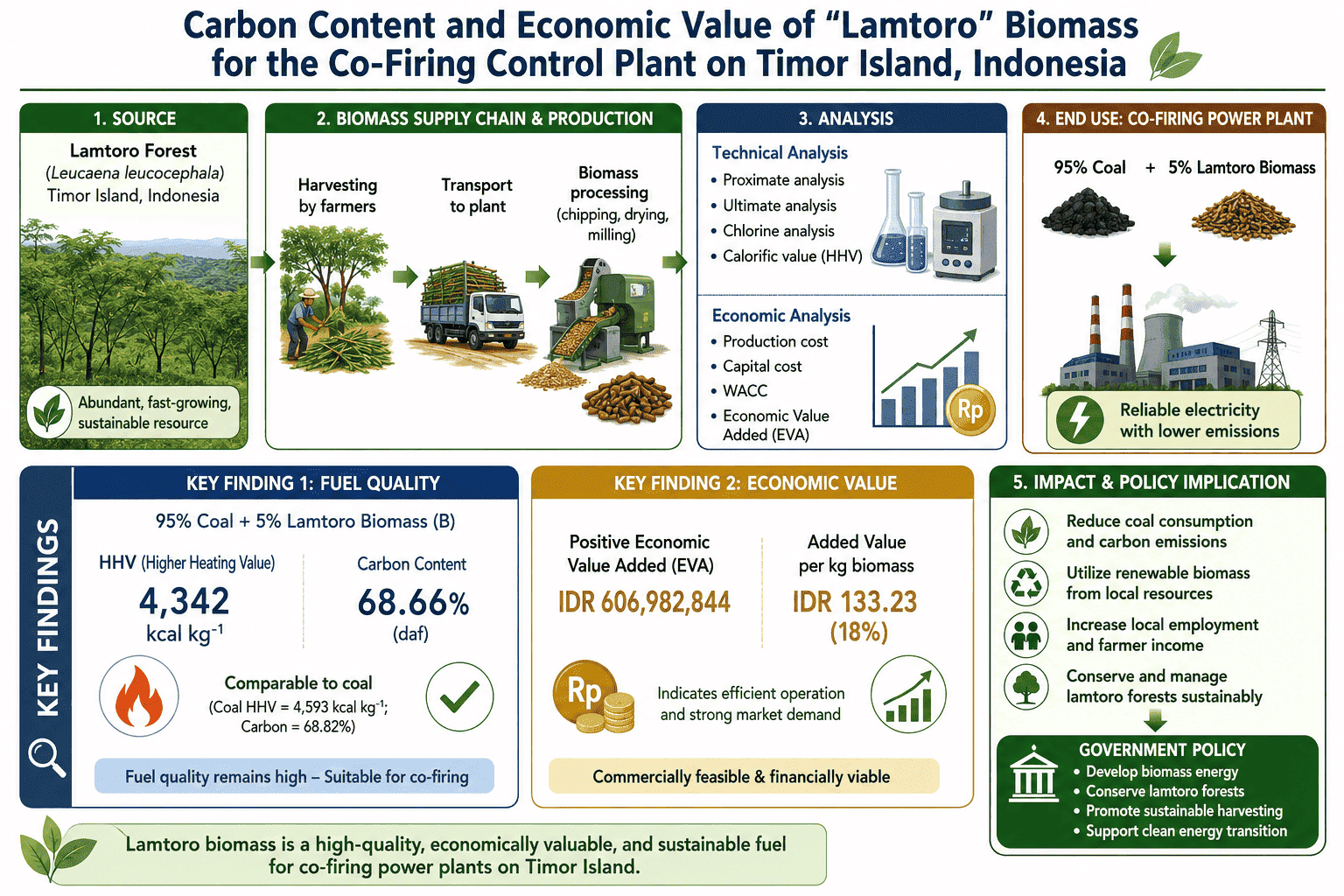
Timor Island has a good source of “lamtoro" (Leucaena leucocephala) energy forests. Although “lamtoro” has been used for the substitution of coal within the co-firing control plant on Timor Island, there is no empirical data on the carbon content, calorific, and economic values generated from the biomass. This study aims to investigate the potential for "Lamtoro" woodlands to produce renewable biomass. The proximate, ultimate, and chlorine techniques have been used to analyze carbon content and calorific values. While the economic value added (EVA) tools of analysis have been used to analyze the economic value of biomass. The result of the study shows that the calorific value (HHV—higher heating value) of the coal and biomass blend with a proportion of 95%:5% is 4,342 kcal kg⁻¹, almost equivalent to the highest calorific value of coal. The commercialization of biomass created from “lamtoro" is financially viable, as evidenced by the company's financial performance. Analysis of the financial performance included in the biomass generation commerce showed that each kilogram of "lamtoro" biomass contributes IDR133.23 (18%) to the final product's value, indicating positive business prospects. Based on this result, the government should implement a policy to develop and maintain the existing forest as a source of bioenergy.
Full text article
References
Advancing Standards Transforming Markets. (2019). Standard test method for gross calorific value of coal and coke (ASTM D5865/D5865M-19). https://doi.org/10.1520/D5865_D5865M-19
Agustina, N., Sadalia, I., & Silalahi, A. S. (2020). Relationship of economic value added (EVA) and financial performance of PT. LC Industry Indonesia period 20132017. International Journal of Research and Review, 7(1), 480485.
Akpenpuun, T. D., Salau, R. A., Adebayo, A. O., Adebayo, O. M., Salawu, J., & Durotoye, M. (2020). Physical and combustible properties of briquettes produced from a combination of groundnut shell, rice husk, sawdust and wastepaper using starch as a binder. Journal of Applied Sciences and Environmental Management, 24(1), 171177. https://doi.org/10.4314/jasem.v24i1.25
ASTM Committee D-5 on Coal and Coke. (2010). Standard test methods for proximate analysis of coal and coke by macro thermogravimetric analysis. ASTM International. https://doi.org/10.1520/D7582
Aulia, A., Farid, F., & Zahar, W. (2021). Korelasi parameter analisis proksimat dan analisis ultimat terhadap nilai kalori batubara. Jurnal Pertambangan dan Lingkungan, 2(1), 2130. https://doi.org/10.31764/jpl.v2i1.4715
Bajus, R. (2023). The impact of the application of the economic value-added method in the food company. Potravinarstvo Slovak Journal of Food Sciences, 17, 972–985. https://doi.org/10.5219/1910
Bale, J., Valot, E., Monin, M., Polit, O., Bathias, C., & Soemardi, T. (2016). Experimental analysis of thermal and damage evolutions of DCFC under static and fatigue loading. Revue des Composites et des Materiaux Avances, 26(2), 165–184. https://doi.org/10.3166/RCMA.26.165-184
Benu, F. L., Amheka, J., King, P., Liufeto, F., & Wulakada, H. (2021). Assimilative capacity of mangrove conversion to salt pond industry: A case study of Bipolo Village, District of Kupang, Indonesia. Review of International Geographical Education Online, 11(12), 886–895. https://doi.org/10.48047/rigeo.11.12.83
Erol, M., Haykiri-Acma, H., & Küçükbayrak, S. (2010). Calorific value estimation of biomass from their proximate analyses data. Renewable Energy, 35(1), 170–173. https://doi.org/10.1016/j.renene.2009.05.008
Gravalos, I., Xyradakis, P., Kateris, D., Gialamas, T., Bartzialis, D., & Giannoulis, K. (2016). An experimental determination of gross calorific value of different agroforestry species and bio-based industry residues. Natural Resources, 7(1), 57–68. https://doi.org/10.4236/nr.2016.71006
Gumirat, M. I. I., & Satriawan, D. (2021). Analisis kalor biobriket sekam padi pada variasi perekat dan variasi tekanan. In Seminar Nasional Terapan Riset Inovatif (SENTRINOV) ke-7 (pp. 598604). Politeknik Negeri Jember.
Hayami, Y., Kawagoe, T., Morooka, Y., & Siregar, M. (1987). Agricultural marketing and processing in Upland Java. A perspective from a sunda village. Bogor: CGPRT Centre.
Hidayat, S., Marimin, Suryani, A., Sukardi, & Yani, M. (2012). Modifikasi metode Hayami untuk perhitungan nilai tambah pada rantai pasok agroindustri kelapa sawit. Jurnal Teknologi Industri Pertanian, 22(1), 2232.
Istomo, F. P., & Tristiasti, A. (2019). Penetapan nilai kalori dalam batubara dengan kalorimeter Parr 6200. Jurnal Sains Natural, 7(2), 8390. https://doi.org/10.31938/jsn.v7i2.257
Liu, G. Q., Liu, Q. C., Wang, X. Q., Meng, F., Ren, S., & Ji, Z. P. (2015). Combustion characteristics and kinetics of anthracite blending with pine sawdust. Journal of Iron and Steel Research International, 22(9), 812–817. https://doi.org/10.1016/S1006-706X(15)30075-3
Martins, G. I., Secco, D., Rosa, H. A., Bariccatti, R. A., Dolci, B. D., Melegari de Souza, S. N., Santos, R. F., Benetoli da Silva, T. R., & Gurgacz, F. (2015). Physical and chemical properties of fish oil biodiesel produced in Brazil. Renewable and Sustainable Energy Reviews, 42, 154–157. https://doi.org/10.1016/j.rser.2014.10.024
Munawar, M. A., Khoja, A. H., Naqvi, S. R., Mehran, M. T., Hassan, M., Liaquat, R., & Dawood, U. F. (2021). Challenges and opportunities in biomass ash management and its utilization in novel applications. Renewable and Sustainable Energy Reviews, 150, Article 111451. https://doi.org/10.1016/j.rser.2021.111451
Pahlevi, Z. S., Pratama, R., Karivan, Y. K., & Paramita, F. B. A. C. (2024). Pemanfaatan bonggol jagung menjadi briket arang di Desa Kesimantengah Kecamatan Pacet Kabupaten Mojokerto. Prosiding Patriot Mengabdi, 3(1), 1113–1120.
Sasongko, N. A, Putra, N. G., & Wardani, M. L. D. (2023). Review of types of biomass as a fuel- combustion feedstock and their characteristics. Advances in Food Science, Sustainable Agriculture and Agroindustrial Engineering, 6(2), 170–184. https://doi.org/10.21776/ub.afssaae.2023.006.02.8
Setyawan, H. Y., Sunyoto, N. M. S., Sugiarto, Y., Dewanti, B. S. D., Widayanti, V. T., Hakim, L., Kurniawan, S., Nugroho, G. A., Ulandari, D., Choirun, A., Hanindipto, F. A., Sundari, S. A., Pamungkas, I. A., Pratama, A. P. A., & Wan, Z. (2024). Characterisation of biochar from various carbon sources. BIO Web of Conferences, 90, Article 06003. https://doi.org/10.1051/bioconf/20249006003
Supriyati, W., Silalahi, E. R., Nuwa, & Alpian. (2023). Karakteristik briket arang dengan komposisi serbuk kayu sungkai (Peronema canescens) dan kayu ulin (Eusideroxylon zwageri). Jurnal Hutan Tropika, 18(1), 99–108. https://doi.org/10.36873/jht.v18i1.9398
Suryaningsih, S., Nurhilal, O., Yuliah, Y., & Mulyana, C. (2017). Combustion quality analysis of briquettes from variety of agricultural waste as source of alternative fuels. IOP Conference Series: Earth and Environmental Science, 65, Article 012012. https://doi.org/10.1088/1755-1315/65/1/012012
Tunggal, A. W. (2001). Memahami konsep economic value added (EVA) dan value-based management (VBM). Harvarindo.
Wahyudi, W., & Tanggasari, D. (2023). Uji karakteristik briket serbuk gergaji kayu jati dengan pencampuran ampas tebu berdasarkan jumlah variasi perekat (tepung beras ketan). Sultra Journal of Mechanical Engineering, 2(1), 17–28. https://doi.org/10.54297/sjme.v2i1.426
Wan Ghazali, W. N. M., Mamat, R., Masjuki, H. H., & Najafi, G. (2015). Effects of biodiesel from different feedstocks on engine performance and emissions: A review. Renewable and Sustainable Energy Reviews, 51, 585–602. https://doi.org/10.1016/j.rser.2015.06.031
Young, S. D., & O’Byrne, S. (2001). EVA and value-based management: A practical guide to implementation. McGraw-Hill.
Authors
Copyright (c) 2026 Jurnal Manajemen Hutan Tropika

This work is licensed under a Creative Commons Attribution 4.0 International License.
Jurnal Manajemen Hutan Tropika is an open access journal which means that all contents is freely available without charge to the user or his/her institution. Users are allowed to read, download, copy, distribute, print, search, or link to the full texts of the articles in this journal without asking prior permission from the publisher or the author. This is in accordance with the Budapest Open Access Initiative (BOAI) definition of open access.Article Details