
Occupational Risk in Traditional Wild Honey Harvesting: A Case from Buloh Seuma, Indonesia

Article Sidebar
-
local knowledge, non-timber forest product, risk levels, hazard, wildlife reserve
Abstract
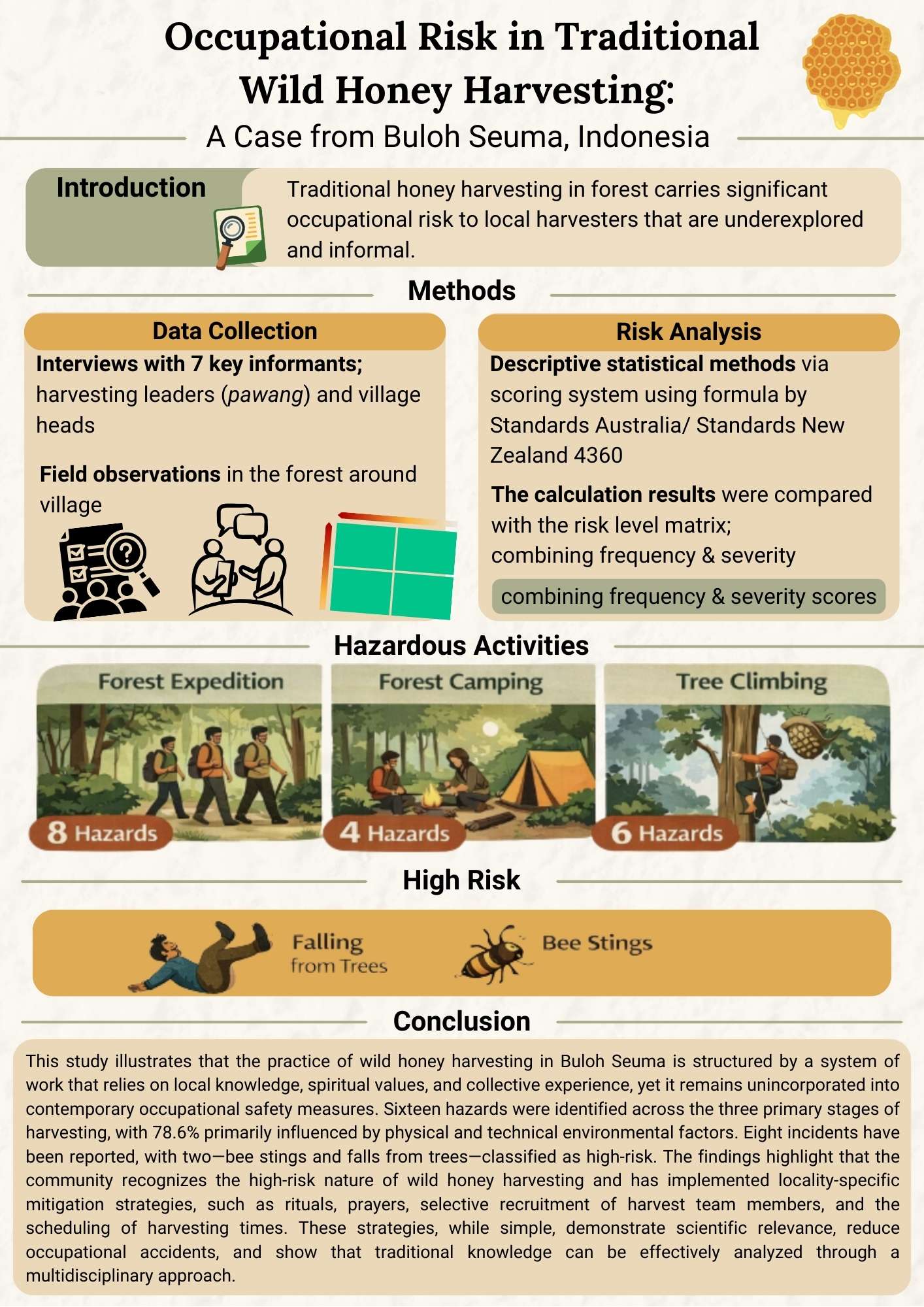
Wild honey harvesting represents a traditional method of utilizing non-timber forest products within the Rawa Singkil Wildlife Reserve, a practice that has been transmitted through generations in Buloh Seuma, Indonesia. In contrast to industrial timber harvesting, there is a lack of research on occupational safety in traditional forestry practices, particularly within wildlife reserves. This research has the objective to identify hazard sources and evaluate the risk level associated with traditional wild honey harvesting in Buloh Seuma. A qualitative methodology was employed, involving in-depth interviews with seven key informants, including pawang (honey harvesting leaders) and village heads, alongside field observations. The risk analysis utilized a semi-quantitative matrix that integrates frequency and severity scores, following a statistical-descriptive methodology. Findings reveal three significant activity stages associated with hazard potentials: forest expedition (8 sources), forest camping (4 sources), and tree climbing (6 sources). In Buloh Seuma, eight hazards have been identified, with two—falling from trees and bee stings—designated as high-risk. The local community exhibits adaptive capacity in mitigating these hazards; however, existing practices are predominantly intuitive and informal. The findings underscore the necessity of formulating context-specific and safer adaptive strategies for wild honey harvesters in Buloh Seuma.
Full text article
References
Chartered Quality Institute. (2018). ISO 45001:2018. Understanding the international standard. London: Chartered Quality Institute.
Deori, B. B., Deb, P., Singha, H., & Choudhury, M. R. (2016). Traditional honey harvesting by the Pnar community of South Assam, India. Our Nature, 14(1), 13–21.
Dhuhri, S., Agustina, L. F., & Fauziyah, N. K. (2024). Peusijuek indigenous psychotherapy: Being oneness to nature in God’s acceptance. Journal of Contemporary Islam and Muslim Societies, 8(2), 220–245. https://doi.org/10.30821/jcims.v8i2.21989
Douglas, M., & Wildavsky, A. (1082). Risk and culture. California: University of California Press.
Fiantika, F. R., Wasil, M., Jumiyati, S., Honesti, L., Wahyuni, S., Mouw, E., Jonata, Mashudi, I., Hasanah, N., Maharani, A., Ambarwati, K., Noflidaputri, R., Nuryami, & Waris, L. (2022). Metodologi penelitian kualitatif. Padang: PT. Global Eksekutif Teknologi.
Gardinia, G., Setyaningsih, Y., & Wahyuni, I. (2024). Hubungan karakteristik individu, safety sign, kondisi APD, dan pengawasan dengan penggunaan APD Depo Lokomotif Semarang Poncol. Jurnal Kesehatan Masyarakat Indonesia, 19(4), 17–23.
Garland, J. (2018). Accident reporting and analysis in forestry: Guidance on increasing the safety of forest work (Forestry Working Paper No. 2). Rome: FAO.
Garland, J., Cedergren, J., Eliasson, L., van Hensbergen, H., McEwan, A., & Wästerlund, D. (2020). Occupational safety and health in forest harvesting and silviculture–A compendium for practitioners and instructors (Forestry Working Paper No. 14). Rome: FAO. https://doi.org/10.4060/ca8773en
Gufran, M., & Amrillah, M. (2022). Transcendental communication between man and God in prayer services: Harold Lasswell's perspective. Jurnal Komunikasi dan Pengembangan Masyarakat Islam, 22(2), 201–218. https://doi.org/10.20414/tasamuh.v20i1.4889
Hamza, M., Eriksson, K., & Staupe-Delgado, R. (2021). Locating potential sources of capacity and vulnerability in geographically remote areas: Reflections based on three case studies. International Journal of Disaster Risk Reduction, 63, Article 102433. https://doi.org/10.1016/j.ijdrr.2021.102433
Hardin. (2016). Komunikasi transendental dalam ritual Kapontasu pada sistem perladangan masyarakat etnik Muna. Jurnal Penelitian Komunikasi dan Opini Publik, 20(1), 63–82.
Häring, I. (2015). Event analysis: Initial situation and hazard source. In Risk analysis and management: Engineering resilience (pp. 91–113). Springer. https://doi.org/10.1007/978-981-10-0015-7_5
Haris, Y. S., Syarqowi, M., & Hafiz, A. (2025). Kajian neuropsikologi: Dampak pola pikir positif terhadap kesehatan fisik dan mental dalam perspektif neurosains. Jurnal Pendidikan Multidisipliner, 1(4), 180–190.
Harrington, M. J. (2021). Forestry–Integrating safety in a time of rapid change. Journal of Agromedicine, 26(1), 88–91. https://doi.org/10.1080/1059924X.2021.1849294
Heinrich, R. (2011). Harvesting of non-wood forest products. In ILO encyclopedia of occupational safety and health. International Labour Organization. Retrieved from http://www.ilocis.org/documents/chpt68e.htm
Hermaliza, E., Manan, A., Fariani, Kodrat, & Adami. (2022). Tradisi mengambil madu lebah Buloh Seuma. Banda Aceh: Balai Pelestarian Nilai Budaya Provinsi Aceh.
Hinze, A., Bowen, J., & König, J. L. (2022). Wearable technology for hazardous remote environments: Smart shirt and rugged IoT network for forestry worker health. Smart Health, 23, Article 100225. https://doi.org/10.1016/j.smhl.2021.100225
International Labour Organization. (2025). Keselamatan dan kesehatan kerja di sektor kehutanan. Jakarta: ILO Indonesia.
Klun, J., & Medved, M. (2007). Fatal accidents in forestry in some European countries. Croatian Journal of Forest Engineering, 28(1), 55–62.
Kustianto, D. C., Faridha, M., Pratama, G. E. W., Karim, S., & Irfan. (2023). Pemanfaatan PLTMH sebagai penerangan jembatan gantung di air terjun Bajuin Kabupaten Tanah Laut. Jurnal Pengabdian Al-Ikhlas Universitas Islam Kalimantan Muhammad Arsyad Al Banjary, 9(1), 73–78. https://doi.org/10.31602/jpaiuniska.v9i1.12069
Lenaini, I. (2021). Teknik pengambilan sampel purposive dan snowball sampling. Historis, 6(1), 33–39.
Madhubhashini, G. T. (2022). The use of traditional forms of communication for honey gathering in rural Sri Lanka. International Journal of Media and Communication Research, 3(1), 1–9.
Matindas, F. P., Suling, P. L., & Niode, N. J. (2022). Skin manifestations due to arthropod bites and stings. E-CliniC, 10(1), 78–83. https://doi.org/10.35790/ecl.v10i1.37601
Nainggolan, R., Ramadhan, R. M., & Lubis, F. M. (2025). Pengaruh penerapan K3 (kesehatan keselamatan kerja) dalam produksi makanan di perusahaan Indonesia. Jurnal Multidisiplin West Science, 4(1), 1–7.
National Institute for Occupational Safety and Health. (2024). About hierarchy of controls. Centers for Disease Control and Prevention. Retrieved from https://www.cdc.gov/niosh/hierarchy-of-controls/about/#.4
Newing, H., Eagle, C. M., Puri, R. K., & Watson, C. W. (2011). Conducting research in conservation. New York: Routledge, Taylor & Francis Group.
Nurfajriani, W. V., Ilhami, M. W., Mahendra, A., Sirodj, R. A., & Afgani, M. W. (2024). Triangulasi data dalam analisis data kualitatif. Jurnal Ilmiah Wahana Pendidikan, 10(17), 826–833. https://doi.org/10.5281/zenodo.13929272
Nurrochmat, D. R., Dharmawan, A. H., Obidzinski, K., Dermawan, A., & Erbaugh, J. T. (2016). Contesting national and international forest regimes: Case of timber legality certification for community forests in Central Java, Indonesia. Forest Policy and Economics, 68, 54–64. https://doi.org/10.1016/j.forpol.2014.09.008
Nurrochmat, D. R., Yovi, E. Y., Hadiyati, O., Sidiq, M., & Erbaugh, J. T. (2015). Changing policies over timber supply and its potential impacts to the furniture industries of Jepara, Indonesia. Jurnal Manajemen Hutan Tropika, 21(1), 36–44. https://doi.org/10.7226/jtfm.21.1.36
Özbakır, O. (2023). Risk perception and occupational health and safety: Evaluation in national and global context. Journal of Natural & Applied Sciences of East, 6(2), 11–23. https://doi.org/10.57244/dfbd.1347259
Pattikawa, R. H., Lamerkabel, J. S. A., & Hasinu, J. V. (2023). Sebaran dan karakter morfologi lebah madu hutan Apis dorsata (F.) di Pulau Sermata Kabupaten Maluku Barat Daya. Jurnal Agrosilvopasture-Tech, 2(2), 394–402. https://doi.org/10.30598/j.agrosilvopasture-tech.2023.2.2.394
Pecyna, A., Buczaj, A., Lachowski, S., Choina, P., Goździewska, M., & Galińska, E. M. (2019). Occupational hazards in opinions of forestry employees in Poland. Annals of Agricultural and Environmental Medicine, 26(2), 242–248. https://doi.org/10.26444/aaem/106246
Purnaya, A., Andriani, M., & Zeki, M. (2025). Analisis risiko bahaya untuk menghindari kecelakaan kerja dengan menggunakan metode HIRADC (Studi kasus: PT Perkebunan Nusantara I). Jurnal Senopati, 6(2), 82–91.
Putra, F. D., Yovi, E. Y., & Kuncahyo, B. (2024). Heat-resilient workforce: Unveiling the relationships between heat-related knowledge, risk perception, and precautionary behavior in Indonesian pine forest workers. European Journal of Forest Engineering, 10(1), 67–77. https://doi.org/10.33904/ejfe.1374811
Rahmi, T. (2018). Suaka Margasatwa Rawa Singkil: Little Amazon in Aceh (Sofyan H., Ed.). Banda Aceh: Balai Konservasi Sumber Daya Alam Aceh.
Reason, J. (2000). Human error: Models and management. Education and Debate, 320, 768–770.
Santriyana, N., Dwimawati, E., & Listyandini, R. (2023). Faktor-faktor yang berhubungan dengan kelelahan kerja pada pekerja pembuat bolu talas Kujang di home industry Kelurahan Bubulak tahun 2022. PROMOTOR: Jurnal Mahasiswa Kesehatan Masyarakat, 6(4), 370–377. https://doi.org/10.32832/pro.v6i4.273
Schouten, C., Lloyd, D., Asharyani, I., Salminah, M., Somerville, D., & Stimpson, K. (2019). The role of honey hunting in supporting subsistence livelihoods in Sumbawa, Indonesia. Geographical Research, 58(1), 64–76. https://doi.org/10.1111/1745-5871.12380
Sefrina, L. R. (2021). Dampak pekerjaan shift malam pada kesehatan kerja. Jurnal Gizi Kerja dan Produktivitas, 2(2), 86–92. https://doi.org/10.52742/jgkp.v2i2.10408
Sofi, B. M. (2015). Penilaian tingkat risiko kegiatan polisi hutan di Taman Nasional Berbak, Jambi [undergraduate thesis]. Bogor: IPB University.
Standards Australia/Standards New Zealand. (2004). AS/NZS 4360:2004 Risk management. Standards Australia International Ltd and Standards New Zealand.
Sunkar, A., Lakspriyanti, A. P., Haryono, E., Brahmi, M., Setiawan, P., & Jaya, A. F. (2022). Geotourism hazards and carrying capacity in geosites of Sangkulirang-Mangkalihat Karst, Indonesia. Sustainability, 14, Article 1704. https://doi.org/10.3390/su14031704
Ting, H., Memon, M. A., Thurasamy, R., & Cheah, J. -H. (2025). Snowball sampling: A review and guidelines for survey research. Asian Journal of Business Research, 15(1), Article 86. https://doi.org/10.14707/ajbr.250186
Topal, E., Saner, G., Yücel, B., Strant, M., Üçeş, E., Olgun, T., & Şengül, Z. (2019). An evaluation on beekeeper's health risk and some other risk factors in beekeeping farms: A case of Izmir-Turkey. Turkish Journal of Agricultural Economics, 25(2), 149–159. https://doi.org/10.24181/tarekoder.584852
van Vliet, N., Massé, F., Muhindo, J., Nyumu, J., Mbangale, E., & Shepard, S. (2024). Wild animal attacks and other occupational risks perceived by indigenous hunters and fishers in the Yangambi landscape. Human Dimensions of Wildlife, 30(5), 586–599. https://doi.org/10.1080/10871209.2024.2394595
van der Wal, J. E. M., Gedi, I. I., & Spottiswoode, C. N. (2022). Awer honey-hunting culture with greater honeyguides in coastal Kenya. Frontiers in Conservation Science, 2, Article 727479. https://doi.org/10.3389/fcosc.2021.727479
Winahyu, N., Amirudin, F., & Azizah, I. N. (2021). Analisis pemasaran lebah madu klanceng (Trigona sp.) di Kecamatan Pagerwojo Kabupaten Tulungagung pada masa pandemi Covid-19. Jurnal Agribest, 5(1), 25–33. https://doi.org/10.32528/agribest.v5i1.4198
Young, A. M., Kodabalagi, S., Brockmann, A., & Dyer, F. C. (2021). A hard day’s night: Patterns in the diurnal and nocturnal foraging behavior of Apis dorsata across lunar cycles and seasons. PLoS ONE, 16(10), e0258604. https://doi.org/10.1371/journal.pone.0258604
Yovi, E. Y., Yamada, Y., Zaini, M. F., Kusumadewi, C. A. Y., & Marisiana, L. (2016). Improving the OSH knowledge of Indonesian forestry workers by using safety game application: Tree felling supervisors and operators. Jurnal Manajemen Hutan Tropika, 22(1), 75–83. https://doi.org/10.7226/jtfm.22.1.75
Yovi, E. Y. (2019). Status ergonomi pekerja sektor kehutanan di Indonesia: Kelelahasn fisik-mental-sosial, kepuasan kerja, konsep sumber bahaya, dan konsep biaya kecelakaan. Journal of Forest Science, 13, 137–150
Yovi, E. Y., & Yamada, Y. (2019). Addressing occupational ergonomics issues in Indonesian forestry: Laborers, operators, or equivalent workers. Croatian Journal of Forest Engineering, 40(2), 351–363. https://doi.org/10.5552/crojfe.2019.558
Yovi, E. Y., Abbas, D., & Takahashi, T. (2021). Safety climate and risk perception of forestry workers: A case study of motor-manual tree felling in Indonesia. International Journal of Occupational Safety and Ergonomics, 28(4), 2193–2201. https://doi.org/10.1080/10803548.2021.1986306
Yovi, E. Y., Nastiti, A., & Kuncahyo, B. (2023). Heat-related knowledge, risk perception, and precautionary behavior among Indonesian forestry workers and farmers: Implications for occupational health promotion in the face of climate change impacts. Forest, 14, Article 1455. https://doi.org/10.3390/f14071455
Authors
Copyright (c) 2026 Jurnal Manajemen Hutan Tropika

This work is licensed under a Creative Commons Attribution 4.0 International License.
Jurnal Manajemen Hutan Tropika is an open access journal which means that all contents is freely available without charge to the user or his/her institution. Users are allowed to read, download, copy, distribute, print, search, or link to the full texts of the articles in this journal without asking prior permission from the publisher or the author. This is in accordance with the Budapest Open Access Initiative (BOAI) definition of open access.Article Details
How to Cite



