
Tree Collateral Loan as a Sustainable Financing Instrument: Evidence from Smallholders’ Livelihood Changes in Gunungkidul, Indonesia

Article Sidebar
-
forestry microcredit, smallholder forestry, sustainable livelihood capitals, propensity score matching, forest policy impacts
Abstract
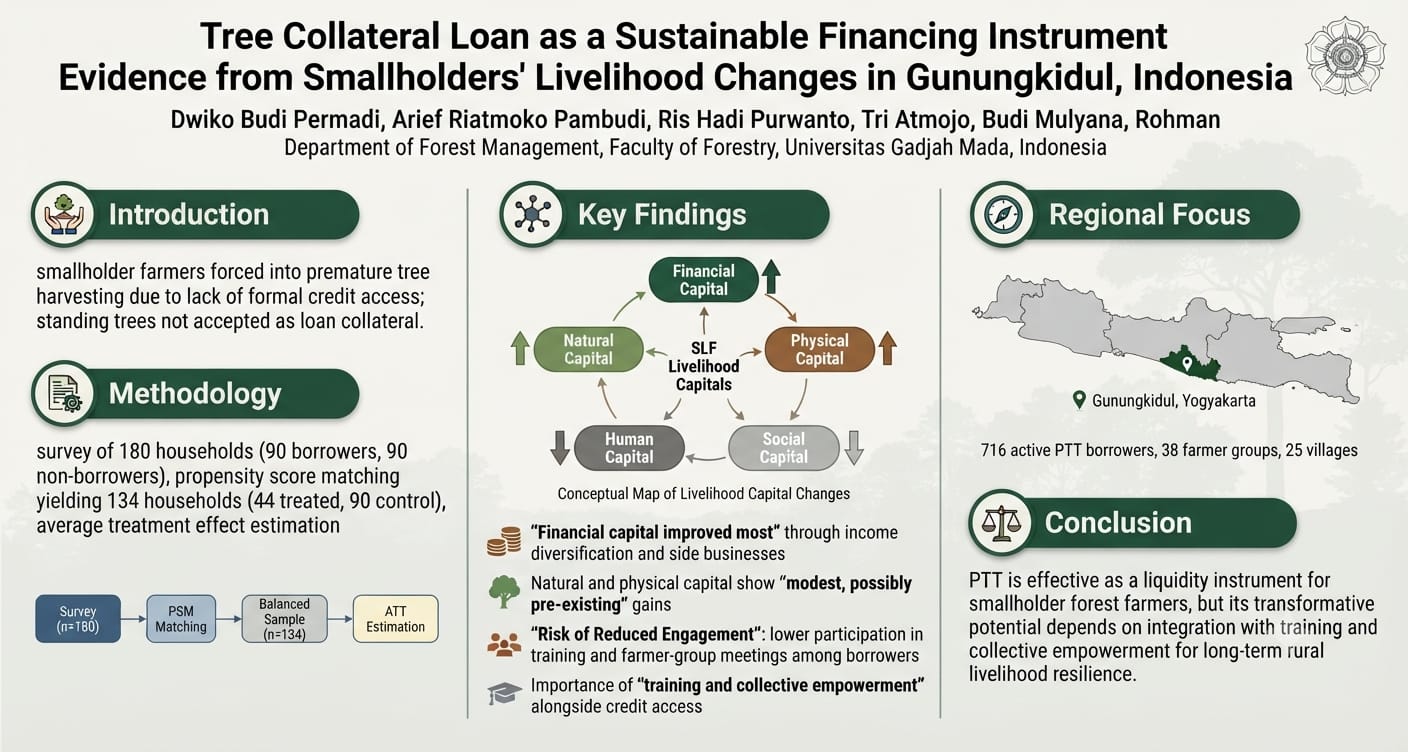
Tree-collateral loans have been introduced in Indonesia to ease liquidity constraints faced by smallholder forest farmers, who often resort to premature harvesting. This study evaluates the impacts of the forestry microcredit called pinjaman tunda tebang (PTT) scheme on household livelihood assets in Gunungkidul District, Yogyakarta. Data were collected from a survey of 180 households (90 borrowers and 90 non-borrowers). To reduce selection bias, propensity score matching was applied, yielding a balanced sample of 134 households (44 borrowers and 90 controls). The average treatment effect on the treated was then estimated across ten indicators representing financial, physical, human, social, and natural capitals. Results show that financial capital improved most, with borrowers more likely to diversify income, operate side businesses, and fall into higher monthly-income brackets. Natural and physical capitals showed modest differences, including larger forestland and higher-perceived infrastructure access, but these may reflect pre-existing assets rather than causal program impacts. By contrast, human and social capital were weaker, with borrowers participating less in training, reporting lower technical adequacy, and engaging less in farmer-group meetings. These findings highlight that while PTT is effective as a liquidity instrument, its transformative potential depends on integration with training and collective empowerment. For broader impact, rural microcredit must be coupled with extension services and group strengthening to align financial access with long-term rural livelihood resilience.
Full text article
References
Abadie, A., & Cattaneo, M. D. (2018). Econometric methods for program evaluation. Annual Review of Economics, 10(1), 465–503. https://doi.org/10.1146/annurev-economics-080217-053402
Angrist, J. D., & Pischke, J. -S. (2008). Mostly harmless econometrics. Princeton University Press. https://doi.org/10.2307/j.ctvcm4j72
Armendáriz, B., & Morduch, J. (2010). The economics of microfinance. MIT Press.
Austin, P. C. (2009). Balance diagnostics for comparing the distribution of baseline covariates between treatment groups in propensity‐score matched samples. Statistics in Medicine, 28(25), 3083–3107. https://doi.org/10.1002/sim.3697
Austin, P. C., & Stuart, E. A. (2015). Moving towards best practice when using inverse probability of treatment weighting (IPTW) using the propensity score to estimate causal treatment effects in observational studies. Statistics in Medicine, 34(28), 3661–3679. https://doi.org/10.1002/sim.6607
Banerjee, A. V., & Duflo, E. (2011). Poor economics: A radical rethinking of the way to fight global poverty. New York: Public Affairs.
Becker, S. O., & Ichino, A. (2002). Estimation of average treatment effects based on propensity scores. The Stata Journal: Promoting Communications on Statistics and Stata, 2(4), 358–377. https://doi.org/10.1177/1536867X0200200403
Carney, D. (1999). Livelihoods approaches compared: A brief comparison of the livelihoods approaches of the UK Department for International Development (DFID), CARE, Oxfam and the United Nations Development Programme (UNDP). London: Department for International Development.
Delvion, B. A., Permadi, D. B., & Marhaento, H. (2025). Fostering sustainable livelihood of the Saga indigenous community through conservation partnership in Kelimutu National Park, Nusa Tenggara Timur. Jurnal Wasian, 10(02), 18–24. https://doi.org/10.62142/esswj444
Department for International Development. (1999). Sustainable livelihoods guidance sheets. Department for International Development.
Ellis, F. (2000). Rural livelihoods and diversity in developing countries. Oxford University Press. https://doi.org/10.1093/oso/9780198296959.001.0001
Feder, G., Murgai, R., & Quizon, J. B. (2004). Sending Farmers Back to School: The Impact of Farmer Field Schools in Indonesia. Review of Agricultural Economics, 26(1), 45–62. https://doi.org/10.1111/j.1467-9353.2003.00161.x
Greenhill, M., Walker, I., Mendham, D., & Permadi, D. (2017). West Kalimantan industrial plantation scheme: Twenty years on. Forests, Trees and Livelihoods, 26(4), 215–228. https://doi.org/10.1080/14728028.2017.1320238
Hailemicheal, H. G., Senbeta, F., Tefera, T., & Seyoum, A. (2024). Rural household livelihood strategy, household reliance on forest goods, and its effect on protected area: Evidence from communities living adjacent to Kafta-Sheraro National Park, Tigray, Northern Ethiopia. Journal of Agriculture and Food Research, 17, Article 101233. https://doi.org/10.1016/j.jafr.2024.101233
Kugler, M., & Oppes, R. (2005). Collateral and risk sharing in group lending: Evidence from an urban microcredit program.
Listiyawan, D., Syaukat, Y., & Falatehan, A. F. (2022). Pola pengelolaan hutan rakyat melalui program pinjaman tunda tebang di Kabupaten Wonogiri, Provinsi Jawa Tengah. Forum Agribisnis, 12(1), 60–75. https://doi.org/10.29244/fagb.12.1.60-75
Lusiya, D. H., Darusman, D., & Nuryartono, N. (2020). Implementasi pinjaman tunda tebang hutan rakyat di Kabupaten Blora dan Kabupaten Wonosobo, Provinsi Jawa Tengah. Jurnal Penelitian Sosial dan Ekonomi Kehutanan, 17(2), 117–135. https://doi.org/10.20886/jpsek.2020.17.2.117-135
Ma, L., Zhang, Y., Li, T., Zhao, S., & Yi, J. (2024). Livelihood capitals and livelihood resilience: Understanding the linkages in China’s government-led poverty alleviation resettlement. Habitat International, 147, Article 103057. https://doi.org/10.1016/j.habitatint.2024.103057
Meager, R. (2019). Understanding the average impact of microcredit expansions: A Bayesian hierarchical analysis of seven randomized experiments. American Economic Journal: Applied Economics, 11(1), 5791.
Naderifar, M., Goli, H., & Ghaljaie, F. (2017). Snowball sampling: A purposeful method of sampling in qualitative research. Strides in Development of Medical Education, 14(3), Article e67670. https://doi.org/10.5812/sdme.67670
Natarajan, N., Newsham, A., Rigg, J., & Suhardiman, D. (2022). A sustainable livelihoods framework for the 21st century. World Development, 155, Article 105898. https://doi.org/10.1016/j.worlddev.2022.105898
Nugroho, B., Soedomo, S., & Dermawan, A. (2017). Policy effectiveness of loan for delaying timber harvesting for smallholder private forest in Indonesia. Jurnal Manajemen Hutan Tropika, 23(2), 61–70. https://doi.org/10.7226/jtfm.23.2.61
Nugroho, E., Ihle, R., Heijman, W., & Oosting, S. J. (2022). The contribution of forest extraction to income diversification and poverty alleviation for Indonesian smallholder cattle breeders. Small-Scale Forestry, 21(3), 417–435. https://doi.org/10.1007/s11842-022-09504-0
Oktoyoki, H., Windari, E. H., Pratama, B., & Ansiska, P. (2023). Post-permit social forestry: An analysis of the economic impact of the forestry revolving fund facility to the community of forest farmers. E3S Web of Conferences, 373, Article 05007. https://doi.org/10.1051/e3sconf/202337305007
Pambudi, A.R. (2025). Kontribusi Pinjaman Tunda Tebang Terhadap Peningkatan Aset Penghidupan Petani dan Serapan Karbon Hutan Rakyat di Kabupaten Gunungkidul D. I. Yogyakarta. Tesis. Fakultas Kehutanan UGM.
Pouliquen, L. Y. (1999). Rural infrastructure from a World Bank perspective: A knowledge management framework. World Bank Publications. Retrieved from http://documents.worldbank.org/curated/en/160821468740106506
Resosudarmo, I. A. P., Tacconi, L., Sloan, S., Hamdani, F. A. U., Subarudi, Alviya, I., & Muttaqin, M. Z. (2019). Indonesia’s land reform: Implications for local livelihoods and climate change. Forest Policy and Economics, 108, Article 101903. https://doi.org/10.1016/j.forpol.2019.04.007
Rosenbaum, P. R., & Rubin, D. B. (1983). The central role of the propensity score in observational studies for causal effects. Biometrika, 70(1), 41–55. https://doi.org/10.1093/biomet/70.1.41
Scoones, I. (1998). Sustainable rural livelihoods: A framework for analysis. IDS Working Paper, 72. Institute of Development Studies.
Scoones, I. (2009). The politics of global assessments: the case of the International Assessment of Agricultural Knowledge, Science and Technology for Development (IAASTD). The Journal of Peasant Studies, 36(3), 547–571. https://doi.org/10.1080/03066150903155008
Starfinger, M. (2021). Financing smallholder tree planting: Tree collateral & Thai ‘Tree Banks’–Collateral 2.0? Land Use Policy, 111, Article 105765. https://doi.org/10.1016/j.landusepol.2021.105765
Starfinger, M., Tham, L. T., & Tegegne, Y. T. (2023). Tree collateral–A finance blind spot for small-scale forestry? A realist synthesis review. Forest Policy and Economics, 147, Article 102886. https://doi.org/10.1016/j.forpol.2022.102886
Stuart, E. A. (2010). Matching methods for causal inference: A review and a look forward. Statistical Science, 25(1), 121. https://doi.org/10.1214/09-STS313
Syamsu, I. F., Hardjanto, & Hero, Y. (2019). Delaying timber harvesting loan for smallholder private forest: Who accessing it? (Case study: Smallholder private forest in Bojonegoro). Jurnal Pengelolaan Sumberdaya Alam dan Lingkungan, 9(1), 114–127. https://doi.org/10.29244/jpsl.9.1.114-127
Tahmasebi, A., & Askaribezayeh, F. (2021). Microfinance and social capital formation- a social network analysis approach. Socio-Economic Planning Sciences, 76, Article 100978. https://doi.org/10.1016/j.seps.2020.100978
Tran, D. B., Tran, H. T. M., Pham, T. D. N., & Nguyen, T. T. (2023). Education and agricultural household income: Comparative evidence from Vietnam and Thailand. World Development Perspectives, 29, Article 100489. https://doi.org/10.1016/j.wdp.2023.100489
van Toan, D., Dinh Nghiep, N., & van Huan, N. (2021). The impacts of microfinance activities in developing human capital for sustainable livelihood in Duc Trong District, Lam Dong Province, Vietnam. International Journal of Sustainable Development Research, 7(4), 7684. https://doi.org/10.11648/j.ijsdr.20210704.12
Yamane, T. (1973). Statistic: An introductory analysis. Harper & Row.
Zhao, Y., & Li, M. (2020). Effect of water-saving society policy on water consumption in the cities of China: A propensity score matching analysis. International Journal of Environmental Research and Public Health, 17(21), Article 8171. https://doi.org/10.3390/ijerph17218171
Authors
Copyright (c) 2026 Jurnal Manajemen Hutan Tropika

This work is licensed under a Creative Commons Attribution 4.0 International License.
Jurnal Manajemen Hutan Tropika is an open access journal which means that all contents is freely available without charge to the user or his/her institution. Users are allowed to read, download, copy, distribute, print, search, or link to the full texts of the articles in this journal without asking prior permission from the publisher or the author. This is in accordance with the Budapest Open Access Initiative (BOAI) definition of open access.Article Details
How to Cite



