
Species Diversity and Ecological Characteristics of Secondary Forests in North Luwu, South Sulawesi, Indonesia

Article Sidebar
-
secondary forest, succession, Wallacea, diversity, pioneer species
Abstract
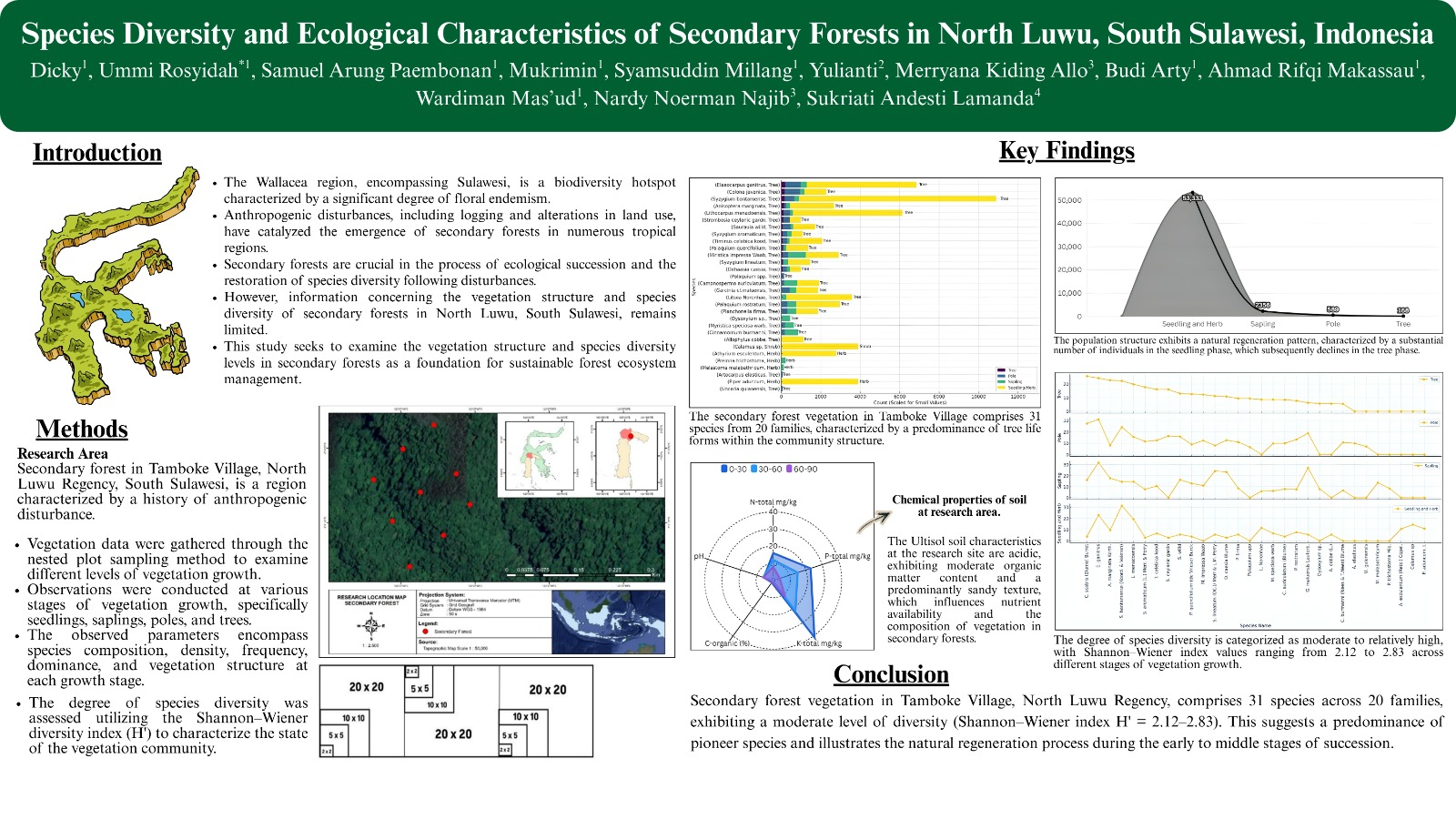
Sulawesi, as part of the Wallacea biogeographical region, has high biodiversity and endemism due to geological processes and unique local environmental conditions. Secondary forests in North Luwu Regency, South Sulawesi, developed after forest exploitation, especially since the 1970s, and are dominated by pioneer species such as Melastoma malabathricum and Colona scabra. This study aims to identify species diversity and ecological characteristics of secondary forest vegetation in Tamboke Village, using a multi-level plot measurement method (seedlings, stakes, poles, trees) and analyzing diversity indices, evenness, species richness, species association, and ecological characteristics, including soil and the composition of climax and pioneer species. The results show a plant community structure that reflects the early succession phase, with a dominance of trees with a trunk diameter of < 30 cm and moderate species diversity (Shannon-Wiener index 1–3). The evenness and species richness indices reinforce the community profile with a dominant presence of pioneer species and indications of biodiversity degradation. Species association analysis revealed diverse interactions between species with varying association strengths. Vegetation patterns are associated with Ultisol soils, which are predominantly acidic in pH, sandy, and have moderate organic matter content, influencing species composition, regeneration processes, and successional dynamics. This study provides an important ecological basis for sustainable forest management and restoration strategies in secondary forest areas to support biodiversity conservation and climate change mitigation.
Full text article
References
Amran, A. N., Noor, N. N. M., & Mohamed, F. (2023). Micromorphological analyses of stomata and epidermal cell among different species in the genus Premna L. (Lamiaceae). Malaysian Journal of Microscopy, 19(1), 319–332.
Binkley, D., & Fisher, R. F. (2019). Ecology and management of forest soils. John Wiley & Sons.
Badan Pusat Statistik Kabupaten Luwu Utara. (2021). Luwu Utara Regency in figures in 2021. Retrieved from https://luwuutarakab.bps.go.id/en
Badan Pusat Statistik Kabupaten Luwu Utara. (2023). Luwu Utara Regency in figures in 2023. Retrieved from https://luwuutarakab.bps.go.id/en
Brink, M., & Escobin, R. P. (Eds.). (2003). Plant resources of South-East Asia No. 17. Fiber plants. Leiden: Backhuys Publishers.
Culmsee, H., Pitopang, R., Mangopo, H., & Sabir, S. (2011). Tree diversity and phytogeographical patterns of tropical high mountain rain forests in Central Sulawesi, Indonesia. Biodiversity and Conservation, 20(5), 1103–1123. https://doi.org/10.1007/s10531-011-0019-y
Cvetković, T., Hinsinger, D. D., Thomas, D. C., Wieringa, J. J., Velautham, E., & Strijk, J. S. (2022). Phylogenomics and a revised tribal classification of subfamily Dipterocarpoideae (Dipterocarpaceae). Taxon, 71(1), 85–102. https://doi.org/10.1002/tax.12648
Dani, D. P., Suleman, S. M., & Febriawan, A. (2024). The relationship of terrestrial fern species (Pteridophyta) at Salodik Waterfall Central Sulawesi based on morphological characteristics. Jurnal Biologi Tropis, 24(2), 106–112. https://doi.org/10.29303/jbt.v24i2.6714
Deng, C., Huang, Z., Zhang, X., Zhao, H., Jiang, S., & Ren, Y. (2022). Correlation between vegetation structure and species diversity in traditional villages in karst topographic regions of the Zunyi City, China. Plants, 11(22), Article 3161. https://doi.org/10.3390/plants11223161
Dharma, W., & Zakaria, R. (2022). Vegetation analysis of 10 urban forests in the city of Banda Aceh, Indonesia. Biodiversitas, 23(8), 4131–4137. https://doi.org/10.13057/biodiv/d230834
Engel, T., Bruelheide, H., Hoss, D., Sabatini, F. M., Altman, J., Arfin-Khan, M. A. S., Bergmeier, E., Černý, T., Chytrý, M., Dainese, M., Dengler, J., Dolezal, J., Field, R., Fischer, F. M., Huygens, D., Jandt, U., Jansen, F., Jentsch, A., Karger, D. N., …, & Pillar, V. (2023). Traits of dominant plant species drive normalized difference vegetation index in grasslands globally. Global Ecology and Biogeography, 32(5), 695–706. https://doi.org/10.1111/geb.13644
Götzenberger, L., de Bello, F., Bråthen, K. A., Davison, J., Dubuis, A., Guisan, A., Lepš, J., Lindborg, R., Moora, M., Pärtel, M., Pellissier, L., Pottier, J., Vittoz, P., Zobel, K., & Zobel, M. (2012). Ecological assembly rules in plant communities-approaches, patterns and prospects. Biological Reviews, 87(1), 111–127. https://doi.org/10.1111/j.1469-185X.2011.00187.x
Greig-Smith, P. (1983). Quantitative plant ecology. Oxford: Blackwell Scientific Publications.
Hamilton, R., & Stevenson, J. (2020). The challenge of the enigmatic tricolporate tropical pollen type: A case study from Sulawesi, Indonesia. Review of Palaeobotany and Palynology, 273, Article 104146. https://doi.org/10.1016/j.revpalbo.2019.104146
Hartoyo, A. P. P., Karlinasari, L., Setiajiati, F., Wijayanto, A. K., Rifana, H. Z., Madani, H. N., Satriawan, H., Rahmawati, R., & Siregar, U. J. (2025). Estimating vegetation density dynamics, tree diversity, and carbon stock in the agroforestry system of the community forest in Bogor Regency, Indonesia. Jurnal Sylva Lestari, 13(1), 120144. https://doi.org/10.23960/jsl.v13i1.989
Hati, D. P., Erwinda, E., Pratamaningsih, M. M., & Mulyani, A. (2023). Land resource-based cocoa development potential in North Luwu District, South Sulawesi Province, Indonesia. IOP Conference Series: Earth and Environmental Science, 1266, Article 012095. https://doi.org/10.1088/1755-1315/1266/1/012095
Helmanto, H., Siregar, M., Rahmawati, S. U., & Sahrudin, U. (2021). Exploration of plant diversity at the forest patches in North Sulawesi and their conservation strategy. IOP Conference Series: Earth and Environmental Science, 948, Article 012048. https://doi.org/10.1088/1755-1315/948/1/012048
Holl, K. D., & Aide, T. M. (2011). When and where to actively restore ecosystems? Forest Ecology and Management, 261, 1558–1563. https://doi.org/10.1016/j.foreco.2010.07.004
Irawan, A., Peniwidiyanti, Ainurrofiah, Destrianto, H., Kusumah, M., & Apriandana, V. (2023). Floristic composition and structure of vegetation in Gunung Salak Geothermal Power Plant, West Java, Indonesia. Reinwardtia, 22(1), 37–53. https://doi.org/10.55981/reinwardtia.2023.4565
Karim, H. A., & Ahmad, A. (2019). Potensi dan model pengembangan spesies tumbuhan di Hutan Lindung Sarambu Alla Kabupaten Luwu Utara. Jurnal Penelitian Kehutanan BONITA, 1(1), 34–41. https://doi.org/10.55285/bonita.v1i1.208
Karim, H. A., & Akmal, A. (2019). Eksplorasi dan identifikasi jenis tumbuhan di Cagar Alam Kalaena Kabupaten Luwu Timur Sulawesi Selatan. Journal TABARO Agriculture Science, 3(1), 295–304. https://doi.org/10.35914/tabaro.v3i1.199
Karim, H. A., Asrianny, Witno, & Tiara. (2021). Association of dominated tree species in secondary pamah forest of Ponda-Ponda Nature Reserve, South Sulawesi, Indonesia. IOP Conference Series: Earth and Environmental Science, 886, Article 012012. https://doi.org/10.1088/1755-1315/886/1/012012
Kessler, M., Keßler, P. J. A., Gradstein, S. R., Bach, K., Shmull, M, & Pitopang, R. (2005). Tree diversity in primary forest and different land use systems in Central Sulawesi, Indonesia. Biodiversity & Conservation, 14, 547–560. https://doi.org/10.1007/s10531-004-3914-7
Land System Indonesia. (2024). Ina-LandSystem. Retrieved from https://inaland.big.go.id/
Lee, T. M., Sodhi, N. S., & Prawiradilaga, D. M. (2007). The importance of protected areas for the forest and endemic avifauna of Sulawesi (Indonesia). Ecological Applications, 17(6), 1727–1741. https://doi.org/10.1890/06-1256.1
Li, R., Yan, Q., Xie, J., Wang, J., Zhang, T., & Zhu, J. (2022). Effects of logging on the trade-off between seed and sprout regeneration of dominant woody species in secondary forests of the Natural Forest Protection Project of China. Ecological Processes, 11, Article 16. https://doi.org/10.1186/s13717-022-00363-3
Liu, J. (2025). Progress in research on the effects of environmental factors on natural forest regeneration. Frontiers in Forests and Global Change, 8, Article 1525461. https://doi.org/10.3389/ffgc.2025.1525461
Ludwig, J. A., & Reynold, J. F. (1998). Statistical ecology: A primer on methods and computing. Wiley-Interscience Pub.
Lutter, R., Tullus, A., Vares, A., Sopp, R., Tullus, T., Kaivapalu, M., Ots, K., Kharel, B., Lundmark, T., & Tullus, H. (2023). Twenty years of afforestation of former agricultural lands with silver birch plantations affects vertical distribution of SOC and macronutrients. Plant and Soil, 482, 385–400. https://doi.org/10.1007/s11104-022-05695-9
Magurran, A. E. (1988). Ecological diversity and its measurements. Princeton University Press.
https://doi.org/10.1007/978-94-015-7358-0
Magurran, A. E. (2004). Measuring biological diversity. Blackwell Publishing.
Mannan, A., Malik, A., & Zhiddiq, S. (2024). Degradasi biodiversitas Wallacea: Tantangan ekologi dan kebutuhan ekonomi. Jurnal Environmental Science, 6(2), 3653. https://doi.org/10.35580/jes.v6i2.60931
Marwa, J., Ungirwalu, A., Imburi, C. S., Murdjoko, A., & Benu, N. M. H. (2024). Ecological perspective to sustainably manage the secondary forest in the lowland of Doberai Peninsula, Indonesia. Biodiversitas, 25(8), 27202732. https://doi.org/10.13057/biodiv/d250845
Mas’ud, W., Maulany, R. I., Putra, P. S., & Ngakan, P. O. (2023). Impacts of edge effects on the invasion of alien plant species in Bantimurung Bulusaraung National Park, Indonesia. Biodiversitas, 24(11), 61606168. https://doi.org/10.13057/biodiv/d241137
Mukharomah, E. (2021). Konsep dasar ekologi tumbuhan. Bening Media Publishing.
Mueller-Dombois, D. & Ellenberg, H. (1974). Aims and methods of vegetation ecology. John Wiley & Sons.
Nanlohy, F. N., Moko, E. M., Ngangi, J., Ngangi, C. M., & Roring, V. I. Y. (2024). Composition and diversity of forestry plant species in forest areas Manado State University, North Sulawesi. Jurnal Penelitian Pendidikan IPA, 10(1), 1218.
Nasution, M. J., Tugiyono, T., Bakri, S., Setiawan, A., Murhadi, M., Wulandari, C., & Wahono, E. P. (2024). The impact of increasing nickel production on forest and environment in Indonesia: A review. Jurnal Sylva Lestari, 12(3), 549–579. https://doi.org/10.23960/jsl.v12i3.847
Nurdin, M., Tellu, A. T., & Zaenal, S. (2021). Diversity of rattan species in production forest in Central Sulawesi, Indonesia. International Journal of Design & Nature and Ecodynamics, 16(2), 211–218. https://doi.org/10.18280/ijdne.160211
Nurkin, B., Achmad, A., Oka, N. P., Rachman, W., & Paembonan, S. A. (2002). Karakteristik ekologi dan aspek silvikultur eboni (Diospyros celebica Bakh.) Sulawesi Selatan. Berita Biologi, 6(2), 267–275. https://doi.org/10.14203/beritabiologi.v6i2.1493
Nytch, C. J., Rojas-sandoval, J., Oliveras, A. E., Santiago Garcia, R. J., & Meléndez-Ackerman, E. J. (2023). Effects of historical land use and recovery pathways on composition, structure, ecological function, and ecosystem services in a Caribbean secondary forest. Forest Ecology and Management, 546, Article 121311. https://doi.org/10.1016/j.foreco.2023.121311
Paembonan, S. A., Larekeng, S. H., Millang, S., & Meinardus. (2021). The dynamics of physiological properties of ebony (Diospyros celebica Bakh) based on crown position and altitude. IOP Conference Series: Earth and Environmental Science, 807, Article 032016. https://doi.org/10.1088/1755-1315/807/3/032016
Pielou, E. C. (1975). Ecological diversity. John Wiley & Sons.
Priatna, D., Heriyanto, N. M., Samsoedin, I., Supriatno, S., Wiharjo, U., & Laksana, E. (2022). Structure and composition of vegetation and carbon stock calculation in a natural lowland forest of plantation forest landscape. Journal of Tropical Biodiversity, 2(3), 177–196. https://doi.org/10.59689/bio.v2i3.116
Putra, P. S., Yamada, T., Achmad, A., Nasri, N., Hamzah, A. S., & Ngakan, P. O. K. A. (2023). Differences in the vegetation dynamic patterns of three tropical secondary forests in South Sulawesi, Indonesia. Biodiversitas, 24(9), 50655073. https://doi.org/10.13057/biodiv/d240950
Poorter, L., Craven, D., Jakovac, C. C., van Der Sande, M. T., Amissah, L., Bongers, F., Chazdon, R. L., Farrior, C. E., Kambach, S., Meave, J. A., Muñoz, R., Norden, N., Rüger, N., van Breugel, M., Zambrano, A. M. A., Amani, B., Andrade, J. L., Brancalion, P. H. S., Broadbent, E. N., ..., & Hérault, B. (2021). Multidimensional tropical forest recovery. Science, 374(6573), 13701376. https://doi.org/10.1126/science.abh3629
Sharma, S., Hussain, S., Rai, D. V., & Singh, A. N. (2023). A comprehensive analysis on the ecosystem services of Elaeocarpus L. (Elaeocarpaceae): A review. Journal of Phytology, 15, 12–37. https://doi.org/10.25081/jp.2023.v15.8020
Souza, A. F. (2021). A review of the structure and dynamics of araucaria mixed forests in southern Brazil and northern Argentina. New Zealand Journal of Botany, 59(1), 2–54. https://doi.org/10.1080/0028825X.2020.1810712
Supriatna, J., Shekelle, M., Fuad, H. A. H., Winarni, N. L., Dwiyahreni, A. A., Farid, M., Mariati, S., Margules, C., Prakoso, B., & Zakaria, Z. (2020). Deforestation on the Indonesian island of Sulawesi and the loss of primate habitat. Global Ecology and Conservation, 24, Article e01205. https://doi.org/10.1016/j.gecco.2020.e01205
Ulfah, M., Fajri, S. N., Nasir, M., Hamsah, K., & Purnawan, S. (2019). Diversity, evenness and dominance index reef fish in Krueng Raya Water, Aceh Besar. IOP Conference Series: Earth and Environmental Science, 348, Article 012074. https://doi.org/10.1088/1755-1315/348/1/012074
Veddeler, D., Schulze, C. H., Steffan-Dewenter, I., Buchori, D., & Tscharntke, T. (2005). The contribution of tropical secondary forest fragments to the conservation of fruit-feeding butterflies: Effects of isolation and age. Biodiversity and Conservation, 14(14), 3577–3592. https://doi.org/10.1007/s10531-004-0829-2
Vitasse, Y., Baumgarten, F., Zohner, C. M., Kaewthongrach, R., Fu, Y. H., Walde, M. G., & Moser, B. (2021). Impact of microclimatic conditions and resource availability on spring and autumn phenology of temperate tree seedlings. New Phytologist, 232(2), 537–550. https://doi.org/10.1111/nph.17606
Wan, X., Joly, F. X., Jia, H., Zhu, M., Fu, Y., & Huang, Z. (2023). Functional identity drives tree species richness-induced increases in litterfall production and forest floor mass in young tree communities. New Phytologist, 240(3), 1003–1014. https://doi.org/10.1111/nph.19216
Wanger, T. C., Iskandar, D. T., Motzke, I., Brook, B. W., Sodhi, N. S., Clough, Y., & Tscharntke, T. (2010). Effects of land‐use change on community composition of tropical amphibians and reptiles in Sulawesi, Indonesia. Conservation Biology, 24(3), 795–802. https://doi.org/10.1111/j.1523-1739.2009.01434.x
Williams, B. A., Beyer, H. L., Fagan, M. E., Chazdon, R. L., Schmoeller, M., Sprenkle-Hyppolite, S., Griscom, B. W., Watson, J. E. M., Tedesco, A. M., Gonzalez-Roglich, M., Daldegan, G. A., Bodin, B., Celentano, D., Wilson, S. J., Rhodes, J. R., Alexandre, N. S., Kim, D. H., Bastos, D., & Crouzeilles, R. (2024). Global potential for natural regeneration in deforested tropical regions. Nature, 636, 131–137. https://doi.org/10.1038/s41586-024-08106-4
Wirabuana, P. Y. A. P., Setiahadi, R., Sadono, R., Lukito, M., & Martono, D. S. (2021). The influence of stand density and species diversity into timber production and carbon stock in community forest. Indonesian Journal of Forestry Research, 8(1), 13–22. https://doi.org/10.20886/IJFR.2021.8.1.13-22
Xi, Y., & Brandt, M. (2024). Stand structure of tropical forests is strongly associated with primary productivity. Communications Earth & Environment, 5, Article 796. https://doi.org/10.1038/s43247-024-01984-6
Yao, L., Ding, Y., Xu, H., Deng, F., Yao, L., Ai, X., & Zang, R. (2020). Patterns of diversity change for forest vegetation across different climatic regions - A compound habitat gradient analysis approach. Global Ecology and Conservation, 23, Article e01106. https://doi.org/10.1016/j.gecco.2020.e01106
Yatar, C., Thinkampheang, S., Sungkaew, S., Wachrinrat, C., Asanok, L., Kamyo, T., Hermhuk, S., Kachina, P., Thongsawi, J., Phumphuang, W., Yarnvudhi, A., Waengsothorn, S., Cheysawat, S., & Marod, D. (2024). The dynamics of deciduous dipterocarp forest in relation to climate variability in the Sakaerat Biosphere Reserve, Northeastern Thailand. Biodiversitas, 25(7), 3088–3098. https://doi.org/10.13057/biodiv/d250730
Zhang, K., Liu, X., Yang, L., Qin, J., Ning, J., & Zang, H. (2025). Succession-driven dynamics of ecosystem function and multifunctionality at regional scales: Evidence from subtropical secondary forests. Ecological Indicators, 180, Article 114358. https://doi.org/10.1016/j.ecolind.2025.114358
Zhao, W., Li, T., Cui, Y., Huang, J., Fu, H., & Yang, X. (2021). Demographic performance of a pioneer tree species during ecological restoration in the soil erosion area of southeastern China. Global Ecology and Conservation, 32, Article e01936. https://doi.org/10.1016/j.gecco.2021.e01936
Zhao, Y., Zhao, M., Qi, L., Zhao, C., Zhang, W., Zhang, Y., Wen, W., & Yuan, J. (2022). Coupled relationship between soil physicochemical properties and plant diversity in the process of vegetation restoration. Forests, 13(5), Article 648. https://doi.org/10.3390/f13050648
Zhu, L., Song, R., Sun, S., Li, Y., & Hu, K. (2022). Land use/land cover change and its impact on ecosystem carbon storage in coastal areas of China from 1980 to 2050. Ecological Indicators, 142, Article 109178. https://doi.org/10.1016/j.ecolind.2022.109178
Authors
Copyright (c) 2026 Jurnal Manajemen Hutan Tropika

This work is licensed under a Creative Commons Attribution 4.0 International License.
Jurnal Manajemen Hutan Tropika is an open access journal which means that all contents is freely available without charge to the user or his/her institution. Users are allowed to read, download, copy, distribute, print, search, or link to the full texts of the articles in this journal without asking prior permission from the publisher or the author. This is in accordance with the Budapest Open Access Initiative (BOAI) definition of open access.Article Details
How to Cite



