
Effectiveness of Biopriming Using Dark Septate Endophytes in Improving Seed Viability and Early Seedling Growth of Gmelina arborea Roxb. ex Sm.

Article Sidebar
-
biopriming, Gmelina arborea, germination , invigoration, seed and seedling quality
Abstract
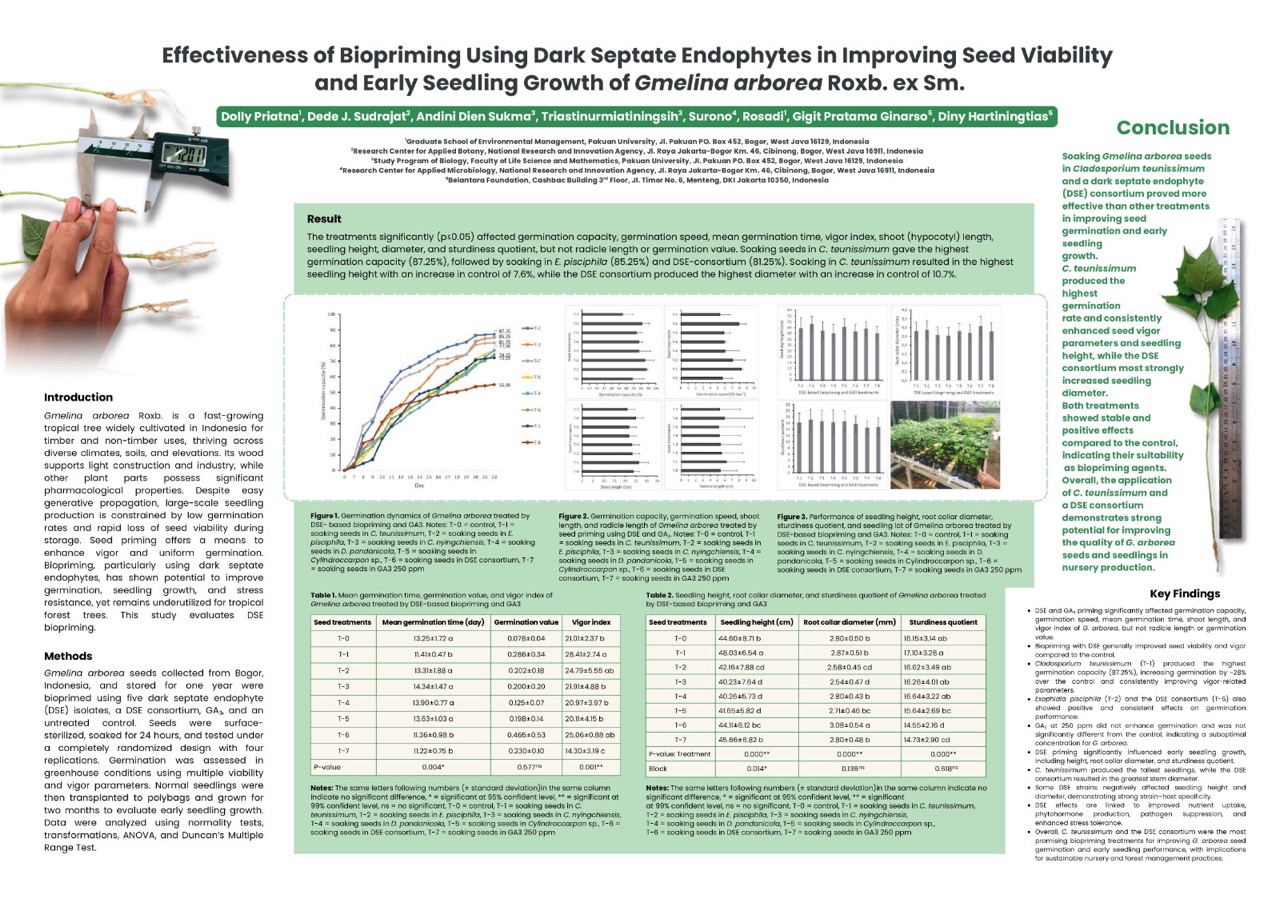
Gmelina arborea is a fast-growing tree species widely cultivated in plantations and community forests, but the low quality of seeds and seedlings often hampers its cultivation. One way to improve the vigor and viability of declining seeds is through priming. This study aimed to assess the effectiveness of dark septate endophyte (DSE) priming treatment in improving seed germination and seedling growth of G. arborea. Eight priming treatments (control, soaking seeds in Cladosporium teunissimum, Exophiala pisciphila, Cladophialophora nyingchiensis, Diaporthe pandanicola, Cylindroccarpon sp., DSE-consortium, and GA3) were set in a completely randomized design. The treatments significantly (p-value ≤ 0.05) affected germination capacity, germination speed, mean germination time, vigor index, shoot (hypocotyl) length, seedling height, diameter, and sturdiness quotient, but not radicle length or germination value. Soaking seeds in C. teunissimum gave the highest germination capacity (87.25%), followed by soaking in E. pisciphila (85.25%) and DSE-consortium (81.25%). Soaking in C. teunissimum resulted in the highest seedling height with an increase in control of 7.6%, while the DSE consortium produced the highest diameter with an increase in control of 10.7%. These findings support the application of DSE-based seed treatments as a promising, sustainable approach to improving seed quality and establishing plantations and community forests.
Full text article
References
Abhilash, Y., Madakemohekar, A. H., Reddy, M. S., Yaswanth, P., & Swetha, K. (2020). Seed invigoration: An overview. International Journal of Current Microbiology Application and Science, Special Issue-11, 2617–2623.
Akhir, J., Herliyana, E. N., Surono, & Budi, S.W. (2024). The first report of dark septate endophytes from Indonesian Pinus merkusii and its symbiosis role as a plant growth promoter in nursery condition. Biodiversitas, 25(1), 312–321. http://doi.org/10.13057/biodiv/d250136
Al-Hawezy, S. M. N. (2013). The role of the different concentrations of GA3 on seed germination and seedling growth of loquat (Eriobotrya japonica L.). IOSR Journal of Agriculture and Veterinary Science, 4(5), 3–6. https://doi.org/10.9790/2380-0450306
Alberton, O., Kuyper, T. W., & Summerbell, R. C. (2010). Dark septate root endophytic fungi increase growth of Scots pine seedlings under elevated CO2 through enhanced nitrogen use efficiency. Plant Soil, 328, 459–470. https://doi.org/10.1007/s11104-009-0125-8
Ananthi, M., Selvaraju, P., & Sundaralingam, K. (2014). Effect of bio-priming using biocontrol agents on seed germination and seedling vigour in chilli (Capsicum annuum L.) ‘PKM 1’. Journal of Horticulture Science and Biotechnology, 89(5), 564–568. https://doi.org/10.1080/14620316.2014.11513121
Andrade-Linares, D. R., Grosch, R., Restrepo, S., Krumbein, A., & Franken, P. (2011). Effects of dark septate endophytes on tomato plant performance. Mycorrhiza, 21, 413–422. https://doi.org/10.1007/s00572-010-0351-1
Andriyanto, M., Hanum, C., Hasanuddin., Fendiyanto, M. H., & Dalimunthe, C. I. (2024). Karakteristik pertumbuhan bibit batang bawah karet yang diaplikasikan cendawan DSE (dark septate endophyte). Jurnal Penelitian Karet, 42(2), 163–176.
Arora, C., & Tamrakar, V. (2017). Gmelina arborea: Chemical constituents pharmacological activities and applications. International Journal of Phytomedicine, 9(4), 528–542. https://doi.org/10.5138/09750185.2149
Asra, R. (2014). The effect of gibberellin (GA3) hormone on the seed germination and vigor of Calopogonium caeruleum. Biospecies, 7, 29–33. https://doi.org/10.22437/BIOSPECIES.7.1.1507
Azmi, C., Rahayu, A., Saadah, I. R., Wulandari, A. W., Sahat, J. P., Jayanti, H., Susilowati, D. N., & Surono. (2022). Use of dark septate endophyte (DSE) for true shallot seed (TSS) germination. Seminar Nasional Bioteknologi II. Yogyakarta: Universitas Gajah Mada.
Badan Standardisasi Nasional. (2018). SNI 8420:2018 Forest tree seedling. Jakarta
Badan Standardisasi Nasional. (2022). SNI 7627:2022 Physical and physiological quality of forest tree seed. Jakarta
Baron, N. C., & Rigobelo, E. C. (2021). Endophytic fungi: A tool for plant growth promotion and sustainable agriculture. Mycology, 13(1), 39–55. https://doi.org/10.1080/21501203.2021.1945699
Berthelot, C., Leyval, C., Chalot, M., & Blaudez, D. (2019). Interactions between dark septate endophytes, ectomycorrhizal fungi and root pathogens in vitro. FEMS Microbiology Letters, 366(13), Article fnz158. https://doi.org/10.1093/femsle/fnz158
Berthelot, C., Leyval, C., Foulon, J., Chalot, M., & Blaudez, D. (2016). Plant growth promotion, metabolite production and metal tolerance of dark septate endophytes isolated from metal-polluted poplar phytomanagement sites. FEMS Microbiology Ecology, 92(10), Article fiw144. https://doi.org/10.1093/femsec/fiw144
Bhattacharyya, S., Datta, K., Choudhury, P., & Sarkar, D. (2025). Chemical constituents and pharmacological potential of Gmelina arborea Roxb. (Lamiaceae): A review. Plant Science Today, 12(1), 1–13. https://doi.org/10.14719/pst.3336
Budiman, B., Sudrajat, D. J., Lee, D. K., & Kim, Y. S. (2015). Effect of initial morphology on field performance in white jabon seedlings at Bogor, Indonesia. Forest Science and Technology, 11(4), 206–211. https://doi.org/10.1080/21580103.2015.1007897
Castro-Camba, R., Sánchez, C., Vidal, N., & Vielba, J. M. (2022). Plant development and crop yield: The role of gibberellins. Plants, 11(19), Article 2650. https://doi.org/10.3390/plants11192650
Chaerani, N., Sudrajat, D. J., Siregar, I. Z., & Siregar, U. J. (2019). Growth performance and wood quality of white jabon (Neolamarckia cadamba) progeny testing at Parung Panjang, Bogor, Indonesia. Biodiversitas, 20, 2295–2301. https://doi.org/10.13057/biodiv/d200826
Chakraborti, S., Bera, K., Sadhukhan, S., & Dutta, P. (2022). Bio-priming of seeds: Plant stress management and its underlying cellular, biochemical and molecular mechanisms. Plant Stress, 3, Article 100052. https://doi.org/10.1016/j.stress.2021.100052
Chaudhary, T., Dixit, M., Gera, R., . Shukla, A. K., Prakash, A., Gupta, G., & Shukla, P. (2020). Techniques for improving formulations of bioinoculants. 3 Biotech 10, Article 199. https://doi.org/10.1007/s13205-020-02182-9
Cornea-Cipcigan, M., Pamfil, D., Sisea, C. R., & Mărgăoan, R. (2020). Gibberellic acid can improve seed germination and ornamental quality of selected Cyclamen species grown under short and long days. Agronomy, 10(4), Article 516. https://doi.org/10.3390/agronomy10040516
Dalimunthe, C. I., Surono, Soekarno, B. P. W., Al-Ani, L. K. T., Munif, A., Sriherwanto, C., & Nurdebyandaru, N. (2023). First report of inhibitory abilities of dark septate endophytic fungi against white root rot disease on Hevea brasiliensis seedlings in nursery conditions. Egyptian Journal of Biological Pest Control, 33, Article 81. https://doi.org/10.1186/s41938-023-00725-9
Devika, O. S., Singh, S., Sarkar, D., Barnwal, P., Suman, J., & Rakshit, A. (2021). Seed priming: a potential supplement in integrated resource management under fragile intensive ecosystems. Frontiers in Sustainable Food System, 5, Article 654001. https://doi.org/10.3389/fsufs.2021.654001
Dhawal, S., Sarkar, D. R., Yadav, R. S., Parihar, M., & Rakshit, A. (2016). Bio-priming with Arbuscular mycorrhizae for addressing soil fertility with special reference to phosphorus. International Journal of Bioresource Science, 3(2), 35–40. https://doi.org/10.5958/2454-9541.2016.00013.X
Deng, X., Song, X., Halifu, S., Yu, W., & Song, R. (2020). Effects of dark septate endophytes strain A024 on damping-off biocontrol, plant growth and the rhizosphere soil environment of Pinus sylvestris var. Mongolica annual seedlings. Plants, 9(7), Article 913. https://doi.org/10.3390/plants9070913
El-Mohamedy, R. S. R., Shafeek, M. R., & Rizk, F. A. (2015). Management of root rot diseases and improvement growth and yield of green bean plants using plant resistance inducers and biological seed treatments. Journal of Agricultural Technology, 11(5), 1219–1234.
Hamayun, M., Khan, S. A., Khan, A. L., Rehman, G., Kim, Y. H., Iqbal, I., Hussain, J., Lee, I. J., & Sohn, E. Y. (2010). Gibberellin production and plant growth promotion from pure cultures of Cladosporium sp. MH-6 isolated from cucumber (Cucumis sativus L.). Mycologia, 102(5), 989–995. https://doi.org/10.3852/09-261
Hossain, M. K. (1999). Gmelina arborea: A popular plantation species in the tropics. FACT 99-05. Arkansas, USA: Winrock International.
Hou, L., He, X., Li, X., Wang, S., & Zhao, L. (2019). Species composition and colonization of dark septate endophytes are affected by host plant species and soil depth in the Mu Us sandland, Northwest China. Fungal Ecology, 39, 276–284. https://doi.org/10.1016/j.funeco.2019.01.001
Islam, M. D. (2020). Enhancement of rice and wheat seed germination and seedling vigor by biocontrol agent, Cladosporium cladosprioides. Research in Agriculture, Livestock and Fisheries, 7(1), 9–15. https://doi.org/10.3329/ralf.v7i1.46826
Jensen, M. (1995). Trees commonly cultivated in Southeast Asia; Illustrated field guide. RAP Publication: 1995/38. Bangkok: FAO.
Khan, A., Singh, A. V., Gautam, S. S., Agarwal, A., Punetha, A., Upadhayay, V. K., Kukreti, B., Bundela, V., Jugran, A. K., & Goel, R. (2023). Microbial bioformulation: A microbial assisted biostimulating fertilization technique for sustainable agriculture. Frontiers in Plant Science, 14, Article 1270039. https://doi.org/10.3389/fpls.2023.1270039
Koryzniene, D., Jurkoniene, S., Žalnierius, T., Gaveliene, V., Jankovska-Bortkeviˇc, E., Bareikiene, N., & Buda, V. (2019). Heracleum sosnowskyi seed development under the effect of exogenous application of GA3. PeerJ, 7, Article e6906. http://doi.org/10.7717/peerj.6906
Li, X., He, C., He, X., Su, F., Hou, L., Ren, Y., & Hou, Y. (2019). Dark septate endophytes improve the growth of host and non-host plants under drought stress through altered root development. Plant Soil, 439, 259–272. https://doi.org/10.1007/s11104-019-04057-2
Lu, B., Lin, Y., He, C., Wang, Z., Li, X., & He, X. (2025). Effects of dark septate endophyte on root growth, physiology and transcriptome of Ammopiptanthus mongolicus seedlings under drought stress. Plant Physiology and Biochemistry, 219, Article 109367. https://doi.org/10.1016/j.plaphy.2024.109367
Luo, Q., Hou, R., Shang, X., & Li, S. (2023). Effects of phosphorus-dissolving dark septate endophytes on the growth of blueberry. Journal of Microbiology, 61(9), 837–851. https://doi.org/10.1007/s12275-023-00080-2
Malicka, M., Magurno, F., & Piotrowska-Seget, Z. (2022). Plant association with dark septate endophytes: When the going gets tough (and stressful), the tough fungi get going. Chemosphere, 302, Article 134830. https://doi.org/10.1016/j.chemosphere.2022.134830
Marfuah, D. S., Hamim, Sulistyaningsih, Y. C., Surono, Setyaningsih, L., & Saprudin, D. (2024). Dark septate endophyte inoculation improved Pb phytoremediation of Jatropha curcas and Reutealis trisperma on gold mine tailings. Bioremediation Journal, 28(3), 325–342. https://doi.org/10.1080/10889868.2023.2279194
Miransari, M., & Smith, D. L. (2014). Plant hormones and seed germination. Environmental and Experimental Botany, 99, 110–121. https://doi.org/10.1016/j.envexpbot.2013.11.005
Naithani, R., Varghese, B., Sahu, K. K., Dulloo, M. E., & Naithani, S. C. (2006). Postharvest storage physiology of Gmelina arborea Roxb. Seeds. Indian Journal of Plant Physiology, 11(1), 20–27.
Nurhasybi, Sudrajat, D. J., & Suita, E. (2019). Kriteria mutu bibit tanaman hutan siap tanam: Untuk pembangunan hutan dan rehabilitasi lahan. Bogor, Indonesia: IPB Press.
Osborne, J. W. (2002). Notes on the use of data transformations. Practical Assessment, Research & Evaluation, 8(6), 1–7.
Pang, Z. Q., Zhao, Y., Xu, P., & Yu, D. Q. (2020). Microbial diversity of upland rice roots and their influence on rice growth and drought tolerance. Microorganisms, 8(9), Article 1329. https://doi.org/10.3390/microorganisms8091329
Prakash, R. (1991). Gmelina arborea. Propagation practices of important Indian trees. Dehradun, India: International Book Distributors.
Priatna, D., Denny., Monk, K. A., Susilo, A., & Hartiningtias, D. (2025). Species diversity of trees with traditional medicinal uses: A core-buffer zone comparison in a biosphere reserve. Jurnal Manajemen Hutan Tropika, 31(2), 145–158. https://doi.org/10.7226/jtfm.31.2.145
Priatna, D., Susilo, A., Denny., & Simanjuntak, H. S. (2024). An ethnopharmacological study of medicinal plants in the buffer zone and its implication to the conservation of Giam Siak Kecil-Bukit Batu Biosphere Reserve. Asian Journal of Conservation Biology, 13(1), 47–61. https://doi.org/10.53562/ajcb.85103
Putri, K. P., Sudrajat, D. J., Yulianti, Surono, Wanda, I. F., Martiansyah, I., Pitaloka, K. M., Putra, I. P., & Budi, S. W. (2025). Dark septate endophytic fungi of Neolamarckia cadamba (Roxb.) Bosser and their potency for improving the seedling morphophysiological traits. Forest Science and Technology, 1–15. https://doi.org/10.1080/21580103.2025.2570357
Qu, D.H., Wu, F.L., Zhao, X.H., Zhu, D.Z., Gu, L., Yang, L.N., Zhao, W.W., Sun, Y.D., Yang, J.J., Tian, W., Su, H.Y., & Wang, L. (2022). A bZIP transcription factor VabZIP12 from blueberry induced by dark septate endocyte improving the salt tolerance of transgenic Arabidopsis. Plant Science, 315, Article 111135. https://doi.org/10.1016/j.plantsci.2021.111135
Rakshit, A., Sunita, K., Pal, S., Singh, A., & Singh, H. B. (2015). Bio-priming mediated nutrient use efficiency of crop species. In A. Rakshit, H. B. Singh, & A. Sen (Eds.), Nutrient use efficiency: From basics to advances (pp. 181–191). New Delhi: Springer.
Răut, L., Călin, M., Capră, L., Gurban, A, M., Doni, M., Radu, M., & Jecu, L. (2021). Cladosporium sp. isolate as fungal plant growth promoting agent. Agronomy, 11(2), Article 392. https://doi.org/10.3390/agronomy11020392
Roller, K. J. (1977). Suggested minimum standards for containerized seedlings in Nova Scotia. Report M-X-69. Canadian: Canadian Forest Service.
Roshetko. J. M., Mulawarman, & Purnomosidhi, P. (2004). Gmelina arborea–a viable species for smallholder tree farming in Indonesia? New Forest, 28, 207–215. https://doi.org/10.1023/B:NEFO.0000040948.53797.c5
Rout, S., Beura, S., Khare, N., & Prusty, A. K. (2021). Role of different concentrations Gibberellic Acid (GA3) on seed germination and seedling quality of Saraca asoca (Roxb.) de Wilde. Frontiers in Crop Improvement, 9(Special Issue-VI), 2495–2500.
Ruotsalainen, A.L., Kauppinen, M., Wali, P.R., Saikkonen, K., Helander, M., & Tuomi, J. (2021). Dark septate endophytes: mutualism from by-products? Trends in Plant Science, 27(3), 247–254. https://doi.org/10.1016/j.tplants.2021.10.001
Santos, M., Cesanelli, I., Diánez, F., Sánchez-Montesinos, B., & Moreno-Gavira, A. (2021). Advances in the role of dark septate endophytes in the plant resistance to abiotic and biotic stresses. Journal of Fungi, 7(11), Article 939. https://doi.org/10.3390/jof7110939
Sarkar, D., & Rakshit, A. (2020). Safeguarding the fragile rice–wheat ecosystem of the Indo-Gangetic Plains through bio-priming and bioaugmentation interventions. FEMS Microbial Ecology, 96(12), Article fiaa221. https://doi.org/10.1093/femsec/fiaa221
Septian, R. R., Sulistijorini, Surono, & Hamim. (2025). Dark septate endophytic fungi and thiocyanate induced gold accumulation of Brassica juncea and Amaranthus spinosus grown on gold mine tailings. Sains Malaysiana, 54(7), 1687–1699. https://doi.org/10.17576/jsm-2025-5407-04
Shahrajabian, M. H., Chaski, C., Polyzos, N., & Petropoulos, S. A. (2021). Biostimulants application: A low input cropping management tool for sustainable farming of vegetables. Biomolecules, 11(5), Article 698. https://doi.org/10.3390/biom11050698
Sharma, I., Raina, A., Choudhary, M., Kaul, S., & Dhar, M.K. (2023). Fungal endophyte bioinoculants as a green alternative towards sustainable agriculture. Heliyon, 9, Article e19487. https://doi.org/10.1016/j.heliyon.2023.e19487
Shi, W., Wang, Z., Wang, Q., Zheng, X., Chen, W., Li, X., & He, X. (2025). Effects of dark septate endophytes on the growth of wheat seedlings under different fertilizer conditions. Journal of Plant Growth Regulation, 44, 5340–5360. https://doi.org/10.1007/s00344-025-11764-x
Silva, L.C., Saggin-Júnior, O.J., Carneiro, M.A.C., Silva, E.M.R.D., Zilli, J.É., & Berbara, R.L.L. (2024). Characterization of dark septate endophytic fungi Periconia macrospinosa isolated from roots of sugarcane in São Paulo, Brazil. Anais da Academia Brasileira de Ciencias, 96(suppl 3), Article e20231367. https://doi.org/10.1590/0001-3765202420231367
Singh, H. B. (2016). Seed biopriming: a comprehensive approach towards agricultural sustainability. Indian Phytopathology, 69(3), 203–209.
Singh, P., Vaishnav, A., Liu, H., Xiong, C., Singh, H. B., & Singh, B. K. (2023). Seed biopriming for sustainable agriculture and ecosystem restoration. Microbial Biotechnology, 16, 2212–2222. https://doi.org/10.1111/1751-7915.14322
Siregar, I. Z., Muharam, K. F., Purwanto, Y. A., & Sudrajat, D. J. (2020), Seed germination characteristics in different storage time of Gmelina arborea treated with ultrafine bubbles priming. Biodiversitas, 21(10), 4558–4564. https://doi.org/10.13057/biodiv/d211013
Sudová, R., Kohout, P., Rydlová, J., Čtvrtlíková, M., Suda, J., Voříšková, J., et al. (2020). Diverse fungal communities associated with the roots of isoetid plants are structured by host plant identity. Fungal Ecology, 45, Article100914. https://doi.org/10.1016/j.funeco.2020.100914
Sudrajat, D. J., & Rustam, E. (2020). Reforestation by direct seeding of Gmelina arborea using seed briquettes: Composition, size and site preparation, and sowing date. IOP Conference Series: Earth and Environmental Science, 533, Article 01201. https://doi.org/10.1088/1755-1315/533/1/012014
Sudrajat, D. J., Nurhasybi, & Suita, E. (2018). Comparison of nyamplung plant establishment: direct seeding, bare-root, blocked seedling media, and containerized seedlings. Jurnal Manajemen Hutan Tropika, 24(2), 51–59. https://doi.org/10.7226/jtfm.24.2.51
Sudrajat, D. J., Yulianti, & Nurhasybi. (2017). Standar pengujian dan mutu benih tanaman hutan. Bogor, Indonesia: IPB Press.
Sudrajat, D. J., Rustam, E., & Widyani, N. (2022). Provenance variation in seed storability of jabon (Neolamarckia cadamba) and their response to seed invigoration by priming and gamma irradiation treatments. Biodiversitas, 23(10), 5074–5084. https://doi.org/10.13057/biodiv/d231014
Sudrajat, D. J., Rustam, E., Yulianti, Widyani, N., Putri, K.P., Yuniarti, N., Nurhasybi, Widyanti, S., Purwanto, Y. A., Yuskianti, V., & Zanzibar, M. (2024). Optimizing seed germination of Acacia crassicarpa by scarification and plasma fine bubbles treatments. International Journal of Forestry Research, 2024, Article 3403948. https://doi.org/10.1155/ijfr/3403948
Suita, E., Priatna, D., Sudrajat, D. J., Surono, & Purwanto, Y. A. (2024). Effect of ultrafine bubbles and dark septate endophytes on the seedling growth of malapari (Pongamia pinnata). Jurnal Penelitian Hutan Tanaman, 21(2), 101–114.
Surono, Yulianti, Putri, K. P., Sudrajat, D.J., Nugraheni, Y. M. M. A., Sriherwanto, C., Syabana, M. A., Widyani, N., Yuniarti, N., Zanzibar, M., Rustam, E., & Sianturi, R. U. D. (2024). Dark septate endophytes symbiosis in Falcataria moluccana and its potency for forest and landscape restoration. Global Journal of Environmental Science and Management, 10(SI), 19–36. https://doi.org/10.22034/gjesm.2024.SI.02
Surono, & Narisawa, K. (2017). The dark septate endophytic fungus Phialocephala fortinii is a potential decomposer of soil organic compounds and a promoter of Asparagus officinalis growth Author links open overlay panel. Fungal Ecology, 28, 1–10. https://doi.org/10.1016/j.funeco.2017.04.001
Syamsuwida, D., Nurhasybi, Sudrajat, D. J. (2020). Advance technology of tropical tree seed handling in Indonesia for high quality seed and seedling productions. IOP Conference Series: Earth and Environmental Science, 522, Article 012017. https://doi.org/10.1088/1755-1315/522/1/012017
Thakur, M., Tiwari, S., Kataria, S., & Anand, A. (2022). Recent advances in seed priming strategies for enhancing planting value of vegetable seeds. Scientia Horticulturae, 305, Article 111355. https://doi.org/10.1016/j.scienta.2022.111355
Therapy, A., Priatna, D., & Sudrajat, D. J. (2020). Seed briquette composition for the direct seeding of Gmelina arborea Roxb. Indonesian Journal of Applied Environmental Studies, 1(1), 17–22. https://doi.org/10.33751/injast.v1i1.1970
Tuheteru, F. D., Husna, Albasri, Arif, A., Basrudin, Nurdin, W. R., Arman, E., Agustin, D. I., Saribadu, J., Rahmat, Dermawansyah, A., Daliana, Lody, L. P., Deri, A. S., Safitri, I., Sudrajat, D. J. (2022). Effect of pre-sowing treatment on the germination and early growth of Kalappia celebica Kosterm.: an endemic and vulnerable tree species of Sulawesi, Indonesia. Biodiversitas, 23(8), 4297–4302. https://doi.org/10.13057/biodiv/d230854
Vergara, C., Araujo, K. E. C., Alves, L. S., Souza, S. R., de Santos, L. A., Santa-Catarina, C., Silva, K., Pereira, G. M. D., Xavier, G. R., & Zilli, J. É. (2018). Contribution of dark septate fungi to the nutrient uptake and growth of rice plants. Brazilian Journal of Microbiology, 49(1), 67–78. https://doi.org/10.1016/j.bjm.2017.04.010
Wang, S., Bi, Y., Quan, W., & Christie, P. (2022). Growth and metabolism of dark septate endophytes and their stimulatory effects on plant growth. Fungal Biology, 126(10), 674–686. https://doi.org/10.1016/j.funbio.2022.08.006
Wang, Z., Shi, W., Chen, X., Lin, Y., Chen, W., Yao, L., Sun, X., Li, X., & He, X. (2025). Effects of biological and abiotic factors on dark septate endophytes distribution and heavy metal resistance in different environments. Frontiers in Microbiology, 15, Article 1527512. https://doi.org/10.3389/fmicb.2024.1527512
Warrier, R. R., Priya, S. M., & Kalaiselvi, R. (2021). Gmelina arborea– an indigenous timber species of India with high medicinal value: A review on its pharmacology, pharmacognosy and phytochemistry. Journal of Ethnopharmacology, 267, Article 113593. https://doi.org/10.1016/j.jep.2020.113593
Wen, Z., Terhonen, E., & Asiegbu, F.O. (2021). The dark septate root endophyte Phialocephala sphaeroides confers growth fitness benefits and mitigates pathogenic effects of Heterobasidion on Norway spruce. Tree Physiology, 42(4), 891–906. https://doi.org/10.1093/treephys/tpab147
Widyani, N., Surono, Sudrajat, D. J., Rustam, E., Nurhasybi, Putri, K. P., & Yuskianti, V. (2024). Direct seeding of Ceiba pentandra and Leucaena leucocephala using seed briquette with AMF and DSE inoculations to support a green economy. IOP Conference Series: Earth and Environmental Science, 1302, Article 012027. https://doi.org/10.1088/1755-1315/1302/1/012027
Wu, F. L., Qu, D. H., Wei, T., Wang, M. Y., Chen, F. Y., Li, K. K., Sun, Y. D., Su, Y. H., Yang, L. N., Su, H. Y., & Lei, W. (2021). Transcriptome analysis for understanding the mechanism of dark septate endophyte S16 in promoting the growth and nitrate uptake of sweet cherry. Journal of Integrative Agriculture, 20(7), 1819–1831. https://doi.org/10.1016/S2095-3119(20)63355-X
Yuniarti, N., Yulianti, Sudrajat, D. J., Nurhasybi, Zanzibar, M., Syamsuwida, D., Mindawati, N., Junaedi, A., Putri, K. P., Rustam, E., Widyani, N., & Nugraheni, Y. M. M. A. (2023). Improvement of seedling quality of red jabon (Neolamarckia macrophylla (Roxb.) Bosser) through seedsowing techniques and seed invigoration, Forest Science and Technology, 19(3), 162–170. https://doi.org/10.1080/21580103.2023.2216208
Yuniarti, N., Sudrajat, D. J., Yulianti, Zanzibar, M., Nurhasybi, Putria, K. P., Widyani, N., Nugraheni, Y. M. M. A., Rustam, E., Ramayanti, R. U., Surono, Mindawati, N., Yuskianti, N., & Haneda, N. F. (2025). Storage behavior and improving seed and seedling quality of the endangered tree species, Agathis borneensis Warb., using biopriming treatments. Forest Science and Technology, 1–3. https://doi.org/10.1080/21580103.2025.2550465
Zhou, Y., Zheng, Y., Li, P., Xu, L., & Fu, Q. (2024). Ectomycorrhizal fungi and dark septate endophyte inoculation improve growth and tolerance of Pinus tabulaeformis under cadmium stress. Pedosphere, 34, 473–483. https://doi.org/10.1016/j.pedsph.2023.09.003
Authors
Copyright (c) 2026 Jurnal Manajemen Hutan Tropika

This work is licensed under a Creative Commons Attribution 4.0 International License.
Jurnal Manajemen Hutan Tropika is an open access journal which means that all contents is freely available without charge to the user or his/her institution. Users are allowed to read, download, copy, distribute, print, search, or link to the full texts of the articles in this journal without asking prior permission from the publisher or the author. This is in accordance with the Budapest Open Access Initiative (BOAI) definition of open access.Article Details
How to Cite



