
Spiritual Dimensions of Local Knowledge in Forest Conservation: An Integrative Deep Ecology-Ecospirituality Framework for Alternative Environmental Governance

Article Sidebar
-
local knowledge, ecospirituality, deep ecology, prohibited forest, environtmental governance
Abstract
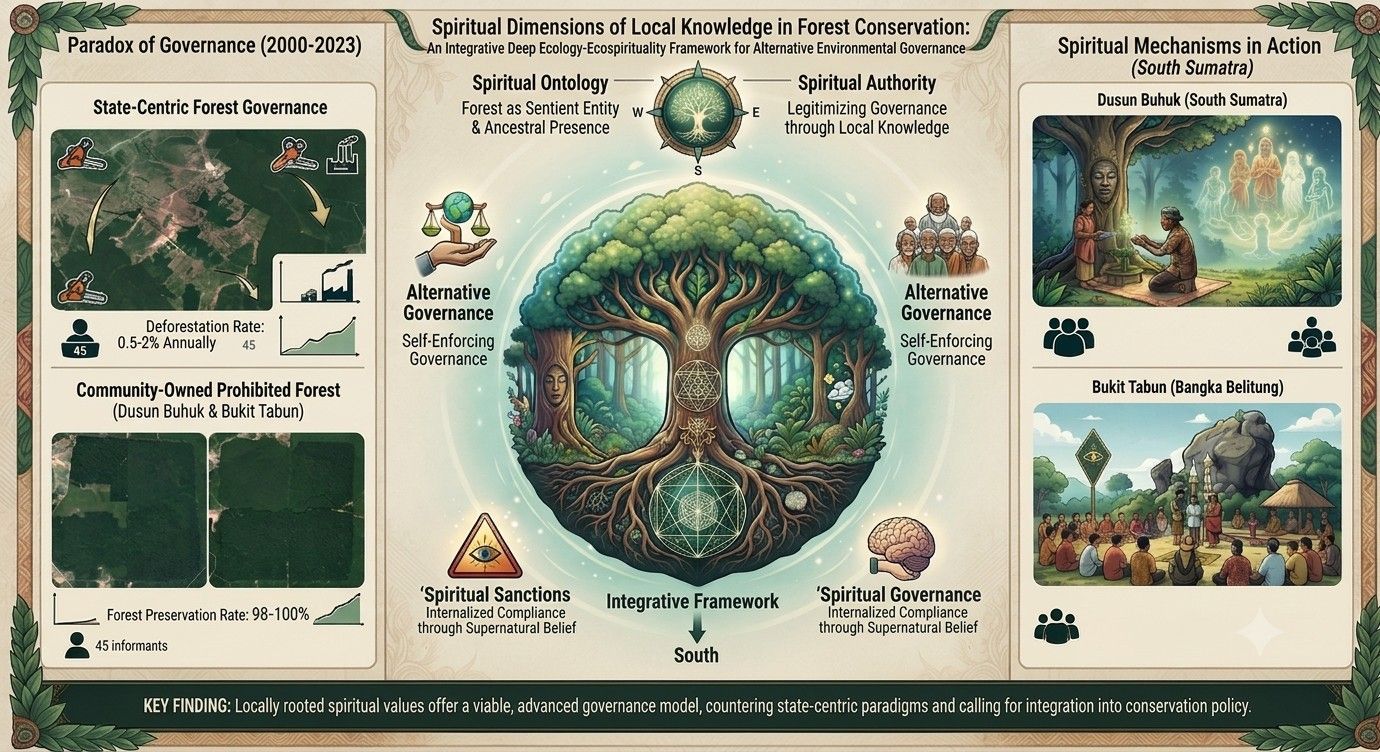
Contemporary forest governance, dominated by commodification-driven paradigms, has accelerated deforestation and marginalized local knowledge systems. While political ecology increasingly recognizes indigenous knowledge, the spiritual dimensions of forest conservation remain theoretically and empirically underexplored. Drawing on deep ecology and ecospirituality, this study examines how the spiritual dimensions of local knowledge legitimize forest conservation and develops an integrative framework as an alternative model of environmental governance. Using a comparative case design with qualitative methods, we studied two prohibited forests: Dusun Buhuk (South Sumatra) and Bukit Tabun (Bangka Belitung). Data came from in-depth interviews with 45 informants, eight months of participant observation, and satellite imagery analysis (2000–2023), examined through thematic analysis and cross-case comparison. We identify three spiritual mechanisms: spiritual ontology, which constructs forests as sentient entities with ancestral presence; spiritual authority, which generates governance legitimacy; and spiritual sanctions, which produce internalized compliance through supernatural punishment. Both sites preserved 98–100% of forest cover over 23 years, whereas formally protected areas lost 0.5–2% annually. Locally rooted spiritual values thus offer practical, self-enforcing governance that sustains biodiversity and social cohesion while adapting to external pressures. These findings counter state-centric paradigms and underscore the need to integrate spiritual values into conservation policy.
Full text article
References
Atran, S., Medin, D. L., & Ross, N. O. (2005). The cultural mind: Environmental decision making and cultural modeling within and across populations. Psychological Review, 112(4), 744 –776. https://psycnet.apa.org/doi/10.1037/0033-295X.112.4.744
Austin, K. G., Schwantes, A., Gu, Y., & Kasibhatla, P. S. (2019). What causes deforestation in Indonesia? Environmental Research Letters, 14(2), Article 24007. https://doi.org/10.1088/1748-9326/aaf6db
Azwar, B., Roza, D., Thamrin, H., & Elfiandri, E. (2021). Strategi keberlanjutan pengelolaan hutan larangan adat Kenegerian Rumbio Kabupaten Kampar Propinsi Riau. Dinamika Lingkungan Indonesia, 8(1), 5764. https://doi.org/10.31258/dli.8.1.p.57-64
Barletti, J. P. S., Larson, A. M., Hewlett, C., & Delgado, D. (2020). Designing for engagement: A realist synthesis review of how context affects the outcomes of multi-stakeholder forums on land use and/or land-use change. World Development, 127, Article 104753. https://doi.org/10.1016/j.worlddev.2019.104753
Berkes, F. (2017). Sacred ecology. Routledge.
Berkes, F., & Ross, H. (2013). Community resilience: Toward an integrated approach. Society & Natural Resources, 26(1), 5–20. https://doi.org/10.1080/08941920.2012.736605
Blaser, M. (2013). Notes towards a political ontology of ‘environmental’conflicts. In Contested ecologies: Dialogues in the south on nature and knowledge (pp. 13–27).
Bourdieu, P. (1991). Language and symbolic power. Harvard University Press.
Braun, V., & Clarke, V. (2006). Using thematic analysis in psychology. Qualitative Research in Psychology, 3(2), 77–101. https://doi.org/10.1191/1478088706qp063oa
Brockington, D., Duffy, R., & Igoe, J. (2012). Nature unbound: Conservation, capitalism and the future of protected areas. Routledge.
Budiman, M. A. K., & Oue, H. (2025). Integrating Indigenous knowledge into sustainable forest management for climate change adaptation and mitigation strategies: Case from southern slopes of Mount Slamet, Indonesia. Jurnal Manajemen Hutan Tropika, 31(1), 4160. https://doi.org/10.7226/jtfm.31.1.41
Capra, F., & Luisi, P. L. (2014). The systems view of life: A unifying vision. Cambridge University Press.
Castro, E. B. V., & Skafish, P. (2014). Cannibal metaphysics: For a post-structural anthropology. Univocal Publishing.
Colding, J., & Folke, C. (2001). Social taboos: “invisible” systems of local resource management and biological conservation. Ecological Applications, 11(2), 584–600. https://doi.org/10.1890/1051-0761(2001)011[0584:STISOL]2.0.CO;2
Denzin, N. K. (2017). The research act: A theoretical introduction to sociological methods. Routledge.
Descola, P. (2013). Beyond nature and culture. University of Chicago Press.
Drengson, A., & Inoue, Y. (Eds.). (1995). The deep ecology movement: An introductory anthology. North Atlantic Books.
Dudley, N., Bhagwat, S., Higgins-Zogib, L., Lassen, B., Verschuuren, B., & Wild, R. (2012). Conservation of biodiversity in sacred natural sites in Asia and Africa: A review of the scientific literature. In B. Verschuuren, R. Wild, J. McNeely, & G. Oviedo (Eds.), Sacred natural sites: Conserving nature and culture (pp. 19–32). Taylor & Francis.
Escobar, A. (2020). Pluriversal politics: The real and the possible. Duke University Press.
Fernández‐Llamazares, Á., & Cabeza, M. (2018). Rediscovering the potential of indigenous storytelling for conservation practice. Conservation Letters, 11(3), Article e12398. https://doi.org/10.1111/conl.12398
Iswandono, E., Zuhud, E. A. M., Hikmat, A., & Kosmaryandi, N. (2015). Integrating local culture into forest conservation: A case study of the Manggarai Tribe in Ruteng Mountains, Indonesia. Jurnal Manajemen Hutan Tropika, 21(2) 5564. https://doi.org/10.7226/jtfm.21.2.55
Kimmerer, R. W. (2013). Braiding sweetgrass: Indigenous wisdom, scientific knowledge and the teachings of plants. Milkweed Editions.
Kohn, E. (2013). How forests think: Toward an anthropology beyond the human. University of California Press.
Lansing, J. S. (2012). Perfect order: Recognizing complexity in Bali. Princeton University Press.
Li, T. (2014). Land’s end book review by Faizah Zakaria. Duke University Press. https://doi.org/10.1215/9780822376460
Lincoln, Y., & Guba, E. (1985). Naturalistic Inquiry. Sage Publications.
Lyons, C. O., Berry, T., Hanh, T. N., Bwoya, C. T., Stanley, J., Loy, D. R., Tucker, M. E., Swimme, B., MacGillis, S. M., & Berry, W. (2016). Spiritual ecology: The cry of the earth. The Golden Sufi Center.
Martin, E., Suharjito, D., Darusman, D., Sunito, S., & Winarno, B. (2016). Tunggu Tubang and Ulu Ayek: Social mechanism of sustainable protected forest management. Jurnal Manajemen Hutan Tropika, 22(2), 8593. https://doi.org/10.7226/jtfm.22.2.85
Ostrom, E. (2009). A general framework for analyzing sustainability of social-ecological systems. Science, 325(5939), 419–422.
Purzycki, B. G., & Sosis, R. (2022). Religion evolving: Cultural, cognitive, and ecological dynamics. Equinox.
Rakatama, A., & Pandit, R. (2020). Reviewing social forestry schemes in Indonesia: Opportunities and challenges. Forest Policy and Economics, 111, Article 102052. https://doi.org/10.1016/j.forpol.2019.102052
Ribot, J. C., & Peluso, N. L. (2003). A theory of access. Rural Sociology, 68(2), 153–181. https://doi.org/10.1111/j.1549-0831.2003.tb00133.x
Scott, J. C. (1998). Seeing like a state: How certain schemes to improve the human condition have failed. Yale University Press.
Sikor, T., & Lund, C. (2009). Access and property: A question of power and authority. Development and Change, 40(1), 1–22. https://doi.org/10.1111/j.1467-7660.2009.01503.x
Studley, J. (2018). Indigenous sacred natural sites and spiritual governance: The legal case for juristic personhood. Routledge.
Taylor, B. (2013). Avatar and nature spirituality. Wilfrid Laurier Press.
Tengö, M., Brondizio, E. S., Elmqvist, T., Malmer, P., & Spierenburg, M. (2014). Connecting diverse knowledge systems for enhanced ecosystem governance: The multiple evidence base approach. Ambio, 43(5), 579–591. https://doi.org/10.1007/s13280-014-0501-3
Turchin, P., Currie, T. E., Turner, E. A. L., & Gavrilets, S. (2013). War, space, and the evolution of Old World complex societies. Proceedings of the National Academy of Sciences, 110(41), 16384–16389. https://doi.org/10.1073/pnas.1308825110
Turner, N. J., Ignace, M. B., & Ignace, R. (2000). Traditional ecological knowledge and wisdom of aboriginal peoples in British Columbia. Ecological Applications, 10(5), 1275–1287. https://doi.org/10.1890/1051-0761(2000)010[1275:TEKAWO]2.0.CO;2
Verschuuren, B., & Brown, S. (2018). Cultural and spiritual significance of nature in protected areas: Governance, management and policy. Routledge.
Verschuuren, B., McNeely, J., Oviedo, G., & Wild, R. (2012). Sacred natural sites. Taylor & Francis Oxfordshire.
von Benda-Beckmann, F., von Benda-Beckmann, K., & Wiber, M. (Eds.). (2006). Changing Properties of Property. Berghahn Books. https://doi.org/10.3167/9781845451394
Yin, R. K. (2018). Case study research and applications (6th ed.). Sage Thousand Oaks.
Authors
Copyright (c) 2026 Jurnal Manajemen Hutan Tropika

This work is licensed under a Creative Commons Attribution 4.0 International License.
Jurnal Manajemen Hutan Tropika is an open access journal which means that all contents is freely available without charge to the user or his/her institution. Users are allowed to read, download, copy, distribute, print, search, or link to the full texts of the articles in this journal without asking prior permission from the publisher or the author. This is in accordance with the Budapest Open Access Initiative (BOAI) definition of open access.Article Details
How to Cite



