
Peat Fires in Indonesia: A Socio-Ecological Synthesis Based on a Literature Review of Management Approaches

Article Sidebar
-
mitigation, peatland fire, social-ecological approaches, systematic literature review
Abstract
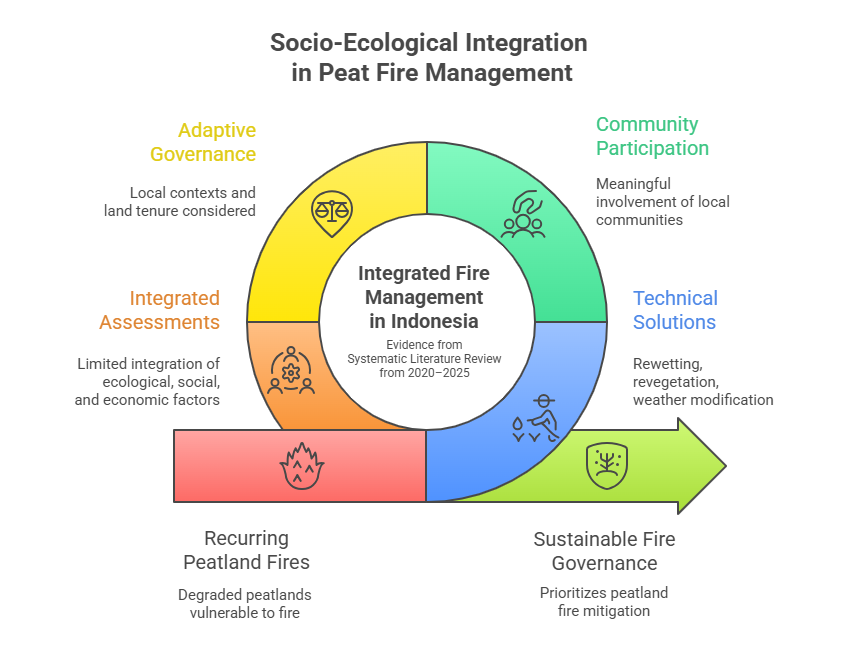
Peatlands play a critical role in supporting Indonesia’s net-zero emissions target due to their carbon storage and provide nature-based solutions. However, drainage, logging, and land-use change have degraded many peatlands in Indonesia, rendering them highly vulnerable to fire. Despite efforts to mitigate fires, fire incidents in peatlands remain a recurring challenge. This study examines peatland fire management in Indonesia using review of recent scientific literature. 10 peer-reviewed published between 2020 and 2025 were analyzed to identify common strategies, actors involved, and socio-ecological dynamics underlying fire management. Findings suggest that the most effective interventions combine technical solutions such as rewetting through canal blocking, revegetation, and weather modification technologies with meaningful community participation and multi-stakeholder collaboration. These strategies are more sustainable when supported by adaptive governance models that considers land tenure, cultural practices, and institutional capacities. The study also identified gaps in long-term impact assessments and limited integration of ecological, social, and economic factors in most existing interventions. By bringing in the ecological and social dimensions, this review offers a more integrated understanding of peatland fire management. This study contributes to informs policy directions toward sustainable fire governance based on efforts to mitigate peatland fires in Indonesia.
Full text article
References
Andriesse, J. P. (1988). Nature and management of tropical peat soils. Food and Agriculture Organization of the United Nations.
Arndt, N., Vacik, H., Koch, V., Arpaci, A., & Gossow, H. (2013). Modeling human-caused forest fire ignition for assessing forest fire danger in Austria. IForest, 6(6), 315–325. https://doi.org/10.3832/ifor0936-006
Badan Perencanaan Pembangunan dan Penelitian Pengembangan Kabupaten Kubu Raya. (2021). RPPEG dan langkah menuju pelestarian gambut di Kabupaten Kubu Raya.
Birgé, H. E., Bevans, R. A., Allen, C. R., Angeler, D. G., Baer, S. G., & Wall, D. H. (2016). Adaptive management for soil ecosystem services. Journal of Environmental Management, 183, 371–378. https://doi.org/10.1016/j.jenvman.2016.06.024
Bowen, M. R., Bompard, J. M., Anderson, I. P., Guizol, P., & Gouyon, A. (2001). Anthropogenic fires in Indonesia: A view from Sumatra. In M. Radojevic, & P. Eaton (Eds.), Forest fires and regional haze in Southeast Asia (pp. 41–66). Nova Science, New York.
Brown, L. E., Holden, J., Palmer, S. M., Johnston, K., Ramchunder, S. J., & Grayson, R. (2015). Effects of fire on the hydrology, biogeochemistry, and ecology of peatland river systems. Freshwater Science, 34(4), 1406–1425. https://doi.org/10.1086/683426
Budiharta, S., Meijaard, E., Wells, J. A., Abram, N. K., & Wilson, K. A. (2016). Enhancing feasibility: Incorporating a socio-ecological systems framework into restoration planning. Environmental Science and Policy, 64, 83–92. https://doi.org/10.1016/j.envsci.2016.06.014
Budiman, I., Hapsari, R. D., Wijaya, C. I., & Sari, E. N. N. (2021). The governance of risk management on peatland: A case study of restoration in South Sumatra, Indonesia [Working paper]. World Resources Institute. https://doi.org/10.46830/wriwp.20.00008
Carmenta, R., Zabala, A., Daeli, W., & Phelps, J. (2017). Perceptions across scales of governance and the Indonesian peatland fires. Global Environmental Change, 46, 50–59. https://doi.org/10.1016/j.gloenvcha.2017.08.001
Carmenta, R., Zabala, A., Trihadmojo, B., Gaveau, D., Salim, M. A., & Phelps, J. (2021). Evaluating bundles of interventions to prevent peat-fires in Indonesia. Global Environmental Change, 67, Article 102154. https://doi.org/10.1016/j.gloenvcha.2020.102154
Cash, D. W., Adger, W. N., Berkes, F., Garden, P., Lebel, L., Olsson, P., Pritchard, L., & Young, O. (2006). Scale and cross-scale dynamics: Governance and information in a multilevel world. Ecology and Society, 11(2), Article 8. https://doi.org/10.5751/es-01759-110208
Cattau, M. E., Harrison, M. E., Shinyo, I., Tungau, S., Uriarte, M., & DeFries, R. (2016). Sources of anthropogenic fire ignitions on the peat-swamp landscape in Kalimantan, Indonesia. Global Environmental Change, 39, 205–219. https://doi.org/10.1016/j.gloenvcha.2016.05.005
Cole, D. H., Epstein, G., & McGinnis, M. D. (2019). The utility of combining the IAD and SES frameworks. International Journal of the Commons, 13(1), 244–275. https://doi.org/10.18352/ijc.864
Couwenberg, J., Dommain, R., & Joosten, H. (2010). Greenhouse gas fluxes from tropical peatlands in south-east Asia. Global Change Biology, 16(6), 1715–1732. https://doi.org/10.1111/j.1365-2486.2009.02016.x
Dini, N. L. K. D., Jauhari, A., & Rachmawati, N. (2022). Prediksi nilai karbon yang hilang akibat kebakaran di Kota Banjarbaru. Jurnal Sylva Scienteae, 5(3), 372–378. https://doi.org/10.20527/jss.v5i3.5708
Dommain, R., Couwenberg, J., Glaser, P. H., Joosten, H., & Suryadiputra, I. N. N. (2014). Carbon storage and release in Indonesian peatlands since the last deglaciation. Quaternary Science Reviews, 97, 1–32. https://doi.org/10.1016/j.quascirev.2014.05.002
Edwards, R. B., Naylor, R. L., Higgins, M. M., & Falcon, W. P. (2020). Causes of Indonesia’s forest fires. World Development, 127, Article 104717. https://doi.org/10.1016/j.worlddev.2019.104717
Eickemeier, P., Schlömer, S., Farahani, E., Kadner, S., Brunner, S., Baum, I., & Kriemann, B. (2019). IPCC, 2012: Summary for policymakers. In E. M. H. Infield, Y. Abunnasr, & R. L. Ryan (Eds.), Planning for climate change. Routledge. https://doi.org/10.4324/9781351201117-15
Field, R. D., Van Der Werf, G. R., Fanin, T., Fetzer, E. J., Fuller, R., Jethva, H., Levy, R., Livesey, N. J., Luo, M., Torres, O., & Worden, H. M. (2016). Indonesian fire activity and smoke pollution in 2015 show persistent nonlinear sensitivity to El Niño-induced drought. Proceedings of the National Academy of Sciences of the United States of America, 113(33), 9204–9209. https://doi.org/10.1073/pnas.1524888113
Fischer, J., Riechers, M., Loos, J., Martin-Lopez, B., & Temperton, V. M. (2021). Making the UN decade on ecosystem restoration a social-ecological endeavour. Trends in Ecology and Evolution, 36(1), 20–28. https://doi.org/10.1016/j.tree.2020.08.018
Gaveau, D. L. A., Salim, M. A., Hergoualc’H, K., Locatelli, B., Sloan, S., Wooster, M., Marlier, M. E., Molidena, E., Yaen, H., DeFries, R., Verchot, L., Murdiyarso, D., Nasi, R., Holmgren, P., & Sheil, D. (2014). Major atmospheric emissions from peat fires in Southeast Asia during non-drought years: Evidence from the 2013 Sumatran fires. Scientific Reports, 4, Article 6112. https://doi.org/10.1038/srep06112
Gough, D., Olliver, S., & Thomas, J. (2017). An introduction to systematic reviews (2nd ed.). Sage Publisher.
Griscom, B. W., Adams, J., Ellis, P. W., Houghton, R. A., Lomax, G., Miteva, D. A., Schlesinger, W. H., Shoch, D., Siikamäki, J. V., Smith, P., Woodbury, P., Zganjar, C., Blackman, A., Campari, J., Conant, R. T., Delgado, C., Elias, P., Gopalakrishna, T., Hamsik, M. R., …, & Fargione, J. (2017). Natural climate solutions. Proceedings of the National Academy of Sciences of the United States of America, 114(44), 11645–11650. https://doi.org/10.1073/pnas.1710465114
Grover, S., Treby, S., Mendham, D. S., Yuwati, T. W., Sakuntaladewi, N., Langston, J. D., & Rawluk, A. (2024). Social and ecological dimensions of tropical peatland restoration. Mires and Peat, 30, Article 2114019. https://doi.org/10.19189/MaP.2023.OMB.Sc.2114019
Hansson, A., & Dargusch, P. (2017). An estimate of the financial cost of peatland restoration in Indonesia. Case Studies in the Environment, 2(1), 1–8. https://doi.org/10.1525/cse.2017.000695
Hao, W. M., Liu, M.-H., & Crutzen, P. J. (1990). Estimates of annual and regional releases of CO2 and other trace gases to the atmosphere from fires in the tropics, based on the FAO statistics for the period 1975–1980. In J. G. Goldammer (Ed.), Fire in the tropical biota. Ecological studies (pp. 440–462). Springer, Berlin, Heidelberg. https://doi.org/10.1007/978-3-642-75395-4_20
Harrison, M. E., Ottay, J. B., d’Arcy, L. J., Cheyne, S. M., Anggodo, Belcher, C., Cole, L., Dohong, A., Ermiasi, Y., Feldpausch, T., Gallego-Sala, A., Gunawan, A., Höing, A., Husson, S. J., Kulu, I. P., Soebagio, S. M., Mang, S., Mercado, L., Morrogh-Bernard, H. C., …, & van Veen, F. J. F. (2020). Tropical forest and peatland conservation in Indonesia: Challenges and directions. People and Nature, 2(1), 4–28. https://doi.org/10.1002/pan3.10060
Harrison, M. E., Page, S. E., & Limin, S. H. (2009). The global impact of Indonesian forest fires. Biologist, 56(3), 156–163.
Imron, M. A., Widyastuti, K., Al Bihad, D., Satria, R. A., Prayoga, W., Pradopo, S. T., Suryatmojo, H., Sopha, B. M., Harrison, M. E., & Berger, U. (2022). Beyond climatic variation: Human disturbances alter the effectiveness of a protected area to reduce fires in a tropical peatland. Frontiers in Forests and Global Change, 5, Article 788023. https://doi.org/10.3389/ffgc.2022.788023
Iqbal, M. (2007). Analisis peran pemangku kepentingan dan implementasinya dalam pembangunan pertanian. Jurnal Penelitian dan Pengembangan Pertanian, 26(3), 89–99.
Kanngieser, A., & Todd, Z. (2021). From environmental case study to environmental kin study. History and Theory, 59(3), 385–393. https://doi.org/10.1111/hith.12166
Ketterings, Q. M., Tri Wibowo, T., van Noordwijk, M., & Penot, E. (1999). Farmers’ perspectives on slash-and-burn as a land clearing method for small-scale rubber producers in Sepunggur, Jambi Province, Sumatra, Indonesia. Forest Ecology and Management, 120(1–3), 157–169. https://doi.org/10.1016/S0378-1127(98)00532-5
Kiely, L., Spracklen, D. V., Wiedinmyer, C., Conibear, L., Reddington, C. L., Archer-Nicholls, S., Lowe, D., Arnold, S. R., Knote, C., Firoz Khan, M., Talib Latif, M., Kuwata, M., Hapsari Budisulistiorini, S., & Syaufina, L. (2019). New estimate of particulate emissions from Indonesian peat fires in 2015. Atmospheric Chemistry and Physics, 19(17), 11105–11121. https://doi.org/10.5194/acp-19-11105-2019
Kiely, L., Spracklen, D. V., Wiedinmyer, C., Conibear, L., Reddington, C. L., Arnold, S. R., Knote, C., Khan, M. F., Latif, M. T., Syaufina, L., & Adrianto, H. A. (2020). Air quality and health impacts of vegetation and peat fires in Equatorial Asia during 2004-2015. Environmental Research Letters, 15(9), Article 094054. https://doi.org/10.1088/1748-9326/ab9a6c
Kementerian Lingkungan Hidup dan Kehutanan. (2019). Peraturan Menteri Nomor 10 Tahun 2019 tentang Penentuan, Penetapan dan Pengelolaan Puncak Kubah Gambut Berbasis Kesatuan Hidrologis Gambut. Peraturan.go.id. https://peraturan.go.id/files/bn359-2019.pdf
Kementerian Lingkungan Hidup dan Kehutanan. (2021). Updated nationally determined contribution Republic of Indonesia. Jakarta: Kementerian Lingkungan Hidup dan Kehutanan.
Koh, L. P., Miettinen, J., Liew, S. C., & Gazoul, J. (2011). Remotely sensed evidence of tropical peatland conversion to oil palm. Proceedings of the National Academy of Sciences, 108(12), 5127–5132. https://doi.org/10.1073/pnas.1018776108
Konecny, K., Ballhorn, U., Navratil, P., Jubanski, J., Page, S. E., Tansey, K., Hooijer, A., Vernimmen, R., & Siegert, F. (2016). Variable carbon losses from recurrent fires in drained tropical peatlands. Global Change Biology, 22(4), 1469–1480. https://doi.org/10.1111/gcb.13186
Koplitz, S. N., Mickley, L. J., Marlier, M. E., Buonocore, J. J., Kim, P. S., Liu, T., Sulprizio, M. P., deFries, R. S., Jacob, D. J., Schwartz, J., Pongsiri, M., & Myers, S. S. (2016). Public health impacts of the severe haze in equatorial Asia in September-October 2015: Demonstration of a new framework for informing fire management strategies to reduce downwind smoke exposure. Environmental Research Letters, 11(9), Article 094923. https://doi.org/10.1088/1748-9326/11/9/094023
Kumar, P., Adelodun, A. A., Khan, M. F., Krisnawati, H., & Garcia-Menendez, F. (2020). Towards an improved understanding of greenhouse gas emissions and fluxes in tropical peatlands of Southeast Asia. Sustainable Cities and Society, 53, Article 101881. https://doi.org/10.1016/j.scs.2019.101881
Law, E. A., Bryan, B. A., Meijaard, E., Mallawaarachchi, T., Law, E. A., Bryan, B. A., Meijaard, E., Mallawaarachchi, T., & Struebig, M. (2020). Ecosystem services from a degraded peatland of Central Kalimantan: Implications for policy, planning, and management. Ecological Applications, 25(1), 70–87. https://doi.org/10.1890/13-2014.1
Liu, Y., Dai, Q., Liu, J. B., Liu, S. Bin, & Yang, J. (2014). Study of burn scar extraction automatically based on level set method using remote sensing data. PLoS ONE, 9(2), Article e87480. https://doi.org/10.1371/journal.pone.0087480
Lockwood, C., Munn, Z., & Porritt, K. (2015). Qualitative research synthesis: Methodological guidance for systematic reviewers utilizing meta-aggregation. International Journal of Evidence-Based Healthcare, 13(3), 179–187. https://doi.org/10.1097/XEB.0000000000000062
McGinnis, M. D., & Ostrom, E. (2014). Social-ecological system framework : Initial changes and continuing challenges. Ecology and Society, 19(2), Article 30. https://doi.org/10.5751/ES-06387-190230
Miettinen, J., Hooijer, A., Wang, J., Shi, C., & Liew, S. C. (2012). Peatland degradation and conversion sequences and interrelations in Sumatra. Regional Environmental Change, 12(4), 729–737. https://doi.org/10.1007/s10113-012-0290-9
Mishra, S., Page, S. E., Cobb, A. R., Lee, J. S. H., Jovani-Sancho, A. J., Sjögersten, S., Jaya, A., Aswandi, & Wardle, D. A. (2021). Degradation of Southeast Asian tropical peatlands and integrated strategies for their better management and restoration. Journal of Applied Ecology, 58(7), 1370–1387. https://doi.org/10.1111/1365-2664.13905
Murdiyarso, D., Lilleskov, E., & Kolka, R. (2019). Tropical peatlands under siege: The need for evidence-based policies and strategies. Mitigation and Adaptation Strategies for Global Change, 24(4), 493–505. https://doi.org/10.1007/s11027-019-9844-1
Novita, N., Subarno, Lestari, N. S., Anshari, G. Z., Lugina, M., Yeo, S., Malik, A., Asyhari, A., Putra, C. A. S., Gangga, A., Ritonga, R. P., Albar, I., Djaenudin, D., Arifanti, V. B., Poor, E., Jupesta, J., Tryanto, D. H., Basuki, I., & Ellis, P. (2022). Natural climate solutions in Indonesia: Wetlands are the key to achieve Indonesia’s national climate commitment. Environmental Research Letters, 17(11), Artilce 114045. https://doi.org/10.1088/1748-9326/ac9e0a
Nurdiati, S., Sopaheluwakan, A., Julianto, M. T., Septiawan, P., & Rohimahastuti, F. (2022). Modelling and analysis impact of El Nino and IOD to land and forest fire using polynomial and generalized logistic function: cases study in South Sumatra and Kalimantan, Indonesia. Modeling Earth Systems and Environment, 8(3), 3341–3356. https://doi.org/10.1007/s40808-021-01303-4
Nurhayati, A. D., Saharjo, B. H., Sundawati, L., Syartinilia, S., & Cochrane, M. A. (2021). Forest and peatland fire dynamics in South Sumatra Province. Forest and Society, 5(2), 591–603. https://doi.org/10.24259/fs.v5i2.14435
Nurhidayah, L., Astuti, R., Hidayat, H., & Siburian, R. (2023). Community-based fire management and peatland restoration in Indonesia. In A. Triyanti, M. Indrawan, L. Nurhidayah, & M. A. Marfai (Eds.), Environmental governance in Indonesia (pp. 135–150). Springer, Cham. https://doi.org/10.1007/978-3-031-15904-6_8
Osaki, M., & Tsuji, N. (2016). Tropical peatland ecosystems. Springer Nature Link.
Ostrom, E. (2009). A general framework for analyzing sustainability of social-ecological systems. Science, 325(5939), 419–422.
Page, M. J., McKenzie, J. E., Bossuyt, P. M., Boutron, I., Hoffmann, T. C., Mulrow, C. D., Shamseer, L., Tetzlaff, J. M., Akl, E. A., Brennan, S. E., Chou, R., Glanville, J., Grimshaw, J. M., Hróbjartsson, A., Lalu, M. M., Li, T., Loder, E. W., Mayo-Wilson, E., McDonald, S., …, & Moher, D. (2021). The PRISMA 2020 statement: An updated guideline for reporting systematic reviews. The BMJ, 372. https://doi.org/10.1136/bmj.n71
Page, S. E., & Hooijer, A. (2016). In the line of fire: The peatlands of Southeast Asia. Philosophical Transactions of the Royal Society B: Biological Sciences, 371(1696), Article 20150176 . https://doi.org/10.1098/rstb.2015.0176
Page, S., Hosciło, A., Wösten, H., Jauhiainen, J., Silvius, M., Rieley, J., Ritzema, H., Tansey, K., Graham, L., Vasander, H., & Limin, S. (2009). Restoration ecology of lowland tropical peatlands in Southeast Asia: Current knowledge and future research directions. Ecosystems, 12(6), 888–905. https://doi.org/10.1007/s10021-008-9216-2
Purnomo, E. P., Ramdani, R., Agustiyara, Nurmandi, A., Trisnawati, D. W., & Fathani, A. T. (2021). Bureaucratic inertia in dealing with annual forest fires in Indonesia. International Journal of Wildland Fire, 30(10), 733–744. https://doi.org/10.1071/WF20168
Purnomo, E. P., Ramdani, R., Agustiyara, Tomaro, Q. P. V., & Samidjo, G. S. (2019). Land ownership transformation before and after forest fires in Indonesian palm oil plantation areas. Journal of Land Use Science, 14(1), 37–51. https://doi.org/10.1080/1747423X.2019.1614686
Puspitaloka, D., Kim, Y. S., Purnomo, H., & Fulé, P. Z. (2021). Analysis of challenges, costs, and governance alternative for peatland restoration in Central Kalimantan, Indonesia. Trees, Forests and People, 6, Article 100131. https://doi.org/10.1016/j.tfp.2021.100131
Reed, J., van Vianen, J., Deakin, E. L., Barlow, J., & Sunderland, T. (2016). Integrated landscape approaches to managing social and environmental issues in the tropics: learning from the past to guide the future. Global Change Biology, 22(7), 2540–2554. https://doi.org/10.1111/gcb.13284
Republik Indonesia. (2024). Undang-Undang Nomor 59 Tahun 2024 tentang Rencana Pembangunan Jangka Panjang Nasional Tahun 2025–2045. Lembaran Negara RI Tahun 2024 Nomor 194. Jakarta.
Robins, L., van Kerkhoff, L., Rochmayanto, Y., Sakuntaladewi, N., & Agrawal, S. (2022). Knowledge systems approaches for enhancing project impacts in complex settings: Community fire management and peatland restoration in Indonesia. Regional Environmental Change, 22(3), Article 100. https://doi.org/10.1007/s10113-022-01960-w
Saarikoski, H., Mustajoki, J., Hjerppe, T., & Aapala, K. (2019). Participatory multi-criteria decision analysis in valuing peatland ecosystem services–Trade-offs related to peat extraction vs. pristine peatlands in Southern Finland. Ecological Economics, 162, 17–28. https://doi.org/10.1016/j.ecolecon.2019.04.010
Saharjo, B. H., & Novita, N. (2022). The high potential of peatland fires management for greenhouse gas emissions reduction in Indonesia. Jurnal Silvikultur Tropika, 13(1), 53–65.
Sandhyavitri, A., Sujatmoko, B., Adhimukti, M., Widodo, F. H., Husaini, R. R., Mammadova, U., & Nugroho, Y. S. (2023a). Reduction of carbon emissions from tropical peat land fire disasters using weather modification technology. Environment and Ecology Research, 11(5), 834–848. https://doi.org/10.13189/eer.2023.110512
Sandhyavitri, A., Widodo, F. H., Sasmita, A., Harsoyo, B., Adhimukti, M., & Tukiyat. (2023b). Weather modification technology as an engineering solution for reducing peat fire disasters. Environment and Ecology Research, 11(1), 102–113. https://doi.org/10.13189/eer.2023.110107
Schmidt, A., Ellsworth, L. M., Boisen, G. A., Novita, N., Malik, A., Gangga, A., Albar, I., Nurhayati, A. D, Putra Ritonga, R., Asyhari, A., & Kauffman, J. B. (2024). Fire frequency, intensity, and burn severity in Kalimantan’s threatened peatland areas over two decades. Frontiers in Forests and Global Change, 7, 1–16. https://doi.org/10.3389/ffgc.2024.1221797
Setyawati, W., & Suwarsono. (2018). Carbon emission from peat fire in 2015. IOP Conference Series: Earth and Environmental Science, 166(1), Article 012041. https://doi.org/10.1088/1755-1315/166/1/012041
Sinclair, A. L., Graham, L. L. B., Putra, E. I., Saharjo, B. H., Applegate, G., Grover, S. P., & Cochrane, M. A. (2020). Effects of distance from canal and degradation history on peat bulk density in a degraded tropical peatland. Science of the Total Environment, 699, Article 134199. https://doi.org/10.1016/j.scitotenv.2019.134199
Sukwika, T., Febrina, L., & Mulyawati, I. (2022). Institutional network of the peat ecosystem restoration plan in Riau Province: Hierarchy and classification approaches. IOP Conference Series: Earth and Environmental Science, 976(1), Article 012019. https://doi.org/10.1088/1755-1315/976/1/012019
Sunanto. (2008). Peran masyarakat dalam pencegahan dan penanggulangan kebakaran lahan [thesis]. Semarang: Universitas Diponegoro
Syaufina, L. (2008). Kebakaran hutan dan lahan di Indonesia: Perilaku, penyebab, dan dampak kebakaran. Malang: Bayumedia Publishing.
Tacconi, L. (2016). Preventing fires and haze in Southeast Asia. Nature Climate Change, 6(7), 640–643. https://doi.org/10.1038/nclimate3008
Tan, Z. D., Carrasco, L. R., Sutikno, S., & Taylor, D. (2022). Peatland restoration as an affordable nature-based climate solution with fire reduction and conservation co-benefits in Indonesia. Environmental Research Letters, 17(6), Article 064028. https://doi.org/10.1088/1748-9326/ac6f6e
Taufik, M., Torfs, P. J. J. F., Uijlenhoet, R., Jones, P. D., Murdiyarso, D., & van Lanen, H. A. J. (2017). Amplification of wildfire area burnt by hydrological drought in the humid tropics. Nature Climate Change, 7(6), 428–431. https://doi.org/10.1038/nclimate3280
Thoha, A. S., Saharjo, B. H., Boer, R., & Ardiansyah, M. (2014). Spatiotemporal distribution of peatland fires in Kapuas District, Central Kalimantan Province, Indonesia. Indonesia. Agriculture, Forestry and Fisheries, 3(3), 163–170. https://doi.org/10.11648/j.aff.20140303.14
Torrent, J. G., Ramírez-Gómez, Á., Fernandez-Anez, N., Medic Pejic, L., & Tascón, A. (2016). Influence of the composition of solid biomass in the flammability and susceptibility to spontaneous combustion. Fuel, 184, 503–511. https://doi.org/10.1016/j.fuel.2016.07.045
Toumbourou, T. D., Lestari, S., Yuwati, T. W., Treby, S., Winarno, B., Rachmanadi, D., Idrus, N. I., Sakuntaladewi, N., Budiningsih, K., Grover, S. P. P., & Rawluk, A. (2024). Principles for equitable and resilient tropical peatland restoration in Central Kalimantan, Indonesia. Restoration Ecology, 32(7), Article e14221. https://doi.org/10.1111/rec.14221
Uda, S. K., Hein, L., & Adventa, A. (2020). Towards better use of Indonesian peatlands with paludiculture and low-drainage food crops. Wetlands Ecology and Management, 28(3), 509–526. https://doi.org/10.1007/s11273-020-09728-x
Uda, S. K., Hein, L., & Sumarga, E. (2017). Towards sustainable management of Indonesian tropical peatlands. Wetlands Ecology and Management, 25(6), 683–701. https://doi.org/10.1007/s11273-017-9544-0
Usup, A., Afentina, & Aguswan, Y. (2021). Climate change mitigation through forest fire prevention and peatland rewetting programs in Central Kalimantan Indonesia. Journal of Ecological Engineering, 22(11), 230–238. https://doi.org/10.12911/22998993/143264
Wulandari, C., Iswandaru, D., Mora, A. M., Sirait, E. R. N. S., Dessy, A., & Novriyanti, N. (2025). Assessing the role of social networks in sustainable post-fire peatland management. Journal of Human, Earth, and Future, 6(1), 84–94. https://doi.org/10.28991/HEF-2025-06-01-06
Wulandari, C., Novriyanti, N., & Iswandaru, D. (2021). Integrating ecological, social and policy aspects to develop peatland restoration strategies in orang kayo hitam forest park, jambi, indonesia. Biodiversitas, 22(10), 4158–4168. https://doi.org/10.13057/biodiv/d221005
Wunder, S., Brouwer, R., Engel, S., Ezzine-De-Blas, D., Muradian, R., Pascual, U., & Pinto, R. (2018). From principles to practice in paying for nature’s services. Nature Sustainability, 1(3), 145–150. https://doi.org/10.1038/s41893-018-0036-x
Yasir, Y., Nurjanah, N., & Samsir, S. (2023). Environmental communication of corporate social responsibility (CSR) in fire disaster mitigation on peatlands. Anuario do Instituto de Geociencias, 46, Article 49559. https://doi.org/10.11137/1982-3908_2023_46_49559
Yunus, M., Pagdee, A., & Baral, H. (2024). Economics of peatland ecosystem services: A study of use and non-use values and people interplays in Sumatra, Indonesia. Land, 13(6), Article 866. https://doi.org/10.3390/land13060866
Authors
Copyright (c) 2026 Jurnal Manajemen Hutan Tropika

This work is licensed under a Creative Commons Attribution 4.0 International License.
Jurnal Manajemen Hutan Tropika is an open access journal which means that all contents is freely available without charge to the user or his/her institution. Users are allowed to read, download, copy, distribute, print, search, or link to the full texts of the articles in this journal without asking prior permission from the publisher or the author. This is in accordance with the Budapest Open Access Initiative (BOAI) definition of open access.Article Details
How to Cite



