
How Does the Issue of Social Forestry Affect the Knowledge of the Young Generation? Case Studies from Universities in Indonesia

Article Sidebar
-
Knowledge management, Intergenerational, Transdisciplinary science, Youth engagement
Abstract
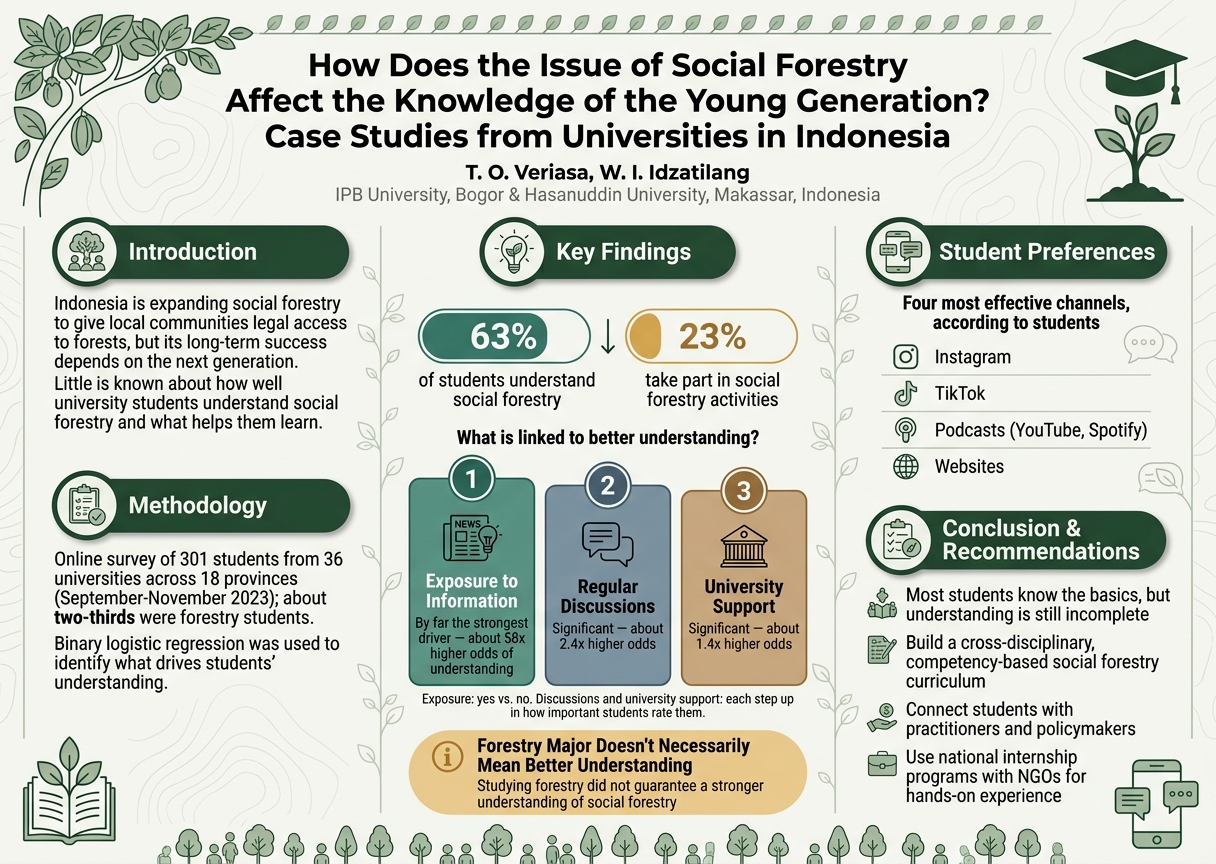
Social forestry has emerged as a key agenda for the Indonesian government, aimed at reducing inequality in forest land tenure, enhancing community welfare, and minimizing conflict. Despite the many challenges of issuing social forestry management permits, specific issues, such as transdisciplinary science, regeneration, and youth engagement as drivers and actors at the site level, have yet to receive adequate attention. This study seeks to address this information gap and contribute to the limited literature available in Indonesia. Our objectives are to understand and assess the need to strengthen students' comprehension of social forestry across various disciplines at Indonesian universities and to analyze the factors that drive a deeper understanding of social forestry among students from diverse fields. Our findings reveal that while a significant portion of students understands social forestry, only a small number of students participate in social forestry activities, both on and off campus. Our statistical analysis indicates that the quality of exposure to information and knowledge about social forestry, regular campus discussions, and supportive university policies for mainstreaming social forestry issues are significant variables that substantially enhance student knowledge and understanding. We recommend bolstering university policy support, particularly within an intergenerational framework, by facilitating discussions with external practitioners and relevant stakeholders, establishing practical learning models, and fostering hands-on experiences in social forestry.
Full text article
References
Alcón, A. I. M. (2016). Who Learns From Whom? Building up Intergenerational Bridges Through Service Learning. Procedia - Social and Behavioral Sciences, 228, 470–475. https://doi.org/10.1016/J.SBSPRO.2016.07.072
Allendorf, T. D., Radeloff, V. C., & Keuler, N. S. (2019). People’s perceptions of protected areas across spatial scales. Parks, 25(1), 25–38. https://doi.org/10.2305/IUCN.CH.2019.PARKS-25-1TDA.en
Allendorf, T. D., Swe, K. K., Aung, M., & Thorsen, A. (2018). Community use and perceptions of a biodiversity corridor in Myanmar’s threatened southern forests. Global Ecology and Conservation, 15, e00409. https://doi.org/10.1016/j.gecco.2018.e00409
Barry, B. (2017). Sustainability and intergenerational justice. Intergenerational Justice, 45(89), 183–208. https://doi.org/10.4324/9781315252100-10
Bennett, N. J. (2016). Using perceptions as evidence to improve conservation and environmental management. Conservation Biology, 30(3), 582–592. https://doi.org/10.1111/cobi.12681
Bisson, M.-J., Gilmore, C., Inglis, M., & Jones, I. (2016). Measuring Conceptual Understanding Using Comparative Judgement. International Journal of Research in Undergraduate Mathematics Education, 2(2), 141–164. https://doi.org/10.1007/s40753-016-0024-3
Chartrand, T. L., & Bargh, J. A. (1999). The chameleon effect: The perception-behavior link and social interaction. Journal of Personality and Social Psychology, 76(6), 893–910. https://doi.org/10.1037/0022-3514.76.6.893
Chua, L., Harrison, M. E., Fair, H., Milne, S., Palmer, A., Rubis, J., Thung, P., Wich, S., Büscher, B., Cheyne, S. M., Puri, R. K., Schreer, V., Stępień, A., & Meijaard, E. (2020). Conservation and the social sciences: Beyond critique and co-optation. A case study from orangutan conservation. People and Nature, 2(1), 42–60. https://doi.org/10.1002/pan3.10072
Cristancho, S., & Vining, J. (2009). Perceived intergenerational differences in the transmission of traditional ecological knowledge (TEK) in two Indigenous groups from Colombia and Guatemala. Culture and Psychology, 15(2), 229–254. https://doi.org/10.1177/1354067X09102892
Desmiwati, D., Veriasa, T. O., Aminah, A., Safitri, A. D., Agus, K., Wisudayati, T. A., Royani, H., Dewi, K. H., & Ikfal, S. N. (2021). Contribution of Agroforestry Systems to Farmer Income in State Forest Areas : A Case Study of Parungpanjang , Indonesia. Forest and Society, 5(1), 109–119. https://doi.org/10.24259/fs.v5i1.11223
Douglas, A. (2024). “Collaborators”, “Guides”, “Facilitators”, and “Advocates”: Using a Spatial Lens to Understand the Roles of NGO Practitioners in Supporting Youth Participation. Journal of Applied Youth Studies, 0123456789. https://doi.org/10.1007/s43151-024-00120-7
Eaton, S. E., Christensen, J., & Editors, H. (2022). Academic Integrity in Canada: Historical Perspectives and Current Trends. In: Eaton, S.E., Christensen Hughes, J. (eds) Academic Integrity in Canada. Ethics and Integrity in Educational Contexts, vol 1. In Springer, Cham.
Elias, M., Zaremba, H., Tavenner, K., Ragasa, C., Paez Valencia, A. M., Choudhury, A., & de Haan, N. (2024). Towards gender equality in forestry, livestock, fisheries and aquaculture. Global Food Security, 41(March 2023). https://doi.org/10.1016/j.gfs.2024.100761
Erbaugh, J. T. (2019). Responsibilization and social forestry in Indonesia. Forest Policy and Economics, 109(October), 102019. https://doi.org/10.1016/j.forpol.2019.102019
Fischer, H. W., Chhatre, A., Duddu, A., Pradhan, N., & Agrawal, A. (2023). Community forest governance and synergies among carbon, biodiversity and livelihoods. Nature Climate Change, 1–8. https://doi.org/10.1038/s41558-023-01863-6
Gentle, P., & Thwaites, R. (2016). Transhumant Pastoralism in the Context of Socioeconomic and Climate Change in the Mountains of Nepal. Mountain Research and Development, 36(2), 173–182. https://doi.org/10.1659/MRD-JOURNAL-D-15-00011.1
Hartley, J. M., Stevenson, K. T., Peterson, M. N., Busch, K. C., Carrier, S. J., DeMattia, E. A., Jambeck, J. R., Lawson, D. F., & Strnad, R. L. (2021). Intergenerational learning: A recommendation for engaging youth to address marine debris challenges. Marine Pollution Bulletin, 170, 112648. https://doi.org/10.1016/J.MARPOLBUL.2021.112648
Igbinenikaro, O. P., Olugbenga, A. O., & Etukudoh, E. A. (2024). Fostering Cross-Disciplinary Collaboration in Offshore Projects: Strategies and Best Practices. International Journal of Management & Entrepreneurship Research, 6(4), 1176–1189. https://doi.org/10.51594/ijmer.v6i4.1006
KC, B., & Race, D. (2019). Outmigration and Land-Use Change: A Case Study from the Middle Hills of Nepal. Land, 9(1), 2. https://doi.org/10.3390/land9010002
Kesharwani, A. (2020). Do (how) digital natives adopt a new technology differently than digital immigrants? A longitudinal study. Information & Management, 57(2), 103170. https://doi.org/10.1016/J.IM.2019.103170
Kheynad, Christine Wulandari, Eny Puspasari, & Pitojo Budiono. (2025). CORRELATION OF KNOWLEDGE AND COMMUNITY PARTICIPATION IN LAND CONSERVATION-BASED AGROFORESTRY: A CASE STUDY IN TANJUNG AGUNG VILLAGE, LAMPUNG. Jurnal Belantara, 8(2), 217–225. https://doi.org/10.29303/jbl.v8i2.1117
Korhonen, J., Miettinen, J., Kylkilahti, E., Tuppura, A., Autio, M., Lähtinen, K., Pätäri, S., Pekkanen, T. L., Luhas, J., Mikkilä, M., Linnanen, L., Ollikainen, M., & Toppinen, A. (2021). Development of a forest-based bioeconomy in Finland: Insights on three value networks through expert views. Journal of Cleaner Production, 299. https://doi.org/10.1016/j.jclepro.2021.126867
Kusuma, A. F., Sahide, M. A. K., Purwanto, R. H., Ismariana, E., Santoso, W. B., Wulandari, E., & Maryudi, A. (2023). Emergent Institutional Issues from New Tenure Reforms and Social-Forestry Initiatives in Indonesia: Notes from The Field. Forest and Society, 7(2), 450–466. https://doi.org/10.24259/fs.v7i2.28319
Lotrecchiano, G. R., Mallinson, T. R., Leblanc-Beaudoin, T., Schwartz, L. S., Lazar, D., & Falk-Krzesinski, H. J. (2016). Individual motivation and threat indicators of collaboration readiness in scientific knowledge producing teams: a scoping review and domain analysis. Heliyon, 2(5). https://doi.org/10.1016/j.heliyon.2016.e00105
Lund, J. F. (2015). Paradoxes of participation: The logic of professionalization in participatory forestry. Forest Policy and Economics, 60, 1–6. https://doi.org/10.1016/J.FORPOL.2015.07.009
Maleknia, R., Azizi, R., & Hălălișan, A. F. (2024). Developing a specific model to exploring the determinant of individuals’ attitude toward forest conservation. Frontiers in Psychology, 15(October). https://doi.org/10.3389/fpsyg.2024.1481087
Martin, A. J. F., Olson, L. G., & Almas, A. D. (2024). Knowledge translation for the advancement of practice: A survey of facilitators and barriers in arboriculture and urban forestry. Urban Forestry and Urban Greening, 94(January), 128242. https://doi.org/10.1016/j.ufug.2024.128242
MoEF. (2016). The Regulation of Minister of Environment and Forestry Republic Indonesia No P.83/2016 concerning Social Forestry.
Msebi, M., & Beukes, J. W. (2024). Enhancing youth involvement in community development: A pragmatic strategy for local churches. Verbum et Ecclesia, 45(1). https://doi.org/10.4102/ve.v45i1.2956
O’Neill, F., & Viljoen, J. M. (2021). Expanding ‘conceptual horizons’: a reflexive approach to intercultural pedagogies in higher education. Language and Intercultural Communication, 21(5), 572–587. https://doi.org/10.1080/14708477.2021.1888965
Padgett, D. K. (2009). GUEST EDITORIAL: Qualitative and Mixed Methods in Social Work Knowledge Development. Social Work, 54(2), 101–105.
Ragandhi, A., Hadna, A. H., Setiadi, S., & Maryudi, A. (2021). Why do greater forest tenure rights not enthuse local communities? An early observation on the new community forestry scheme in state forests in Indonesia. Forest and Society, 5(1), 159–166. https://doi.org/10.24259/fs.v5i1.11723
Resosudarmo, I. A. P., Tacconi, L., Sloan, S., Hamdani, F. A. U., Subarudi, Alviya, I., & Muttaqin, M. Z. (2019a). Indonesia’s land reform: Implications for local livelihoods and climate change. Forest Policy and Economics, 108(August 2018), 101903. https://doi.org/10.1016/j.forpol.2019.04.007
Resosudarmo, I. A. P., Tacconi, L., Sloan, S., Hamdani, F. A. U., Subarudi, Alviya, I., & Muttaqin, M. Z. (2019b). Indonesia’s land reform: Implications for local livelihoods and climate change. Forest Policy and Economics, 108(August 2018), 101903. https://doi.org/10.1016/j.forpol.2019.04.007
Robson, J. P., Wilson, S. J., Sanchez, C. M., & Bhatt, A. (2020). Youth and the future of community forestry. Land, 9(11), 1–24. https://doi.org/10.3390/land9110406
Rustiadi, E., & Veriasa, T. O. (2022). Towards Inclusive Indonesian Forestry: An Overview of a Spatial Planning and Agrarian Perspective. Jurnal Manajemen Hutan Tropika, 28(1), 60–71. https://doi.org/10.7226/jtfm.28.1.60
Sahide, M. A. K., Fisher, M. R., Erbaugh, J. T., Intarini, D., Dharmiasih, W., Makmur, M., Faturachmat, F., Verheijen, B., & Maryudi, A. (2020). The boom of social forestry policy and the bust of social forests in Indonesia: Developing and applying an access-exclusion framework to assess policy outcomes. Forest Policy and Economics, 120(September), 102290. https://doi.org/10.1016/j.forpol.2020.102290
Sarigumba, M. P., Soriano, M., Robson, J. P., Quiviquivi, I., & Cabrera, O. L. (2023). Understanding the role of youth in Indigenous territorial governance. Frontiers in Environmental Science, 11(October), 1–18. https://doi.org/10.3389/fenvs.2023.1200434
Sarstedt, M., & Mooi, E. (2014). Regression analysis. A concise guide to market research: The process, data, and methods using IBM SPSS Statistics . Springer-Verlag Berlin Heidelberg. https://doi.org/10.1007/978-3-642-53965-7
Sevnarayan, K., & Maphoto, K. B. (2024). Exploring the Dark Side of Online Distance Learning: Cheating Behaviours, Contributing Factors, and Strategies to Enhance the Integrity of Online Assessment. Journal of Academic Ethics, 22(1), 51–70. https://doi.org/10.1007/s10805-023-09501-8
Shahrier, S., Kotani, K., & Saijo, T. (2017). Intergenerational sustainability dilemma and the degree of capitalism in societies: a field experiment. Sustainability Science, 12(6), 957–967. https://doi.org/10.1007/s11625-017-0447-z
Sirimorok, N., Sahide, M. A. K., Herrawan, H., Faturachmat, F., & Maryudi, A. (2024). Linking commoning with social forestry: An Indonesian case. Trees, Forests and People, 18(November), 100737. https://doi.org/10.1016/j.tfp.2024.100737
Sloan Morgan, O. V., Thomas, K., & McNab-Coombs, L. (2022). Envisioning healthy futures: Youth perceptions of justice-oriented environments and communities in Northern British Columbia Canada. Health & Place, 76, 102817. https://doi.org/10.1016/J.HEALTHPLACE.2022.102817
Timilsina, R. R., Kotani, K., Nakagawa, Y., & Saijo, T. (2021). Concerns for future generations in societies: A deliberative analysis of the intergenerational sustainability dilemma. Journal of Behavioral and Experimental Economics , 90. https://doi.org/10.1016/j.socec.2020.101628
Timilsina, R. R., Kotani, K., Nakagawa, Y., & Saijo, T. (2022). Intragenerational deliberation and intergenerational sustainability dilemma. European Journal of Political Economy, 73. https://doi.org/10.1016/j.ejpoleco.2021.102131
Tong, Y., Pang, L., Sun, M., & Han, J. (2023). Detection of Multi-dimensional Driving Forces of Public Environmental Concern in China: Based on Spatial Heterogeneity Perspectives. Chinese Geographical Science, 33(6), 1109–1126. https://doi.org/10.1007/s11769-023-1378-5
Trumpower, D. L., & Goldsmith, T. E. (2004). Structural enhancement of learning. Contemporary Educational Psychology, 29(4), 426–446. https://doi.org/10.1016/J.CEDPSYCH.2004.02.001
Twongyirwe, R., Bithell, M., Richards, K. S., & Rees, W. G. (2017). Do livelihood typologies influence local perceptions of forest cover change? Evidence from a tropical forested and non-forested rural landscape in western Uganda. Journal of Rural Studies, 50, 12–29. https://doi.org/10.1016/j.jrurstud.2016.12.009
Veriasa, T. O., Aliviani, A., Imron, N. A., Yulianto, F. D., & Cantika, F. S. P. (2024). Berpikir & Bertindak untuk Perubahan Bermakna: Menakar Dampak Sekolah Sosial Forestri (SESORE) (1st ed.). PT Penerbit IPB Press.
Veriasa, T. O., Daxoko, B. T., Imron, N. A., Kosar, M., & Santosa, A. (2023). Memperbaiki Kinerja Perhutanan Sosial Menuju Keberlanjutan Hutan Jawa. Policy Brief Pertanian, Kelautan Dan Biosains Tropika, 5(4). https://doi.org/10.29244/agro-maritim.5.4.17-28
Vitvitskaya, O., Suyo-Vega, J. A., Meneses-La-Riva, M. E., & Fernández-Bedoya, V. H. (2022). Behaviours and Characteristics of Digital Natives Throughout the Teaching-Learning Process: A Systematic Review of Scientific Literature from 2016 to 2021. Academic Journal of Interdisciplinary Studies, 11(3), 38–49. https://doi.org/10.36941/ajis-2022-0066
Zurba, M., & Trimble, M. (2014). Youth as the inheritors of collaboration: Crises and factors that influence participation of the next generation in natural resource management. Environmental Science & Policy, 42, 78–87. https://doi.org/10.1016/J.ENVSCI.2014.05.009
Authors
Copyright (c) 2026 Jurnal Manajemen Hutan Tropika

This work is licensed under a Creative Commons Attribution 4.0 International License.
Jurnal Manajemen Hutan Tropika is an open access journal which means that all contents is freely available without charge to the user or his/her institution. Users are allowed to read, download, copy, distribute, print, search, or link to the full texts of the articles in this journal without asking prior permission from the publisher or the author. This is in accordance with the Budapest Open Access Initiative (BOAI) definition of open access.Article Details