
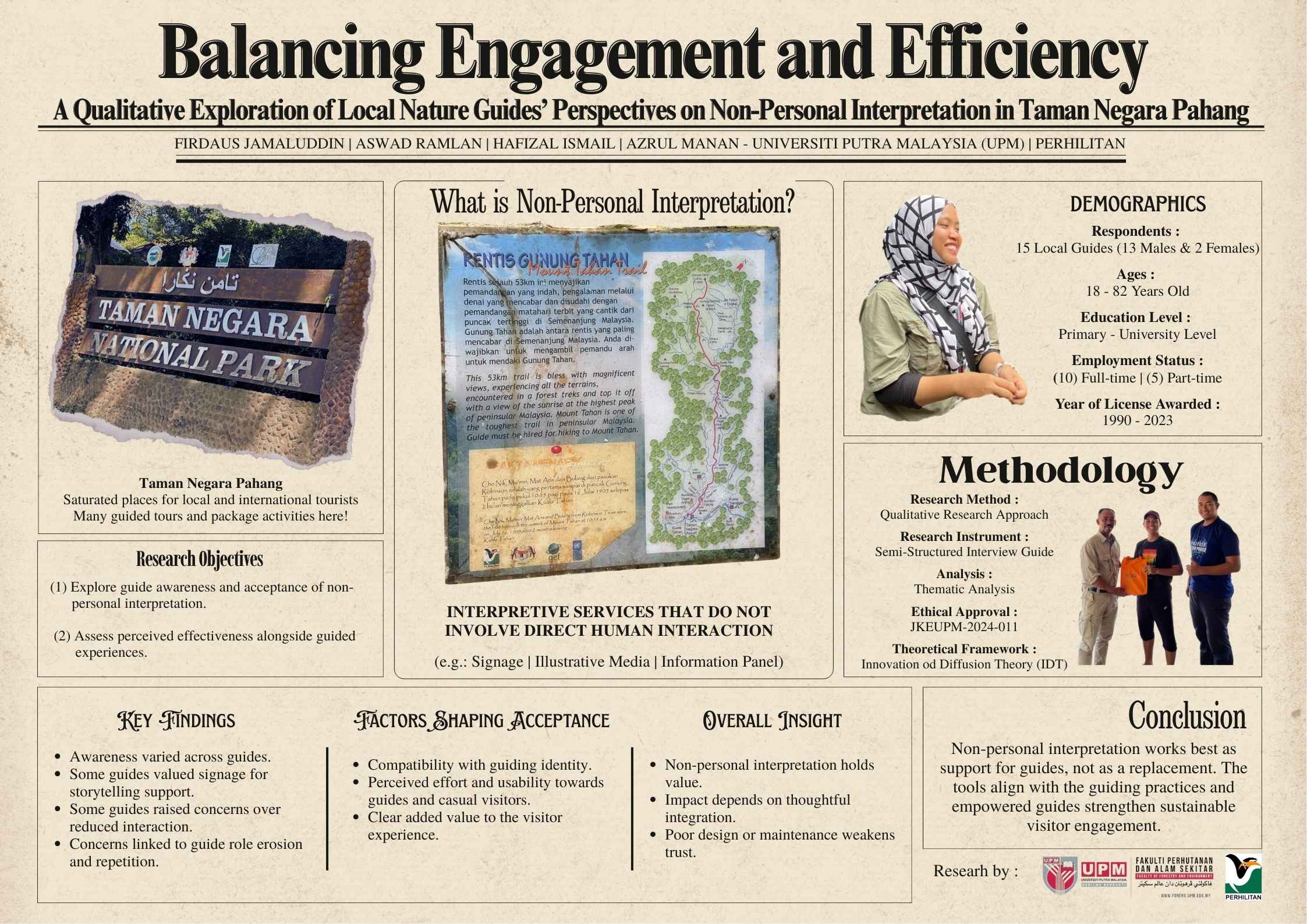
Balancing Engagement and Efficiency: A Qualitative Exploration of Local Nature Guides’ Perspectives on Non-Personal Interpretation in Taman Negara Pahang

Article Sidebar
-
nature-based tourism, innovation adoption, visitor engagement strategies, non-personal tools
Abstract
The post-pandemic resurgence of nature-based tourism has intensified visitor pressure on ecologically sensitive areas such as Taman Negara Pahang, Malaysia, prompting a renewed focus on sustainable visitor management strategies. This study explored the awareness, acceptance, and perceived effectiveness of non-personal interpretation among local nature guides, with attention to its role in complementing traditional guiding experiences. Using a qualitative design, semi-structured interviews were conducted with fifteen certified local guides and analyzed thematically, guided by Rogers’ innovation diffusion theory. The findings revealed varied responses regarding awareness and understanding, with some guides viewing non-personal interpretation, such as signage and panels, as beneficial for enhancing storytelling and engaging independent visitors. Others expressed concerns about redundancy, reduced guide-visitor interaction, and the diminished role of personal interpretation. Key determinants of acceptance or resistance included compatibility with guiding roles, perceived complexity, and relative advantage. Overall, non-personal interpretation was recognized as a potentially valuable tool when strategically integrated and well-maintained. The study concludes that effective implementation requires participatory planning, alignment with guiding practices, and ongoing support from park authorities. These insights inform interpretive management strategies and highlight the importance of empowering local guides in developing inclusive, effective, and sustainable visitor engagement approaches in protected areas.
Full text article
References
Aziz, A., Alias, S. N. H. S., Jamaludin, M., Idris, N. H., & Mariapan, M. (2017). The attractiveness of Taman Negara National Park, Malaysia as perceived by local visitors. Journal of Wildlife and Parks, 33, 1–13. https://doi.org/10.64291/fxsrtz68
Ballantyne, R., Packer, J., & Sutherland, L. A. (2011). Visitors’ memories of wildlife tourism: Implications for the design of powerful interpretive experiences. Tourism Management, 32(4), 770–779. https://doi.org/10.1016/j.tourman.2010.06.012
Baloch, Q. B., Shah, S. N., Iqbal, N., Sheeraz, M., Asadullah, M., Mahar, S., & Khan, A. U. (2023). Impact of tourism development upon environmental sustainability: A suggested framework for sustainable ecotourism. Environmental Science and Pollution Research International, 30(3), 5917–5930. https://doi.org/10.1007/s11356-022-22496-w
Braun, V., & Clarke, V. (2006). Using thematic analysis in psychology. Qualitative Research in Psychology, 3, 77–101. https://doi.org/10.1191/1478088706qp063oa
Busetto, L., Wick, W., & Gumbinger, C. (2020). How to use and assess qualitative research methods. Neurological Research and Practice, 2(1), Article 14. https://doi.org/10.1186/s42466-020-00059-z
Cheng, T., Cao, M., & Wang, J. (2017). A review of environmental interpretation research in the West in the past decade. In Proceedings of the 3rd international conference on economics, management, law and education (EMLE). Atlantis Press. Zhengzhou, China. https://doi.org/10.2991/emle-17.2017.100
Hamilton, M. (2022). How can a non-personal interpretive guide increase place attachment for visitors, encourage the appropriate development of sustainable community-based ecotourism, and increase knowledge of the desert and coastal ecosystems and migratory whales of Baja Mexico? School of Education and Leadership Student Capstone Projects, 831.
Hughes, M., & Morrison-Saunders, A. (2002). Impact of trailside interpretive signs on visitor knowledge. Journal of Ecotourism, 1, 122–132. https://doi.org/10.1080/14724040208668119
Kohl, J. (2008). Environmental interpretation versus environmental education as an ecotourism conservation strategy. In A. Stronza, & W. H. Durham (Eds.), Ecotourism and conservation in the Americas (pp. 127–140). CABI Dgital Library. https://doi.org/10.1079/9781845934002.0127
Lincoln, Y. S. (1995). Emerging criteria for quality in qualitative and interpretive research. Qualitative Inquiry, 1(3), 275–289. https://doi.org/10.1177/107780049500100301
Miller, J. (2013, March 30). From personal to non-personal interpretation. Interpretive Communications. https://interpcomm.com/2013/03/30/from-personal-to-non-personal-interpretation/
Ministry of Tourism, Arts and Culture Pahang. (2023). Senarai nama pemandu pelancong Taman Negara Kuala Tahan Jerantut.
Moscardo, G. (2020). Stories and design in tourism. Annals of Tourism Research, 83, Article 102950. https://doi.org/10.1016/j.annals.2020.102950
Moscardo, G., Woods, B., & Saltzer, R. (2004). The role of interpretation in wildlife tourism. In K. Higginbottom (Ed.), Wildlife tourism: Impacts, management and planning (pp. 231–251). Common Ground Publishing, Altona, Victoria, Australia.
Munro, J. K., Morrison-Saunders, A., & Hughes, M. (2008). Environmental interpretation evaluation in natural areas. Journal of Ecotourism, 7(1), 1–14. https://doi.org/10.2167/joe137.0
Pendit, U. C., & Zaibon, S. B. (2013). Non-personal digital interpretive media at cultural heritage. In Proceedings of the 4th international conference on computing and informatics (ICOCI) (pp. 346–351). Universiti Utara Malaysia.
Rahimi, S., & Khatooni, M. (2024). Saturation in qualitative research: An evolutionary concept analysis. International Journal of Nursing Studies Advances, 6, Article 100174. https://doi.org/10.1016/j.ijnsa.2024.100174
Reja, U., Manfreda, K., Hlebec, V., & Vehovar, V. (2003). Open-ended vs. close-ended questions in web questionnaires. Developments in Applied Statistics, 19, 159–177.
Roberts, M., Mearns, K., & Edwards, V. (2014). Evaluating the effectiveness of guided versus non-guided interpretation in the Kruger National Park, South Africa. Koedoe-African Protected Area Conservation and Science, 56(2), Article a1160. https://doi.org/10.4102/koedoe.v56i2.1160
Rogers, E. M. (1983). Diffusion of innovations (3rd ed.). Free Press
Rogers, E. M. (2003). Diffusion of innovations (5th ed.). Simon and Schuster.
Tilden, F. (1977). Interpreting our heritage (3rd ed.). University of North Carolina Press.
Weiler, B., & Black, R. (2015). The changing face of the tour guide: One-way communicator to choreographer to co-creator of the tourist experience. Tourism Recreation Research, 40(3), 364–378. https://doi.org/10.1080/02508281.2015.1083742
Weiler, B., & Walker, K. (2014). Enhancing the visitor experience: Reconceptualising the tour guide’s communicative role. Journal of Hospitality and Tourism Management, 21, 90–99. https://doi.org/10.1016/j.jhtm.2014.08.001
Authors
Copyright (c) 2026 Jurnal Manajemen Hutan Tropika

This work is licensed under a Creative Commons Attribution 4.0 International License.
Jurnal Manajemen Hutan Tropika is an open access journal which means that all contents is freely available without charge to the user or his/her institution. Users are allowed to read, download, copy, distribute, print, search, or link to the full texts of the articles in this journal without asking prior permission from the publisher or the author. This is in accordance with the Budapest Open Access Initiative (BOAI) definition of open access.Article Details
How to Cite



