
Media Framing of Human–Orangutan Interactions in Kalimantan: A Topic Modelling and Sentiment Analysis Approach

Article Sidebar
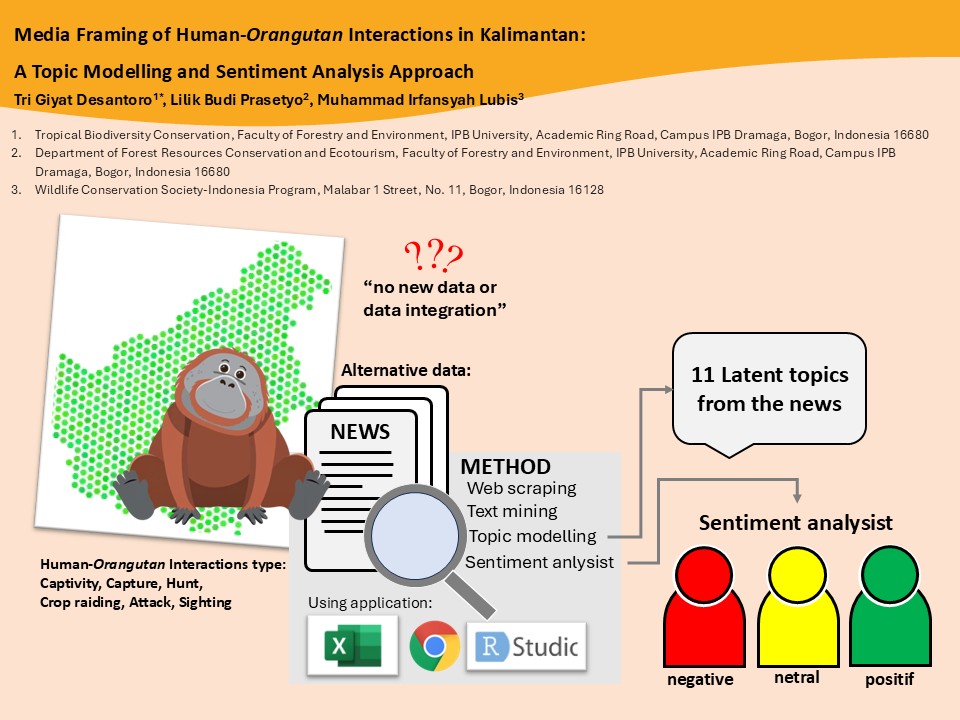
-
conservation response, bornean orangutan, topic modelling, text mining, media-based monitoring
Abstract
People's perceptions of orangutans strongly influence their responses in every interaction, which can have negative impacts on both humans and orangutans. Misperceptions, fear, or negative attitudes may increase the risk of conflict, injury, or retaliatory actions, thereby threatening conservation outcomes. Understanding community sentiment toward human–orangutan interactions is therefore essential for designing effective conservation strategies. However, direct data collection to understand community sentiment often faces cost and accuracy constraints. Therefore, an alternative approach that is more efficient and objective is needed to capture community sentiment toward human-orangutan interactions. This research offers latent topic modelling and sentiment analysis of online news articles as a novel method to understand these dynamics and support conservation efforts. A total of 11 latent topics were obtained from the news articles. Orangutan sightings and handovers of orangutans were the most frequently discussed in 2016. Palm oil plantations emerged as a prominent topic related to human-orangutan interaction incidents. Negative sentiment was predominantly linked to topic such as injured orangutans and orangutan sightings on plantations, whereas orangutan translocation received the highest positive sentiment score. This study highlights the potential of natural language processing for analyzing Indonesian language texts in conservation contexts, with applications extendable to broader environmental and forestry issues such as deforestation and wildlife hunting.
Full text article
References
Abram, N. K., Meijaard, E., Wells, J. A., Ancrenaz, M., Pellier, A. S., Runting, R. K., Gaveau, D., Wich, S., Nardiyono, Tjiu, A., Nurcahyo, A., & Mengersen, K. (2015). Mapping perceptions of species’ threats and population trends to inform conservation efforts: the Bornean orangutan case study. Diversity and Distributions, 21(5), 487–499. https://doi.org/10.1111/ddi.12286
Ancrenaz, M., Gumal, M., Marshall, A. J., Meijaard, E., Wich, S. A., & Husson, S. (2016). Pongo pygmaeus (Errata version published in 2018). The IUCN red list of threatened species 2016: e.T17975A123809220. https://doi.org/10.2305/IUCN.UK.2016-1.RLTS.T17975A17966347.en
Ancrenaz, M., Oram, F., Laurentius, A., Lackman, I., Ahmad, E., Elahan, H., Kler, H., Abram, N. K., & Meijaard, E. (2014). Of pongo, palms and perceptions: A multidisciplinary assessment of bornean orang-utans Pongo pygmaeus in an oil palm context. Oryx, 49(3), 465–472. https://doi.org/10.1017/S0030605313001270
Aprillyasari, W. M. (2023). Hubungan aktivitas antropogenik dengan interaksi orangutan dan manusia di Suaka Margasatwa Lamandau [thesis]. Bogor: IPB University.
Aprillyasari, W. M., Sunkar, A., & Rahman, D. A. (2025). Two sides of a coin: Do genders affect human-orangutan interactions in Lamandau Wildlife Reserve, Central Kalimantan? Media Konservasi, 30(1), 73–83. https://doi.org/10.29244/medkon.30.1.73
Ardiantiono., Alfarisi, A. M., Ishaq, Y., Wijaya, R., Septian, R., Hadi, A. N., Surya, R. A., & Rahmi, T. (2022). Analisis konten pemberitaan interaksi manusia-satwa predator di Indonesia. Jurnal Belantara, 5(2), 153–168. https://doi.org/10.29303/jbl.v5i2.874
Bache, S. M., & Wickham, H., (2022). magrittr: A forward-pipe operator for R. Retrieved from https://CRAN.R-project.org/package=magrittr
Blei, D. M., Ng, A. Y., & Jordan, M. I. (2003). Latent dirichlet allocation. In T. G. Dietterich, S. Becker, & Z. Ghahramani (Eds.), Advances in neural information processing systems 14: Proceedings of the 2001 conference (pp. 601–608). MIT Press. https://doi.org/10.7551/mitpress/1120.003.0082
Campbell‐Smith, G., Simanjorang, H. V. P., Leader‐Williams, N., & Linkie, M. (2010). Local attitudes and perceptions toward crop‐raiding by orangutans (Pongo abelii) and other nonhuman primates in northern Sumatra, Indonesia. American Journal of Primatology, 72(10), 866–876. https://doi.org/10.1002/ajp.20822
Campbell-Smith, G., Campbell-Smith, M., Singleton, I., & Linkie, M. (2011). Raiders of the Lost Bark: Orangutan foraging strategies in a degraded landscape. PLoS ONE, 6(6), Article e20962. https://doi.org/10.1371/journal.pone.0020962
Chamberlain, J. (2018). Using social media for biomonitoring: How Facebook, Twitter, Flickr and other social networking platforms can provide large-scale biodiversity data. Advances in Ecological Research, 59, 133–168. https://doi.org/10.1016/bs.aecr.2018.06.001
Davis, J. T., Mengersen, K., Abram, N. K., Ancrenaz, M., Wells, J. A., & Meijaard, E. (2013). It’s not just conflict that motivates killing of orangutans. PLoS ONE, 8(10), Article e75373. https://doi.org/10.1371/journal.pone.0075373
Egri, G., Han, X., Ma, Z., & Chakraborty, S. (2021). Classifying and analysing human-wildlife conflicts in India using news articles. EasyChair Preprint 5989. Retrieved from https://easychair.org/publications/preprint/8nS7
Fredriksson, G. (2005). Human-sun bear conflicts in East Kalimantan, Indonesian Borneo. Ursus, 16(1), 130–137. https://doi.org/10.2192/1537-6176(2005)016[0130:HBCIEK]2.0.CO;2
Gaynor, K. M., Hayes, F. P., Manlove, K., Galloway, N., Benson, J. F., Cherry, M. J., Epps, C. W., Fletcher, J. r., Orrock, J., Smith, J. A., Aiello, C., Belant, J. L., Berger, J., Biel, M., Bright, J., Bump, J., Burchett, M., Butler, C., Carlson, J., ..., & Cross, C . P. (2025). The influence of human presence and footprint on animal space use in US national parks. Proceedings of the Royal Society B, 292, Article 20251013. http://doi.org/10.1098/rspb.2025.1013
Griffiths, T. L., & Steyvers, M. (2004). Finding scientific topics. Proceedings of the National Academy of Sciences of the United States of America, 101(suppl_1), 5228–5235. https://doi.org/10.1073/pnas.0307752101
Grün, B., & Hornik, K. (2011). topicmodels: An package for fitting topic models. Journal of Statistical Software, 40(13), 1–30. https://doi.org/10.18637/jss.v040.i13
Grundei, L. -L., Schöttes, F. M., Gethöffer, F., Tost, D., Kluge, L., Siebert, U., & Pees, M. (2024). Human–wildlife interaction–a social survey. Animals, 14(5), Article 808. https://doi.org/10.3390/ani14050808
Hanifah, M., Syaufina, L., & Prasasti, I. (2016). The detection of burnt area using medium resolution satellite imagery of MODIS based on fire index approach. Jurnal Pengelolaan Sumberdaya Alam dan Lingkungan, 6(1), 77–85. https://doi.org/10.29244/jpsl.6.1.77
Hornik, K., Meyer, D., & Buchta, C. (2024). slam: Sparse lightweight arrays and matrices. https://doi.org/10.32614/CRAN.package.slam
Ihsan, F., Suciadi, H., Latifatunnisa, H., Rosatika, F., Afandi, R., Stephen-Moore, R., & Sanchez, K. L. (2024, November 23–27). Analysis of slow loris threats and conservation efforts from online news headlines using machine learning [Conference presentation]. Asian Primates Symposium, Medan, Sumatra Utara, Indonesia.
Jones, T. (2015). textmineR: Functions for text mining and topic modeling. Version 3.0.5. https://doi.org/10.32614/CRAN.package.textmineR
Khatoon, R., Anwar, M., Nilon, C. H., & Gompper, M. E. (2022). Human-carnivore conflicts in a recently established Pakistani national park. Human-Wildlife Interactions, 16(1), 144–157. https://doi.org/10.26077/4a09-b334
Khoo, C. S. G., & Johnkhan, S. B. (2017). Lexicon-based sentiment analysis: Comparative evaluation of six sentiment lexicons. Journal of Information Science, 44(4), 491–511. https://doi.org/10.1177/0165551517703514
Kolde, R. (2019). pheatmap: Pretty heatmaps. Version 1.0.12. https://doi.org/10.32614/CRAN.package.pheatmap
Koto, F, & Rahmaningtyas, G. Y. (2017). Inset lexicon: Evaluation of a word list for Indonesian sentiment analysis in microblogs. In 2017 International conference on Asian language processing (pp. 391–394), Singapore. https://doi.org/10.1109/IALP.2017.8300625
Kretser, H. E., Curtis, P. D., Fracis, J. D., Pendall, R. J., & Knutuh, B. A. (2009). Factors affecting perceptions of human–wildlife interactions in residential areas of northern New York and implications for conservation. Human Dimensions of Wildlife, 14(2), 102–118. https://doi.org/10.1080/10871200802695594
Meijaard, E., Buchori, D., Hadiprakarsa, Y., Utami-Atmoko, S. S., Nurcahyo, A., Tjiu, A., Prasetyo, D., Nardiyono, Christie, L., Ancrenaz, M., Abadi, F., Antoni, I. N. G., Armayadi, D., Dinato, A., Gumelar, E. P., Indrawan, T. P., Kussaritano, Munajat, C., Priyono, C. W. P., ..., & Mengersen, K. (2011). Quantifying killing of orangutans and human-orangutan conflict in Kalimantan, Indonesia. PLoS ONE, 6(11), Article e27491. https://doi.org/10.1371/journal.pone.0027491
Mimno, D., Wallach, H., Talley, E., Leenders, M., & McCallum, A. (2011). Optimizing semantic coherence in topic models. Proceedings of the 2011 Conference on Empirical Methods in Natural Language Processing, 2011, 262–272.
Neo, W. H. Y., Lubis, M. I., & Lee, J. S. H. (2023). Settlements and plantations are sites of human–tiger interactions in Riau, Indonesia. Oryx, 57(4), 476–480. https://doi.org/10.1017/S0030605322000667
Nikita, M. (2015). ldatuning: Tuning of the latent dirichlet allocation models parameters. Version 1.0.2. https://doi.org/10.32614/CRAN.package.ldatuning
Ohtani, S. (2022). How is people’s awareness of “biodiversity” measured? Using sentiment analysis and LDA topic modeling in the twitter discourse space from 2010 to 2020. SN Computer Science, 3(5), Article 371. https://doi.org/10.1007/s42979-022-01276-w
Oram, F., Kapar, M. D., Saharon, A. R., Elahan, H., Segaran, P., Poloi, S., Saidal, H., Abulani, A., Lackman, I., & Ancrenaz, M. (2022). Engaging the enemy: Orangutan (Pongo pygmaeus morio) conservation in human modified environments in the Kinabatangan floodplain of Sabah, Malaysian Borneo. International Journal of Primatology, 43(6), 1067–1094. https://doi.org/10.1007/s10764-022-00288-w
Perepolkin, D. (2019). polite: Be nice on the web. Version 0.1.3. https://doi.org/10.32614/CRAN.package.polite
Qomariah, I. N., Rahmi, T., Said, Z., & Wijaya, A. (2018). Conflict between human and wild sumatran elephant (Elephas maximus sumatranus Temminck, 1847) in Aceh Province, Indonesia. Biodiversitas, 20(1), 77–84. https://doi.org/10.13057/biodiv/d200110
Risdiyanto, I., Santosa, Y., Santoso, N., & Sunkar, A. (2023). MaxEnt model application for conflict mitigation of bornean orangutan (Pongo pygmaeus wurmbii) in oil palm plantation. IOP Conference Series: Earth and Environmental Science, 1243, Article e012022. https://doi.org/10.1088/1755-1315/1243/1/012022
Sherman, J., Ancrenaz, M., & Meijaard, E. (2020). Shifting apes: Conservation and welfare outcomes of bornean orangutan rescue and release in Kalimantan, Indonesia. Journal for Nature Conservation, 55, Article 125807. https://doi.org/10.1016/j.jnc.2020.125807
Soehartono, T., Susilo, H. D., Andayani, N., Utami-Atmoko, S. S., Sihite, J., Saleh, C., & Sutrisno, A. (2007). Strategi rencana aksi konservasi orangutan Indonesia 2007–2017. Jakarta: Direktorat Jenderal Perlindungan Hutan dan Konservasi Alam, Departemen Kehutanan Republik Indonesia.
Suwannarong, K., Soonthornworasiri, N., Maneekan, P., Balthip, K., Yimsamran, S., Maneewatchararangsri, S., Ponlap, T., Saengkul, C., Lantican, C., Thammasutti, K., & Singhasivanon, P. (2023). Love or conflict: A qualitative study of the human-long tailed macaque interface in Nakhon Sawan Province, Thailand. Acta Tropica, 240, Article 106861. https://doi.org/10.1016/j.actatropica.2023.106861
Tala, F. Z. (2016). A study of stemming effects on information retrieval in Bahasa Indonesia. The Netherlands: Universiteit van Amsterdam.
Utami-Atmoko, S. S, Traylor-Holzer, K., Rifqi, M. A., Siregar, P. G., Achmad, B., Priadjati, A., Husson, S. J., Wich, S. A., Hadisiswoyo, P., Saputra, F., Campbell-Smith, G., Kuncoro, P., Russon, A., Voigh, M., Santika, T., Nowak, M., Singleton, I., Sapari, I., Meididit, A., ..., & Less, C. M. (Eds.). (2017). Orangutan population and habitat viability assessment: Final report. Bogor: IUCN/SSC Conservation Breeding Specialist Group.
van Der Loo, M. (2013). stringdist: Approximate string matching, fuzzy text search, and string distance functions. Version 0.9.15. https://doi.org/10.32614/CRAN.package.stringdist
Wibowo, A. P., & Papilaya, F. S. (2020). Analisis pola kebakaran lahan di Kalimantan Timur dengan MODIS dan VIIRS. Media Komunikasi Geografi, 21(1), 84–98. https://doi.org/10.23887/mkg.v21i1.23253
Wickham, H. (2009). stringr: Simple, consistent wrappers for common string operations. Version 1.5.1. https://doi.org/10.32614/CRAN.package.stringr
Wickham, H. (2014). rvest: Easily harvest (Scrape) web pages. Version 1.0.4. https://doi.org/10.32614/CRAN.package.rvest
Wickham, H. (2016). ggplot2: Elegant graphics for data analysis. https://doi.org/10.1007/978-0-387-98141-3
Wickham, H., François, R., Henry, L., Müller, K., & Vaughan, D. (2015). dplyr: A grammar of data manipulation. https://doi.org/10.32614/CRAN.package.dplyr
Yi, L., Liu, B., & Li, X. (2003). Eliminating noisy information in Web pages for data mining. In Proceedings of the ninth ACM SIGKDD international conference on knowledge discovery and data mining (pp. 296–305). Association for Computing Machinery, New York, USA. https://doi.org/10.1145/956750.956785
Authors
Copyright (c) 2026 Jurnal Manajemen Hutan Tropika

This work is licensed under a Creative Commons Attribution 4.0 International License.
Jurnal Manajemen Hutan Tropika is an open access journal which means that all contents is freely available without charge to the user or his/her institution. Users are allowed to read, download, copy, distribute, print, search, or link to the full texts of the articles in this journal without asking prior permission from the publisher or the author. This is in accordance with the Budapest Open Access Initiative (BOAI) definition of open access.Article Details
How to Cite



