
Wildlife Value Orientations towards Hunting among Communities in Bintulu, Sarawak: A Comparison of the Demographic Factors

Article Sidebar
-
wildlife value orientation, wildlife hunting, wildlife conservation, community, Sarawak
Abstract
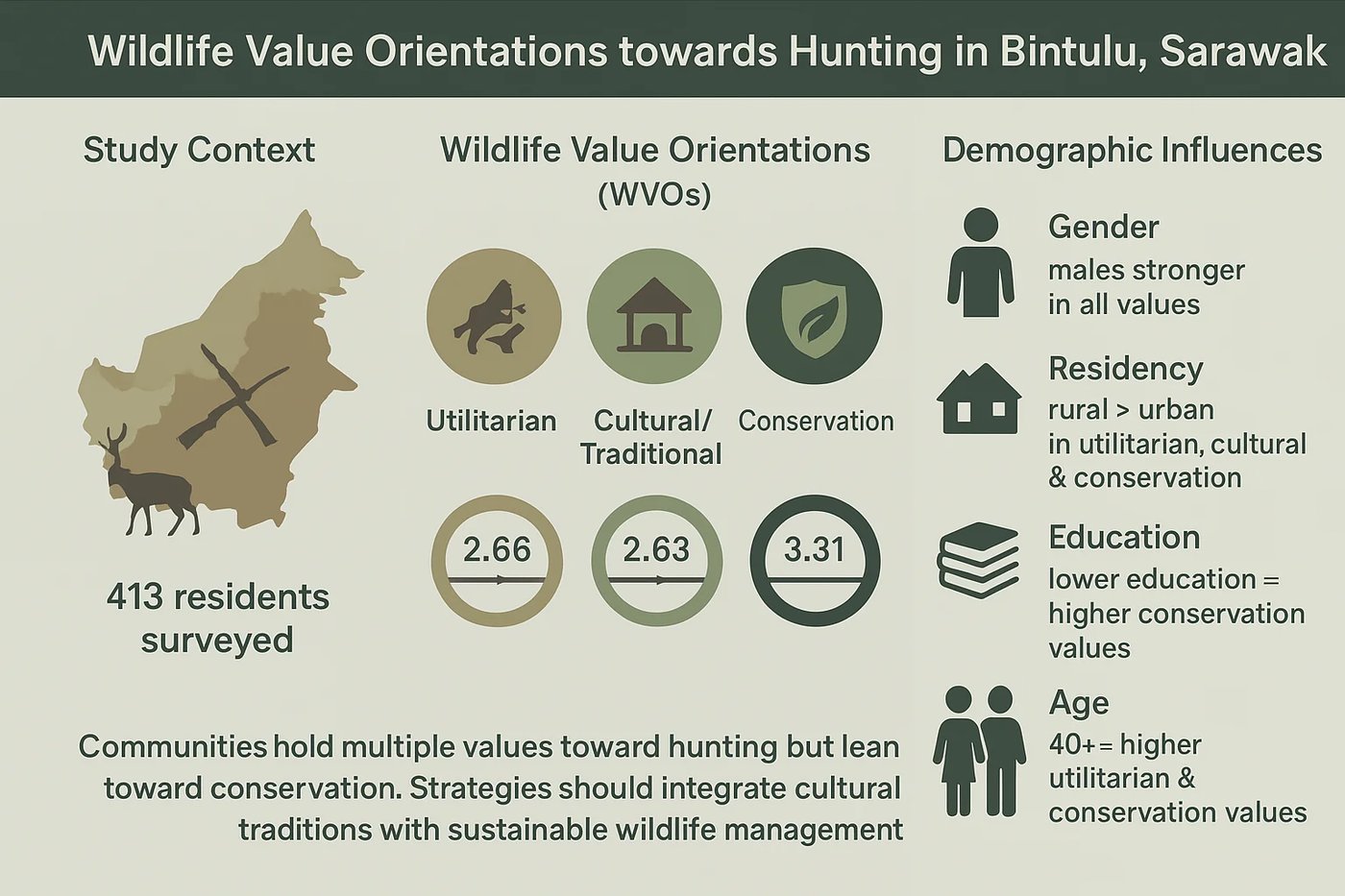
Communities living near forest areas have long hunted wildlife for food and other products. Among the communities in Bintulu, Sarawak, traditional hunting and the consumption of wildlife meat are deeply ingrained in their culture. This study identifies the wildlife value orientation among communities in Bintulu, Sarawak, and compares their values with demographic factors, including gender, residency, age, and education level. A survey was developed to identify the communities' value orientation towards hunting, specifically the utilitarian, cultural/traditional, and conservation values. A total of 413 residents were surveyed, including individuals with knowledge of hunting practices and those who consume wildlife products, even if not active hunters themselves. Findings revealed that communities in Bintulu hold multiple values towards wildlife hunting, with a stronger tendency towards conservation values. When the demographic factors were compared, males exhibited stronger utilitarian and cultural/traditional values. Rural residents displayed higher utilitarian and cultural/traditional values, yet they also had stronger conservation values. Communities aged 40 and above displayed higher utilitarian, cultural/traditional, and conservation values. Those with lower levels of education, including primary and no formal education, show stronger conservation values than those with tertiary education. These findings emphasize the diversity of perspectives toward wildlife use and highlight the need for conservation strategies that align with local cultural contexts. Balancing traditional practices with ecological sustainability offers a more inclusive and region-specific approach to wildlife management and conservation policy.
Full text article
References
Akhmar, A. M., Rahman, F., Supratman, S., Hasyim, H., & Nawir, M. (2023). The cultural transmission of traditional ecological knowledge in Cerekang, South Sulawesi, Indonesia. SAGE Open, 13(4), Article 21582440231194160. https://doi.org/10.1177/21582440231194160
Andaya, B. W., & Andaya, L. Y. (2017). A history of Malaysia (3rd ed.). Palgrave MacMillan.
Anthony, C. (2020, March 5). Indigenous hunting and wildlife conservation are not in conflict, say experts. Investigative Earth. Retrieved from https://www.investigative.earth/pangolins-malaysia/indigenous-hunting-and-wildlife-conservation
Baierl, T. -M., Kaiser, F. G., & Bogner, F. X. (2024). The role of attitude toward nature in learning about environmental issues. Frontiers in Psychology, 15, Article 1471026. https://doi.org/10.3389/fpsyg.2024.1471026
Basak, S. M., Hossain, Md. S., O’Mahony, D. T., Okarma, H., Widera, E., & Wierzbowska, I. A. (2022). Public perceptions and attitudes toward urban wildlife encounters–A decade of change. Science of the Total Environment, 834, Article 155603. https://doi.org/10.1016/j.scitotenv.2022.155603
Benítez-López, A., Alkemade, R., Schipper, A. M., Ingram, D. J., Verweij, P. A., Eikelboom, J. A., & Huijbregts, M. A. (2017). The impact of hunting on tropical mammal and bird populations. Science, 356(6334), 180–183. https://doi.org/10.1126/science.aaj1891
Bennett, N. J. (2016). Using perceptions as evidence to improve conservation and environmental management. Conservation Biology, 30(3), 582592. https://doi.org/10.1111/cobi.12681
Berkes, F., & Turner, N. J. (2022). Traditional ecological knowledge: Learning from indigenous practices for environmental sustainability. Prairie Edge.
Booth, D. (2021). Post-materialism as a basis for achieving environmental sustainability. The Journal of Population and Sustainability, 5(2), 97–125. https://doi.org/10.3197/jps.2021.5.2.97
Burnette, C. E., Clark, C. B., & Rodning, C. B. (2018). Living off the land: How subsistence promotes well-being and resilience among indigenous peoples of the Southeastern United States. Social Service Review, 92(3), 369–400. https://doi.org/10.1086/699287
Cawthorn, D. -M., & Hoffman, L. C. (2015). The bushmeat and food security nexus: A global account of the contributions, conundrums, and ethical collisions. Food Research International, 76(4), 906–925. https://doi.org/10.1016/j.foodres.2015.03.025
Castilho, L. C., de Vleeschouwer, K. M., Milner-Gulland, E. J., & Schiavetti, A. (2018). Attitudes and behaviors of rural residents toward different motivations for hunting and deforestation in protected areas of the northeastern Atlantic Forest, Brazil. Tropical Conservation Science, 11(1), Article 1940082917753507. https://doi.org/10.1177/1940082917753507
Chase, L. D. (2016). Measurement of wildlife value orientations among diverse audiences: A multigroup confirmatory factor analysis among hispanic and non-hispanic white communities. Human Dimensions of Wildlife, 21(2), 127–143. https://doi.org/10.1080/10871209.2016.1110735
Creswell, J. W. (2018). Research design: Qualitative, quantitative, and mixed methods approaches (5th ed.). SAGE Publications.
Davis, E. O. (2022). Critical research gaps in understanding Southeast Asian women’s wildlife trade and use practices. Frontiers in Conservation Science, 3, Article 936172. https://doi.org/10.3389/fcosc.2022.936172
Dayak Daily. (2020, November 23). SFC defends stance against trading of wildlife meat. Dayak Daily. Retrieved from https://dayakdaily.com/sfc-defends-stance-against-trading-of-wildlife-meat/
Department of Statistics Malaysia. (2020). Population and housing census of Malaysia 2020. Department of Statistics Malaysia.
Fa, J. E., Funk, S. M., & Nasi, R. (2022). Hunting wildlife in the tropics and subtropics. Cambridge University Press.
Fariss, B., deMello, N., Powlen, K. A., Latimer, C. E., Masuda, Y., & Kennedy, C. M. (2022). Catalyzing success in community‐based conservation. Conservation Biology, 37(1), Article e13973. https://doi.org/10.1111/cobi.13973
Fiebelkorn, F., & Menzel, A. (2020). A study of wildlife consumption and its implications. Journal of Wildlife Management, 30(2), 120132. https://doi.org/10.1016/j.jenvman.2020.02.059
Fowler, F. J. (2020). Survey research methods (5th ed.). SAGE Publications.
Gomez, J., van Vliet, N., & Canales, N. (2022). The values of wildlife revisited. Ecology and Society, 27(4), Article 23. https://doi.org/10.5751/ES-13571-270423
Gómez-Baggethun, Erik & Corbera, Esteve & Reyes-García, Victoria. (2013). Traditional ecological knowledge and global environmental change: Research findings and policy implications. Ecology and Society, 18(4), Article 72. https://doi.org/10.5751/ES-06288-180472
Gren, I. -M., Häggmark-Svensson, T., Elofsson, K., & Engelmann, M. (2018). Economics of wildlife management–An overview. European Journal of Wildlife Research, 64, Article 22. https://doi.org/10.1007/s10344-018-1180-3
Grilli, G., Notaro, S., & Campbell, D. (2018). Including value orientations in choice models to estimate benefits of wildlife management policies. Ecological Economics, 151, 70–81. https://doi.org/10.1016/j.ecolecon.2018.04.035
Hair, J. F., Black, W. C., Babin, B. J., & Anderson, R. E (2013). Multivariate data analysis (7th ed.). Pearson Education.
Hasan, S. M., & Csányi, S. (2023). Attitude index of local communities toward wildlife and their management methods in Malaysia. Diversity, 15(2), Article 202. https://doi.org/10.3390/d15020202
Ihemezie, E. J., Nawrath, M., Strauß, L., Stringer, L. C., & Dallimer, M. (2021). The influence of human values on attitudes and behaviours towards forest conservation. Journal of Environmental Management, 292, Article 112857. https://doi.org/10.1016/j.jenvman.2021.112857
Inglehart, R., & Welzel, C. (2017). Cultural evolution: People's motivations are changing and reshaping the world (2nd ed.). Cambridge University Press.
Jacobs, M. H., Dubois, S., Hosaka, T., Ladanović, V., Muslim, H. F. M., Miller, K. K., Numata, S., Ranaweerage, E., Straka, T. M., Weston, M. A., & Abidin, Z. A. Z. (2022). Exploring cultural differences in wildlife value orientations using student samples in seven nations. Biodiversity and Conservation, 31(3), 757–777. https://doi.org/10.1007/s10531-022-02361-5
Karim, N., Othman, H., Zaini, Z. -‘. I., Rosli, Y., Wahab, M. I. A., Al Kanta, A. M., Omar, S., & Sahani, M. (2022). Climate change and environmental education: Stance from science teachers. Sustainability, 14(24), Article 16618. https://doi.org/10.3390/su142416618
Karpudewan, M. (2021). The influence of ethnicity and other socio-demographic characteristics on pro-environmental attitudes: A Malaysian perspective. Local Environment, 26(10), 1284–1298. https://doi.org/10.1080/13549839.2021.1973976
Kato, Y., & Samejima, H. (2019).The effects of landscape and livelihood transitions on hunting in Sarawak. In N. Ishikawa, & R. Soda (Eds.), Anthropogenic tropical forests. Advances in Asian human-environmental research (pp. 277–313). Springer, Singapore. https://doi.org/10.1007/978-981-13-7513-2_14
Kato, E., Yano, Y., & Ohe, Y. (2019). Investigating gaps in perception of wildlife between urban and rural inhabitants: Empirical evidence from Japan. Sustainability, 11(17), Article 4516. https://doi.org/10.3390/su11174516
Kellert, S. R. (1993). Values and perceptions of insects. In S. R. Kellert & E. O. Wilson (Eds.), The biophilia hypothesis (pp. 4359). Washington, DC: Island Press.
Krejcie, R. V., & Morgan, D. W. (1970). Determining sample size for research activities. Educational and Psychological Measurement, 30(3), 607–610. https://doi.org/10.1177/001316447003000308
Kgomo, T. J., & Modley, L. A. S. (2022). Do younger generations care more about environmental issues? A comparison of perceptions between Gen Z and Gen X in Johannesburg, South Africa. South African Geographical Journal, 105(3), 402–421. https://doi.org/10.1080/03736245.2022.2150283
Kilbourne, W., Grünhagen, M., & Foley, J. (2005). A cross-cultural examination of the relationship between materialism and individual values. Journal of Economic Psychology, 26(5), 624–641. https://doi.org/10.1016/j.joep.2004.12.009
Kurz, D. J., Saikim, F. H., Justine, V. T., Bloem, J., Libassi, M., Luskin, M. S., Withey, L. S., Goossens, B., Brashares, J. S., & Potts, M. D. (2021). Transformation and endurance of indigenous hunting: Kadazandusun-Murut bearded pig hunting practices amidst oil palm expansion and urbanization in Sabah, Malaysia. People and Nature, 3(5), 1078–1092. https://doi.org/10.1002/pan3.10250
Kurz, D. J., Middleton, A. D., Chapman, M., Huber, B. R., McInturff, A., Sorgen, J., VanHoutan, K. S., Wilkinson, C. E., Withey, L., & Brashares, J. S. (2023). Including rural America in academic conservation science. Frontiers in Conservation Science, 4, Article 1227227. https://doi.org/10.3389/fcosc.2023.1227227
Lee, D. E., & Bond, M. L. (2018). Quantifying the ecological success of a community-based wildlife conservation area in Tanzania. Journal of Mammalogy, 99(2), 459–464. https://doi.org/10.1093/jmammal/gyy014
Lechner, C. M., Beierlein, C., Davidov, E., & Schwartz, S. H. (2024). Measuring the four higher-order values in Schwartz’s theory: Validation of a 17-item inventory. Journal of Personality Assessment, 106(5), 651–664. https://doi.org/10.1080/00223891.2024.2311193
Lechner, A. M., Ang, M. L. E., Ooi, J. Y., Azhar, B., Kanai, J. M., Hamel, P., & Sagala, S. (2021). Urban biodiversity and nature-based solutions in Southeast Asia: Perspectives from Indonesia and Malaysia. Singapore: ISEAS Publishing. https://doi.org/10.1355/9789815011210
Lineil, M. (2023, February 20). Wildlife protection measures to get beefed-up. Sarawak Tribune. Retrieved from https://www.sarawaktribune.com/wildlife-protection-measures-to-get-beef-up/
Liordos, V., Kontsiotis, V. J., Eleftheriadou, I., Telidis, S., & Triantafyllidis, A. (2021). Wildlife value orientations and demographics in Greece. Earth, 2(3), 457–467. https://doi.org/10.3390/earth2030027
Liordos, V., Kontsiotis, V. J., Telidis, S., Eleftheriadou, I., & Triantafyllidis, A. (2023). Relationships between wildlife value orientations and social identity. Euro-Mediterranean Journal for Environmental Integration, 8(3), 717–727. https://doi.org/10.1007/s41207-023-00393-z
Mahabale, D., Bodmer, R., Pizuri, O., Uraco, P., Chota, K., Antunez, M., & Groombridge, J. (2025). Sustainability of Hunting in Community-Based Wildlife Management in the Peruvian Amazon. Sustainability, 17(3), Article 914. https://doi.org/10.3390/su17030914
Malay Mail (2025, March 27). From survival to sport: Sarawak's wildlife at risk as illegal 'game hunting' surges. Malay Mail. Retrieved from https://www.malaymail.com/news/malaysia/2025/03/27/from-survival-to-sport-sarawaks-wildlife-at-risk-as-illegal-game-hunting-surges/171011#google_vignette
Manfredo, M. J., Teel, T. L., Don Carlos, A. W., Sullivan, L., Bright, A. D., Dietsch, A. M., Bruskotter, J., & Fulton, D. (2020). The changing sociocultural context of wildlife conservation. Conservation Biology, 34(6). 1549–1559. https://doi.org/10.1111/cobi.13493
Manfredo, M. J., Teel, T. L., Sullivan, L., & Dietsch, A. M. (2017). Values, trust, and cultural backlash in conservation governance: The case of wildlife management in the United States. Biological Conservation, 214, 303–311. https://doi.org/10.1016/j.biocon.2017.07.032
Manfredo, M. J., Teel, T. L., & Zinn, H. C. (2009). Understanding global values toward wildlife. In M. J. Manfredo, J. J. Vaske, P. J. Brown, D. J. Decker, & E. A. Duke (Eds.), Wildlife and society: The science of human dimensions (pp. 31–43). Island Press.
Martell, J. E. M., & Rodewald, A. D. (2024). Wildlife values can inform strategic conservation communication efforts. Human Dimensions of Wildlife, 30(2), 182–200. https://doi.org/10.1080/10871209.2024.2346100
Massoi, L. W. (2019). Gender roles and practices in natural resource management among the Kilosa Maasai in Tanzania. Tanzania Journal of Development Studies, 17(1), 102–116.
Mei, N. S., Wai, C. W., & Ahamad, R. (2017). Public environmental awareness and behaviour in Malaysia. Asian Journal of Quality of Life, 2(5), 43–53. https://doi.org/10.21834/ajqol.v2i5.10
Meilani, M. M., Thwaites, R., Race, D., Andayani, W., Faida, L. R. W., & Maryudi, A. (2019). Finding alternatives of livelihood sources for forest dependent communities in protected areas: A case study of Sebangau National Park, Central Kalimantan Province, Indonesia. IOP Conference Series: Earth and Environmental Science, 285(1), Article 012005. https://doi.org/10.1088/1755-1315/285/1/012005
Menzies, A. K., Bowles, E., McGregor, D., Ford, A. T., & Popp, J. N. (2024). Sharing indigenous values, practices and priorities as guidance for transforming human–environment relationships. People and Nature, 6(5), 2109–2125. https://doi.org/10.1002/pan3.10707
Moral. (2021, June 21). Moral motivations for wildlife conservation. Tamu. Retrieved from https://stories.tamu.edu/news/2021/06/21/moral-motivations-for-wildlife-conservation/?utm_source=chatgpt.com
Mulhern, O. (2020, November 26). Bushmeat consumption in Asia. Earth. Retrieved from https://earth.org/data_visualization/bushmeat-consumption-in-asia/
Mustățea, M., & Pătru-Stupariu, I. (2021). Using landscape change analysis and stakeholder perspective to identify driving forces of human–wildlife interactions. Ecology and Society, 26(1), Article 7. https://doi.org/10.3390/land10020146
Nelson, J., Muhammed, N., & Abdul Rashid, R. (2015). Community’s forest dependency and its effects towards the forest resources and wildlife abundances in Sarawak, Malaysia. International Journal of Sustainable Development & World Ecolog, 22(5), 401–412. https://doi.org/10.1080/13504509.2015.1072117
Neumann, F. & Seidel, M. (2021). Hunters as stewards for wildlife conservation: Evaluating the relationship between hunting and the protection of wildlife in North America based on social, ecological, and economic aspects. Greifswald Studies on the Economics of Landscape and Nature Conservation, No. 2–04/2021. Retreived from https://rsf.uni-greifswald.de/storages/uni-greifswald/fakultaet/rsf/lehrstuehle/ls-beckmann/forschung/GSLN/Baende/GSLN_2_Neumann_Seidel_2021-1.pdf
.Nicholas Institute for Environmental Policy Solutions. (2019). Rural America’s conservation challenge: Understanding attitudes toward environmental conservation and sustainability. Duke University. https://nicholasinstitute.duke.edu/research/environmental-conservation
Notaro, S., Grilli, G., & Vaske, J. J. (2024). Demographics and wildlife value orientations: Insights for managing wildlife in the Alps. Human Dimensions of Wildlife, 1–12 https://doi.org/10.1080/10871209.2024.2393824
Pattiselanno, F., & Nasi, R. (2015). Importance of bushmeat hunting and trade in Papua. XIV World Forestry Congress, Durban, South Africa, 711 September 2015. Retrieved from https://foris.fao.org/wfc2015/api/file/552e5deb9e00c2f116f8e973/contents/e610fbd8-7c7e-4594-a42a-879e778e34fc.pdf
Peterson, T., & Tollefson, K. (2024). A scientific discussion of post-materialism values and environmental behavior. Businesses, 4(3), 347–370. https://doi.org/10.3390/businesses4030022
Plieninger, T., Bogadóttir, R., Fagerholm, N., Magnussen, E., Olafsson, A. S., Raymond, C. M., & Verbrugee, L. N. H. (2025). Exploring values, rules, and knowledge around traditional hunting in a rapidly developing society. People and Nature, 7(4), 777–789. https://doi.org/10.1002/pan3.10780
Plieninger, T., Shamohamadi, S., García-Martín, M., Quintas-Soriano, C., Shakeri, Z., & Valipour, A. (2023). Community, pastoralism, landscape: Eliciting values and human-nature connectedness of forest-related people. Landscape and Urban Planning, 233, 104706–104706. https://doi.org/10.1016/j.landurbplan.2023.104706
Rai, S. C., & Mishra, P. K. (2023, January 2). Traditional ecological knowledge and resource management: A conceptual framework. In S. C. Rai, & P. K. Mishra (Eds.), Traditional ecological knowledge of resource management in Asia. Springer, Cham. https://doi.org/10.1007/978-3-031-16840-6_1
Ramos, S. C., Shenk, T. M., & Leong, K. M. (2016). Introduction to traditional ecological knowledge in wildlife conservation. Natural Resource Report NPS/NRSS/BRD/NRR—2016/1291. National Park Service. Retrieved from https://irma.nps.gov/DataStore/DownloadFile/554622
Saikim, F. H., Mohd. Yunus, N. S., Mahyudin, A., Nathan, S. K., Muin, H., Hamid, A., Abdul Aziz, N. A., Mohd. Nordin, N., Salleh, N., Ka Fu, M. L. L., George Kunai, J., Anak Jimbau, P., Mohd. Nasir, M. A., Peter, C., Awang Joseph, J., & Mohamed Dawood, M. (2023). Empty forest syndrome: Are we there yet? A preliminary analysis of the hunting and poaching activities in selected areas in Sabah, Malaysia. Journal of Tropical Biology & Conservation, 20, 219244. https://doi.org/10.51200/jtbc.v20i.4641
Shrestha, S., Borgerson, C., & Rasolofoniaina, B. J. R. (2024). Gender roles in natural resource use in Madagascar. Ecosystems and People, 20(1), Article 2344850. https://doi.org/10.1080/26395916.2024.2344850
Sinthumule, I. N. (2023). Traditional ecological knowledge and its role in biodiversity conservation: A systematic review. Frontiers in Environmental Science, 11, Article 1164900. https://doi.org/10.3389/fenvs.2023.1164900
Sponarski, C. C., Vaske, J. J., & Bath, A. J. (2015). Attitudinal differences among residents, park staff, and visitors toward coyotes in Cape Breton Highlands National Park of Canada. Society & Natural Resources, 28(7), 720–732. https://doi.org/10.1080/08941920.2015.1014595
Teow, H. H., Tang, S., Ahmed, P. K., Nair, M. S., & Vaithilingam, S. (2023). Roles of Malaysian indigenous communities in biodiversity conservation: A case study approach (Working Paper No. IGSC WP 2023-001). Sunway Institute for Global Strategy and Competitiveness. Retrieved from https://sunwayuniversity.edu.my/sites/default/files/documents/2024 05/4_malaysian_indigenous_communities_igsc_wp.pdf
The Guardian. (2025, January 28). Community-based conservation in Africa: How local people are leading the way. The Guardian. Retrieved from https://www.theguardian.com/environment/2025/jan/28/conservation-environment-africa-community-wildlife-conservancies-national-parks-sustainable-tourism-indigenous-people-aoe
Thomas, A., Mariapan, M., Lim, E. A. L., & Johari, S. (2023). Urban-rural communities' attitudes and perceptions toward wildlife meat consumption in Bintulu, Sarawak. The Malaysian Forester, 86(1), 239–255.
Tien, N. D., Duyen, T. N. L., Huyen, N. T. T., Thuy, P. T., Dat, L. Q., Oanh, N. T., Hong, T., & Lee, K. (2024). Willingness of payment for forest environmental services: A systematic literature review for determinants. Journal of Forest Research, 29(5), 327–342. https://doi.org/10.1080/13416979.2024.2358257
Tong, P. S. (2020). More policies and laws, is it better for biodiversity conservation in Malaysia? Conservation Science and Practice, 2(8), Article e235. https://doi.org/10.1111/csp2.235
Tumbali, G. C. (2025). Exploring traditional ecological knowledge (TEK) in Kalinga Province: Practices, preservation, and perspectives. Religion and Social Communication, 23(1), 9–35. https://doi.org/10.62461/gct101624
van Vliet, N., Cruz, D., Quiceno-Mesa, M., de Aquino, L. J. N., Moreno, J., Ribeiro, R., & Fa, J. (2015a). Ride, shoot, and call: Wildlife use among contemporary urban hunters in Três Fronteiras, Brazilian Amazon. Ecology and Society, 20(3), Article 8. https://doi.org/10.5751/ES-07506-200308
van Vliet, N., Fa, J., & Nasi, R. (2015b). Managing hunting under uncertainty: From one-off ecological indicators to resilience approaches in assessing the sustainability of bushmeat hunting. Ecology and Society, 20(3), Article 7. https://doi.org/10.5751/ES-07669-200307
Vaske, J. J., Don Carlos, A. W., Manfredo, M. J., & Teel, T. L. (2022). Evaluating alternative survey methodologies in human dimensions of wildlife research. Human Dimensions of Wildlife, 28(4), 320–334. https://doi.org/10.1080/10871209.2022.2057622
Whitehouse‐Tedd, K., Abell, J., & Dunn, A. (2020). Evaluation of the use of psychometric scales in human–wildlife interaction research to determine attitudes and tolerance toward wildlife. Conservation Biology, 35(2), 533–547. https://doi.org/10.1111/cobi.13599
Yeshey, Ford, R. M., Keenan, R. J., & Nitschke, C. R. (2023). Religious beliefs and wildlife value orientations influence tolerance of wildlife impacts in Bhutan. Human Dimensions of Wildlife, 29(3), 300–318. https://doi.org/10.1080/10871209.2023.2234389
Zainal Abidin, Z. A. (2019). Understanding human responses to wildlife in Malaysia [dissertation]. Wageningen University. https://doi.org/10.18174/494705
Zhang, Z., Yang, T., Hu, Y., Cirella, G. T., & Xie, Y. (2022). Behavioral intention to resist the consumption of wild animals in China: Netizen survey. Diversity, 14(5), Article 343. https://doi.org/10.3390/d14050343
Authors
Copyright (c) 2025 Jurnal Manajemen Hutan Tropika

This work is licensed under a Creative Commons Attribution 4.0 International License.
Jurnal Manajemen Hutan Tropika is an open access journal which means that all contents is freely available without charge to the user or his/her institution. Users are allowed to read, download, copy, distribute, print, search, or link to the full texts of the articles in this journal without asking prior permission from the publisher or the author. This is in accordance with the Budapest Open Access Initiative (BOAI) definition of open access.Article Details
How to Cite



