
Hydrological Responses to Rainfall Across Varying Canopy Densities in a Tropical Peat Swamp Forest

Article Sidebar
-
water, temperature, peat, tree density, evapotranspiration
Abstract
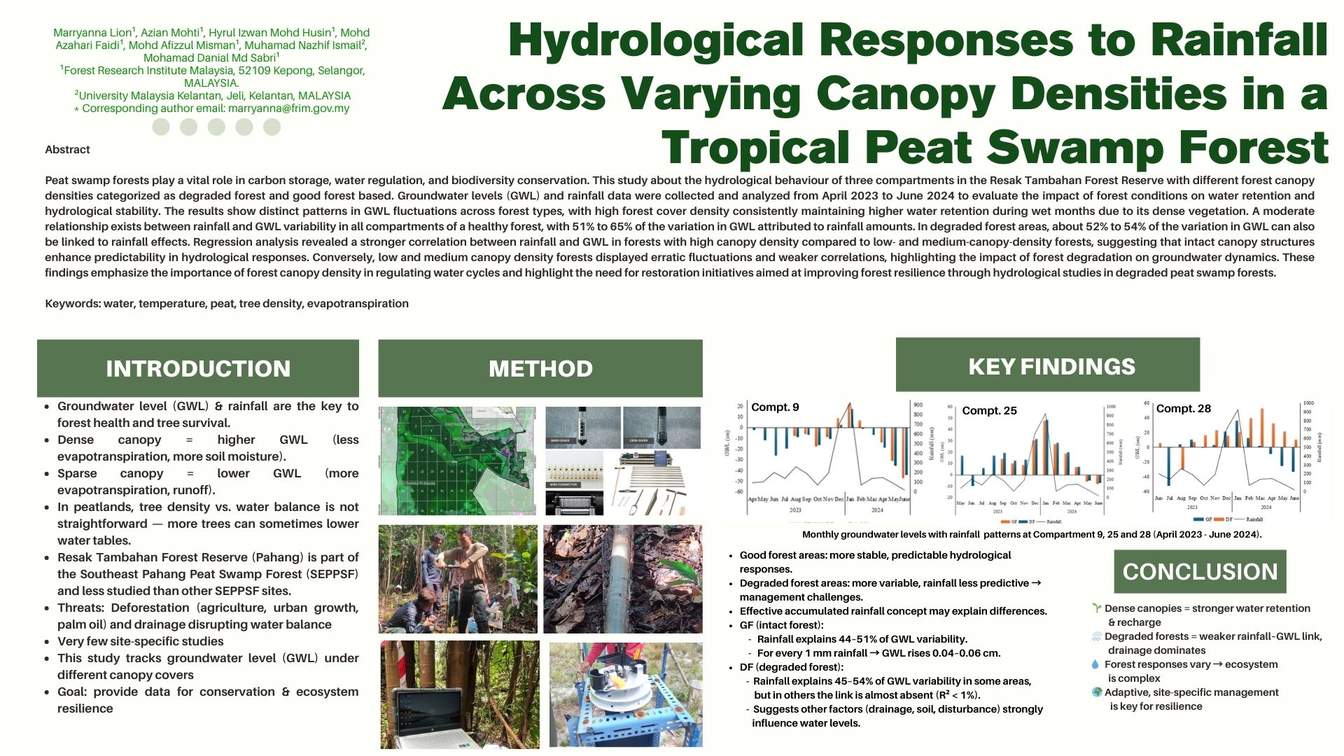
Peat swamp forests play a vital role in carbon storage, water regulation, and biodiversity conservation. This study about the hydrological behaviour of three compartments in the Resak Tambahan Forest Reserve with different forest canopy densities categorized as degraded forest and good forest based. Groundwater levels (GWL) and rainfall data were collected and analyzed from April 2023 to June 2024 to evaluate the impact of forest conditions on water retention and hydrological stability. The results show distinct patterns in GWL fluctuations across forest types, with high forest cover density consistently maintaining higher water retention during wet months due to its dense vegetation. A moderate relationship exists between rainfall and GWL variability in all compartments of a healthy forest, with 51% to 65% of the variation in GWL attributed to rainfall amounts. In degraded forest areas, about 52% to 54% of the variation in GWL can also be linked to rainfall effects. Regression analysis revealed a stronger correlation between rainfall and GWL in forests with high canopy density compared to low- and medium-canopy-density forests, suggesting that intact canopy structures enhance predictability in hydrological responses. Conversely, low and medium canopy density forests displayed erratic fluctuations and weaker correlations, highlighting the impact of forest degradation on groundwater dynamics. These findings emphasize the importance of forest canopy density in regulating water cycles and highlight the need for restoration initiatives aimed at improving forest resilience through hydrological studies in degraded peat swamp forests.
Full text article
References
Abdullahi, M., Gasim, M., & Juahir, H. (2015). Determination of groundwater level sased on rainfall distribution: Using integrated modeling techniques in Terengganu, Malaysia. Journal of Geology & Geosciences, 4(1), Article 187. https://doi.org/10.4172/2329-6755.1000187
Apers, S., De Lannoy, G. J. M., Baird, A. J., Cobb, A. R., Dargie, G. C., del Aguila Pasquel, J., Gruber, A., Hastie, A., Hidayat, H., Hirano, T., Hoyt, A. M., Jovani-Sancho, A. J., Katimon, A., Kurnain, A., Koster, R. D., Lampela, M., Mahanama, S. P. P., Melling, L., Page, S. E., ..., & Bechtold, M. (2022). Tropical peatland hydrology simulated with a global land surface model. Journal of Advances in Modeling Earth Systems, 14(2), Article e2021MS002784. https://doi.org/10.1029/2021MS002784
Anggat, F. U., Soh-Fong, L., Yau-Seng, M., Nur Azima, B., Nagamitsu, M., Faustina, S., & Lulie, M. (2024). Long-term rainfall and water table influence on groundwater nutrient dynamics from an oil palm plantation. Water Science, 38(1), 569586, https://doi.org/10.1080/23570008.2024.2417514
Azizi, Z., Najafi, A, & Sohrabi, H. (2008). Forest canopy density estimating using satellite images. The International Archives of the Photogrammetry, Remote Sensing and Spatial Information Sciences, 37, 11271130. https://doi.org/10.13140/2.1.2953.6967
Cai, W., Wang, G., Santoso, A., McPhaden, M. J., Wu, L., Jin, F. -F., Timmermann, A., Collins, M., Vecchi, G., Lengaigne, M., England, M. H., Dommenget, D., Takahashi, K., & Guilyardi, E. (2015). Increased frequency of extreme La Niña events under greenhouse warming. Nature Climate Change, 5(2), 132–137. https://doi.org/10.1038/nclimate2492
Calle, J. (2024). Exploring forest hydrology: The crucial role of forests in water cycle dynamics. Hydrology: Current Research, 15, Article 542. https://doi.org/10.37421/2157-7587.2024.15.542
Chen, Q. -W., Liu, M. -J., Lyu, J., Li, G., Otsuki, K., Yamanaka, N., & Du, S. (2022). Characterization of dominant factors on evapotranspiration with seasonal soil water changes in two adjacent forests in the semiarid Loess Plateau. Journal of Hydrology, 613, 128427–128427. https://doi.org/10.1016/j.jhydrol.2022.128427
Dommain, R., Couwenberg, J., & Joosten, H. (2011). Development and carbon sequestration of tropical peat domes in south-east Asia: Links to post-glacial sea-level changes and Holocene climate variability. Quaternary Science Reviews, 30(78), 999–1010. https://doi.org/10.1016/j.quascirev.2011.01.018
Hasselquist, N. J., Benegas, L., Roupsard, O., Malmer, A., & Ilstedt, U. (2018). Canopy cover effects on local soil water dynamics in a tropical agroforestry system: Evaporation drives soil water isotopic enrichment. Hydrological Processes, 32(8), 994–1004. https://doi.org/10.1002/hyp.11482
Hirano, T., Segah, H., Harada, T., Limin, S., June, T., Hirata, R., & Osaki, M. (2007). Carbon dioxide balance of a tropical peat swamp forest in Kalimantan, Indonesia. Global Change Biology, 13(2), 412–425. https://doi.org/10.1111/j.1365-2486.2006.01301.x
Hooijer, A., Page, S., Jauhiainen, J., Lee, W. A., Lu, X. X., Idris, A., & Anshari, G. (2012). Subsidence and carbon loss in drained tropical peatlands. Biogeosciences, 9(3), 1053–1071. https://doi.org/10.5194/bg-9-1053-2012
Hrachowitz, M., Stockinger, M., Coenders-Gerrits, M., van der Ent, R., Bogena, H., Lücke, A., & Stumpp, C. (2021). Reduction of vegetation-accessible water storage capacity after deforestation affects catchment travel time distributions and increases young water fractions in a headwater catchment. Hydrology and Earth System Sciences, 25(9), 4887–4915. https://doi.org/10.5194/hess-25-4887-2021
Ishikura, K., Hirata, R., Hirano, T., Okimoto, Y., Wong, G. X., Melling, L., Aeries, E. B., Kiew, F., Lo, K. S., Musin, K. K., Waili, J. W., & Ishii, Y. (2019). Carbon dioxide and methane emissions from peat soil in an undrained tropical peat swamp forest. Ecosystems, 22, 1852–1868. https://doi.org/10.1007/s10021-019-00376-8
Ismail, P., Nizam, M. S., Latiff, A., Faridah Hanum, I., & Shamsudin, I. (2011). Phenology of Gonystylus bancanus in Pahang, Peninsular Malaysia. Journal of Tropical Forest Science, 23(2), 143–151.
Jamil, R. A., Mohd Yasin, M. H., Tahir, R., Akeng, G., Ismail, M. S., & Modingin, D. (2021). Pahang as an integral part of Central Forest Spine (CFS) in Peninsular Malaysia. Retrieved from https://www.forestry.gov.my/images/pengumuman/2022/MFC/MFC2022/paperwork/KK13.pdf
Jan, C. -D., Chen, T. -H., & Lo, W. -C. (2007). Effect of rainfall intensity and distribution on groundwater level fluctuations. Journal of Hydrology, 332(34), 348–360. https://doi.org/10.1016/j.jhydrol.2006.07.010
Jauhiainen, J., Limin, S., Silvennoinen, H., & Vasander, H. (2008). Carbon dioxide and methane fluxes in drained tropical peat before and after hydrological restoration. Ecology, 89(12), 3503–3514. https://doi.org/10.1890/07-2038.1
Limpens, J., Holmgren, M., Jacobs, C. M. J., van der Zee, S. E. A. T. M., Karofeld, E., & Berendse, F. (2014). How does tree density affect water loss of peatlands? A mesocosm experiment. PLoS ONE, 9(3), Article e91748. https://doi.org/10.1371/journal.pone.0091748
Marryanna, L., Kosugi, Y., Itoh, M., Noguchi, S., Takanashi, S., Katsuyama, M., Tani, M., & Siti Aisah, S. (2017). Temporal variation in stable isotopes in precipitation related with rainfall pattern in a tropical rainforest in peninsular Malaysia. Journal of Tropical Forest Science, 29(3), 349–362. https://doi.org/10.26525/jtfs2017.29.3.349362
Miettinen, J., Shi, C., & Liew, S. C. (2016). Land cover distribution in the peatlands of Peninsular Malaysia, Sumatra and Borneo in 2015 with changes since 1990. Global Ecology and Conservation, 6, 67–78. https://doi.org/10.1016/j.gecco.2016.02.004
Noguchi, S., Kosugi, Y., Takanashi, S., Tani, M., Niiyama, K., Siti Aisah, S., & Marryanna, L. (2016). Long term variation in soil moisture in the Pasoh Forest Reserve, a lowland tropical rain forest in Malaysia. Journal of Tropical Forest Science, 28, 324–333.
Nur Shuhada, M. T., Azian, M., Hyrul Izwan, M. H., Muhamad Afizzul, M., & Nurul Mayzaitul Azwa, J. (2025). The assessment of peat physico-chemical properties and carbon stocks in Resak Tambahan Peat Swamp Forest, Pahang. Malaysian Journal of Soil Science, 29, 111.
Nyoman, I. N. S., Alue, D., Roh, S. B. W., Lili, M., Irwansyah, R. L., Ferry, H., & Iwan, T. C. W. (2005). A guide to the blocking of canal and ditches in conjunction with the community. Bogor: Wetland International Indonesia Programme.
Page, S. E., Rieley, J. O., & Wüst, R. (2006). Chapter 7 Lowland tropical peatlands of Southeast Asia. Developments in Earth Surface Processes, 9, 145–172. https://doi.org/10.1016/s0928-2025(06)09007-9
Pratama, H., Sutikno, S., & Yusa, M. (2019). Modeling of groundwater level fluctuation in the tropical peatland area of Riau, Indonesia. IOP Conference Series: Materials Science and Engineering, 796(1), Article 012037. https://doi.org/10.1088/1757-899X/796/1/012037
Roundtable on Sustainable Palm Oil Manual. (n.d.). Manual amalan pengurusan terbaik (BMP) Pekebun kecil RSPO untuk penanaman sawit sedia ada di tanah gambut.
Rikimaru, A., Roy, P. S., & Miyatake, S. (2002). Tropical forest cover density mapping. Tropical Ecology, 43(1), 3947.
Taufik, M., Minasny, B., McBratney, A. B., van Dam, J. C., Jones, P. D., & van Lanen, H. A. J. (2020). Human-induced changes in Indonesian peatlands increase drought severity. Environmental Research Letters, 15, Article 084013.
Tangang, F., Chung, J. X., Juneng, L., Supari, Salimun, E., Ngai, S. T., Jamaluddin, A. F., Mohd, M. S. F., Cruz, F., Narisma, G., Santisirisomboon, J., Ngo-Duc, T., Van Tan, P., Singhruck, P., Gunawan, D., Aldrian, E., Sopaheluwakan, A., Grigory, N., Remedio, A. R. C., & Sein, D. V. (2020). Projected future changes in rainfall in Southeast Asia based on CORDEX–SEA multi-model simulations. Climate Dynamics, 55(56), 1247–1267. https://doi.org/10.1007/s00382-020-05322-2
Warren, M., Frolking, S., Dai, Z., & Kurnianto, S. (2017). Impacts of land use, restoration, and climate change on tropical peat carbon stocks in the twenty-first century: Implications for climate mitigation. Mitigation and Adaptation Strategies for Global Change, 22(6), 1041–1061. https://doi.org/10.1007/s11027-016-9712-1
Wösten, J. H. M., Clymans, E., Page, S. E., Rieley, J. O., & Limin, S. H. (2008). Peat–water interrelationships in a tropical peatland ecosystem in Southeast Asia. Catena, 73(2), 212–224. https://doi.org/10.1016/j.catena.2007.07.010
Yule, C. M. (2008). Loss of biodiversity and ecosystem functioning in Indo-Malayan peat swamp forests. Biodiversity and Conservation, 19(2), 393–409. https://doi.org/10.1007/s10531-008-9510-5
Zhu, G., Yong, L., Zhao, X., Liu, Y., Zhang, Z., Xu, Y., Sun, Z., Sang, L., & Wang, L. (2022). Evaporation, infiltration and storage of soil water in different vegetation zones in the Qilian Mountains: A stable isotope perspective. Hydrology and Earth System Sciences, 26, 3771–3784. https://doi.org/10.5194/hess-26-3771-2022
Authors
Copyright (c) 2025 Jurnal Manajemen Hutan Tropika

This work is licensed under a Creative Commons Attribution 4.0 International License.
Jurnal Manajemen Hutan Tropika is an open access journal which means that all contents is freely available without charge to the user or his/her institution. Users are allowed to read, download, copy, distribute, print, search, or link to the full texts of the articles in this journal without asking prior permission from the publisher or the author. This is in accordance with the Budapest Open Access Initiative (BOAI) definition of open access.Article Details
How to Cite



