
Development of Post Fire Severity Assessment Module in Indonesian Forest and Land Fire Prevention Patrol System

Article Sidebar
-
deep learning, fire severity, mobile application, SIPP Karhutla
Abstract
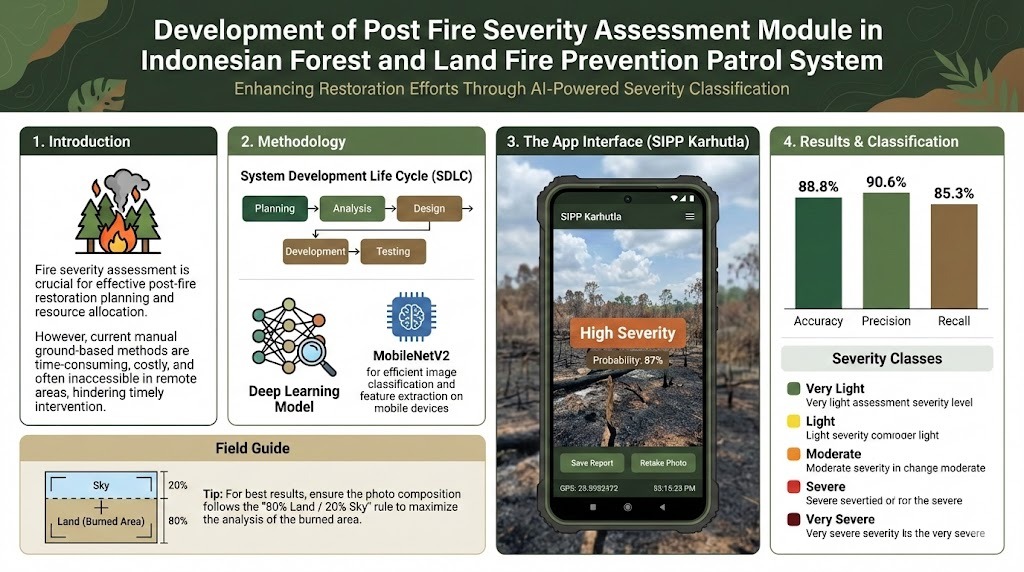
The severity of forest and land fires is a crucial indicator for assessing their impact on ecosystems, particularly vegetation and soil. The assessment results serve as a foundation for forest and land restoration, rehabilitation, and conservation efforts. This study employs a deep learning algorithm to develop a forest and land fire severity assessment module. The CNN model used is MobileNetV2 that has an accuracy of 88.8%. The smart module is integrated into the Indonesian Forest and Land Fire Prevention Patrol Mobile Application and follows the Software Development Life Cycle approach in its development. Field observation images are input to the CNN module in the mobile application. The module then analyzes the fire severity and classifies it into very light, light, moderate, severe, and very severe categories. Testing results indicate that the module accurately predicts fire severity based on established assessment standards. The optimal time for capturing images is a few days after the fire, during daylight hours, to ensure the majority of images depict burned areas. Additionally, the findings highlight that lighting conditions and image quality significantly influence the accuracy of severity predictions. Further development is required to enhance the module's compatibility and flexibility, enabling its use across various devices.
Full text article
References
Arrafi, M., Somantri, L., & Ridwana, R. (2022). Pemetaan tingkat keparahan kebakaran hutan dan lahan menggunakan algoritma Normalized Burn Ratio (NBR) pada Citra Landsat 8 di Kabupaten Muaro Jambi. Jurnal Geosains dan Remote Sensing, 3(1), 10–19. https://doi.org/10.23960/jgrs.2022.v3i1.68
Budiningsih, K., Nurfatriani, F., Salminah, M., Ulya, N. A., Nurlia, A., Setiabudi, I. M., & Mendham, D. S. (2022). Forest management units’ performance in forest fire management implementation in Central Kalimantan and South Sumatra. Forests, 13(6), Article 894. https://doi.org/10.3390/f13060894
Dong, K., Zhou, C., Ruan, Y., & Li, Y. (2020). MobileNetV2 model for image classification. In Proceedings-2020 2nd international conference on information technology and computer application (p. 476–480). ITCA 2020. Institute of Electrical and Electronics Engineers Inc.
Ghali, R., & Akhloufi, M. A. (2023). Deep learning approaches for wildland fires using satellite remote sensing data: Detection, mapping, and prediction. Fire, 6(5), Article 192. https://doi.org/10.3390/fire6050192
Heidari, F. B., & Arfania, R. (2022). Wildfire susceptibility mapping using NBR index and frequency ratio model. Geoconservation Research, 5(1), 240–260. https://doi.org/10.30486/gcr.2022.1961153.1107
Kementerian Lingkungan Hidup dan Kehutanan. (2023). KLHK RI. https://sipongi.menlhk.go.id/indikasi-luas-kebakaran.
Intaraprasit, P., Bui, T. H., & Phu, P. M. (2023). MobileNetV2-based deep learning for retinal disease classification on a mobile application. In 15th biomedical engineering international conference (pp. 1–5). IEEE. https://doi.org/10.1109/BMEiCON60347.2023.10322079
Jhariya, M. K., & Singh, L. (2021). Effect of fire severity on soil properties in a seasonally dry forest ecosystem of Central India. International Journal of Environmental Science and Technology, 18(12), 3967–3978. https://doi.org/10.1007/s13762-020-03062-8
Kumar, R., Kumar, A., & Saikia, P. (2022). Deforestation and forests degradation impacts on the environment. In V. P. Singh, S. Yadav, K. K. Yadav, & R. N. Yadava (Eds.), Environmental degradation: Challenges and strategies for mitigation (pp. 19–46). Springer, Cham. https://doi.org/10.1007/978-3-030-95542-7_2
Maryani., Prabowo, H., Gaol, F. L., & Hidayanto, A. N. (2022). Comparison of the system development life cycle and prototype model for software engineering. International Journal of Emerging Technology and Advanced Engineering, 12(4), 155–162. https://doi.org/10.46338/ijetae0422_19
Olorunshola, O. E., & Ogwueleka, F. N. (2022). Review of system development life cycle (SDLC) models for effective application delivery. In A. Joshi, M. Mahmud, R. G. Ragel, & N. V. Thakur (Eds.), Information and communication technology for competitive strategies (ICTCS 2020). Lecture notes in networks and systems (pp. 281–289). Springer, Singapore. https://doi.org/10.1007/978-981-16-0739-4_28
Oswalt, S. N., Smith, W. B., Miles, P. D., & Pugh, S. A. (2019). Forest resources of the United States. General Technical Report-US Department of Agriculutal and Forest Services.
Pinciroli, F., Barros, J. J. L., & Forradellas, R. (2022). Systematic mapping study: On the coverage of aspect-oriented methodologies for the early phases of the software development life cycle. Journal of King Saud University-Computer and Information Sciences, 34(6), 2883–2896. https://doi.org/10.1016/j.jksuci.2020.10.029
Rauf, R., Zainal, Z., Prayuda, R., Rahman, K., & Yuza, A. F. (2020). Civil society’s participatory models: A policy of preventing land and forest fire in Indonesia. International Journal of Innovation, Creativity and Change, 14(3), 1030–1046.
Roh, J. -H., Min, S. -H., & Kong, M. -S. (2022). Analysis of fire prediction performance of image classification models based on convolutional neural network. Fire Science and Engineering, 36(6), 70–77. https://doi.org/10.7731/kifse.9e906e7a
Saroja, S., & Haseena, S. (2023). Functional and non‐functional requirements in Agile Software Development. In Agile software development: Trends, challenges and applications (pp. 71–86). Wiley. https://doi.org/10.1002/9781119896838.ch5
Sherif, E., Helmy, W., & Galal-Edeen, G. H. (2023). Proposed framework to manage non-functional requirements in agile. IEEE Access, 11, 53995–54005. https://doi.org/10.1109/ACCESS.2023.3281195
Sitanggang, I. S., Syaufina, L., Trisminingsih, R., Ramdhany, D., Nuradi, E., Hidayat, M. F. A., Rahmawan, H., Wulandari., Ardiansyah, F., Albar, I., & Krisnanto, F. (2022). Indonesian forest and land fire prevention patrol system. Fire, 5(5), Article 0136. https://doi.org/10.3390/fire5050136
Syaufina, L., & Hamzah, A. A. (2021). Changes of tree species diversity in peatland impacted by moderate fire severity at teluk meranti, Pelalawan, Riau province, Indonesia. Biodiversitas, 22(5), 2899–2908. https://doi.org/10.13057/biodiv/d220555
Syaufina, L., Sitanggang, I. S., & Afina, F. S. (2021). Challenges on fire severity assessment in Indonesia: A vegetation diversity changes perspective. IOP Conference Series: Earth and Environmental Science, 886, Article 012107 https://doi.org/10.1088/1755-1315/886/1/012107
Taley, D. S. (2020). Comprehensive study of software testing techniques and strategies: A review. International Journal of Engineering Research and Technology, 9(8), Article 373. https://doi.org/10.17577/IJERTV9IS080373
Tariq, A., Shu, H., Siddiqui, S., Mousa, B.G., Munir, I., Nasri, A., Waqas, H., Lu, L., & Baqa, M. F. (2021). Forest fire monitoring using spatial-statistical and geo-spatial analysis of factors determining forest fire in Margalla Hills, Islamabad, Pakistan. Geomatics, Natural Hazards and Risk, 12(1), 1212–1233. https://doi.org/10.1080/19475705.2021.1920477
Taye, M. M. (2023). Theoretical understanding of convolutional neural network: Concepts, architectures, applications, future directions. Computation, 11(3), Article 52. https://doi.org/10.3390/computation11030052
Westerling, A. L. R. (2016). Increasing western US forest wildfire activity: Sensitivity to changes in the timing of spring. Philosophical Transactions Royal Society B Biological Science, 371(1696), Article 20150178. https://doi.org/10.1098/rstb.2015.0178
Yaz, Q. M., ALazzawi, A., & Rahmatullah, B. (2023). A comprehensive review of software development life cycle methodologies: Pros, cons, and future directions. Iraqi Journal for Computer Science and Mathematics, 4(4), 173–190. https://doi.org/10.52866/ijcsm.2023.04.04.014
Authors
Copyright (c) 2026 Jurnal Manajemen Hutan Tropika

This work is licensed under a Creative Commons Attribution 4.0 International License.
Jurnal Manajemen Hutan Tropika is an open access journal which means that all contents is freely available without charge to the user or his/her institution. Users are allowed to read, download, copy, distribute, print, search, or link to the full texts of the articles in this journal without asking prior permission from the publisher or the author. This is in accordance with the Budapest Open Access Initiative (BOAI) definition of open access.Article Details
How to Cite



