
Evaluating Enrichment Planting for Tropical Forest Restoration: A Case Study of Erythrophleum fordii and Manglietia conifera in Central Vietnam

Article Sidebar
-
mixed-species enrichment, restoration goals, species-specific trade-offs, sustainable timber management, tropical forest restoration
Abstract
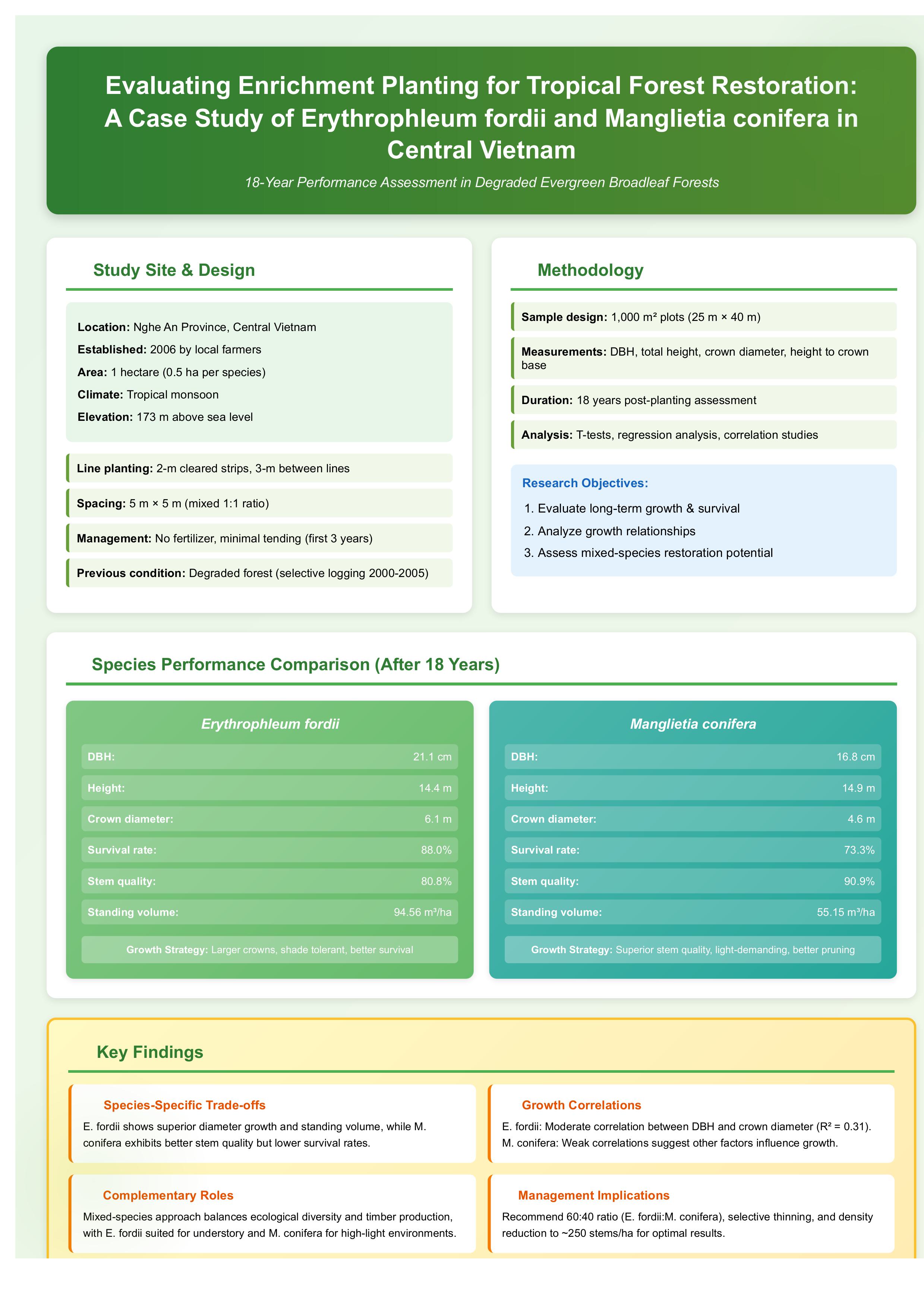
This study evaluates the long-term effectiveness of enrichment planting as a restoration strategy in Central Vietnam, focusing on the performance of Erythrophleum fordii and Manglietia conifera. A restoration site was established in 2006 using a line planting over a 1-ha area, with no fertilizer applied and minimal tending during the first three years. After 18 years, E. fordii demonstrated superior growth performance, with a larger diameter at breast height (21.1 cm) and standing volume (94.56 m-3 ha-1), while M. conifera showed a lower diameter at breast height (16.8 cm) and standing volume (55.15 m-3 ha-1). Survival rates differed significantly between species, with E. fordii achieving 88.0% compared to 73.3% for M. conifera. Notably, M. conifera had better stem quality (90.9%) compared to E. fordii (80.8%). Regression analyses revealed weak to moderate correlations between growth parameters for E. fordii, indicating complex growth dynamics, while M. conifera exhibited minimal correlations, suggesting other factors influence its development. These findings highlight the species-specific trade-offs and complementary roles in mixed-species planting. This research provides descriptive evidence of the potential for enrichment planting to establish valuable tree species in degraded forests, emphasizing the importance of species selection and management strategies for achieving restoration objectives in sustainable forest management.
Full text article
References
Artaxo, P., Hansson, H. C., Machado, L. A. T., & Rizzo, L. V. (2022). Tropical forests are crucial in regulating the climate on Earth. PLOS Climate, 1(8), Article e0000054. https://doi.org/10.1371/journal.pclm.0000054
Ashton, M. S., Gunatilleke, C. V. S., Singhakumara, B. M. P., & Gunatilleke, I. A. U. N. (2001). Restoration pathways for rain forest in southwest Sri Lanka: A review of concepts and models. Forest Ecology and Management, 154(1–3), 409–430. https://doi.org/10.1016/S0378-1127(01)00512-6
Bernard, O. E., Gbenga, A. F., & Leah, B. S. (2021). A 17-year successional enrichment plantation of tree recruitment and restoration in a tropical rainforest forest. Vegetos, 34(4), 750–760. https://doi.org/10.1007/S42535-021-00255-5
Chaonan, C., & Feng, L. (2024). Ecosystem restoration and management based on nature-based solutions in China: Research progress and representative practices. Nature-Based Solutions, 6, Article 100176. https://doi.org/10.1016/j.nbsj.2024.100176
Chazdon, R. L. (2008). Beyond deforestation: Restoring forests and ecosystem services on degraded lands. Science, 320(5882), 1458–1460. https://doi.org/10.1126/science.1155365
Clémentine, M., Élise, B., Gregory, M., Renaud, J., James, M. B., Laurent, T., & Thierry, D. (2024). Ecological restoration and rewilding: two approaches with complementary goals? Biological Reviews, 99(3), 820–836. https://doi.org/10.1111/brv.13046
Cohen, J. (1988). Statistical power analysis for the behavioral sciences (2nd ed.). Lawrence Erlbaum Associates.
Corsa, L. C. L., Oleksandra, K., & Konstantin, V. K. (2018). Mixed-species versus monocultures in plantation forestry: Development, benefits, ecosystem services and perspectives for the future. Global Ecology and Conservation, 15, Article e00419. https://doi.org/10.1016/j.gecco.2018.e00419
Doc, L. (2015). Conservation and development of Erythrophleum fordii species in Ben En National Park, Thanh Hoa Province. Project summary report. Department of Agriculture and Rural Development of Thanh Hoa Province, Vietnam.
Forest Inventory and Planning Institute (2002). Forest inventory handbook. Hanoi: Agriculture Publishing House.
Ha, C. C., Nguyen, T. C., Le, V. Q., Dang, V. H., Vu, Q. N., Cao, T. V. N., Nguyen, T. Y., Vu, V. S., & Phan, T. H. (2022). Some forestry characteristics of Camellia tonkinensis (Pit.) Cohen-Stuart at Ba Vi National Park. Journal of Forest Science and Technology, 3, 48–52.
Hofhansl, F., Chacón-Madrigal, E., Fuchslueger, L., Jenking, D., Morera-Beita, A., Plutzar, C., Silla, F., Andersen, K. M., Buchs, D. M., Dullinger, S., Fiedler, K., Franklin, Hietz, P., Huber, W., Quesada, C. A., Rammig, A., Schrodt, F., Vincent, A. G., Weissenhofer, A., & Wanek, W. (2020). Climatic and edaphic controls over tropical forest diversity and vegetation carbon storage. Scientific Reports, 10, Article 5066. https://doi.org/10.1038/s41598-020-61868-5
Huang, Z. L., Guo, G. Z., & Zhang, Z. P. (1997). A study about endangered mechanism of Erythrophleum fordii. Acta Ecologia Sinica, 17(6), 671–676.
James, F. C. J. (2003). Lack of relationship between below-ground competition and allocation to roots in 10 grassland species. Journal of Ecology, 91(3), 532–540. https://doi.org/10.1046/j.1365-2745.2003.00792.x
Jeffrey, E. H., Gerald, E. S., & Albert, R. (2006). Monitoring ecological processes for restoration projects. Journal for Nature Conservation, 14, 161–171. https://doi.org/10.1016/j.jnc.2006.05.001
Kefyalew, K., Getaneh, G., Tesfaye, B., & Shiferaw, A. (2023). Rehabilitation options for degraded secondary forests in Adiyo district of Kaffa zone, Southwest, Ethiopia. Trees, Forests and People, 12, Article 100394. https://doi.org/10.1016/j.tfp.2023.100394
Ministry of Agriculture and Rural Development. (2010). The preparatory survey on the project for reforestation and sustainable management of protection forests in the Socialist Republic of Vietnam: Final report, Volume I: Main report. Japan International Cooperation Agency
Marshall, A., Nelson, C. R., & Hall, J. S. (2022). Species selection and plantation management in enrichment planting with native timber species in the Panama Canal watershed. Frontiers in Forests and Global Change, 5, Article 925877. https://doi.org/10.3389/ffgc.2022.925877
Meyfroidt, P., & Lambin, E. F. (2008). Forest transition in Vietnam and displacement of deforestation abroad. Proceedings of the National Academy of Sciences, 106(38), 16139–16144. https://doi.org/10.1073/pnas.0904942106
Millet, J., Tran, N., Ngoc, N. V., Thi, T. T., & Prat, D. (2013). Enrichment planting of native species for biodiversity conservation in a logged tree plantation in Vietnam. New Forests, 44, 369–383. https://doi.org/10.1007/s11056-012-9344-6
Paquette, A., Hawryshyn, J., Senikas, A. V., & Potvin, C. (2009). Enrichment planting in secondary forests: A promising clean development mechanism to increase terrestrial carbon sinks. Ecology and Society, 14(1), Article 31. https://doi.org/10.5751/ES-02781-140131
Pilarczyk, K. W., & Nuoi, N. S. (2005). Experience and practices on flood control in Vietnam. Water International, 30(1), 114–122. https://doi.org/10.1080/02508060508691843
Rodrigo, C. P., César, P., Edson, V., & Gustavo, S. (2021). Technical and financial evaluation of enrichment planting in logging gaps with the high-value species Swietenia macrophylla and Handroanthus serratifolius in the Eastern Amazon. Forest Ecology and Management, 495, Article 119380. https://doi.org/10.1016/j.foreco.2021.119380
Sein, C. C., & Mitlöhner, R. (2011). Erythrophleum fordii Oliver: Ecology and silviculture. Bogor: CIFOR.
South, D. B., Zwolinski, J. B., & Kotze, H. (2011). Early growth responses from weed control and planting larger stock of Pinus radiata are greater than that obtained from mechanical soil cultivation. New Forests, 22(2), 199–211. http://doi.org/10.1023/A:1015648605949
Sovu, T., Tigabu, M., Savadogo, P., Odén, P. C., & Xayvongsa, L. (2010). Enrichment planting in a logged-over tropical mixed deciduous forest of Laos. Journal of Forestry Research, 21(3), 273–280. https://doi.org/10.1007/s11676-010-0071-6
Thanh, D. T., Ying, Z., Thanh, N. C., Hung, D. Q., & Thao, D. T. (2023). Distribution and structural-functional attributions of Erythrophleum fordii Oliver in Bac Giang Province, Vietnam. Caspian Journal of Environmental Sciences, 21(5), 1255–1264. https://doi.org/10.22124/cjes.2023.6975
Wen, C. -Y., Lian, J. -Y., Peng, W. -X., Wang, Z. -F., Yang, Z. -G., & Cao, H. -L. (2023). Genome assembly of Erythrophleum fordii, a special “ironwood” tree in China. BMC Genom Data, 24, Article 73. https://doi.org/10.1186/s12863-023-01176-9
Zhao, Z. -G., Guo, J., Sha, E., Zeng, J., & Xu, J. -M. (2011). Natural distribution, endangered mechanism and conservation strategy of an endangered tree species, Erythrophleum fordii Oliv. S. Heok-Choh, S. A. Hamid, & L. Mei (Eds.), Asia and the Pacific workshop: Multinational and transboundary conservation of valuable and endangered forest species (pp. 113–116). IUFRO World Series.
Zimmer, H., Tran, L. D., Dang, T. T., Thi, H. L., Le, T. H., Lo, Q. T., Minh, D. L., & Nichols, J. D. (2022). Rehabilitating forest and marginal land using native species in mountainous northern Vietnam. Trees, Forests and People, 10, Article 100323. https://doi.org/10.1016/j.tfp.2022.100323
Authors
Copyright (c) 2026 Jurnal Manajemen Hutan Tropika

This work is licensed under a Creative Commons Attribution 4.0 International License.
Jurnal Manajemen Hutan Tropika is an open access journal which means that all contents is freely available without charge to the user or his/her institution. Users are allowed to read, download, copy, distribute, print, search, or link to the full texts of the articles in this journal without asking prior permission from the publisher or the author. This is in accordance with the Budapest Open Access Initiative (BOAI) definition of open access.Article Details
How to Cite



