
Vegetation Structure and Potential Key Species for Bali Myna (Leucopsar rothschildi) Introduction in Tengkudak Village, Bali, Indonesia

Article Sidebar
-
habitat assessment, species introduction, endemic species, vegetation analysis
Abstract
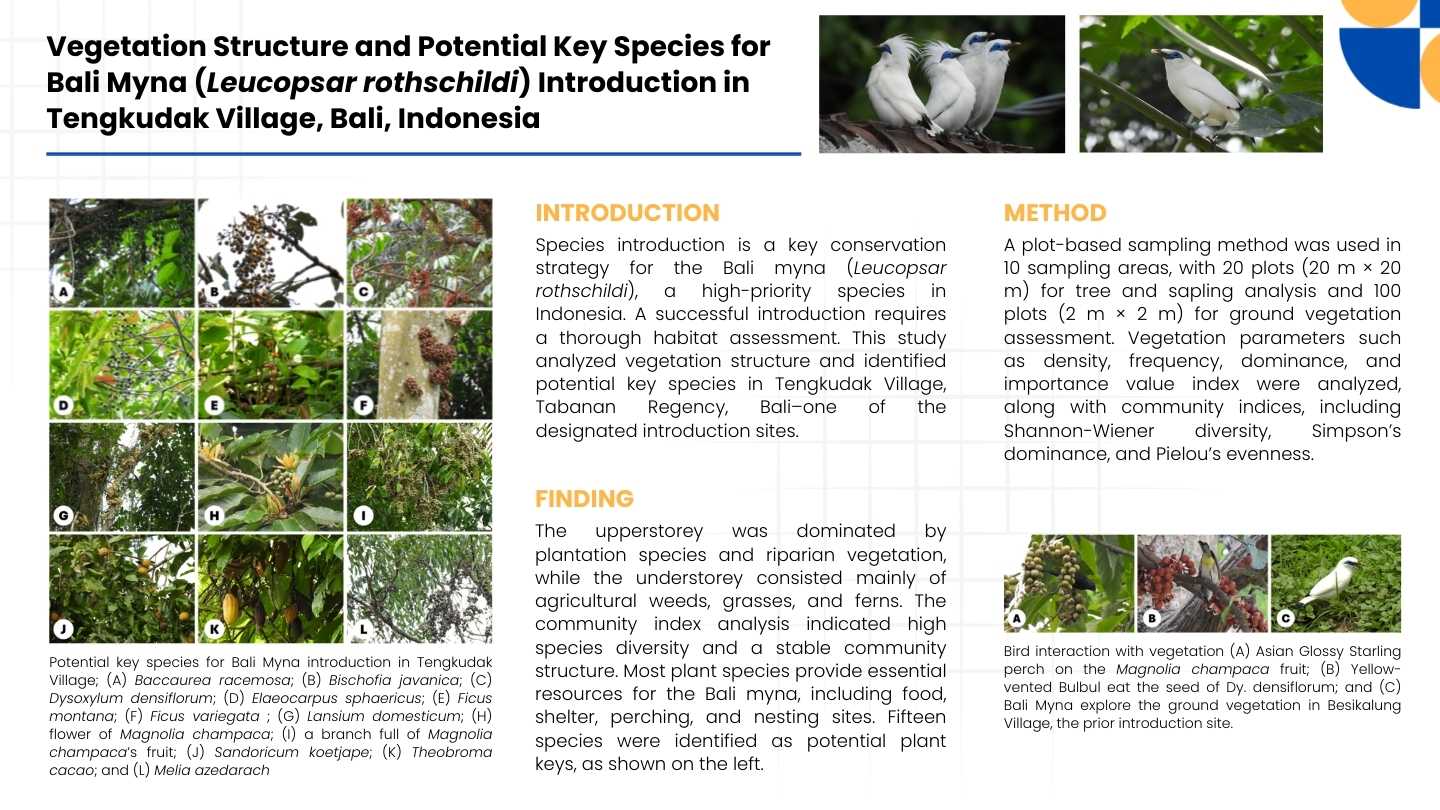
Species introduction is a key conservation strategy for the Bali myna (Leucopsar rothschildi), a high-priority species in Indonesia. Successful introduction requires thorough habitat assessment. This study analyzed vegetation structure and identified potential key species in Tengkudak Village, Tabanan Regency, Bali–one of the designated introduction sites. A plot-based sampling method was used in 10 sampling areas, with 20 plots (20 m × 20 m) for tree and sapling analysis and 100 plots (2 m × 2 m) for ground vegetation assessment. Vegetation parameters such as density, frequency, dominance, and importance value index were analyzed, along with community indices, including Shannon-Wiener diversity, Simpson’s dominance, and Pielou’s evenness. The upperstorey was dominated by plantation species and riparian vegetation, while the understorey consisted mainly of agricultural weeds, grasses, and ferns. The community index analysis indicated high species diversity and a stable community structure. Most plant species provide essential resources for the Bali myna, including food, shelter, perching, and nesting sites. Fifteen species were identified as potential plant keys, including Baccaurea racemosa, Bischofia javanica, Carica papaya, Cocos nucifera, Dysoxyllum densiflorum, Elaeocarpus sphaericus, Ficus spp., Lansium domesticum, Magnolia champaca, Persea americana, Sandoricum koetjape, and Theobroma cacao.
Full text article
References
Forests, 13(1), Article 103. https://doi.org/10.3390/f13010103
Pramatana, F., Hernowo, J. B., & Praseetyo, L. B. (2022). Population and habitat suitability index model of bali starling (Leucopsar rothschildi) in West Bali National Park. Jurnal Sylva Lestari, 10(1), 26–38.
Raman, T. R. S., Gonsalves, C., Jeganathan, P., & Mudappa, D. (2021). Native shade trees aid bird conservation in tea plantations in southern India. Current Science, 121(2), 421–421.
Reddy, P. V. R., Rajan, V. V., Mani, M., Kavitha, S. J., & Sreedevi, K. (2022). Insect pollination in horticultural crops. In Trends in Horticultural Entomology (pp. 491–516). Singapore: Springer.
Riany, C. F., & Aunurohim. (2013). Populasi burung jalak bali (Leucopsar rothschildi, Stresemann 1912) hasil pelepasliaran di Desa Ped dan Hutan Tembeling Pulau Nusa Penida, Bali. Jurnal Sains dan Seni POMITS, 2(2), 186–190.
Roy, S., & Bhattacharya, K. R. (2023). A new biodiversity index and the corresponding index of evenness: a simple theoretical analysis. Brainwave, 4(3), 445–453.
Rugayah, Retnowati, A., Windadri, F. I., & Hidayat, A. (2004). Pengumpulan data taksonomi. In Pedoman pengumpulan data keanekaragaman flora (pp. 5–42). Bogor: Puslit Biologi-LIPI.
Sagwe, R. N., Peters, M. K., Dubois, T., Steffan-Dewenter, I., & Lattorff, H. M. G. (2022). Pollinator efficiency of avocado (Persea americana) flower insect visitors. Ecological Solutions and Evidence, 3, Article 12178. https://doi.org/10.1002/2688-8319.12178
Santillán, V., Quitián, M., Tinoco, B. A., Zárate, E., Schleuning, M., Böhning-Gaese, K., & Neuschulz, E. L. (2020). Direct and indirect effects of elevation, climate and vegetation structure on bird communities on a tropical mountain. Acta Oecologica, 102, Article 103500. https://doi.org/10.1016/j.actao.2019.103500
Shanahan, M., Samson, S. O., Compton, S. G., & Corlett, R. (2001). Fig-eating by vertebrate frugivores: A global review. Biological Reviews of the Cambridge Philosophical Society, 76(4), 529–572. https://doi.org/10.1017/S1464793101005760
Sontag, W. A. (1992). Habitat utilization in various south asian starlings (Sturnidae). Zoologisches Museum Und Institut Für Spezielle Zoologie, 68(16), 115–123. https://doi.org/10.1002/mmnz.4830680304
Sudaryanto, F. X., Hardini, J., Kalih, L. A. T. T. W. S., Asrori, M. M., & Suana, I. W. (2019). Bird communities and vegetation composition in Nusa Penida, Bali, Indonesia. Biodiversitas, 20(12), 3676–3683. https://doi.org/10.13057/biodiv/d201229
Sudaryanto, F. X., Pudyatmoko, S., Djohan, T. S., Subagja, J., Suana, I. W., Kalih, L. A. T. T. W. S., Hardini, J., & Subagio, J. (2020). Daily activity, diet and habitat of Bali myna (Leucopsar rothschildi) in Nusa Penida, Bali, Indonesia. Biodiversitas, 21(10), 4474–4482. https://doi.org/10.13057/biodiv/d211002
Sun, B., Lu, Y., Yang, Y., Yu, M., Yuan, J., Yu, R., Bullock, J. M., Stenseth, N. C., Li, X., Cao, Z., Lei, H., & Li, J. (2022). Urbanization affects spatial variation and species similarity of bird diversity distribution. Science Advances, 8(49), Article ade3061. https://doi.org/10.1126/sciadv.ade3061
Sutomo, Yuni, L. P. E. K., Iryadi, R., & van Etten, E. (2023). Habitat suitability modeling for jalak bali (Leucopsar rothschildi) in East Java, Bali, and Lombok: A Potential Sites for Its Ex-Situ Conservation. AIP Conference Proceedings, 2606, Article 050005. https://doi.org/10.1063/5.0118658
Tu, H. M., Fan, M. W., & Ko, J. C. J. (2020). Different habitat types affect bird richness and evenness. Scientific Reports, 10, Article 1221. https://doi.org/10.1038/s41598-020-58202-4
Vansynghel, J., Ocampo-Ariza, C., Maas, B., Martin, E. A., Thomas, E., Hanf-Dressler, T., Nils-Christian Schumacher, N. -C., Ulloque-Samatelo, C., Yovera, F. F., Tscharntke, T., & Steffan-Dewenter, I. (2022). Quantifying services and disservices provided by insects and vertebrates in cacao agroforestry landscapes. Proceedings of the Royal Society B: Biological Sciences, 289, Article 20221309. https://doi.org/10.1098/rspb.2022.1309
Wang, G., Huang, Y., Yao, W., Huang, Q., Huang, Y., Wei, L., & Zhou, Q. (2023). Structure and characteristics of the plant-frugivore bird network from the Guilin Botanical Garden. PeerJ, 11, Article 15028. https://doi.org/10.7717/peerj.15028
Wijaya, I. M. S., & Defiani, M. R. (2021). Diversity and distribution of figs (Ficus: Moraceae) in Gianyar district, Bali, Indonesia. Biodiversitas, 22(1), 233–246. https://doi.org/10.13057/biodiv/d220129
Xu, W., Yu, J., Huang, P., Zheng, D., Lin, Y., Huang, Z., Zhao, Y., Dong, J., Zhu, Z., & Fu, W. (2022). Relationship between vegetation habitats and bird communities in urban mountain parks. Animals, 12, Article 2470. https://doi.org/10.3390/ani12182470
Yuliantara, I. W., Warpala, I. W. S., & Mulyadiharja, S. (2018). Analisis habitat dan populasi Jalak Bali (Leucopsar rothschildi) di Resort Teluk Brumbun Taman Nasional Bali Barat. Jurnal Pendidikan Biologi Undiksha, 5(1), 32–45.
Yuni, L. P. E. K., Wijaya, I. M. S., & Sari, I. A. E. P. (2022). Assessing the bird and tree species diversity in the north of Badung, Bali, Indonesia. Biodiversitas, 23(9), 4482–4489. https://doi.org/10.13057/biodiv/d230914
Authors
Copyright (c) 2026 Jurnal Manajemen Hutan Tropika

This work is licensed under a Creative Commons Attribution 4.0 International License.
Jurnal Manajemen Hutan Tropika is an open access journal which means that all contents is freely available without charge to the user or his/her institution. Users are allowed to read, download, copy, distribute, print, search, or link to the full texts of the articles in this journal without asking prior permission from the publisher or the author. This is in accordance with the Budapest Open Access Initiative (BOAI) definition of open access.Article Details
How to Cite



