
Forest Conservation by Conserving Socio-cultural Aspects: A Lesson from the Sougb Tribe in Teluk Bintuni, West Papua Province

Article Sidebar
-
customary right, ecosystem service, ethnoecology, traditional knowledge, sustainable forest management
Abstract
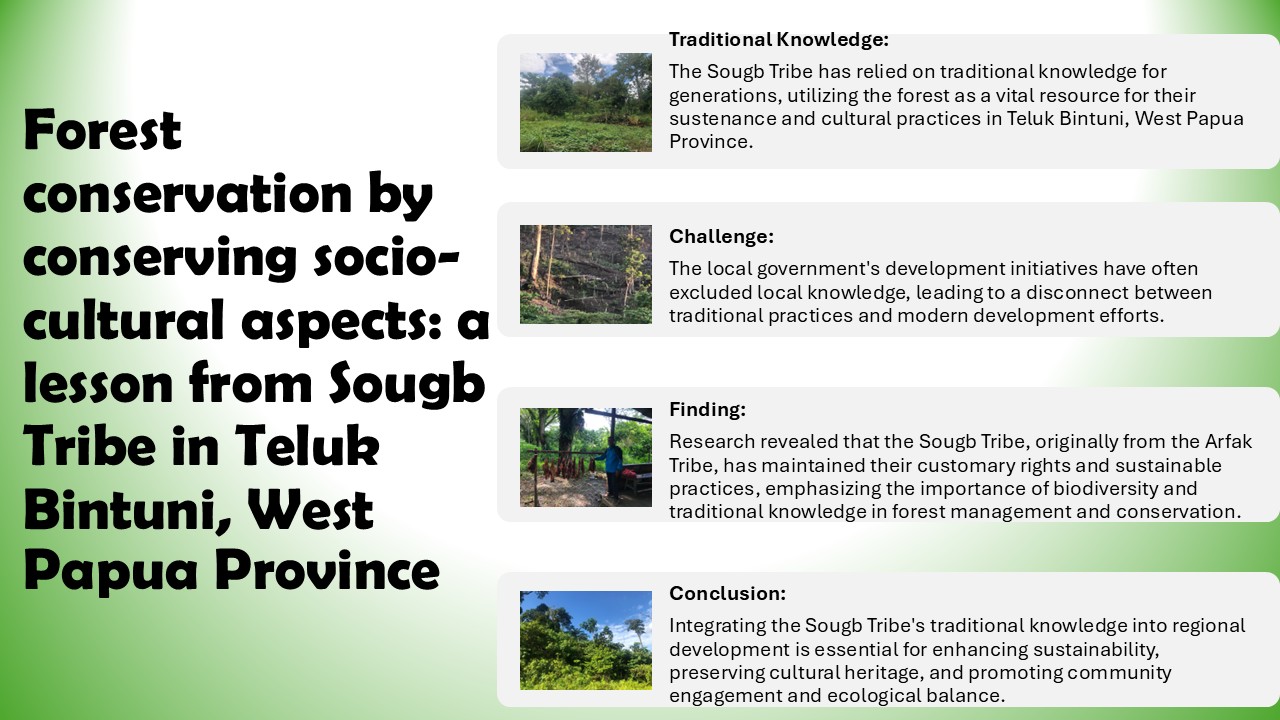
Forest has been part of local people such as Sougb Tribe for generations where at the same time they have applied the traditional knowledge. However, the local government has been conducting development for decades with less involvement of the local knowledge. Hence, this research aimed to figure out the traditional knowledge during the forest utilization by Sougb Tribe in Teluk Bintuni, West Papua Province. The data were collected using interviews with the snowball method in subdistricts of Bintuni, Bintuni Timur, Manimeri, Tuhiba, and Tembun. Then, the study revealed that the Sougb Tribe, originally part of the Arfak Tribe, has inhabited the Teluk Bintuni area for generations, migrating from the highlands to the lowlands due to various factors like marriage and conflict. They still maintain customary rights while managing the land through traditional organizations. This tribe relies profoundly on forest resources for sustenance, practicing sustainable agriculture and traditional hunting. Despite facing challenges in forest utilization, they emphasize the importance of biodiversity and traditional knowledge in local conservation. Thus, it is vital to integrate this local wisdom into regional development that can enhance sustainability and cultural preservation, fostering community engagement and ecological balance.
Full text article
References
Asmuruf, A., Holle, Y., Murdjoko, A., Benu, N., & Djitmau, D. (2024). Species richness and diversity of Klawalu Mangrove, Doberai Peninsula, Indonesian New Guinea. Annals of Silvicultural Research, 49(2), 44–52. https://doi.org/https://doi.org/10.12899/asr-2483
Benner, J., Nielsen, J., & Lertzman, K. (2021). Using traditional ecological knowledge to understand the diversity and abundance of culturally important trees. Journal of Ethnobiology, 41(2), 209–228. https://doi.org/10.2993/0278-0771-41.2.209
Cámara-Leret, R., Paniagua-Zambrana, N., Balslev, H., Barfod, A., Copete, J. C., & Macía, M. J. (2014). Ecological community traits and traditional knowledge shape palm ecosystem services in northwestern South America. Forest Ecology and Management, 334, 28–42. https://doi.org/10.1016/j.foreco.2014.08.019
Cámara-Leret, R., Schuiteman, A., Utteridge, T., Bramley, G., Deverell, R., Fisher, L. A., McLeod, J., Hannah, L., Roehrdanz, P., Laman, T. G., Scholes, E., de Fretes, Y., & Heatubun, C. (2019). The Manokwari declaration: Challenges ahead in conserving 70% of Tanah Papua’s forests. Forest and Society, 3(1), 148–151. https://doi.org/10.24259/fs.v3i1.6067
Carrasco, L. R., Nghiem, T. P. L., Sunderland, T., & Koh, L. P. (2014). Economic valuation of ecosystem services fails to capture biodiversity value of tropical forests. Biological Conservation, 178, 163–170. https://doi.org/10.1016/j.biocon.2014.08.007
Castleden, H., Garvin, T., & First Nation, H. (2008). Modifying photovoice for community-based participatory Indigenous research. Social Science and Medicine, 66(6), 1393–1405. https://doi.org/10.1016/j.socscimed.2007.11.030
Charnley, S., Fischer, A. P., & Jones, E. T. (2007). Integrating traditional and local ecological knowledge into forest biodiversity conservation in the Pacific Northwest. Forest Ecology and Management, 246, 14–28. https://doi.org/10.1016/j.foreco.2007.03.047
de Wilde de Ligny, H. J., Moll, H. W., & Vollema, J. S. (1963). Experiences with hevea rubber in West New Guinea. Netherlands Journal of Agricultural Science, 11(4), 237–249. https://doi.org/10.18174/njas.v11i4.17540
Dirhamsyah. (2013). The community-based and co-management concept for coral reef management in the Raja Ampat Islands. Australian Journal of Maritime and Ocean Affairs, 5(2), 65–73. https://doi.org/10.1080/18366503.2013.10815734
Fatem, S. M., Awang, S. A., Pudyatmoko, S., Sahide, M. A. K., Pratama, A. A., & Maryudi, A. (2018). Camouflaging economic development agendas with forest conservation narratives: A strategy of lower governments for gaining authority in the re-centralising Indonesia. Land Use Policy, 78, 699–710. https://doi.org/10.1016/j.landusepol.2018.07.018
Fatem, S. M., Runtuboi, Y. Y., Fisher, M. R., Sufi, Y., Maryudi, A., & Sirimorok, N. (2023). Conservation policy, indigeneity, and changing traditional hunting practices in West Papua. Forest and Society, 7(2), 359–379. https://doi.org/10.24259/fs.v7i2.27420
Fraser, J. A., Diabaté, M., Narmah, W., Beavogui, P., Guilavogui, K., de Foresta, H., & Junqueira, A. B. (2016). Cultural valuation and biodiversity conservation in the Upper Guinea forest, West Africa. Ecology and Society, 21(3). https://doi.org/10.5751/ES-08738-210336
Gaveau, D. L. A., Santos, L., Locatelli, B., Salim, M. A., Husnayaen, H., Meijaard, E., Heatubun, C., & Sheil, D. (2021). Forest loss in Indonesian New Guinea (2001–2019): Trends, drivers and outlook. Biological Conservation, 261, Article 109225. https://doi.org/10.1016/j.biocon.2021.109225
Goodman, L. A. (1961). Snowball sampling. The Annals of Mathematical Statistics, 32(1), 148–170. https://doi.org/10.1214/aoms/1177705148
Haile, A. A., Seid, A., Mekonnen, A. B., Wassie, W. A., Yemata, G., Yihune, E., & Mekuriaw, A. (2025). Human disturbances and their impact on woody species diversity in sacred church forests in West Gojjam Zone, Northwestern Ethiopia. Trees, Forests and People, 19, Article 100776. https://doi.org/10.1016/j.tfp.2025.100776
Heads, M. (2001). Birds of paradise, biogeography and ecology in New Guinea: A review. Journal of Biogeography, 28(7), 893–925. https://doi.org/10.1046/j.1365-2699.2001.00600.x
Jackson, C. M., Durowoju, O. S., Adelabu, S. A., & Adeniyi, S. A. (2025). An assessment of Kenya’s forest policy and law on participatory forest management for sustainable forest management: Insights from Mt. Kenya Forest Reserve. Trees, Forests and People, 19, Article 100770. https://doi.org/10.1016/j.tfp.2024.100770
Jenkins, D. (2022). Traditional ecological knowledge. In Nature and bureaucracy (pp. 222–233). Routledge. https://doi.org/10.4324/9781003297444-13
Joa, B., Winkel, G., & Primmer, E. (2018). The unknown known–A review of local ecological knowledge in relation to forest biodiversity conservation. Land Use Policy, 79, 520–530. https://doi.org/10.1016/j.landusepol.2018.09.001
Kasihiw, P., Bawole, R., Marwa, J., Murdjoko, A., Wihyawari, A., Heipon, Y., Cabuy, R. L., Benu, N. M. H., & Hematang, F. (2023). Floristic richness and diversity of Bintuni mangrove, Bird’s Head Peninsula, West Papua, Indonesia. Biodiversitas Journal of Biological Diversity, 24(5), 2887–2897. https://doi.org/10.13057/biodiv/d240543
Kasihiw, P., Bawole, R., Marwa, J., Murdjoko, A., Wihyawari, A., Heipon, Y., Cabuy, R. L., Benu, N. M. H., Hematang, F., & Leftungun, N. Y. (2024). Mangrove distribution to support biodiversity management in Teluk Bintuni District, West Papua, Indonesia. Biodiversitas, Journal of Biological Diversity, 25(2), 644–653. https://doi.org/10.13057/biodiv/d250223
Kik, A., Adamec, M., Aikhenvald, A. Y., Bajzekova, J., Baro, N., Bowern, C., Colwell, R. K., Drozd, P., Duda, P., Ibalim, S., Jorge, L. R., Mogina, J., Ruli, B., Sam, K., Sarvasy, H., Saulei, S., Weiblen, G. D., Zrzavy, J., & Novotny, V. (2021). Language and ethnobiological skills decline precipitously in Papua New Guinea, the world’s most linguistically diverse nation. Proceedings of the National Academy of Sciences, 118(22), Article e2100096118. https://doi.org/10.1073/pnas.2100096118
Klanderud, K., Mbolatiana, H. Z. H., Vololomboahangy, M. N., Radimbison, M. A., Roger, E., Totland, Ø., & Rajeriarison, C. (2010). Recovery of plant species richness and composition after slash-and-burn agriculture in a tropical rainforest in Madagascar. Biodiversity and Conservation, 19(1), 187–204. https://doi.org/10.1007/s10531-009-9714-3
Kukla, J., Whitfeld, T., Cajthaml, T., Baldrian, P., Veselá-Šimáčková, H., Novotný, V., & Frouz, J. (2019). The effect of traditional slash-and-burn agriculture on soil organic matter, nutrient content, and microbiota in tropical ecosystems of Papua New Guinea. Land Degradation and Development, 30(2), 166–177. https://doi.org/10.1002/ldr.3203
Laumonier, Y., Bourgeois, R., & Pfund, J. L. (2008). Accounting for the ecological dimension in participatory research and development: Lessons learned from Indonesia and Madagascar. Ecology and Society, 13(1), Article 15. https://doi.org/10.5751/ES-02384-130115
Laurance, W. F. (2015). Emerging threats to tropical forests. Annals of the Missouri Botanical Garden, 100(3), 71–79. https://doi.org/10.1007/978-1-4614-7161-5_5
Legra, L., Li, X., & Peterson, A. T. (2008). Biodiversity consequences of sea level rise in New Guinea. Pacific Conservation Biology, 14(3), 191–199. https://doi.org/10.1071/PC080191
Lhoest, S., Fonteyn, D., Daïnou, K., Delbeke, L., Doucet, J. L., Dufrêne, M., Josso, J. F., Ligot, G., Oszwald, J., Rivault, E., Verheggen, F., Vermeulen, C., Biwolé, A., & Fayolle, A. (2020). Conservation value of tropical forests: Distance to human settlements matters more than management in Central Africa. Biological Conservation, 241, Article 108351. https://doi.org/10.1016/j.biocon.2019.108351
Marwa, J., Ungirwalu, A., Imburi, C. S., Djitmau, D. A., Murdjoko, A., & Benu, N. M. H. (2024). Ecological perspective to sustainably manage the secondary forest in the lowland of Doberai Peninsula, Indonesia. Biodiversitas, 25(8), 2720–2732. https://doi.org/10.13057/biodiv/d250845
Maryudi, A., & Fisher, M. (2020). The power in the interview: A practical guide for identifying the critical role of actor interests in environment research. Forest and Society, 4(1), 142–150. https://doi.org/10.24259/fs.v4i1.9132
Murdjoko, A., Brearley, F. Q., Ungirwalu, A., Djitmau, D. A., & Benu, N. M. H. (2022). Secondary succession after slash-and-burn cultivation in Papuan lowland forest, Indonesia. Forests, 13(3), Article 434. https://doi.org/10.3390/f13030434.
Murdjoko, A., Djitmau, D. A., Sirami, E. V., Siburian, R. H. S., Ungirwalu, A., Mardiyadi, Z., Wanma, J. F., Mofu, W. Y., Marwa, J., Susanti, C. M. E., Tokede, M. J., Imburi, C. S., Sagrim, M., Mamboai, H., Sonbait, L. Y., Dwiranti, F., Salosa, Y. Y., Paembonan, J. B., Wiradyo, E. T., …, & Saragih, A. S. B. (2021a). Tree species diversity of Pegunungan Bintang, Papua, Indonesia as potency of wood supply. Biodiversitas, 22(12), 5665–5675. https://doi.org/10.13057/biodiv/d221263
Murdjoko, A., Djitmau, D. A., Ungirwalu, A., Sinery, A. S., Herlina, R., Siburian, S., Mardiyadi, Z., Wanma, A. O., Wanma, J. F., Rumatora, A., Mofu, W. Y., Worabai, D., May, N. L., Jitmau, M. M., Alexander, G., Mentansan, F., Krey, K., Musaad, I., Manaf, M., …, & Kuswandi, R. (2021b). Pattern of tree diversity in lowland tropical forest in Nikiwar, West Papua, Indonesia. Dendrobiology, 85, 78–91. https://doi.org/10.12657/denbio.085.008
Murdjoko, A., Marsono, D., Sadono, R., & Hadisusanto, S. (2017). Recovery of residual forest ecosystem as an impact of selective logging in South Papua: An ecological approach. Biotropia, 24(3), 230–245. https://doi.org/10.11598/btb.2017.24.3.732
Murdjoko, A., Ungirwalu, A., Mardiyadi, Z., Tokede, M. J., Djitmau, D. A., & Benu, N. M. H. (2021c). Floristic composition of Buah Hitam habitats in lowland tropical mixed forest of West Papua, Indonesia. Floresta e Ambiente, 28(3), Article e20210042. https://doi.org/10.1590/2179-8087-floram-2021-0042
Nzau, J. M., Gosling, E., Rieckmann, M., Shauri, H., & Habel, J. C. (2020). The illusion of participatory forest management success in nature conservation. Biodiversity and Conservation, 29(6), 1923–1936. https://doi.org/10.1007/s10531-020-01954-2
Parrotta, J. A., & Agnoletti, M. (2007). Traditional forest knowledge: Challenges and opportunities. Forest Ecology and Management, 249(1–2), 1–4. https://doi.org/10.1016/j.foreco.2007.05.022
Parsch, C., Wagner, B., Pangau-Adam, M., Nitschke, C. R., Kreft, H., & Schrader, J. (2022). Papua at the Crossroads: A plea for systematic conservation planning in one of the largest remaining areas of tropical rainforest. Frontiers in Forests and Global Change, 5, Article 763131. https://doi.org/10.3389/ffgc.2022.763131
Pattiselanno, F., Apituley, J. R. M., Arobaya, A. Y. S., & Koibur, J. F. (2019). Short communication: Using wildlife for local livelihood-Experiences from the bird’s head Peninsula, West Papua, Indonesia. Biodiversitas, 20(7), 1839–1845. https://doi.org/10.13057/biodiv/d200708
Pattiselanno, F., & Krockenberger, A. (2021). Road development and indigenous hunting in tanah papua: Connecting the facts for future wildlife conservation agendas. Forest and Society, 5(1), 181–189. https://doi.org/10.24259/fs.v5i1.12528
Pattiselanno, F., & Lubis, M. I. (2014). Hunting at the Abun regional marine protected areas: A link between wildmeat and food security. HAYATI Journal of Biosciences, 21(4), 180–186. https://doi.org/10.4308/hjb.21.4.180
Peterson, D., Hanazaki, N., & Li, F. (2019). Understanding canoe making as a process of preserving cultural heritage. Ethnobiology Letters, 10(1), 59–68. https://doi.org/10.14237/ebl.10.1.2019.1363
Ruinard, J. (1964). Cocoa research in West Irian (West New Guinea). Netherlands Journal of Agricultural Science, 12(2), 89–112. https://doi.org/10.18174/njas.v12i2.17525
Rumayomi, N. A. A., Murdjoko, A., Ungirwalu, A., Mulyadi, M., & Benu, N. M. H. (2024). Species richness and diversity in secondary lowland forest, Bintuni, Bird’s Head Peninsula, West Papua, Indonesia. Jurnal Manajemen Hutan Tropika, 30(2), 295–304. https://doi.org/10.7226/jtfm.30.2.295
Sagrim, M. (2022). Traditional knowledge of land management in Maybrat District, West Papua Province, Indonesia: Implication for agriculture development. Biodiversitas, 23(8), 4144–4151. https://doi.org/10.13057/biodiv/d230836
Saiba, Y., Ungirwalu, A., Murdjoko, A., Brearley, F. Q., Peday, M. H., Yowei, R. N., Imburi, C. S., Runtuboi, Y. Y., Djitmau, D. A., & Sa’diyah, S. H. (2023). Ethnobotany and conservation applications in the Noken making by the Sougb Tribe of West Papua, Indonesia. Biodiversitas, 24(8), 4577–4583. https://doi.org/10.13057/biodiv/d240861
Sillanpää, M., Vantellingen, J., & Friess, D. A. (2017). Vegetation regeneration in a sustainably harvested mangrove forest in West Papua, Indonesia. Forest Ecology and Management, 390, 137–146. https://doi.org/10.1016/j.foreco.2017.01.022
Singh, R. K., Hussain, S. M., Riba, T., Singh, A., Padung, E., Rallen, O., Lego, Y. J., & Bhardwaj, A. K. (2018). Classification and management of community forests in Indian Eastern Himalayas: implications on ecosystem services, conservation and livelihoods. Ecological Processes, 7(1). https://doi.org/10.1186/s13717-018-0137-5
Sonbait, L. Y., Manik, H., Warmetan, H., Wambrauw, Y. L. D., Sagrim, M., Djitmau, D. A., Wanggai, J., Rettob, B. B., & Murdjoko, A. (2021). The natural resource management to support tourism: A traditional knowledge approach in Pegunungan Arfak Nature Reserve, West Papua, Indonesia. Biodiversitas Journal of Biological Diversity, 22(10), 4466–4474. https://doi.org/10.13057/biodiv/d221040
Tang, R., & Gavin, M. C. (2016). A classification of threats to traditional ecological knowledge and conservation responses. Conservation and Society, 14(1), 57–70. https://doi.org/10.4103/0972-4923.182799
Tawer, P., Maturbongs, R., Murdjoko, A., Jitmau, M., Djitmau, D., Siburian, R., Ungirwalu, A., Wanma, A., Mardiyadi, Z., Wanma, J., Rumatora, A., Mofu, W., Sinery, A., Fatem, S., Benu, N., Kuswandi, R., Lekitoo, K., Khayati, L., & Tambing, J. (2021). Vegetation dynamic post-disturbance in tropical rain forest of bird’s head peninsula of West Papua, Indonesia. Annals of Silvicultural Research, 46(1), 48–58. https://doi.org/10.12899/ASR-2145
Ungirwalu, A., Awang, S. A., Suryanto, P., & Maryudi, A. (2019). Small scale ecology and society: Forest-culture of Papua Nutmeg. Jurnal Ilmu Kehutanan, 13, 114–126.
Ungirwalu, A., Mansoben, J. R., Runtuboi, Y. Y., Fatem, S. M., Peday, M. H., Marwa, J., & Maryudi, A. (2025). The fall of the kings: Power relations and dynamics in Papua’s indigenous community in forest resource management. Forest Policy and Economics, 172, Article 103424. https://doi.org/10.1016/j.forpol.2025.103424
Authors
Copyright (c) 2025 Jurnal Manajemen Hutan Tropika

This work is licensed under a Creative Commons Attribution 4.0 International License.
Jurnal Manajemen Hutan Tropika is an open access journal which means that all contents is freely available without charge to the user or his/her institution. Users are allowed to read, download, copy, distribute, print, search, or link to the full texts of the articles in this journal without asking prior permission from the publisher or the author. This is in accordance with the Budapest Open Access Initiative (BOAI) definition of open access.Article Details
How to Cite



