
Factors Influencing the Physical Characteristics of Peats in West Kalimantan's Forests and Oil Palm Plantations

Article Sidebar
-
peatland, water table, peat depth, land use, sustainable management
Abstract
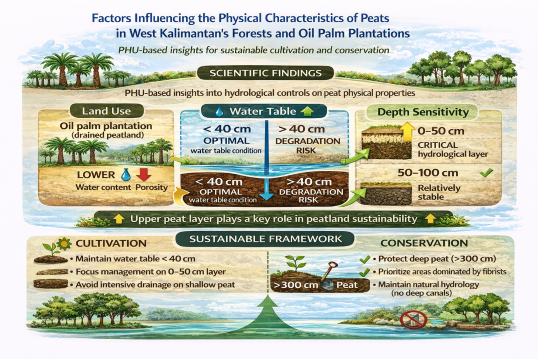
Peatlands in West Kalimantan play a vital role in regulating water and supporting land productivity, yet they are highly sensitive to changes in hydrological conditions and land use. Peatland areas widely practice drainage and cultivation, which can alter the physical properties of peat and have long-term implications for ecosystem stability and land management. However, how land use and groundwater conditions influence peat physical characteristics across different hydrological settings remains insufficiently understood. This study examined peat physical properties across contrasting hydrological units representing cultivated peatlands and peat swamp forests. Bulk density, water content, and porosity were evaluated in relation to groundwater level, peat thickness, sampling depth, soil suborder, and land use. The results indicate that groundwater conditions and land use are the primary controls of peat physical properties. Peat soils under shallow groundwater conditions consistently exhibited higher water content and porosity, with values exceeding 80%, whereas cultivated peatlands showed lower water retention and porosity compared to forested peatlands. Peat thickness, soil suborder, and sampling depth further influenced the vertical and spatial variability of peat characteristics. Differences were observed both between hydrological units and across soil layers, reflecting pronounced spatial heterogeneity associated with site-specific management. Overall, these findings demonstrate that peat physical properties vary systematically across hydrological units and soil layers, highlighting the importance of hydrology-based and site-specific management strategies to maintain peatland stability and support sustainable land management.
Full text article
References
Adhi, Y. A., Anwar, S., Tarigan, S. D., & Sahari, B. (2020). Relationship between groundwater level and water content in oil palm plantation on drained peatland in Siak, Riau Province, Indonesia. Pertanika Journal of Tropical Agricultural Science, 43(3), 415–427.
Anda, M., Ritung, S., Suryani, E., Hikmat, M., Yatno, E., Mulyani, A., & Subandiono, R. E. (2021). Revisiting tropical peatlands in Indonesia: Semi-detailed mapping, extent and depth distribution assessment. Geoderma, 402, Article 115235. https://doi.org/10.1016/j.geoderma.2021.115235
Anshari, G. Z., Gusmayanti, E., & Novita, N. (2021). The use of subsidence to estimate carbon loss from deforested and drained tropical peatlands in Indonesia. Forests, 12(6), Article 732. https://doi.org/10.3390/f12060732
Arabia, T., Basri, H., Zainabun., & Mukhtaruddin. (2020). Physical and chemical characteristics in peat lands of Aceh Jaya District, Indonesia. IOP Conference Series: Earth and Environmental Science, 499, Article 012004. https://doi.org/10.1088/1755-1315/499/1/012004
Astiani, D., Burhanuddin, B., Curran, L. M., Mujiman, M., & Salim, R. (2017). Effects of drainage ditches on water table level, soil conditions and tree growth of degraded peatland forests in West Kalimantan. Indonesian Journal of Forestry Research, 4(1), 15–25. https://doi.org/10.20886/ijfr.2017.4.1.15-25
Badan Standardisasi Nasional. (2010). Standar Nasional Indonesia 7645:2010 Klasifikasi penutup lahan. Jakarta: Badan Standardisasi Nasional
Badan Informasi Geospasial. (2024). Map of West Kalimantan Province. BIG. Retrieved from https://inaland.big.go.id/map
Badan Meteorologi, Klimatologi, dan Geofisika. (2023). Rainfall data. BMKG. Retrived from https://dataonline.bmkg.go.id/data-harian
Dhandapani, S., Evers, S., Boyd, D., Evans, C. D., Page, S., Parish, F., & Sjogersten, S. (2023). Assessment of differences in peat physico-chemical properties, surface subsidence and GHG emissions between the major land-uses of Selangor peatlands. Catena, 230, Article 107255. https://doi.org/10.1016/j.catena.2023.107255
Dohong, A., Abdul Aziz, A., & Dargusch, P. (2018). A review of techniques for effective tropical peatland restoration. Wetlands, 38, 275–292. https://doi.org/10.1007/s13157-018-1017-6
Firdaus, M. S., Gandaseca, S., Ahmed, O. H., & Majid, N. M. A. (2010). Effect of converting secondary tropical peat swamp forest into oil palm plantation on selected peat soil physical properties. American Journal of Environmental Sciences, 6(4), 402–405. https://doi.org/10.3844/ajessp.2010.402.405
Ginting, E. N., Darlan, N. H., & Winarna. (2016). Effective water management for oil palm in peatland: For peat conservation and yield optimization. In 15th international peat congress (pp. 497–501). Kuching, Malaysia.
Gramlich, A., Stoll, S., Stamm, C., Walter, T., & Prasuhn, V. (2018). Effects of artificial land drainage on hydrology, nutrient and pesticide fluxes from agricultural fields–A review. Agriculture, Ecosystems & Environment, 266, 84–99. https://doi.org/10.1016/j.agee.2018.04.005
Hikmatullah, H., & Sukarman, S. (2014). Physical properties of peat soil in relation to its thickness in Jambi Province, Indonesia. Journal of Tropical Soils, 19(3), 147–154. https://doi.org/10.5400/jts.2014.v19i3.131-141
Junedi, H., Armanto, M. E., Bernas, S. M., & Imanudin, M. S. (2017). Changes to some physical properties due to conversion of secondary forest of peat into oil palm plantation. Sriwijaya Journal of Environment, 2(3), 76–80. https://doi.org/10.22135/sje.2017.2.3.76-80
Jurasinski, G., Ahmad, S., Anadon-Rosell, A., Berendt, J., Beyer, F., Bill, R., Blume-Werry, G., Couwenberg, J., Günther, A., Joosten, H., , Koebsch, F., Köhn, D., Koldrack, N., Kreyling, J., Leinweber, P., Lennartz, B., Liu, H., Michaelis, D., Mrotzek, A., ..., & Wrage-Mönnig, N. (2020). From understanding to sustainable use of peatlands: The WETSCAPES approach. Soil Systems, 4(1), Article 14. https://doi.org/10.3390/soilsystems4010014
Kementerian Lingkungan Hidup dan Kehutanan. (2017). Keputusan Menteri Lingkungan Hidup dan Kehutanan Nomo 219 Tahun 2017 tentang Penetapan Peta Kesahutan Hidrologis Gambut Nasional. Kementerian Lingkungan Hidup. http://pkgppkl.menlhk.go.id/v0/kepmen-no-129-tahun-2017-penetapan-peta-kesatuan-hidrologis-gambut-nasional/
Kementerian Lingkungan Hidup dan Kehutanan. (2017). Peraturan Menteri Lingkungan Hidup dan Kehutanan Nomor 10 Tahun 2019 tentang Tata Cara Inventarisasi dan Penetapan Fungsi Ekosistem Gambut. Peraturan.go.id. https://peraturan.go.id/id/permen-lhk-no-p-14-menlhk-setjen-kum-1-2-2017-tahun-2017
Kementerian Lingkungan Hidup dan Kehutanan. (2019). Peraturan Menteri Lingkungan Hidup dan Kehutanan Nomor 14 Tahun 2017 tentang Penentuan, Penetapan, dan Pengelolaan Puncak Kubah Gambut berbasis Kesatuan Hidrologis Gambut. Peraturan.go.id. https://peraturan.go.id/id/permen-lhk-no-p-10-menlhk-setjen-kum-1-3-2019-tahun-2019
Kunarso, A., Bonner, M. T., Blanch, E. W., Grover, S. (2022). Differences in tropical peat soil physical and chemical properties under different land uses: A systematic review and meta-analysis. Journal of Soil Science and Plant Nutrition, 22(4), 4063–4083. https://doi.org/10.1007/s42729-022-01008-2
Liu, H., Price, J., Rezanezhad, F., & Lennartz, B. (2020). Centennial‐scale shifts in hydrophysical properties of peat induced by drainage. Water Resources Research, 56(10), Article e2020WR027538. https://doi.org/10.1029/2020WR027538
Liu, Y., Li, Z., Wang, D., Li, X., Zheng, X., Liu, H., Liu, J., & Li, Z. (2023).The Genetic Characteristics of Intermittency and Continuity in Peat Formation and Accumulation Processes. Ore Geology Reviews, 161,105650. https://doi.org/10.1016/j.oregeorev.2023.105650
Ma, L., Zhu, G., Chen, B., Zhang, K., Niu, S., Wang, J., Ciais, P., & Zuo, H. (2022). A globally robust relationship between water table decline, subsidence rate, and carbon release from peatlands. Communications Earth & Environment, 3(1), Article 254. https://doi.org/10.1038/s43247-022-00590-8
Marwanto, S., Watanabe, T., Iskandar, W., Sabiham, S., & Funakawa, S. (2018). Effects of seasonal rainfall and water table movement on the soil solution composition of tropical peatland. Soil Science and Plant Nutrition, 64(3), 386–395. https://doi.org/10.1080/00380768.2018.1436940
Masganti, M., Anwar, K., & Susanti, M. A. (2017). Potensi dan pemanfaatan lahan gambut dangkal untuk pertanian. Jurnal Sumberdaya Lahan, 11(1), 43–52. https://doi.org/10.21082/jsdl.v11n1.2017.43-52
McCalmont, J., Kho, L. K., Teh, Y. A., Chocholek, M., Rumpang, E., Rowland, L., Basri, M. H. A., & Hill, T. (2023). Oil palm (Elaeis guineensis) plantation on tropical peatland in South East Asia: Photosynthetic response to soil drainage level for mitigation of soil carbon emissions. Science of the Total Environment, 858, Article 159356. https://doi.org/10.1016/j.scitotenv.2022.159356
Monteverde, S., Healy, M. G., O'leary, D., Daly, E., & Callery, O. (2022). Management and rehabilitation of peatlands: The role of water chemistry, hydrology, policy, and emerging monitoring methods to ensure informed decision making. Ecological Informatics, 69, Article 101638. https://doi.org/10.1016/j.ecoinf.2022
Nasution, H., Yusfaneti, Y., & Saat, A. (2023). The relationship between peat water content to physical properties of peat at various ages of oil palm plant and year products in Mekar Jaya Village. Attractive: Innovative Education Journal, 5(1), 437–446. https://doi.org/10.51278/aj.v5i1.720
Nursyamsi, D., Noor, M., & Maftu’ah, E. (2016). Peatland management for sustainable agriculture. In M. Osaki, & N. Tsuji (Eds.), Tropical peatland ecosystems (pp. 493–511). Springer, Tokyo. https://doi.org/10.1007/978-4-431-55681-7_34
Osman, K. T. (2018). Peat soils. In K. T. Osman (Ed.), Management of soil problems (pp. 145–183). Springer, Cham. https://doi.org/10.1007/978-3-319-75527-4_7
Parfenova, L. N., Selyanina, S. B., Trufanova, M. V., Bogolitsyn, K. G., Orlov, A. S., Volkova, N. N., & Sokolova, T. V. (2016). Influence of climatic and hydrological factors on structure and composition of peat from northern wetland territories with low anthropogenic impact. Science of the Total Environment, 551, 108–115. https://doi.org/10.1016/j.scitotenv.2016.01.204
Putra, E. I., & Hayasaka, H. (2011). The effect of the precipitation pattern of the dry season on peat fire occurrence in the Mega Rice Project area, Central Kalimantan, Indonesia. Tropics, 19(4), 145–156. https://doi.org/10.3759/tropics.19.145
Republik Indonesia. (2016). Peraturan Pemerintah Republik Indonesia Nomor 57 Tahun 2016 tentang Perubahan Atas Peraturan Pemerintah Nomor 71 Tahun 2014 tentang Perlindungan dan Pengelolaan Ekosistem Gambut. Peraturan.go.id. https://peraturan.go.id/id/pp-no-57-tahun-2016
Robert, U. W., Etuk, S. E., & Agbasi, O. E. (2019). Bulk volume determination by modified water displacement method. Iraqi Journal of Science, 60(8), 1704–1710. https://doi.org/10.24996/ijs.2019.60.8.7
Royal Eijkelkamp. (2026). Peat sampler-Operating instructions. Retrieved from https://www.royaleijkelkamp.com/products/augers-samplers/soil-augers-samplers/profile-samplers/peat-sampler-set/
Sinclair, A. L., Graham, L. L., Putra, E. I., Saharjo, B. H., Applegate, G., Grover, S. P., & Cochrane, M. A. (2020). Effects of distance from canal and degradation history on peat bulk density in a degraded tropical peatland. Science of the Total Environment, 699, Article 134199. https://doi.org/10.1016/j.scitotenv.2019.134199
Soil Survey Staff. (2022). Keys to soil taxonomy (13th ed.). USDA Natural Resources Conservation Service.
Subardja, D. S., Ritung, S., Anda, M., Sukarman, E. S., & Subandiono, R. E. (2014). Klasifikasi tanah nasional. Bogor: Balai Besar Penelitian dan Pengembangan Sumberdaya Lahan Pertanian.
Syaufina. L., Nuruddin, A. A., Basharuddin, J., See, L. F., & Yusof, M. R. M. (2004). The effects of climatic variations on peat swamp forest conditions and fire behaviour. Jurnal Manajemen Hutan Tropika, 10(2), 1–14.
Syaufina, L. (2008). Kebakaran hutan dan lahan di Indonesia: Perilaku api, penyebab, dan dampak kebakaran. Bayumedia Pub.
Tonks, A. J., Aplin, P., Beriro, D. J., Cooper, H., Evers, S., Vane, C. H., & Sjögersten, S. (2017). Impacts of conversion of tropical peat swamp forest to oil palm plantation on peat organic chemistry, physical properties and carbon stocks. Geoderma, 289, 36-45. https://doi.org/10.1016/j.geoderma.2016.11.018
Uda, S. K., Hein, L., & Sumarga, E. (2017). Towards sustainable management of Indonesian tropical peatlands. Wetlands Ecology and Management, 25, 683–701. https://doi.org/10.1007/s11273-017-9544-0
Wang, M., Liu, H., & Lennartz, B. (2021). Small-scale spatial variability of hydro-physical properties of natural and degraded peat soils. Geoderma, 399, Article 115123. https://doi.org/10.1016/j.geoderma.2021.115123
Winarna, Murtilaksono, K., Sabiham, S., Sutandi, A., & Sutarta, E.S. (2016). Hydrophobicity of tropical peat soil from an oil palm plantation in North Sumatra. Journal of Agronomi, 15(3), 114–121. https://doi.org/10.3923/ja.2016.114.121
Authors
Copyright (c) 2026 Jurnal Manajemen Hutan Tropika

This work is licensed under a Creative Commons Attribution 4.0 International License.
Jurnal Manajemen Hutan Tropika is an open access journal which means that all contents is freely available without charge to the user or his/her institution. Users are allowed to read, download, copy, distribute, print, search, or link to the full texts of the articles in this journal without asking prior permission from the publisher or the author. This is in accordance with the Budapest Open Access Initiative (BOAI) definition of open access.Article Details
How to Cite



