
Factors Influencing Non-Timber Forest Products on Household Welfare in Maraba Sector, Huye District, Rwanda

Article Sidebar
-
credit access, distance to forests, honey, mushrooms, traditional medicines
Abstract
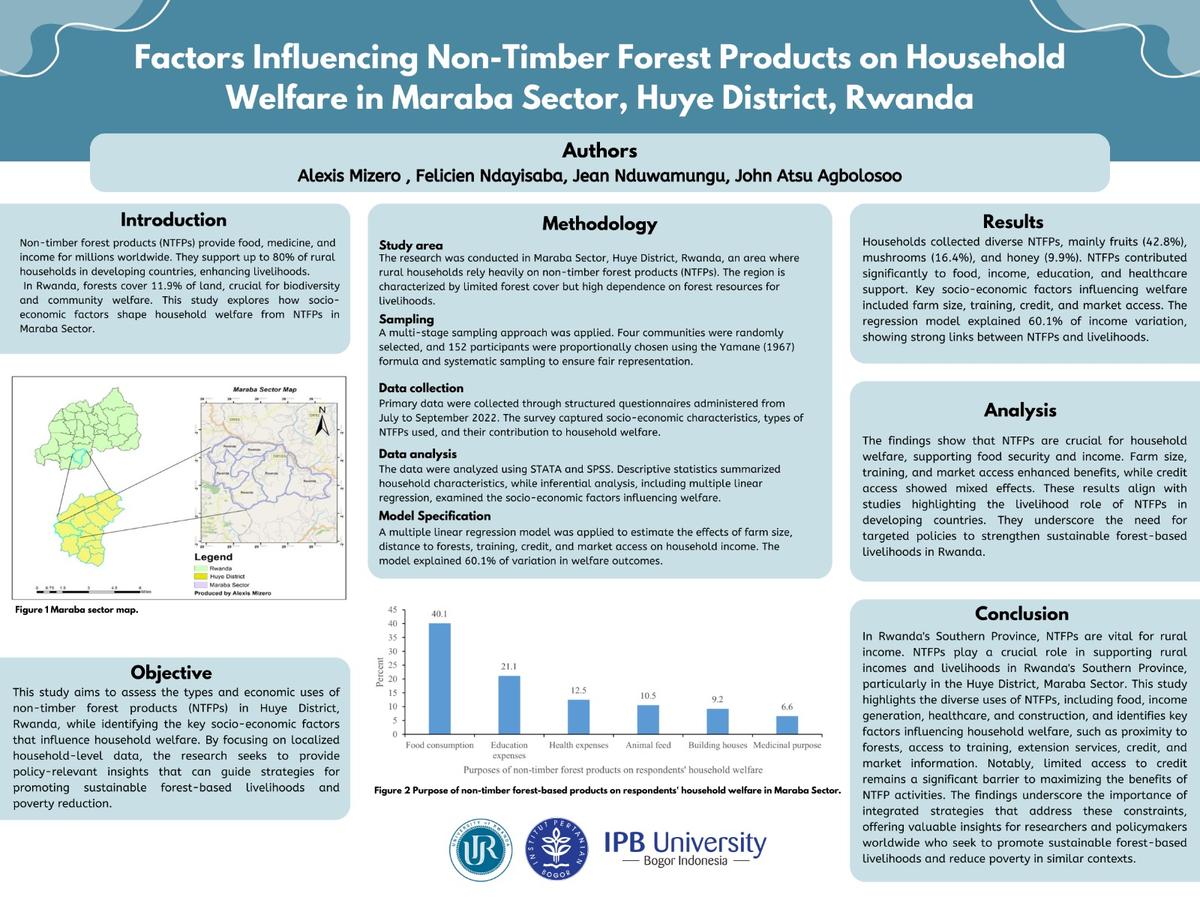
Non-timber forest products (NTFPs) enhance rural household income. In Rwanda, natural forests cover 11.9% of the land and are key for biodiversity conservation, providing water catchment protection, tourism, medicinal plants, honey, and handicraft materials. Despite the forest sector's economic potential, rural residents dependent on NTFPs face challenges, leading to high unemployment and poverty. This research examines how socio-economic factors affect Huye district NTFP collectors' welfare. Using multi-stage sampling, 152 participants were selected, and data was collected through structured questionnaires in 2022. Data analysis used SPSS version 29 and STATA version 16 for multiple linear regression. The research identified NTFPs including fruits, vegetables, honey, traditional medicine, mushrooms, building materials, bush meats, art crafts, fuel, forage, and fodder. The main reasons for NTFP participation included food provision, income generation, education and health expenses, obtaining forage and fodder, building materials, and traditional medicine. Factors like distance to forest, training, extension services, credits, and market information significantly influenced household income. The study recommends increasing forestland allocation for NTFPs and implementing agroforestry systems to boost household income. Reforestation and afforestation initiatives should enhance forest conservation and biodiversity. The Ministry of Lands and Forestry and stakeholders should establish payment systems for ecological services benefiting community residents
Full text article
References
Adongo, W. A., Osei, C. K., & Wongnaa, C. A. (2019). Contribution of nontimber forest products to rural household income in the Kassena-Nankana West district of Ghana. Forest Products Journal, 69(3), 217–227. https://doi.org/10.13073/FPJ-D-18-00049
Amusa, T. O., Jimoh, S. O., & Azeez, I. O. (2017). Socio-economic factors influencing marketing of non-timber forest products in tropical lowland rainforests of South-western Nigeria. Southern Forests, 79(2), 161–168. https://doi.org/10.2989/20702620.2016.1255411
Angelsen, A., Jagger, P., Babigumira, R., Belcher, B., Hogarth, N. J., Bauch, S., Börner, J., Smith-Hall, C., & Wunder, S. (2014). Environmental income and rural livelihoods: A global-comparative analysis. World Development, 64(S1), S12–S28. https://doi.org/10.1016/j.worlddev.2014.03.006
Belcher, B., Ruíz-Pérez, M., & Achdiawan, R. (2005). Global patterns and trends in the use and management of commercial NTFPs: Implications for livelihoods and conservation. World Development, 33(9 SPEC. ISS.), 1435–1452. https://doi.org/10.1016/j.worlddev.2004.10.007
Beyene, A. D., Mekonnen, A., Hirons, M., Robinson, E. J. Z., Gonfa, T., Gole, T. W., & Demissie, S. (2020). Contribution of non-timber forest products to the livelihood of farmers in coffee growing areas: Evidence from Yayu Coffee Forest Biosphere Reserve. Journal of Environmental Planning and Management, 63(9), 1633–1654. https://doi.org/10.1080/09640568.2019.1679615
Caspa, R. G., Nyambi, G. N., Amang, M. J., Mabe, M. N., Nwegueh, A. B., & Foahom, B. (2020). Socio-economic benefits of non-timber forest products to the AFCOE2M communities of Southern Cameroon. Sustainable Agriculture Research, 9(3), Article 30. https://doi.org/10.5539/sar.v9n3p30
Chu, T. van, Thoai, T. Q., An, C. Q., Toai, P. M., Camacho, L. D., & Sam, H. van. (2019). Contribution of forest to rural households’ livelihood: Evidences from da river basin in the northwest mountainous region of Vietnam. Forest and Society, 3(2), 235–247. https://doi.org/10.24259/fs.v3i2.7050
Demie, G. (2019). Contribution of non-timber forest products in rural communities’ livelihoods around Chilimo forest, West Shewa, Ethiopia. Journal of Natural Sciences Research, 9(22), 25–37. https://doi.org/10.7176/jnsr/9-22-04
Derebe, B., Alemu, A., & Asfaw, Z. (2023). Contribution of nontimber forest products earn to livelihood in rural households and the type of use: A systematic review. International Journal of Forestry Research, 2023, Article 9643290. https://doi.org/10.1155/2023/9643290
Epanda, M. A., Donkeng, R. T., Nonga, F. N., Frynta, D., Adi, N. N., Willie, J., & Speelman, S. (2020). Contribution of non-timber forest product valorisation to the livelihood assets of local people in the northern periphery of the Dja Faunal Reserve, East Cameroon. Forests, 11(9), Article 1019. https://doi.org/10.3390/F11091019
FAO & Dalberg Catalyst. (2024). Building a sustainable bioeconomy in Africa through forest products-Trends, opportunities and challenges. FAO & Dalberg Catalyst. https://doi.org/10.4060/cd2463en
Gujarati, D. N., & Porter, D. C. (2015). Basic econometrics (5th ed., vol. 5). McGraw Hill Irwin.
Hakizimana, E., Wali, U. G., Sandoval, D., & Venant, K. (2020). Environmental impacts of biomass energy sources in Rwanda. Energy and Environmental Engineering, 7(3), 62–71. https://doi.org/10.13189/eee.2020.070302
Huye District. (2013). District potentialities assessment for the integrated and self-centered local economic development.
Lepcha, L. D., Shukla, G., Moonis, M., Vineeta, Bhat, J. A., Kumar, M., & Chakravarty, S. (2022). Seasonal relation of NTFPs and socio-economic indicators to the household income of the forest-fringe communities of Jaldapara National Park. Acta Ecologica Sinica, 42(3), 180–187. https://doi.org/10.1016/j.chnaes.2021.03.002
Lovrić, M., Da Re, R., Vidale, E., Prokofieva, I., Wong, J., Pettenella, D., Verkerk, P. J., & Mavsar, R. (2020). Non-wood forest products in Europe–A quantitative overview. Forest Policy and Economics, 116, Article 102175. https://doi.org/10.1016/j.forpol.2020.102175
Ministry of Lands and Forestry. (2018). Rwanda national forestry policy 2018. Ministry of Lands and Forestry.
Miyake, Y., & Kohsaka, R. (2023). Climate change adaptation in non-timber forest products: How resilient are small shiitake producers? Journal of Sustainable Forestry, 42(9), 922–946. https://doi.org/10.1080/10549811.2022.2123822
Mohamed, T. B., & Tesfaye, Y. (2020). Economic contribution to local livelihoods and household dependence on non-timber forest products: The case of Yeki Woreda Forests, Southwest Ethiopia. International Journal of Scientific and Research Publications (IJSRP), 10(06), 489–509. https://doi.org/10.29322/ijsrp.10.06.2020.p10259
Mugido, W., & Shackleton, C. M. (2019). The contribution of NTFPS to rural livelihoods in different agro-ecological zones of South Africa. Forest Policy and Economics, 109, Article 101983. https://doi.org/10.1016/j.forpol.2019.101983
Nahayo, A., Ekise, I. E., & Niyigena, D. (2013). Assessment of the contribution of non-timber forest products to the improvement of local people’s livelihood in Kinigi Sector, Musanze District, Rwanda. Ethiopian Journal of Environmental Studies and Management, 6(6), 698–706. https://doi.org/10.4314/ejesm.v6i6.13
Nerfa, L., Rhemtulla, J. M., & Zerriffi, H. (2020). Forest dependence is more than forest income: Development of a new index of forest product collection and livelihood resources. World Development, 125, Article 104689. https://doi.org/10.1016/j.worlddev.2019.104689
Nsabimana, D. (2012). Seasonal variation of litter arthropods in some Eucalyptus plantations at the Arboretum of Ruhande in Rwanda. Biology Agriculture and Healthcare, 3(9), 49–56.
Olufunmilayo, D. E., Jimoh, A. K., Oyewole, O. S., & Ayeni, E. A. (2019). Non-timber forest products (NTFPs) as a means of livelihood and safety net among the rurals in Nigeria: A review. American Journal of Service Science and Management, 6(1), 27–31.
Panda, L. R. L., Uniyal, A., Kukreti, J., Ritu, & Singh, N. (2024). The role of non-timber forest products for livelihood diversification in Bundelkhand Region of Uttar Pradesh. International Journal of Economic Plants, 11, 70–78. https://doi.org/10.23910/2/2024.5005
Rahman, M. H., Roy, B., & Islam, M. S. (2021). Contribution of non-timber forest products to the livelihoods of the forest-dependent communities around the Khadimnagar National Park in northeastern Bangladesh. Regional Sustainability, 2(3), 280–295. https://doi.org/10.1016/j.regsus.2021.11.001
Republic of Rwanda. (2018). Republic of Rwanda Southern Province Huye District.
Reta, Z., Adgo, Y., Girum, T., & Mekonnen, N. (2020). Assessment of contribution of non-timber forest products in the socio-economic status of peoples in Eastern Ethiopia. Open Access Journal of Biogeneric Science and Research, 4(4).
Shackleton, C., Delang, C. O., Shackleton, S., & Shanley, P. (2011). Non-timber forest products: Concept and definitions. In S. Shackleton, C. Shackleton, & P. Shanley (Eds.), Non-timber forest products in the global context (pp. 3–21). Springer, Berlin, Heidelberg. https://doi.org/10.1007/978-3-642-17983-9_1
Talukdar, N. R., Choudhury, P., Barbhuiya, R. A., & Singh, B. (2021). Importance of non-timber forest products (NTFPs) in rural livelihood: A study in Patharia Hills Reserve Forest, Northeast India. Trees, Forests and People, 3, Article 100042. https://doi.org/10.1016/j.tfp.2020.100042
Thammanu, S., Han, H., Marod, D., Zang, L., Jung, Y., Soe, K. T., Onprom, S., & Chung, J. (2021). Non-timber forest product utilization under community forest management in northern Thailand. Forest Science and Technology, 17(1), 1–15. https://doi.org/10.1080/21580103.2020.1862712
Thomas, R. L. (1997). Modern econometrics: An introduction. Addison Welsey Longman Ltd.
Tuyisenge, M. F., Kayitete, L., Tuyisingize, D., O’Malley, M., Stoinski, T. S., & van der Hoek, Y. (2023). Status of African authorship among conservation research output from sub-Saharan Africa: An African perspective. Conservation Science and Practice, 5(10), Article 13013. https://doi.org/10.1111/csp2.13013
Verkerk, P. J., Hassegawa, M., van Bresselen, J., Cramm, M., Chen, X., Maximo, Y. I., Koc, M., Lovric, M., & Tegegne, Y. T. (2021). Forest products in the global bioeconomy. Enabling substitution by wood-based products and contributing to the sustainable development goals. FAO. https://doi.org/10.4060/cb7274en
Yamane, T. (1967). Statistics: An introductory analysis (2nd ed.).
Zubair, M., Karim, M., & Hussain, S. B. (2022). Assessment of the potential of non-timber forest products in livelihoods’ sustenance of the flood proximate communities of the Indus Basin, Pakistan. Asian Journal of Research in Agriculture and Forestry, 201–210. https://doi.org/10.9734/ajraf/2022/v8i4180
Authors
Copyright (c) 2025 Jurnal Manajemen Hutan Tropika

This work is licensed under a Creative Commons Attribution 4.0 International License.
Jurnal Manajemen Hutan Tropika is an open access journal which means that all contents is freely available without charge to the user or his/her institution. Users are allowed to read, download, copy, distribute, print, search, or link to the full texts of the articles in this journal without asking prior permission from the publisher or the author. This is in accordance with the Budapest Open Access Initiative (BOAI) definition of open access.Article Details
How to Cite



