
Population Dynamics of (Asplenium nidus) as a Bed Bioindicator (Paradisaea minor jobiensis Rothschild, 1897) in the Period 2018-2024 in Barawai, Yapen Island, Papua, Indonesia

Article Sidebar
-
population, Asplenium nidus, bioindicator, Paradisaea minor jobiensis, Barawai Yapen Papua
Abstract
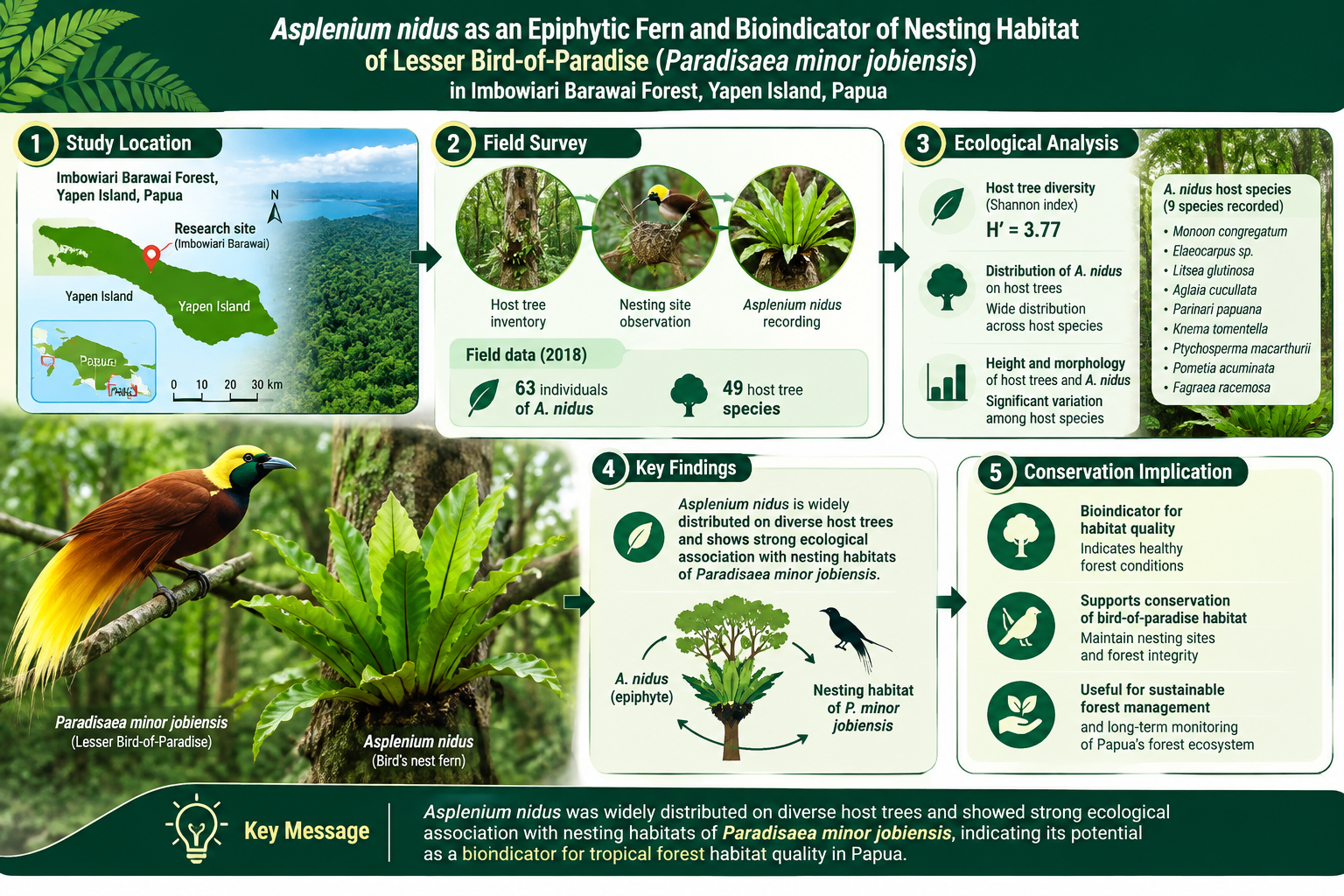
Asplenium nidus is an epiphytic fern recognized as an ecological bioindicator associated with the nesting habitat of the lesser bird-of-paradise (Paradisaea minor jobiensis Rothschild, 1897). This study analyzed population dynamics of A. nidus between 2018 and 2024 and examined its relationship with host tree species as an indicator of forest ecosystem health in the Imbowiari Barawai Forest, Yapen Island, Papua, Indonesia. Field observations were conducted using a transect-plot method, and data were analyzed using diversity indices, descriptive statistics, and morphometric comparisons. In 2018, 63 individuals of A. nidus were recorded on 49 host tree species, with high host diversity (H′ = 3.77). In 2024, 79 individuals were recorded on only nine host species, resulting in moderate diversity (H′ = 1.79). Five host species, Canarium hirsutum, Pimeleodendron amboinicum, Intsia bijuga, Ficus sp., and Myristica longipes, consistently supported A. nidus populations in both periods. Morphometric characteristics showed no significant differences among sampling sites. These findings indicate that A. nidus can serve as a useful bioindicator of habitat conditions and provide baseline information for long-term ecological monitoring, habitat assessment, and conservation of bird-of-paradise nesting habitats in Papua and support sustainable forest management practices.
Full text article
References
Ainuddin, N. A., & Najwa, D. A. N. (2009). Growth and physiological responses of Asplenium nidus to water stress. Asian Journal of Plant Sciences, 8(6), 447450. https://doi.org/10.3923/ajps.2009.447.450
Arrijani. (2008). Struktur dan komposisi vegetasi zona montana Taman Nasional Gunung Gede Pangrango. Biodiversitas, 9(2), 134141. https://doi.org/10.13057/biodiv/d090212
Astuti, C. C., & Sulistiyowati, W. (2017). Buku ajar statistika dasar: Konsep dan aplikasinya. Sidoarjo: Umsida Press.
Beljai, M., & Worabai, M. S. (2018). Struktur dan komposisi vegetasi keanekaragaman jenis amfibi di Hutan Pegunungan Arfak Papua Barat. Prosiding Seminar Nasional Biodiversitas Indonesia, 1(4), 112. https://doi.org/10.13057/psnmbi/m0401017.
Böhnert, T., Wenzel, A., Altenhövel, C., Beeretz, L., Tjitrosoedirdjo, S. S., Meijide, A., Rembold, K., & Kreft, H. (2016). Effects of land-use change on vascular epiphyte diversity in Sumatra (Indonesia). Biological Conservation, 202, 2029. https://doi.org/10.1016/j.biocon.2016.08.008
Callaway, R. M., Reinhart, K. O., Moore, G. W., Moore, D. J., & Pennings, S. C. (2002). Epiphyte host preferences and host traits: Mechanisms for species-specific interactions. Oecologia, 132(2), 221–230. https://doi.org/10.1007/s00442-002-0943-3
Chen, X. -Z., Hogan, J. A., Wang, C. -P., Wang, P. -L., & Lin, T. -C. (2023). Responses of a common tropical epiphyte, Asplenium nidus, to changes in water and nutrient availability. AoB Plants, 15(6), Article plad076. https://doi.org/10.1093/aobpla/plad076
Darma, I. D., Lestari, W. S., Priyadi, A., & Iryadi, R. (2018). Paku epifit dan pohon inangnya di Bukit Pengelengan, Tapak Lesung, Bedugul, Bali. Jurnal Penelitian Hutan dan Konservasi Alam, 15(1), 4150.
Darma, I. D. P., & Peneng, I. N. (2007). Inventory of ferns in the Laiwangi-Wanggameti National Park of East Sumba, Waingapu, NTT. Biodiversitas, 8(3), 242248. https://doi.org/10.13057/biodiv/d080316
Dong, S. -Y. (2011). Taxonomic studies on Asplenium sect. thamnopteris (Aspleniaceae) I: Cytological observations. American Fern Journal, 101(3), 156171. https://doi.org/10.1640/0002-8444-101.3.156
Fitrah, H., Arbain, A., & Mildawati. (2014). Jenis-jenis paku sarang (Asplenium): Aspleniaceae di Gubung Singgalang Sumatera Barat. Jurnal Biologi Universitas Andalas, 3(2), 141146.
Hartini, S. (2006). Tumbuhan paku di Cagar Alam Sago Malintang, Sumatera Barat dan aklimatisasinya di Kebun Raya Bogor. Biodiversitas, 7(3), 230236. https://doi.org/10.13057/biodiv/d070307
Imaniar, R., Pujiastuti, P., & Murdiyah, S. (2017). Identifikasi keanekaragaman tumbuhan paku di kawasan air terjun Kapas Biru Kecamatan Pronojiwo Kabupaten Lumajang serta pemanfaatnnya sebagai booklet. Jurnal Pendidikan Biologi, 6(3), 337345. https://doi.org/10.24114/jpb.v6i3.7901
Janna, M., Dwi, R., & Sepriyaningsih. (2020). Keanekaragaman jenis tumbuhan Pteridophyta (Paku-pakuan) di kawasan Curug Panjang Desa Durian Remuk Kabupaten Musi Rawas. Jurnal Biologi dan Pembelajarannya, 7(1), 1922. https://doi.org/10.29407/jbp.v7i1.14801
Karasawa, S., & Hijii, N. (2006). Effects of distribution and structural traits of bird's nest ferns (Asplenium nidus) on oribatid (Acari: Oribatida) communities in a subtropical Japanese forest. Journal of Tropical Ecology, 22(2), 213222. https://doi.org/10.1017/S0266467405003032
Komada, N., Itioka, T., Nakanishi, A., Tagane, S., & Shimizu-kaya, U. (2022). Effects of host tree size on the species richness and abundance of epiphyte assemblages in a Bornean lowland tropical forest. Tropics, 30(4), 53–61.
Larrivée, M. C., & Buddle, C. M. (2009). Diversity of canopy and understorey spiders in north- temperate hardwood forests. Agricultural and Forerst Entomology, 11(2), 225237. https://doi.org/10.1111/j.1461-9563.2008.00421.x
Mansur, M., Kohyama, T., Simbolon, H., Partomihardjo, T., & Tani, T. (2004). Distribusi vertikal dan horizontal Asplenium nidus di Taman Nasional Gunung Halimun Jawa Barat. Berita Biologi, 7(1), 8186.
Mudiana, D. (2008). Asplenium nidus L. pada beberapa pohon inang di kawasan Taman Wisata Alam Bukit Kelam, Kabupaten Sintang, Kalimantan Barat. Biota: Jurnal Ilmiah Ilmu-Ilmu Hayati, 13(2), 75–81. https://doi.org/10.24002/biota.v13i2.2674
Nakamura, A., Kitching, R. L., Cao, M., Creedy, T. J., Fayle, T. M., Freiberg, M., Hewitt, C. N., Itioka, T., Koh, L. P., Ma, K., Malhi, Y., Mitchell, A., Novotny, V., Ozanne, C. M. P., Song, L., Wang, H., & Ashton, L. A. (2017). Forests and their canopies: Achievements and horizons in canopy science. Trends in Ecology & Evolution, 32(6), 438–451. https://doi.org/10.1016/j.tree.2017.02.020
Nawawi, G. R. N., Indriyanto, & Duryat. (2014). Identifikasi jenis epifit dan tumbuhan yang menjadi penopangnya di blok perlindungan dalam kawasan Taman Hutan Raya Wan Abdul Rachman. Jurnal Sylva Lestari, 2(3), 3948. https://doi.org/10.23960/jsl3239-48
Paiki, A. Y. C, Simbiak, M., & Raunsay, E. K. (2022). Analysis of structure, the composition of vegetation, and diversity of epiphytes and their hosts. Jurnal Penelitian Pendidikan IPA, 8(6), 27522763. https://doi.org/10.29303/jppipa.v8i6.2492
Perrie, L. R., & Brownsey, P. J. (2005). Insights into the biogeography and polyploid evolution of New Zealand Asplenium from chloroplast DNA sequence data. American Fern Journal, 95(1), 121.
Proctor, M. C. F. (2012). Light and desiccation responses of some Hymenophyllaceae (filmy ferns) from Trinidad, Venezuela and New Zealand: Poikilohydry in a light-limited but low evaporation ecological niche. Annals of Botany, 109(5), 1019–1026. https://doi.org/10.1093/aob/mcs012
Raunsay, E. K. (2014). Peran masyarakat dalam pelestarian burung Cenderawasih di Barawai Kabupaten Kepulauan Yapen Provinsi Papua [thesis]. Bogor: IPB University.
Raunsay, E. K. (2020). Pohon tempat beraktivitas burung Cenderawasih (Paradisaea minor jobiensis Rothschild, 1897) di Hutan Imbowiari Barawai Yapen, Papua. Jurnal Ilmu Lingkungan, 18(1), 133139.
Raunsay, E. K. (2022). Habitat dan konservasi burung Cenderawasih: Studi kasus melalui peran masyarakat Barawai. Bekasi: Amerta Media.
Raunsay, E. K., Akobiarek, M., & Ruamba, M. Y. (2022). Distribusi vertikal Asplenium nidus L. di kawasan hutan Imbowiari, Kepulauan Yapen, Papua. Jurnal Sylva Lestari, 8(3), 390399. https://doi.org/10.23960/jsl38390-399
Saroh, I., & Krisdianto (2020). Manfaat ekologis kanopi pohon terhadap iklim mikro di ruang terbuka hijau kawasan perkotaan. Jurnal Hutan dan Masyarakat, 12(2), 136145. https://doi.org/10.24259/jhm.v12i2.10040
Simbolo, H. (2007). Epifit dan liana pada pohon di hutan Pamah primer dan bekas terbakar Kalimantan Timur Indonesia. Berita Biologi, 8(4), 249261.
Sirami, E. (2015). Tingkat dan tipe asosiasi enam jenis paku epifit dengan pohon inang di Taman Wisata Alam Gunung Meja Manokwari. Jurnal Kehutanan Papuasia, 1(1), 1827. https://doi.org/10.46703/jurnalpapuasia.vol1.iss1.25
Sofiyanti, N., Sari, A. K., Iriani, D., Mutrofin, R., Taufiq, I., Juliantari, E., & Pranata, S. (2021). Morphological and anatomical study of four Pyrrosia (Polypodiaceae) species from Rumbai Forest, Riau Province, Indonesia. Biodiversitas, 22(11), 4905–4914. https://doi.org/10.13057/biodiv/d221124
Sujalu, A. P. (2017). Identifikasi pohon inang di hutan Dipterocarpaceae dataran rendah klimaks Kabupaten Malinau. Ulin: Jurnal Hutan Tropis, 1(2), 196201. https://doi.org/10.32522/ujht.v1i2.1014
Sukarsa, Hidayah, H. A., & Chasanah, T. (2011). Diversitas spesies tumbuhan paku hias dalam upaya melestarikan sumberdaya hayati Kebun Raya Buturraden. Biosfera, 28(1), 2331.
Taylor, A., & Burns, K. (2015). Plant composition patterns inside an endemic birds' nest and plant dispersal abilities. Journal of Tropical Ecology, 31(5), 413421. https://doi.org/10.1017/S0266467415000334
Trimanto, Hapsari, L., & Budiharta, S. (2021). Integrating indicators of natural regeneration, enrichment planting, above-ground carbon stock, micro-climate and soil to assess vegetation succession in postmining reclamation in tropical forest. Turkish Journal of Botany, 2(1), 4149. https://doi.org/10.3906/bot-2103-35
Utami, D. N., Kusumastuti, E., Sudiana, N., Rahayu, B., Hidayat, N., Sulistiawan, I. N., Purnomo, A., Atang, & Sittadewi, E. H. (2023). Karakteristik kapasitas penyimpan air dan efisiensi penyimpanan air media tumbuh penahan erosi ‘biotextile’. Berkala Ilmiah Biologi, 14(1), 3847. https://doi.org/10.22146/bib.v14i1.5891
Voronkov, A. S., & Ivanova, T. V. (2021). Fatty acids composition of the epiphytic ferns, Platycerium bifurcatum and Asplenium nidus, and the terrestrial fern, Asplenium trichomanes. Americans Fern Journal, 111(2), 117128. https://doi.org/10.1640/0002-8444-111.2.117
Yatabe, Y., Masuyama, S., Darnaedi, D., & Murakami, N. (2001). Molecular systematics of the Asplenium nidus complex from Mt. Halimun National Park, Indonesia: Evidence for reproductive isolation among three sympatric rbcL sequence types 1. American Journal of Botany, 88(8), 15171522. https://doi.org/10.2307/3558459
Zhang, L., Nurvianto, S., & Harrison, R. (2009). Factors affecting the distribution and abundance of Asplenium nidus L. in a tropical lowland rain forest in Peninsular Malaysia. Biotropica, 42(4), 464469. https://doi.org/10.1111/j.1744-7429.2009.00607.x
Zotz, G. (2016). Plants on plants: The biology of vascular epiphytes. Springer International Publishing. https://doi.org/10.1007/978-3-319-39237-0
Zotz, G., & Hietz, P. (2001). The physiological ecology of vascular epiphytes: Current knowledge, open questions. Journal of Experimental Botany, 52(364), 2067–2078. https://doi.org/10.1093/jexbot/52.364.2067
Zuquim, G., Benchimol, M., Tonon, R., Peres, C. A., & Storck-Tonon, D. (2022). Effects of forest degradation on Amazonian ferns in a land-bridge island system as revealed by non-specialist inventories. Ecological Solutions and Evidence, 3, Article e12123. https://doi.org/10.1002/2688-8319.12123
Authors
Copyright (c) 2026 Jurnal Manajemen Hutan Tropika

This work is licensed under a Creative Commons Attribution 4.0 International License.
Jurnal Manajemen Hutan Tropika is an open access journal which means that all contents is freely available without charge to the user or his/her institution. Users are allowed to read, download, copy, distribute, print, search, or link to the full texts of the articles in this journal without asking prior permission from the publisher or the author. This is in accordance with the Budapest Open Access Initiative (BOAI) definition of open access.Article Details