
Wildlife Trade in East Nusa Tenggara Province Based on Facebook Social Media Groups

Article Sidebar
-
conservation, east nusa tenggara, online trade, social media, wildlife trade
Abstract
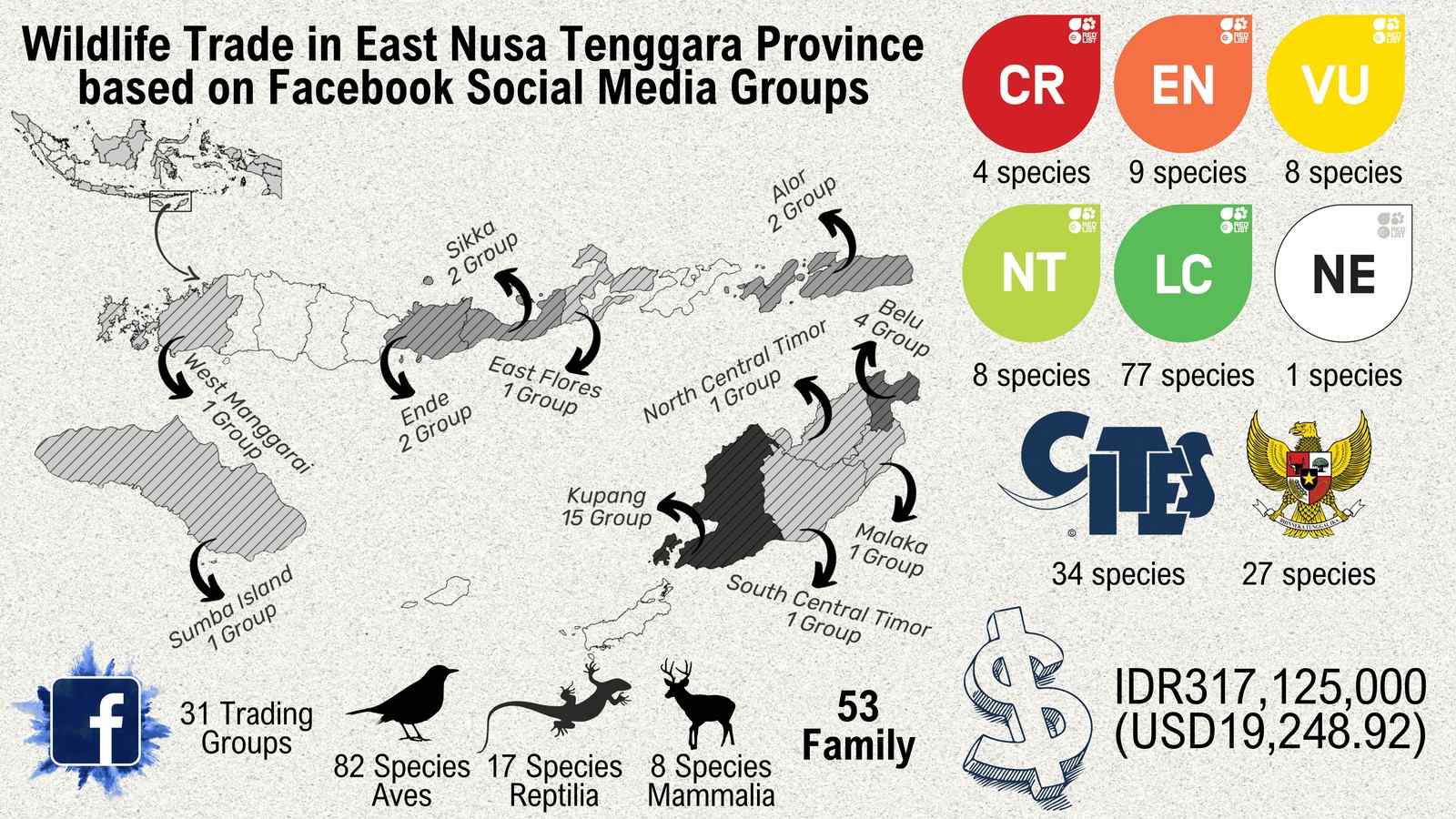
Wildlife conservation is fundamental to mitigating the extinction due to wildlife trade. Thus, various conservation policies have been used as a reference: IUCN, CITES, and Government Policy P.106 of 2018. This research aims to record Facebook-based wildlife trade, identify the traded wildlife conservation status, and estimate the selling price. Data was taken since the group was formed until 1 July 2023. The results reveal that 107 species belonging to 53 families were recorded in 31 trading groups, comprising 82 species of aves, 17 species of herpetofauna, and eight species of mammals. Among those traded wildlife, based on P.106, 80 species are unprotected, while 27 are protected. Based on the IUCN, most traded wildlife is categorized as LC with 77 species. Some species are categorized as CR with four species, EN with 9, VU with 8, NT with 8, and NE with one species. Referring to CITES, 73 species classified as non-appendices dominate the trading groups, followed by 24 species of Appendix II, 9 of Appendix I, and 1 of Appendix III. The estimated selling price of all traded wildlife is approximately IDR 317,125,000. Governments and other conservation bodies must pay more attention to the growing Facebook-based wildlife trade, especially for protected and endangered species.
Full text article
References
Alagona, P. S. (2022). The accidental ecosystem: People and wildlife in American cities. Univ of California Press.
Alalwan, A. A., Rana, N. P., Dwivedi, Y. K., & Algharabat, R. (2017). Social media in marketing: A review and analysis of the existing literature. Telematics and Informatics, 34(7), 1177–1190. http://doi.org/10.1016/j.tele.2017.05.008
Allison, C. (2017). International Whaling Commission Catch Data Base v. 6.1. As Cited in Cooke.
Amalia, S. R. (2024). Perdagangan Satwa Liar Asia Tenggara dalam Rantai Nilai Industri Obat Tradisional Tiongkok. Indonesian Journal of International Relations, 8(2), 313–332. http://doi.org/10.32787/ijir.v8i2.572
Appel, G., Grewal, L., Hadi, R., & Stephen, A. T. (2020). The future of social media in marketing. Journal of the Academy of Marketing Science, 48(1), 79–95. http://doi.org/10.1007/s11747-019-00695-1
BirdLife International. (2016). Cacatua moluccensis. The IUCN Red List of Threatened Species 2016: E.T22684784A93046425. https://dx.doi.org/10.2305/IUCN.UK.2016-3.RLTS.T22684784A93046425.en. Accessed on 21 September 2024.
BirdLife International. (2017a). Lorius garrulus (amended version of 2016 assessment). The IUCN Red List of Threatened Species 2017: E.T22684581A117219105. https://dx.doi.org/10.2305/IUCN.UK.2017-3.RLTS.T22684581A117219105.en. Accessed on 21 September 2024.
BirdLife International. (2017b). Pitta nympha (amended version of 2016 assessment). The IUCN Red List of Threatened Species 2017: E.T22698684A116880779. https://dx.doi.org/10.2305/IUCN.UK.2017-3.RLTS.T22698684A116880779.en. Accessed on 21 September 2024.
BirdLife International. (2021a). Cacatua alba. The IUCN Red List of Threatened Species 2021: E.T22684789A178092137. https://dx.doi.org/10.2305/IUCN.UK.2021-3.RLTS.T22684789A178092137.en. Accessed on 21 September 2024.
BirdLife International. (2021b). Cacatua sulphurea. The IUCN Red List of Threatened Species 2021: E.T200296187A178119524. https://dx.doi.org/10.2305/IUCN.UK.2021-3.RLTS.T200296187A178119524.en. Accessed on 21 September 2024.
Brown, V. F. (2017). The extinction market: Wildlife trafficking and how to counter it. Oxford University Press.
Bruwer, C. (2020). Smuggling and trafficking of illicit goods by sea. Global Challenges in Maritime Security: An Introduction, 49–73. http://doi.org/10.1007/978-3-030-34630-0_4
Cardador, L., Abellán, P., Anadón, J. D., Carrete, M., & Tella, J. L. (2021). The world parrot trade. Naturalized Parrots of the World: Distribution, Ecology, and Impacts of the World's Most Colorful Colonizers, 13–21. http://doi.org/10.2307/j.ctv1g13jxb.5
Chaber, A.-L., Amstrong, K. N., Wiantoro, S., Xerri, V., Caraguel, C., Boardman, W. S. J., & Nielsen, T. D. (2021). Bat E-commerce: Insights into the extent and potential implications of this dark trade. Frontiers in Veterinary Science, 8, 651304. http://doi.org/10.3389/fvets.2021.651304
Chan, D. T. C., Poon, E. S. K., Wong, A. T. C., & Sin, S. Y. W. (2021). Global trade in parrots–Influential factors of trade and implications for conservation. Global Ecology and Conservation, 30, e01784. http://doi.org/10.1016/j.gecco.2021.e01784
Cooke, J. G. (2018). Balaenoptera musculus (errata version published in 2019). The IUCN Red List of Threatened Species 2018: E.T2477A156923585. https://dx.doi.org/10.2305/IUCN.UK.2018-2.RLTS.T2477A156923585.en. Accessed on 21 September 2024.
Cuckston, T. (2018). Making extinction calculable. Accounting, Auditing & Accountability Journal, 31(3), 849–874. http://doi.org/10.1108/aaaj-10-2015-2264
De Vos, A., Brownell Jr, R. L., Tershy, B., & Croll, D. (2016). Anthropogenic threats and conservation needs of blue whales, Balaenoptera musculus indica, around Sri Lanka. Journal of Marine Sciences, 2016(1), 8420846. http://doi.org/10.1155/2016/8420846
Evans, D., Bratton, S., & McKee, J. (2021). Social media marketing. AG Printing & Publishing.
Fa, J. E., Funk, S. M., & Nasi, R. (2022). Hunting wildlife in the tropics and subtropics. Cambridge University Press. http://doi.org/10.1017/9781316338704
Frezina, N. C. A., & Rozarina, N. J. A. (2012). Extinction of Species and its Management for Ecological Balance. BOOK OF PROCEEDINGS, 417.
Fryxell, J. M., Sinclair, A. R. E., & Caughley, G. (2014). Wildlife ecology, conservation, and management. John Wiley & Sons.
Fukushima, C. S., Mammola, S., & Cardoso, P. (2020). Global wildlife trade permeates the Tree of Life. Biological Conservation, 247, 108503. http://doi.org/10.1016/j.biocon.2020.108503
Gbogbo, F., & Daniels, J. K. (2019). Trade in wildlife for traditional medicine in Ghana: therapeutic values, zoonoses considerations, and implications for biodiversity conservation. Human Dimensions of Wildlife, 24(3), 296–300. http://doi.org/10.1080/10871209.2019.1605637
Gunawan, A. P., & Noske, R. (2017). The use of social media in the illegal trade in Indonesian raptors. Kukila, 20, 1–10.
Harrison, J. R., Roberts, D. L., & Hernandez‐Castro, J. (2016). Assessing the extent and nature of wildlife trade on the dark web. Conservation Biology, 30(4), 900–904. http://doi.org/10.1111/cobi.12707
Hasibuan, H. S., & Mulyani, M. (2022). Transit-oriented development: towards achieving sustainable transport and urban development in jakarta metropolitan, Indonesia. Sustainability, 14(9), 5244. http://doi.org/10.3390/su14095244
Hemelikova, A., Zoubek, P., Ouhel, T., Awaluddin, A., & Ferasyi, T. R. (2021). Conservation of hawksbill turtle (Eretmochelys imbricata) in Indonesia. 2nd International Conference on Veterinary, Animal, and Environmental Sciences (ICVAES 2020), 44–47. http://doi.org/10.2991/absr.k.210420.010
Hidayat, O., & Pramatana, F. (2022). Biodiversity catastrophic: Overexploitation of the endemic fauna in East Nusa Tenggara, Indonesia. IOP Conference Series: Earth and Environmental Science, 1109(1), 012088. http://doi.org/10.1088/1755-1315/1109/1/012088
Holtmeier, F. (2015). Animals' Influence on the Landscape and Ecological Importance. Netherlands: Springer.
Hughes, A. C. (2021). Wildlife trade. Current Biology, 31(19), R1218–R1224. http://doi.org/10.1016/j.cub.2021.08.056
Isbell, F., Tilman, D., Polasky, S., & Loreau, M. (2015). The biodiversity‐dependent ecosystem service debt. Ecology Letters, 18(2), 119–134. http://doi.org/10.1111/ele.12393
IUCN. (2024). The IUCN Red List of Threatened Species. Version 2024-1. https://www.iucnredlist.org
Jeethvendra, K., Nishizawa, H., Alin, J., Muin, H., & Joseph, J. (2023). Illegal tortoiseshell harvest of hawksbill turtles (Eretmochelys imbricata) in Southeast Asia: evidence from Baturua Reef, Semporna, Sabah, Malaysia. Journal of Sustainability Science and Management, 18(7), 53–66. http://doi.org/10.46754/jssm.2023.07.004
Kamrullah, M. R. N. (2023). Perdagangan Ilegal Satwa Dilindungi Berbasis Online Melalui Sosial Media Facebook Ditinjau dari Teori Green Criminology. Anomie, 5(3).
KLHK. (2018). Kementerian Lingkungan Hidup dan Kehutanan 2018 Peraturan Menteri Lingkungan Hidup dan Kehutanan Nomor: P.106/Menlhk/Setjen/Kum.1/12/2018 tentang Perubahan Kedua Atas Peraturan Menteri Lingkungan Hidup dan Kehutanan Nomor: P.20/Menlhk/Setjen/Kum.1/6/2018.
Koutchoro, A. M., Amahowe, O. I., Houessou, L. G., & Lougbegnon, T. O. (2024). Role of local markets in illegal wildlife trade and conservation efforts for trafficked species. Global Ecology and Conservation, 54, e03110. http://doi.org/10.1016/j.gecco.2024.e03110
Latinne, A., Saputro, S., Kalengkongan, J., Kowel, C. L., Gaghiwu, L., Ransaleleh, T. A., Nangoy, M. J., Wahyuni, I., Kusumaningrum, T., & Safari, D. (2020). Characterizing and quantifying the wildlife trade network in Sulawesi, Indonesia. Global Ecology and Conservation, 21, e00887. http://doi.org/10.1016/j.gecco.2019.e00887
Lavorgna, A. (2014). Wildlife trafficking in the Internet age. Crime Science, 3, 1–12.
Lehtinen, S. O. (2021). Ecological and evolutionary consequences of predator-prey role reversal: Allee effect and catastrophic predator extinction. Journal of Theoretical Biology, 510, 110542. http://doi.org/10.1016/j.jtbi.2020.110542
Lele, S. (2021). From wildlife-ism to ecosystem-service-ism to a broader environmentalism. Environmental Conservation, 48(1), 5–7. http://doi.org/10.1017/s0376892920000466
Liana, L., & Witno, W. (2021). Perdagangan satwa liar di pasar tradisional dan pasar modern di Sulawesi Utara. Jurnal Penelitian Kehutanan BONITA, 3(1), 28–34. http://doi.org/10.55285/bonita.v3i1.767
LuiSeLLi, L. (2015). Correlates of indigenous hunting techniques with wildlife trade in bushmeat markets of the Niger delta (Nigeria). Vie et Milieu-Life and Environment, 65(3), 169–174.
Maulany, R. I., Mutmainnah, A., Nasri, N., Achmad, A., & Ngakan, P. O. (2021). Tracing current wildlife trade: An initial investigation in Makassar City, Indonesia. Forest and Society, 5(2), 277–287. http://doi.org/10.24259/fs.v5i2.9097
McConkie, A. (2021). Illegal Wildlife Trade in China. Ballard Brief, 2021(3), 5.
McNamara, J., Rowcliffe, M., Cowlishaw, G., Alexander, J. S., Ntiamoa-Baidu, Y., Brenya, A., & Milner-Gulland, E. J. (2016). Characterising wildlife trade market supply-demand dynamics. PloS One, 11(9), e0162972. http://doi.org/10.1371/journal.pone.0162972
Mittermeier, R. A., Turner, W. R., Larsen, F. W., Brooks, T. M., & Gascon, C. (2011). Global biodiversity conservation: the critical role of hotspots. In Biodiversity hotspots: distribution and protection of conservation priority areas (pp. 3–22). Springer. http://doi.org/10.1007/978-3-642-20992-5_1
Morgan, J., & Chng, S. (2018). Rising internet-based trade in the Critically Endangered ploughshare tortoise Astrochelys yniphora in Indonesia highlights need for improved enforcement of CITES. Oryx, 52(4), 744–750. http://doi.org/10.1017/s003060531700031x
Mortimer, J. A., Donnelly, M. (IUCN SSC Marine Turtle Specialist Group). (2008). Eretmochelys imbricata. The IUCN Red List of Threatened Species 2008: E.T8005A12881238. https://dx.doi.org/10.2305/IUCN.UK.2008.RLTS.T8005A12881238.en. Accessed on 21 September 2024.
Mukherjee, S., Appel, A., Duckworth, J. W., Sanderson, J., Dahal, S., Willcox, D. H. A., Herranz Muñoz, V., Malla, G., Ratnayaka, A., Kantimahanti, M., Thudugala, A., Thaung, R., & Rahman, H. (2016). Prionailurus viverrinus (errata version published in 2022). The IUCN Red List of Threatened Species 2016: E.T18150A221434864. https://dx.doi.org/10.2305/IUCN.UK.2016-2.RLTS.T18150A221434864.en. Accessed on 21 September 2024.
Mulawka, E. J. (2014). The cockatoos: A complete guide to the 21 species. McFarland.
Mutiaradita, N. A., Kusrini, M. D., & Mardiastuti, A. (2023). Herpetofauna trade via e-commerce in Indonesia. IOP Conference Series: Earth and Environmental Science, 1220(1), 012006. http://doi.org/10.1088/1755-1315/1220/1/012006
Nandika, D., Agustina, D., Heinsohn, R., & Olah, G. (2021). Wildlife trade influencing natural parrot populations on a biodiverse Indonesian Island. Diversity, 13(10), 483. http://doi.org/10.3390/d13100483
Nijman, V. (2022). Online trade threatens even inconspicuous wildlife. Oryx, 56(3), 332–333. http://doi.org/10.1017/s0030605322000187
Nijman, V., Ardiansyah, A., Langgeng, A., Hendrik, R., Hedger, K., Foreman, G., Morcatty, T. Q., Siriwat, P., van Balen, S., & Eaton, J. A. (2022). Illegal wildlife trade in traditional markets, on Instagram and Facebook: Raptors as a case study. Birds, 3(1), 99–116. http://doi.org/10.3390/birds3010008
Nijman, V., & Nekaris, K. A. I. (2014). Trade in Wildlife in Bali, Indonesia, for Medicinal and Decorative Purposes. TRAFFIC Bulletin, 26(1), 31.
Nijman, V., Smith, J. H., Foreman, G., Campera, M., Feddema, K., & Nekaris, K. A. I. (2021). Monitoring the trade of legally protected wildlife on Facebook and Instagram illustrated by the advertising and sale of apes in Indonesia. Diversity, 13(6), 236. http://doi.org/10.3390/d13060236
Paridi, A., & Noske, R. A. (2017). The illegal trade of Indonesian raptors through social media. Kukila, 20, 1–11.
Pimm, S. L., Jenkins, C. N., Abell, R., Brooks, T. M., Gittleman, J. L., Joppa, L. N., Raven, P. H., Roberts, C. M., & Sexton, J. O. (2014). The biodiversity of species and their rates of extinction, distribution, and protection. Science, 344(6187), 1246752. http://doi.org/10.1126/science.1246752
Pires, S. F., Olah, G., Nandika, D., Agustina, D., & Heinsohn, R. (2021a). Illegal parrot trade in Indonesia. CrimRxiv. http://doi.org/10.21428/cb6ab371.79e4137a
Pires, S. F., Olah, G., Nandika, D., Agustina, D., & Heinsohn, R. (2021b). What drives the illegal parrot trade? Applying a criminological model to market and seizure data in Indonesia. Biological Conservation, 257, 109098. http://doi.org/10.1016/j.biocon.2021.109098
Rao, M., Zaw, T., Htun, S., & Myint, T. (2011). Hunting for a living: Wildlife trade, rural livelihoods and declining wildlife in the Hkakaborazi National Park, North Myanmar. Environmental Management, 48(1), 158–167. http://doi.org/10.1007/s00267-011-9662-z
Robards, M. D., & Reeves, R. R. (2011). The global extent and character of marine mammal consumption by humans: 1970–2009. Biological Conservation, 144(12), 2770–2786. http://doi.org/10.1016/j.biocon.2011.07.034
Rockwood, R. C., Calambokidis, J., & Jahncke, J. (2017). High mortality of blue, humpback and fin whales from modeling of vessel collisions on the US West Coast suggests population impacts and insufficient protection. PLoS One, 12(8), e0183052. http://doi.org/10.1371/journal.pone.0201080
Ruitan, N. B., Kiroh, H. J., Rimbing, S. C., Assa, G. S. V, Montong, P., & Ratulangi, F. S. (2024). Inventarisasi satwa liar dan satwa endemik yang beredar di pasar tradisional di Wilayah Minahasa Utara. ZOOTEC, 44(1), 50–58. http://doi.org/10.35792/zot.40.2.2020.30095
Salas-Picazo, R. I., Ramírez-Bravo, O. E., Meza-Padilla, I., & Camargo-Rivera, E. E. (2023). The role of social media groups on illegal wildlife trade in four Mexican states: A year-long assessment. Global Ecology and Conservation, 45, e02539. http://doi.org/10.1016/j.gecco.2023.e02539
Scheffers, B. R., Oliveira, B. F., Lamb, I., & Edwards, D. P. (2019). Global wildlife trade across the tree of life. Science, 366(6461), 71–76. http://doi.org/10.1126/science.aav5327
Senko, J. F., Burgher, K. M., del Mar Mancha‐Cisneros, M., Godley, B. J., Kinan‐Kelly, I., Fox, T., Humber, F., Koch, V., Smith, A. T., & Wallace, B. P. (2022). Global patterns of illegal marine turtle exploitation. Global Change Biology, 28(22), 6509–6523. http://doi.org/10.1111/gcb.16378
Siriwat, P., & Nijman, V. (2018). Illegal pet trade on social media as an emerging impediment to the conservation of Asian otters species. Journal of Asia-Pacific Biodiversity, 11(4), 469–475. http://doi.org/10.1016/j.japb.2018.09.004
Sol, J. (2019). Economics in the anthropocene: species extinction or steady state economics. Ecological Economics, 165, 106392. http://doi.org/10.1016/j.ecolecon.2019.106392
Spee, L. B., Hazel, S. J., Dal Grande, E., Boardman, W. S. J., & Chaber, A.-L. (2019). Endangered exotic pets on social media in the Middle East: Presence and impact. Animals, 9(8), 480. http://doi.org/10.3390/ani9080480
Sung, Y.-H., & Fong, J. J. (2018). Assessing consumer trends and illegal activity by monitoring the online wildlife trade. Biological Conservation, 227, 219–225. http://doi.org/10.1016/j.biocon.2018.09.025
Taogan, S., Kainde, R. P., & Tasirin, J. S. (2020). Perdagangan Jenis Satwa Liar di Pasar Langowan, Sulawesi Utara. Cocos, 2(1). http://doi.org/10.55285/bonita.v3i1.767
Toomes, A., Moncayo, S., Stringham, O. C., Lassaline, C., Wood, L., Millington, M., Drake, C., Jense, C., Allen, A., & Hill, K. G. W. (2023). A snapshot of online wildlife trade: Australian e-commerce trade of native and non-native pets. Biological Conservation, 282, 110040. http://doi.org/10.1016/j.biocon.2023.110040
Tow, J. H., Symes, W. S., & Carrasco, L. R. (2021). Economic value of illegal wildlife trade entering the USA. PloS One, 16(10), e0258523. http://doi.org/10.1371/journal.pone.0258523
Tuten, T. L. (2023). Social media marketing. Sage publications limited.
UNEP-WCMC (Comps.). (2024). The Checklist of CITES Species Website. CITES Secretariat, Geneva, Switzerland. Compiled by UNEP-WCMC, Cambridge, UK. http://checklist.cites.org. http://doi.org/10.5962/bhl.title.44852
Valiente‐Banuet, A., Aizen, M. A., Alcántara, J. M., Arroyo, J., Cocucci, A., Galetti, M., García, M. B., García, D., Gómez, J. M., & Jordano, P. (2015). Beyond species loss: the extinction of ecological interactions in a changing world. Functional Ecology, 29(3), 299–307. http://doi.org/10.1111/1365-2435.12356
Van Uhm, D. P. (2016). The illegal wildlife trade: Inside the world of poachers, smugglers and traders (Vol. 15). Springer. http://doi.org/10.1007/978-3-319-42129-2
Van Uhm, D., South, N., & Wyatt, T. (2021). Connections between trades and trafficking in wildlife and drugs. Trends in Organized Crime, 24(4), 425–446. http://doi.org/10.1007/s12117-021-09416-z
Vietnamese, E. (2016). A rapid assessment of e-commerce wildlife trade in Viet Nam. TRAFFIC Bulletin, 28(2), 53.
Wardle, D. A., Bardgett, R. D., Callaway, R. M., & Van der Putten, W. H. (2011). Terrestrial ecosystem responses to species gains and losses. Science, 332(6035), 1273–1277. http://doi.org/10.1126/science.1197479
Whiting, M. J., Williams, V. L., & Hibbitts, T. J. (2013). Animals traded for traditional medicine at the Faraday market in South Africa: species diversity and conservation implications. Animals in Traditional Folk Medicine: Implications for Conservation, 421–473. http://doi.org/10.1007/978-3-642-29026-8_19
Wyatt, T., Miralles, O., Massé, F., Lima, R., da Costa, T. V., & Giovanini, D. (2022). Wildlife trafficking via social media in Brazil. Biological Conservation, 265, 109420. http://doi.org/10.1016/j.biocon.2021.109420
Yudhistira, M. H., & Sofiyandi, Y. (2018). Seaport status, port access, and regional economic development in Indonesia. Maritime Economics & Logistics, 20, 549–568. http://doi.org/10.1057/s41278-017-0089-1
Yuni, L., & Yuda, I. P. (2020). The island biogeography of Wallacea and Krakatoa Island. Encyclopedia of the World's Biomes, 1, 217–229. http://doi.org/10.1016/b978-0-12-409548-9.11789-0
Zainal, A., Farza, T. C. N., Putra, P. D., Harahap, K., & Welly, Y. (2023). Government Governance, Government Quality, Transportation Infrastructure, and the Economic Growth: Evidence from Indonesia. Jurnal Samudra Ekonomi Dan Bisnis, 14(1), 113–128. http://dx.doi.org/10.33059/jseb.v14i1.5701
Authors
Copyright (c) 2025 Jurnal Manajemen Hutan Tropika

This work is licensed under a Creative Commons Attribution 4.0 International License.
Jurnal Manajemen Hutan Tropika is an open access journal which means that all contents is freely available without charge to the user or his/her institution. Users are allowed to read, download, copy, distribute, print, search, or link to the full texts of the articles in this journal without asking prior permission from the publisher or the author. This is in accordance with the Budapest Open Access Initiative (BOAI) definition of open access.Article Details
How to Cite



