
Seedling Distribution and Genetic Diversity of Rubroshorea acuminata, Shorea guiso, and Rubroshorea leprosula in the Harapan Rainforest: A Crucial Study for Conservation Efforts

Article Sidebar
-
dipterocarps, genetic diversity, Harapan Rainforest, microsatellite, seedling distribution
Abstract
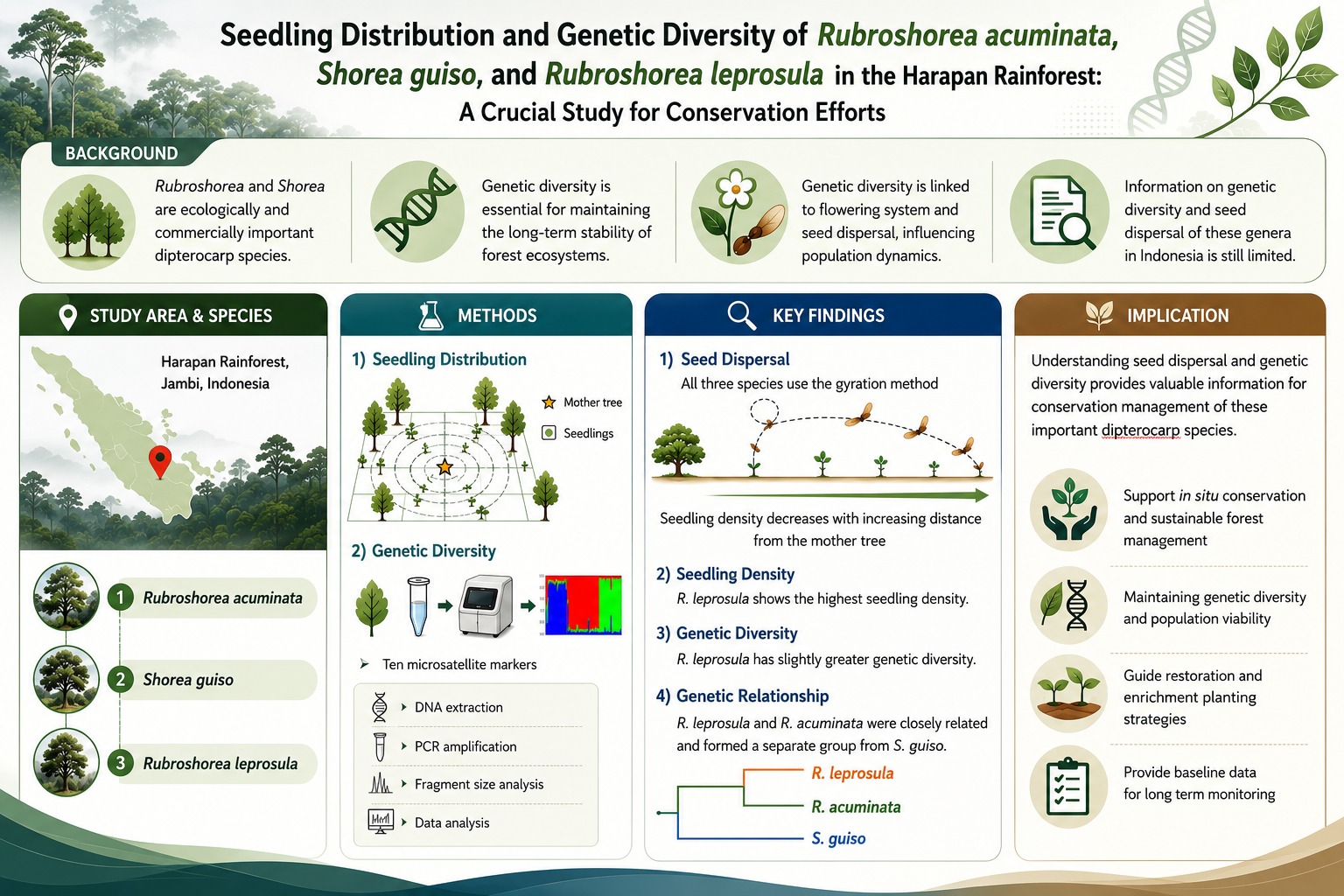
The genera Rubroshorea and Shorea are ecologically and commercially important timber species in Indonesia. Genetic diversity is vital for ensuring the long-term stability of the forest ecosystems where these species thrive. Furthermore, genetic diversity is linked to the flowering system and seed dispersal methods, which play a crucial role in determining population dynamics. However, studies on genetic diversity and seed dispersal in these genera in Indonesia remain limited. This study mapped the seedling distribution of Rubroshorea acuminata, Shorea guiso, and Rubroshorea leprosula in the Harapan Rainforest. It also assessed the genetic diversity and genetic structure of the three species using ten microsatellite markers. The results showed that the three species used the gyration method for seed dispersal, which helps explain the decline in seedling density with increasing distance from the putative mother tree. Among these species, R. leprosula exhibited the highest seedling density and slightly greater genetic diversity than the others. The genetic relationship analysis revealed that R. leprosula and R. acuminata were closely related and formed a separate group from S. guiso. The study’s findings provide valuable insights into seed dispersal methods and genetic diversity, which can aid in developing conservation management strategies for the three dipterocarp species.
Full text article
References
Aavik. T., Träger, S., Zobel, M., Honnay, O., van Geel, M., Bueno, C.G., & Koorem, K. (2021). The joint effect of host plant genetic diversity and arbuscular mycorrhizal fungal communities on restoration success. Functional Ecology, 35(12), 2621–2634. https://doi.org/10.1111/1365-2435.13914
Abasolo, M. A., Fernando, E. S., Borromeo, T. H., & Hautea, D. M. (2009). Cross-species amplification of Shorea microsatellite DNA markers in Parashorea malaanonan (Dipterocarpaceae). Philippine Journal of Science, 138(1), 23–28.
Aldrian, E., & Susanto, R. D. (2003). Identification of three dominant rainfall regions within Indonesia and their relationship to sea surface temperature. International Journal of Climatology, 23(12), 1435–1452. https://doi.org/10.1002/joc.950
Ashton, P. S. (1982). Dipterocarpaceae. In Steenis (Ed.), Flora Malesiana series I vol. 9. part 2, national herbarium of the Netherlands (pp. 237552). The Hague: Martinus-Nijhoff Publishers.
Ashton, P. S. (1988). Dipterocarp biology as a window to the understanding of tropical forest structure. Annual Review of Ecology, Evolution, and Systematics, 19(1), 347–370. https://doi.org/10.1111/j.1744-7429.2012.00913.x
Ashton, P. S. (2014). On the forests of tropical Asia: Lest the memory fade. Royal Botanic Gardens, Kew in association with the Arbold Arboretum of Harvard University.
Ashton, P. S. & Heckenhauer, J. (2022). Tribe Shoreae (Dipterocarpaceae subfamily Dipterocarpoideae) finally dissected. Kew Bulletin, 77, 885–903. https://doi.org/10.1007/S12225-022-10057-W
Attarik, N., Pamoengkas, P., Rachmat, H. H., & Susilowati, A. (2024). Potential use of Shorea leprosula for rehabilitation of degraded tropical production forest ecosystems. Jurnal Sylva Lestari, 12(2), 519–531. https://doi.org/10.23960/jsl.v12i2.861
Barstow, M. (2019). Shorea acuminata. The IUCN Red List of Threatened Species 2019: e.T33921A68072072. https://doi.org/10.2305/IUCN.UK.2019-2.RLTS.T33921A68072072.en
Benítez-Benítez, C., Sanz-Arnal, M., Urbani, M., Jiménez-Mejías, P., & Martín-Bravo, S. (2022). Dramatic impact of future climate change on the genetic diversity and distribution of ecologically relevant Western Mediterranean Carex (Cyperaceae). PeerJ. 10, Article e13464. https://doi.org/10.7717/peerj.13464
Cane, M. A. (2005). The evolution of El Niño, past and future. Earth and Planetary Science Letters, 230(3), 227–240. https://doi.org/10.1016/j.epsl.2004.12.003
Cao, C. P., Finkeldey, R., Siregar, I. Z., Siregar, U. J., & Gailing, O. 2006. Genetic diversity within and among populations of Shorea leprosula Miq. and Shorea parvifolia Dyer (Dipterocarpaceae) in Indonesia detected by AFLPs. Tree Genetics & Genomes, 2(4), 225–239. https://doi.org/10.1007/s11295-006-0046-0
Chan, H. T. (1980). Reproductive biology of some Malaysian dipterocarps II. Fruiting biology and seedling studies. Malaysian Forester, 43(4), 438–451.
Chan, H. T. (1981). Reproductive biology of some Malaysian dipterocarps III. Breeding systems. Malaysian Forester, 44(1), 28–36.
Clair, B. St., & Johnson, R. (2004). Structure of genetic variation and implications for the management of seed and planting stock. USDA Forest Service Proceedings RMRS-P-33.
Corlett, R., & Primack, R. (2005). Dipterocarps: Trees that dominate the Asian rain forest. Arnoldia, 63(3), 1–5.
Curran, L. M., & Leighton, M. (2000). Vertebrate responses to spatiotemporal variation in seed production of mast-fruiting Dipterocarpaceae. Ecological Monographs, 70(1), 101–128. https://doi.org/10.1890/0012-9615(2000)070[0101:VRTSVI]2.0.CO;2
Datta, A., & Rawat, G. S. (2008). Dispersal modes and spatial patterns of tree species in a tropical forest in Arunachal Pradesh, Northeast India. Tropical Conservation Science, 1(3), 163–185. https://doi.org/10.1177/194008290800100302
Dillon, N. L., Bally I. S. E., Wright, C. L., Hucks, L., Innes, D. J., & Dietzgen, R. G. (2013). Genetic diversity of the Australian National Mango Genebank. Scientia Horticulturae, 150, 213–226. https://doi.org/10.1016/j.scienta.2012.11.003
Drescher, J., Rembold, K., Allen, K., Beckschäfer, P., Buchori, D., Clough, Y., Faust, H., Fauzi, A. M., Gunawan, D., Hertel, D., Irawan, B., Jaya, I. N. S., Klarner, B., Kleinn, C., Knohl, A., Kotowska, M. M., Krashevska, V., Krishna, V., Leuschner, C., …, & Scheu, S. (2016). Ecological and socio-economic functions across tropical land use systems after rainforest conversion. Philosophical Transactions of the Royal Society B: Biological Sciences, 371(1694), Article 20150275. https://doi.org/10.1098/rstb.2015.0275
Duncan, R. S., & Chapman, C. A. (1999). Seed dispersal and potential forest succession in abandoned agriculture in tropical Africa. Ecological Applications, 9(3), 998–1008. https://doi.org/10.1890/1051-0761(1999)009[0998:SDAPFS]2.0.CO;2
Dwiyanti, F. G., Harada, K., Siregar I. Z., & Kamiya, K. (2014a). Population genetics of the critically endangered species Dipterocarpus littoralis Blume (Dipterocarpaceae) endemic in Nusakambangan Island, Indonesia. Biotropia, 21(1), 1–12. https://doi.org/10.11598/btb.2014.21.1.304
Dwiyanti, F. G., Kamiya, K., & Harada, K. (2014b). Phylogeographic structure of the commercially important tropical tree species, Dryobalanops aromatica Gaertn. f. (Dipterocarpaceae) revealed by microsatellite markers. Reinwartdia, 14(1), 43–51. https://doi.org/10.14203/reinwardtia.v14i1.394
Dwiyanti, F. G., Chong, L., Diway, B., Fah, L. Y., Siregar, I. Z., Subiakto, A., Kamiya, K., Ninomiya, I., & Harada, K. (2015). Population genetic diversity in the genus Dryobalanops Gaertn. f. (Dipterocarpaceae) based on nuclear microsatellite markers. International Journal Sustainable Future for Human Security, 3(1), 12–20.
Dwiyanti, F. G., Rosdayanti, H., Yulita., K. S., Rachmat, H. H., Muharam, K. F., Rahman, M. M., Adzkia, U., & Siregar, I. Z. (2024). Growth and wood traits evaluation of 15-year-old tengkawang (Shorea spp.) tree stands in Gunung Walat University Forest, West Java, Indonesia. Indonesian Journal of Forestry Research, 11(2), 243–258. https://doi.org/10.59465/ijfr.2024.11.2.243-258
Dwiyanti, F. G., Kustiyarini, N. F., Kamiya, K., Rachmat, H. H., Majiidu, M., Wati, R., & Siregar, I. Z. (2025). Evaluation of phenotypic and genetic characteristics of Dryobalanops aromatica (Dipterocarpaceae) seedlings growing in peat and mineral media. Hayati, 32(1), 27–40. https://doi.org/10.4308/hjb.32.1.27-40
Earl, D. A., & vonHoldt, B. M. (2012). STRUCTURE HARVESTER: A website and program for visualizing STRUCTURE output and implementing the Evanno method. Conservation Genetics Resources, 4(2), 359–361. https://doi.org/10.1007/s12686-011-9548-7
Evanno, G., Regnaud, S., & Goudet, J. (2005). Detecting the number of clusters of individuals using the software structure: A simulation study. Molecular Ecology, 14(8), 2611–2620. https://doi.org/10.1111/j.1365-294X.2005.02553.x
Freund, C. (2012). Assessing the role of seed dispersal in peat swamp forest regeneration [thesis]. New York: Columbia University.
Goetze, M., Louzada, R. B., Wanderley, M. G. L., Souza, L. M., Bered, F., & Silva, C. P. (2013). Development of microsatellite marker for genetic diversity analysis of Aechmea caudata (Bromeliaceae) and cross-species amplification in other bromeliads. Biochemical Systematics and Ecology, 48, 194–198. https://doi.org/10.1016/j.bse.2012.12.022
Hamrick, J. L., Murawski, D. A., & Nason, J. D. (1993). The influence of seed dispersal mechanisms on the genetic structure of tropical tree populations. Vegetatio, 107, 281–297. https://doi.org/10.1007/BF00052230
Ho, W. S., Wickneswari, R., Mahani, M. C., & Shukor, M. N. (2006). Comparative genetic diversity studies of Shorea curtisii (Dipterocarpaceae): An assessment using SSR and DAMD markers. Journal of Tropical Forest Science, 18(1), 22–35.
Iskandar, I., Lestari, D. O., Saputra, A. D., Setiawan, R. Y., Wirasatriya, A., Susanto, R. D., Mardiansyah, W., Irfan, M., Rozirwan, Setiawan, J. D., & Kunarso. (2022). Extreme Positive Indian Ocean Dipole in 2019 and its impact on Indonesia. Sustainability, 14(22), Article 15155. https://doi.org/10.3390/su142215155
Janzen, D. H. (1974) Tropical blackwater rivers, animals and mast fruiting by the Dipterocarpaceae. Biotropica, 6, 69–103.
Joker, D. (2002). Shorea leprosula. Seed leaflet. No. 64. Humlebaek, Denmark: Danida Forest Seed Centre.
Kenzo, T., Kamiya, K., Ngo, K. M., Faizu, N., Lum, S. K. Y., Igarashi, S., Norichika, Y., & Ichie, T. (2019). Overlapping flowering periods among Shorea species and high growth performance of hybrid seedlings promote hybridization and introgression in a tropical rainforest of Singapore. Forest Ecology and Management, 435, 38–44. https://doi.org/10.1016/j.foreco.2018.12.038
Khou, E., Luu, H. T., Pooma, R., Newman, M. F. & Barstow, M. (2017). Shorea guiso. The IUCN Red List of Threatened Species 2017: e.T33114A2832842. https://doi.org/10.2305/IUCN.UK.2017-3.RLTS.T33114A2832842.en
Kondo, T., Nishimura, S., Tani, N., Ng, K. K. S., Muhammad, N., Okuda, T., Tsumura, Y., & Isagi, Y. (2016). Complex pollination of a tropical Asian rainforest canopy tree by flower-feeding thrips and thrips-feeding predators. American Journal of Botany, 103(11), 1912–1920. https://doi.org/10.3732/ajb.1600316
Laumonier, Y. (1997). The vegetation and physiography of Sumatra. Dordrecht: Kluwer Academic Publishers.
Lee, S. L., Wickneswari, R., Mahani, M. C., & Zakri, A. H. (2000). Mating system parameters in a tropical tree species, Shorea leprosula Miq. (Dipterocarpaceae), from Malaysian lowland dipterocarp forest. Biotropica, 32, 693–702.
Lee, S. L., Tani, N., Ng, K. K. S., & Tsumura, Y. (2004). Isolation and characterization of 20 microsatellite loci for an important tropical tree Shorea leprosula (Dipterocarpaceae) and their applicability to S. parvifolia. Molecular Ecology Notes, 4(2), 222–225. https://doi.org/10.1111/j.1471-8286.2004.00623.x
Lemes, M. R., Esashika, T., & Gaoue, O. G. (2011). Microsatellite for mahagonies: Twelve new loci for Swietenia macrophylla and its high transferability to Khaya senegalensis. American Journal of Botany, 98(8), e207–e209. https://doi.org/10.3732/ajb.1100074
Malau, J. H. F. (2024). Komparasi dinamika evapotranspirasi pada kebun kelapa sawit dan hutan sekunder di Provinsi Jambi [undergraduate thesis]. Bogor: IPB University.
Malinda, C.A., Pamoengkas, P., & Rachmat, H. H. (2022). Natural regeneration capacity of Shore leprosula Miq. at Gunung Dahu Research Forest in Bogor. Journal of Natural Resources and Environment Management, 12(3), 423434. https://doi.org/10.29244/jpsl.12.3.423-434
Mansur, M., Triono, T., Ismail, Adi, S. W., Wahyu, E., & Ismail, G. (2010). Vegetation analysis of trees in Harapan Rainforest, Jambi. Berita Biologi, 10(2), 173–178.
Mantello, C. C., Suzuki, F. I., Souza, L. M., Goncalves, P. S., & Souza, A. P. (2012). Microsatellite marker development for the rubber tree (Hevea brasiliensis): Characterization and cross-amplification in wild Hevea species. BMC Research Notes, 5(1), 329–336. https://doi.org/10.1186/1756-0500-5-329
McKenzie, J. D. (2004). Minitab Student Release 14: Statistical software for education. Boston: Pearson Addison-Wesley.
Meinata, A., Na’iem, M., & Adriyanti, D.T. (2021). Variations in leaf morphological characters of Shorea leprosula in progeny trial stand of a logging concession in Kalimantan, Indonesia. Biodiversitas, 22(11), 5097–5105.
Murawski, D. A., Dayanandan, B., & Bawa, K.S. (1994a). Outcrossing rates of two endemic Shorea species from Sri Lankan tropical rain forests. Biotropica, 26, 23–29.
Murawski, D. A., Gunatilleke, I. A. U. N., & Bawa, K. S. (1994b). The effect of selective logging on inbreeding in Shorea megistophylla (Dipterocarpaceae) from Sri Lanka. Conservation Biology, 8(4), 997–1002. https://doi.org/10.1046/j.1523-1739.1994.08040997.x
Murfahatun, N., Susilowati, A., Hilwan, I., Arrofaha, N., Yulita, K. S., Dwiyanti, F. G. Hidayat, A., Kamiya, K., & Rachmat, H. H. (2023). Leaf morphological traits of nine major tropical trees of Shorea species (Dipterocarpaceae). Biodiversitas, 24(3), 1704–1712.
Nagamitsu, T., Ichikawa, S., Ozawa, M., Shimamura, R., Kachi, N., Tsumura, Y., & Muhammad, N. (2001). Microsatellite analysis of the breeding system and seed dispersal in Shorea leprosula (Dipterocarpaceae). International Journal of Plant Sciences, 162(1), 155–159. https://doi.org/10.1086/317902
Naito, Y., Kanzali, M., Iwata, H., Obayashi, K., Lee, S.L., Muhammad, N., Okuda, T., & Tsumura, Y. (2008). Density-dependent selfing and its effects on seed performance in a tropical canopy tree species, Shorea acuminata (Dipterocarpaceae). Forest Ecology and Management, 256, 375–383. https://doi.org/10.1016/j.foreco.2008.04.031
Naranjo, S. E., & Stimac, J. L. (1985). Development, survival, and reproduction of Geocoris punctipes (Hemiptera: Lygaeidae): Effects of plant feeding on soybean and associated weeds. Environmental Entomology, 14(4), 523–530. https://doi.org/10.1093/ee/14.4.523
Nei, M., Tajima, F., & Tateno, Y. (1983). Accuracy of estimated phylogenetic trees from molecular data. II. Gene frequency data. Journal of Molecular Evolution, 19(2), 153–170. https://doi.org/10.1007/BF02300753
Newman, M. F., Burgess, P. F., & Whitmore, T. C. (1996). Manual of Dipterocarps for foresters. Sumatra light hardwoods: Anisoptera, Parashorea, Shorea (red, white and yellow meranti). Huddersfield: The Charlesworth Group.
Newman, M. F., Burgess, P. F., & Whitmore, T. C. (1998a). Manual of Dipterocarps for foresters. Sumatra medium and heavy hardwoods: Dipterocarpus, Dryobalanops, Hopea, Shorea (balau). Huddersfield: The Charlesworth Group.
Newman, M. F., Burgess, P. F., & Whitmore, T. C. (1998b). Manual of Dipterocarps for foresters. Borneo Island medium and heavy hardwoods: Dipterocarpus, Dryobalanops, Hopea, Shorea (balau/selangan batu), Upuna. Huddersfield: The Charlesworth Group.
Ng, K. K. S., Lee, S. L., & Koh, C. L. (2004). Spatial structure and genetic diversity of three tropical tree species with different habitat preferences within a natural forest. Tree Genetics & Genomes, 30(2), 121–131. https://doi.org/10.1007/s11295-006-0035-3
Ng, K. K. S., Lee, S. L., Tsumura, Y., Ueno, S., Ng, C. H., & Lee, C. T. (2009a). Expressed sequence tag-simple sequence repeats isolated from Shorea leprosula and their transferability to 36 species within the Dipterocarpaceae. Molecular Ecology Notes, 9(1), 393–398. https://doi.org/10.1111/j.1755-0998.2008.02238.x
Ng, K. K. S., Lee, S. L., & Ueno, S. (2009b). Impact of selective logging on genetic diversity of two tropical tree species with contrasting breeding system using direct comparison and simulation methods. Forest Ecology and Management, 257(1), 107–116. https://doi.org/10.1016/j.foreco.2008.08.035
Ng, K. K. S., Lee, S. L., Tnah, L. H., Ng, C. H., Lee, C. T., Nurul-Farhanah, Z., & Amelia, A. (2020). Confirmation of natural hybrid of Shorea leprosula and S. curtisii in Pasir Panjang Forest Reserve, Negeri Sembilan, Malaysia. Journal of Tropical Forest Science, 32(1), 92–96.
Ng, C. H., Ng, K. K., Lee, S. L., Zakaria, N. -F., Lee, C. T., & Tnah, L. H. (2022). DNA databases of an important tropical timber tree species Shorea leprosula (Dipterocarpaceae) for forensic timber identification. Scientific Reports, 12, Article 9546. https://doi.org/10.1038/s41598-022-13697-x
Nguyen, C. H., Hapsari, K. A., Saad, A., Sabiham, S. & Behling, H. (2023). Late Holocene riparian vegetation dynamics, environmental changes, and human impact in the Harapan forest of Sumatra, Indonesia. Frontiers in Ecology and Evolution, 11, Article 1224160. https://doi.org/10.3389/fevo.2023.1224160
Nurfaeiza, A. R. S., Juliana, W. A. W., Shamsul, K. & Shukor, M. N. (2022). Morpho-physiological strategies of Shorea leprosula Miq. and Shorea acuminata Dyer in response to light intensity and nutrient amendments. Forests, 13, Article 1768. https://doi.org/10.3390/f13111768
Obayashi, K., Tsumura, Y., Ihara-Ujino, T., Niiyama, K., Tanouchi, H., Suyama, Y., Washitani, I., Lee, C. T., Lee, S. L., & Muhammad, N. (2002). Genetic diversity and outcrossing rate between undisturbed and selectively logged forests of Shorea curtisii (Dipterocarpaceae) using microsatellite DNA analysis. International Journal of Plant Sciences, 163, 151–158.
Pamoengkas, P., Gandaseca, S., Hardiansyah, G., Priyanto, & Jamaludin, M.R. (2014). Tree diameters and planting distance as the most important factors for the liberation of tree competitors in silvicultural systems of TPTJ. Agriculture, Forestry and Fisheries, 3(5), 392–396. https://doi.org/10.11648/j.aff.20140305.20
Peakall, R., & Smouse, P. E. (2006). GENALEX 6: Genetic analysis in Excel. Population genetic software for teaching and research. Molecular Ecology Resources, 6(1), 288–295. https://doi.org/10.1111/j.1471-8286.2005.01155.x
Perez, R. S., Ruiz, D., Dicenta, F., Egea, J., & Martínez-Gómez, P. (2005). Application of simple sequence repeat (SSR) markers in apricot breeding: molecular characterization, protection, and genetic relationships. Scientia Horticulturae, 103(3), 305–315. https://doi.org/10.1016/j.scienta.2004.06.009
Philander, S. G. (Ed.). (1990). El Niño, La Niña, and the Southern oscillation. Academic Press.
Pooma, R. & Newman, M. F. (2024). Shorea leprosula (Amended version of 2017 assessment). The IUCN Red List of Threatened Species 2024: e.T33123A254583583. https://doi.org/10.2305/IUCN.UK.2024-1.RLTS.T33123A254583583.en
Pritchard, J. K., Wena, X., & Falushb, D. (2010). Documentation for structure software: Version 2.3. Oxford: University of Oxford.
Rachmat, H. H., Yulita, K. S., Dwiyanti, F. G., Susilowati, A., Arrofaha, N., Susila, Kamal, I., & Siregar, I. Z. (2024). Optimizing DNA extraction and selecting suitable regions for biodiversity assessment: A study on Shorea leprosula. Jurnal Manajemen Hutan Tropika, 30(1), 144154. https://doi.org/10.7226/jtfm.30.1.144
Ribbens, E., Silander, J. A., & Pacala, S. W. (1994). Seedling recruitment in forests: Calibrating models to predict patterns of tree seedling dispersion. Ecology, 75(6), 1794–1806. https://doi.org/10.2307/1939638
Rohlf, F. J. (2008). Numerical taxonomy and analysis system (NTSYSpc) version 2.0. New York: University of New York.
Saji, N. H., Goswami, B. N., Vinayachandran, P. N., & Yamagata, T. (1999). A dipole mode in the tropical Indian Ocean. Nature, 401(6751), 360–363. https://doi.org/10.1038/ 43854
Sari, V. K., & Restanto, D. P. (2022). Article review: Genomic DNA Extraction Method for Plants with High Levels of Polysaccharides and Secondary Metabolites. Agroteknika, 5(2), 118–129.
Schneider, D., Engelhaupt, M., Allen, K., Kurniawan, S., Krashevska, V., Heinemann, M., Nacke, H., Wijayanti, M., Meryandini, A., Corre, M. D., Scheu, S., & Daniel, R. (2015) Impact of lowland rainforest transformation on diversity and composition of soil prokaryotic communities in Sumatra (Indonesia). Frontiers in Microbiology, 6, Article 1339. https://doi.org/10.3389/fmicb.2015.01339
Seidler, T. G., & Plotkin, J. B. (2006). Seed dispersal and spatial pattern in tropical trees. PLoS Biology, 4(11), Article 344. https://doi.org/10.1371/journal.pbio.0040344
Soerianegara, I., & Lemmens, R. H. M. J. (1993). Timber trees: Major commercial timbers. In P. C. M. Jansen, E. Westphal, M. S. M. Sosef, I. Soerianegara, & R. H. M. J. Lemmens (Eds.), Plant resources of South-East Asia 50-1 (pp. 384–391). Wageningen: Pudoc Scientific.
Subiakto, A., Rachmat, H. H., & Wijaya, K. (2016). Dipterocarps: Walk through the remnant forest in Riau-Sumatera. Indonesia: Forda Press
Takeuchi, Y., Kenta, T., & Nakashizuka, T. (2005). Comparison of sapling demography of four dipterocarp species with different seed-dispersal strategies. Forest Ecology Management, 208(1), 237–248. https://doi.org/10.1016/j.foreco.2004.12.002
Thomas, E., Jalonen, R., Lao, J., Boshier, D., Gallo, L. Cavers, S., Bordács, S., Smith, P., & Bozzano, M. (2014). Genetic considerations in ecosystem restoration using native tree species. Forest Ecology and Management, 333, 66–75. https://doi.org/10.1016/j.foreco.2014.07.015
Tinio, C. E., Finkeldey, R., Prinz, K., & Fernando, E. S. (2014). Genetic variation in natural and planted populations of Shorea guiso (Dipterocarpaceae) in the Philippines revealed by microsatellite DNA markers. Asia Life Sciences, 23(1), 75–91.
Ujino, T., Kawahara, T., Tsumura, Y., Nagamitsu, T., Yoshimaru, H., & Ratnam, W. (1998). Development and polymorphism of simple sequence repeat DNA markers for Shorea curtisii and other Dipterocarpaceae species. Heredity, 81(4), 422–428. https://doi.org/10.1046/j.1365-2540.1998.00423.x
Varshney, R. K, Chabane, K., Hendre, P. S., Aggarwal, R. K., & Graner, A. (2007). Comparative assessment of EST-SSR, EST-SNP and AFLP markers for evaluation of genetic diversity and conservation of genetic resources using wild, cultivated and elite barleys. Plant Science, 173(6), 638–649. https://doi.org/10.1016/j.plantsci.2007.08.010
Varshney, K., Chang, S., & Wang, Z. J. (2012). The kinematics of falling maple seeds and the initial transition to a helical motion. Nonlinearity, 25, C1–C8. https://doi.org/10.1088/0951-7715/25/1/C1
Weising, K., Nybon, H., Wolff, K., & Kahl, G. (2005). DNA fingerprinting in plants: Principles, methods, and applications. CRC Press Taylor & Francis Group.
Yeh, F. C., & Yang, R. (1999). POPGENE version 1.31: User guide Centre for International Forestry Research. Alberta: University of Alberta.
Zalapa, J. E, Cuevas, H., Zhu, H., Steffan, S., Senalik, D., Zeldin, E., McCown, Harbut, R., & Simon, P. (2012). Using next-generation sequencing approaches to isolate simple sequence repeat (SSR) loci in the plant sciences. American Journal of Botany, 99(2), 193–208. https://doi.org/10.3732/ajb.1100394
Zulfahmi, Siregar, I. Z, & Siregar, U. J. (2010). Chloroplast DNA variation of Shorea acuminata Dyer in Eastern Sumatra assessed by microsatellite markers. Biodiversitas, 11(3), 107–111. https://doi.org/10.13057/biodiv/d110301
Authors
Copyright (c) 2026 Jurnal Manajemen Hutan Tropika

This work is licensed under a Creative Commons Attribution 4.0 International License.
Jurnal Manajemen Hutan Tropika is an open access journal which means that all contents is freely available without charge to the user or his/her institution. Users are allowed to read, download, copy, distribute, print, search, or link to the full texts of the articles in this journal without asking prior permission from the publisher or the author. This is in accordance with the Budapest Open Access Initiative (BOAI) definition of open access.Article Details
How to Cite



