
Species Diversity of Trees with Traditional Medicinal Uses: A Core-Buffer Zone Comparison in a Biosphere Reserve

Article Sidebar
-
medicinal tree, diversity, core zone, buffer zone, Giam Siak Kecil-Bukit Batu, Biosphere Reserve
Abstract
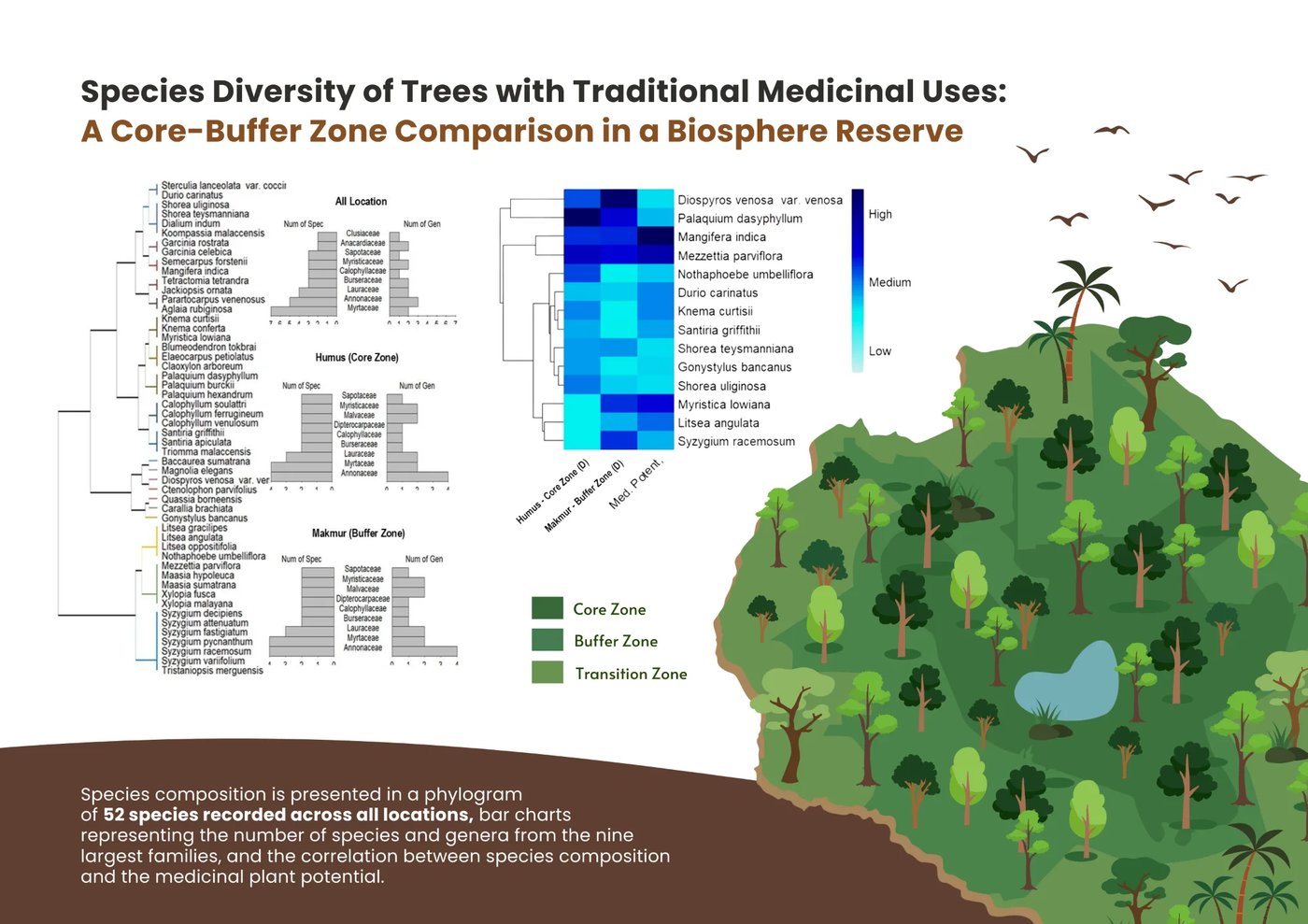
Giam Siak Kecil-Bukit Batu, a UNESCO Biosphere Reserve, uses a zoned management approach, including core, buffer, and transition zones. The core zone prioritizes biodiversity conservation, buffer zones mitigate human impacts, and transition zones focus on sustainable development. The diversity and density of medicinal tree species in the core and buffer zones of this reserve were investigated. It was hypothesized that the core zone would support greater diversity and density of medicinal trees than the buffer zone. Standardized plot sampling was conducted using 1-ha plots, each subdivided into 25 subplots (20 m × 20 m). Trees with a diameter at breast height exceeding 10 cm were inventoried, measured, and identified, with voucher specimens collected for herbarium confirmation. A total of 52 medicinal tree species from 27 families and 36 genera were recorded. Species richness was higher in the buffer zone (39 species) than in the core zone (29 species). These findings underscore the ecological significance of buffer zones in conserving medicinal tree diversity and providing sustainable resources for local communities. The observed species richness in the buffer zone challenges the conventional assumption that core zones harbor higher biodiversity, highlighting the need for further research on sustainable resource management in buffer zones.
Full text article
References
Ambarwari, A., Adrian, Q. J., Herdiyeni, Y., & Hermadi, I. (2020). Plant species identification based on leaf venation features using SVM. TELKOMNIKA (Telecommunication Computing Electronics and Control), 18(2), 726–732. http://doi.org/10.12928/telkomnika.v18i2.14062
Aminudin, N. I., Ahmad, F., Taher, M., & Zulkifli, R. M. (2016). Cytotoxic and antibacterial activities of constituents from Calophyllum ferrugineum Ridley. Records of National Products, 10(5), 649–653.
Ariawan, I., Herdiyeni, Y., & Siregar, I. Z. (2020). Geometric morphometric analysis of leaf venation in four shorea species for identification using digital image processing. Biodiversitas, 21(7), 3303–3309. https://doi.org/10.13057/biodiv/d210754
Arifin, Y. F., Hamidah, S., Panjaitan, S., & Suhartono, E. (2015). In vitro anti-inflammatory activities of red gemor (Nothaphoebe cf Umbelliflora). Journal of Medical and Bioengineering, 4(4), 312–317. https://doi.org/10.12720/jomb.4.4.312-317
Arshad, F., Haq, S. M., Waheed, M., Jameel, M. A., & Bussmann, R. W. (2024). Environmental variables drive medicinal plant composition and distribution in various forest types of subtropical region in Pakistan. Ecological Frontiers, 44(2), 234–246. https://doi.org/10.1016/j.chnaes.2023.05.004
Atmoko, T., & Ma’ruf, A. (2009). Uji toksisitas dan skrining fitokimia ekstrak tumbuhan sumber pakan orangutan terhadap larva. Jurnal Penelitian Hutan dan Konservasi Alam, 6(1), 37–45.
Badan Pengawas Obat dan Makanan. (2013). Formularium ramuan etnomedisin obat asli Indonesia (Vol. III).
Badan Pusat Statistik. (2022). Statistik Indonesia 2022. Jakarta: Badan Pusat Statistik.
Bang, N. A., Tai, B. H., Yen, P. H., & van. Kiem, P. (2024). The genus Aglaia: Diversity in chemical structure and biological activity. Vietnam Journal of Chemistry, 62(6), 737–757. https://doi.org/10.1002/VJCH.202400102
Barbosa, L., Braz‐Filho, R., & Vieira, I. J. C. (2011). Chemical constituents of plants from the genus Simaba (Simaroubaceae). Chemistry & Biodiversity, 8(12), 2163–2178. https://doi.org/10.1002/cbdv.201000323
Batubara, I., Kuspradini, H., & Mitsunaga, T. (2010). Anti-acne and tyrosinase inhibition properties of taxifolin and some flavanonol rhamnosides from Kempas (Koompassia malaccensis). Wood Research Journal, 1(1), 45–49.
Begon, M., Harper, J. L., & Townsend, C. R. (2009). Ecology: Individuals, populations, and communities (3rd ed.). Liverpool: University of Liverpool.
Belyakov, D. V., Konyushatov, O. A., Korchagov, S. A., & Gribov, S. (2024). The conservation of plant species diversity in forest management in the key Biotopes of the Vologda Region. Forestry Journal, 2(389), 189–200. https://doi.org/10.37482/0536-1036-2024-2-189-200
Berry, N. J., Phillips, O. L., Lewis, S. L., Hill, J. K., Edwards, D. P., Tawatao, N. B., Ahmad, N., Magintan, D., Khen, C. V., Maryati, M., Ong, R. C., & Hamer, K. C. (2010). The high value of logged tropical forests: Lessons from northern Borneo. Biodiversity and Conservation, 19(4), 985–997. https://doi.org/10.1007/S10531-010-9779-Z
Bin Ismail, A. A. F., Ee, G. C. L., Bin Daud, S., Teh, S. S., Hashim, N. M., & Awang, K. (2015). Venuloxanthone, a new pyranoxanthone from the stem bark of Calophyllum venulosum. Journal of Asian Natural Products Research, 17(11), 1104–1108. https://doi.org/10.1080/10286020.2015.1047353
Botello, D. (2024). Verifying the taxonomic validity and resolving the subspecific boundaries of the Lomatium foeniculaceum complex [thesis]. Boise: Boise State University. https://doi.org/10.18122/td.2153.boisestate
Boukeng, L. B. K., Nzefa, L. D., Sali, D., Minkandi, C. A., Bevela, J. Y., Nouko, A., & Ebogo, C. E. (2024). Oral pathologies and underweight conditions among people living with HIV/AIDS in a health facility in Yaoundé, Cameroon: A study of 205 cases. BMC Nutrition, 10(1), Artilce 30. https://doi.org/10.1186/s40795-024-00835-z
Brahma, J., Islary, A., & Ray, S. (2022). Traditional importance and unique properties of Garcinia spp. found in Assam, India. The Pharma Innovation Journal, 11(3), 10–17.
Cocks, M., & Dold, A. P. (2006). Cultural significance and biodiversity conservation of biosphere reserves. Biodiversity & Conservation, 15(1), 4475–4493.
Connell, J. H. (1978). Diversity in tropical rain forests and coral reefs. Science, 199(4335), 1302–1310. https://doi.org/10.1126/SCIENCE.199.4335.1302
Cunningham, A. B. (2001). Applied ethnobotany: People, wild plant use and conservation (1st ed.). London: Routledge. https://doi.org/10.4324/9781849776073
da Costa, J. S., da Cruz, E. de N. S., Setzer, W. N., da Silva, J. K. D. R., Maia, J. G. S., & Figueiredo, P. L. B. (2020). Essentials oils from Brazilian eugenia and syzygium species and their biological activities. Biomolecules, 10(8), Article 1155. https://doi.org/10.3390/BIOM10081155
Dao, T. H. H., Saborowski, J., & Hölscher, D. (2016). Patterns of tree community differences in the core and buffer zones of a nature reserve in north-western Vietnam. Global Ecology and Conservation, 8, 220-229. https://doi.org/10.1016/J.GECCO.2016.09.011
Davis, O., Thompson, E., & Clark, E. (2024). The impact of selective logging on forest structure and function. Journal of Selvicoltura Asean, 1(6), 282–292.
DeFries, R. S., Foley, J. A., & Asner, G. P. (2004). Land‐use choices: Balancing human needs and ecosystem function. Frontiers in Ecology and the Environment, 2(5), 249-257. https://doi.org/10.1890/1540-9295(2004)002[0249:LCBHNA]2.0.CO;2
Denny, & Kalima, T. (2016). Keanekaragaman tumbuhan obat pada hutan rawa gambut Punggualas, Taman Nasional Sebangau, Kalimantan Tengah. Buletin Plasma Nutfah, 22(7), 137–148.
Denny, & Wardani, M. (2019). Konservasi kehati skala demo plot: Pengembangan sistem identifikasi jenis pohon hutan rawa gambut berbasis web (1st ed.). Bogor: IPB Press.
Dudley, N., & Phillips, A. (2006). Forests and protected areas: Guidance on the use of the IUCN protected area management categories. IUCN World Commission on Protected Areas (WCPA). https://doi.org/10.2305/IUCN.CH.2006.PAG.12.en
Endress, B. A., Gorchov, D. L., & Berry, E. J. (2006). Sustainability of a non-timber forest product: Effects of alternative leaf harvest practices over 6 years on yield and demography of the palm Chamaedorea radicalis. Forest Ecology and Management, 234(1–3), 181–191. https://doi.org/10.1016/J.FORECO.2006.07.020
Feng, J., Wang, Y., Yi, X., Yang, W., & He, X. (2016). Phenolics from durian exert pronounced NO inhibitory and antioxidant activities. Journal of Agricultural and Food Chemistry, 64(21), 4273–4279. https://doi.org/10.1021/ACS.JAFC.6B01580/SUPPL_FILE/JF6B01580_SI_001.PDF
Ferdinan, F., Jamilah, J., & Sarifuddin, S. (2013). Evaluasi kesesuaian lahan sawah beririgasi di Desa Air Hitam Kecamatan Lima Puluh Kabupaten Batubara. Jurnal Agroekoteknologi, 1(2), 338–347. https://doi.org/10.32734/jaet.v1i2.1615
Fitmawati, F., Resida, E., Kholifah, S. N., Roza, R. M., Almurdani, M., & Emrizal, E. (2020). Phytochemical screening and antioxidant profiling of Sumatran wild mangoes (Mangifera spp.): A potential source for medicine antidegenerative effects. F1000Research, 9, Article 220. https://doi.org/10.12688/f1000research.22380.3
García-Flores, J., González-Espinosa, M., Lindig-Cisneros, R., & Casas, A. (2019). Traditional medicinal knowledge of tropical trees and its value for restoration of tropical forests. Botanical Sciences, 97(3), 336–354. https://doi.org/10.17129/botsci.2122
Gaston, K. J., & O’Neill, M. A. (2004). Automated species identification: Why not? Philosophical Transactions of the Royal Society of London. Series B: Biological Sciences, 359(1444), 655–667. https://doi.org/10.1098/RSTB.2003.1442
Haida, Z., & Hakiman, M. (2019). A review of therapeutic potentials of Clinacanthus nutans as source for alternative medicines. Sains Malaysiana, 48(12), 2683–2691. https://doi.org/10.17576/jsm-2019-4812-09
Hanski, I. (2015). Habitat fragmentation and species richness. Journal of Biogeography, 42(5), 989–993. https://doi.org/10.1111/jbi.12478
Harahap, D., Niaci, S., Mardina, V., Zaura, B., Qanita, I., Purnama, A., Puspita, K., Rizki, D. R., & Iqhrammullah, M. (2022). Antibacterial activities of seven ethnomedicinal plants from family Annonaceae. Journal of Advanced Pharmaceutical Technology and Research, 13(3), 148–153. https://doi.org/10.4103/JAPTR.JAPTR_111_22
Harneti, D., & Supratman, U. (2021). Phytochemistry and biological activities of Aglaia species. Phytochemistry, 181, Article 112540. https://doi.org/10.1016/J.PHYTOCHEM.2020.112540
Haruna, E., Zin, N. M., & Adams, J. M. (2017). Draft genome sequence of an endophytic bacterium, Paenibacillus tyrfis strain SUK123, isolated from Santiria apiculata stem. Genomics Data, 14, 44–46. https://doi.org/10.1016/J.GDATA.2017.08.005
Harvey, C. A., Dickson, B., & Kormos, C. (2010). Opportunities for achieving biodiversity conservation through REDD. Conservation Letters, 3(1), 53–61. https://doi.org/10.1111/J.1755-263X.2009.00086.X
Hasan, N. F. B. (2011). Chemical composition and biological activity of essential oil from Cinnamomum spp. and Litsea spp. [dissertation]. Sarawak: Universiti Malaysia. Retrieved from https://ir.unimas.my/id/eprint/7348/
Hebert, P. D., Cywinska, A., Ball, S. L., & DeWaard, J. R. (2003). Biological identifications through DNA barcodes. Proceedings of the Royal Society of London. Series B: Biological Sciences, 270(1512), 313–321. https://doi.org/10.1098/rspb.2002.2218
Henderson, A., Comiskey, J., Dallmeier, F., & Alonso, A. (2007). Framework for assessment and monitoring of biodiversity. Encyclopedia of Biodiversity Online Update 1.
Heyne, K. (1987). Tumbuhan berguna Indonesia I-IV. (Badan Penelitian dan Pengembangan Kehutanan, Trans). Jakarta: Yayasan Sarana Wana Jaya.
Hobbs, R. J., & Huenneke, L. F. (1992). Disturbance, diversity, and invasion: Implications for conservation. Conservation Biology, 6(3), 324–337. https://doi.org/10.1046/J.1523-1739.1992.06030324.X
Humeirah, S., Ghani, A., Ali, A. M., Jamil, M., Mohtar, M., Johari, S. A., Isa, M. M., Faridz, M., & Patah, Z. (2016). Chemical compositions and antimicrobial activity of twig essential oils from three Xylopia (Annonaceae) species. African Journal of Biotechnology, 15(10), 356–362. https://doi.org/10.5897/AJB2015.14775
Ibrahimov, T. O., & Sadullayev, R. R. (2022). Crucial problems of the organization of biosphere reserves in Azerbaijan. Journal of Geology, Geography and Geoecology, 31(4), 628–634. https://doi.org/10.15421/112258
IUCN SSC Primate Specialist Group. (2023). Pongo abelii. The IUCN red list of threatened Species 2023: E.T17966A2047720. Retrieved from https://www.iucnredlist.org/search?query=orangutan&searchType=species
Jacinto, S. D., Ramos, E. F., Siguan, A. P. T., & Canoy, R. J. C. (2011). Determining the antioxidant property of plant extracts: A laboratory exercise. The Asian Journal of Biology Education, 5, 22–25. https://doi.org/10.57443/AJBE.5.0_22
Jain, P., Singh, S., Prasad Sharma, H., Kumari Singh, S., Sharma, H., & Basri, F. (2014). Phytochemical screening and antifungal activity of Semecarpus anacardium L. (an anti-cancer plant). International Journal of Pharmaceutical Sciences and Research, 5(5), 1884–1891. https://doi.org/10.13040/IJPSR.0975-8232.5(5).1884-91
Jeong, S. C., Pi, D. M., Lee, I. W., Lee, J. Y., & Kim, K. D. (2023). Do physiognomically designated protected areas match well with ecological data based upon diversity indices and ordination? Implications for urban forest conservation. Journal of Environmental Science International, 32(5), 329–341. https://doi.org/10.5322/JESI.2023.32.5.329
Jia, S., Chen, Q., Liu, X., Li, Y., Wang, L., Li, X., & Hu, S. (2024). Efficacy of integrated traditional Chinese and western medicine in managing mild-moderate acute pancreatitis: A real-world clinical perspective analysis. Frontiers in Medicine, 11, Article 1429546. https://doi.org/10.3389/fmed.2024.1429546
Jin, Y., & Qian, H. (2022). V.PhyloMaker2: An updated and enlarged R package that can generate very large phylogenies for vascular plants. Plant Diversity, 44(4), 335–339. https://doi.org/10.1016/J.PLD.2022.05.005
Junejo, J. A., Rudrapal, M., & Zaman, K. (2020). Antidiabetic activity of Carallia brachiata Lour. leaves hydro-alcoholic extract (HAE) with antioxidant potential in diabetic rats. Indian Journal of Natural Products and Resources (IJNPR) [Formerly Natural Product Radiance (NPR)], 11(1), 18–29. https://doi.org/10.56042/IJNPR.V11I1.24717
Kang, D., Deng, L., Andersen, L. H., & Sándor, A. D. (2024). Editorial: Regeneration mechanisms and tradeoffs of ecosystem function after drastic environmental changes. Frontiers in Ecology and Evolution, 12, Article 1531956. https://doi.org/10.3389/fevo.2024.1531956
Kartawinata, K., Priyadi, H., Sheil, D., Riswan, S., & Sist, P. (2006). A field guide to the permanent sample plots in the conventional logging blocks 28 and 29 at CIFOR Malinau research forest East Kalimantan. Bogor: CIFOR.
Kaur, N., Kaur, N., & Saggoo, M. I. S. (2022). Conservation strategies for medicinal plants in the face of environmental challenges. In Environmental challenges and medicinal plants: Sustainable production solutions under adverse conditions (pp. 461–485). Cham: Springer International Publishing.
Kim, T. K., Hong, J., Ryu, D., Kim, S., Byeon, S. Y., Huh, W., Kim, K., Baek, G. H., & Kim, H. S. (2022). Identifying and extracting bark key features of 42 tree species using convolutional neural networks and class activation mapping. Scientific Reports, 12, Article 4772. https://doi.org/10.1038/s41598-022-08571-9
Kindt, R. (2020). WorldFlora: An R package for exact and fuzzy matching of plant names against the World Flora Online taxonomic backbone data. Applications in Plant Sciences, 8(9), Article e11388. https://doi.org/10.1002/APS3.11388
Kwapong, A. A., Soares, S., Teo, S. P., Stapleton, P., & Gibbons, S. (2020). Myristica lowiana phytochemicals as inhibitor of plasmid conjugation in Escherichia coli. Evidence-Based Complementary and Alternative Medicine, 2020(1), Article 1604638. https://doi.org/10.1155/2020/1604638
Laurance, W. F., Lovejoy, T. E., Vasconcelos, H. L., Bruna, E. M., Didham, R. K., Stouffer, P. C., Gascon, C., Bierregaard, R. O., Laurance, S. G., & Sampaio, E. (2002). Ecosystem decay of Amazonian forest fragments: A 22-year investigation. Conservation Biology, 16(3), 605–618. https://doi.org/10.1046/J.1523-1739.2002.01025.X
Lecina-Diaz, J., Alvarez, A., De Cáceres, M., Herrando, S., Vayreda, J., & Retana, J. (2019). Are protected areas preserving ecosystem services and biodiversity? Insights from Mediterranean forests and shrublands. Landscape Ecology, 34(10), 2307–2321. https://doi.org/10.1007/S10980-019-00887-8/FIGURES/3
Leigh Jr, E. G., Davidar, P., Dick, C. W., Terborgh, J., Puyravaud, J. P., ter Steege, H., & Wright, S. J. (2004). Why do some tropical forests have so many species of trees? Biotropica, 36(4), 447–473. https://doi.org/10.1111/j.1744-7429.2004.tb00342.x
Lubis, S. S., Sari, A. N., Fahmi, M. H., & Diningrat, D. S. (2021). Potensi ekstrak daun asam keranji (Dialium indum) Aceh sebagai antioksidan alami. Biofaal Journal, 2(1), 2723–4959. https://doi.org/10.30598/biofaal.v2i1pp11-18
Magurran, A. E. (2021). Measuring biological diversity. Current Biology, 31(19), R1174–R1177. https://doi.org/10.1016/j.cub.2021.07.049
Mah, S. H., Ee, G. C. L., Teh, S. S., & Sukari, M. A. (2015). Calophyllum inophyllum and Calophyllum soulattri source of anti-proliferative xanthones and their structure–activity relationships. Natural Product Research, 29(1), 98–101. https://doi.org/10.1080/14786419.2014.959949
Mahardika, R. G., Fajri, K., & Henri, H. (2023). Antioxidant capacity fraction of the pelawan stems (Tristaniopsis merguensis Griff). Indonesian Journal of Chemical Research, 10(3), 143–148. https://doi.org/10.30598//IJCR.2023.10-MAH
Malik, O. A., Ismail, N., Hussein, B. R., & Yahya, U. (2022). Automated real-time identification of medicinal plants species in natural environment using Deep Learning Models-A case study from Borneo region. Plants, 11(15), Article 1952. https://doi.org/10.3390/PLANTS11151952
Mateos, D. M., & Bhatnagar, J. M. (2024). Restoring ecological complexity in a changing environment. Current Biology, 34(9), R365–R371. https://doi.org/10.1016/j.cub.2024.03.059
McNeely, J. A., & Scherr, S. J. (2003). Macroeconomics for biodiversity conservation: Investing in the wealth of nations. The World Bank Group.
Medina, E. (2007). Tropical forests: Diversity and function of dominant life-forms. In Functional plant ecology (pp. 313–350). CRC Press.
Mishra, R. K., Upadhyay, V. P., & Mohanty, R. C. (2008). Vegetation ecology of the Similipal Biosphere Reserve, Orissa, India. Applied Ecology and Environmental Research, 6(2), 89–99. https://doi.org/10.15666/AEER%2F0602_089099
Mohamad, T. A. S. T., Naz, H., Jalal, R. S., Hussin, K., Rahman, M. R. A., Adam, A., & Weber, J. F. F. (2013). Chemical and pharmacognostical characterization of two Malaysian plants both known as Ajisamat. Revista Brasileira de Farmacognosia, 23(5), 724–730. https://doi.org/10.1590/S0102-695X2013000500002
Murdifin, M., Pakki, E., Alam, G., Manggau, M. A., Muslimin, L., Rusdi, M., & Wahyudin, E. (2017). Lipid peroxidation inhibitory activity in vitro of Mezzetia parviflora Becc. wood bark polar extract. Pharmacognosy Journal, 9(2), 171–175. https://doi.org/10.5530/pj.2017.2.28
Nanni, L., Gobbi, M. D., Junior, R. D. A. M., & Fusaro, D. (2025). Advancing taxonomy with Machine Learning: A hybrid ensemble for species and genus classification. Algorithms, 18(2), Article 105. https://doi.org/10.3390/a18020105
Navia, Z. I., Suwardi, A. B., & Harmawan, T. (2022). The diversity of wild Tampoi (Baccaurea, Phyllantaceae) and their potential to improve the livelihoods of local people in Aceh, Indonesia. IOP Conference Series: Earth and Environmental Science, 1114(1), Article 012088. https://doi.org/10.1088/1755-1315/1114/1/012088
Oktavianawati, I., Santoso, M., & Fatmawati, S. (2023). Metabolite profiling of Borneo’s Gonystylus bancanus through comprehensive extraction from various polarity of solvents. Scientific Reports, 13, Article 15215. https://doi.org/10.1038/s41598-023-41494-7
Ong, C. Y., Ling, S. K., Ali, R. M., Chee, C. F., Samah, Z. A., Ho, A. S. H., Teo, S. H., & Lee, H. B. (2009). Systematic analysis of in vitro photo-cytotoxic activity in extracts from terrestrial plants in Peninsula Malaysia for photodynamic therapy. Journal of Photochemistry and Photobiology B: Biology, 96(3), 216–222. https://doi.org/10.1016/J.JPHOTOBIOL.2009.06.009
Pardini, R., de Bueno, A. A., Gardner, T. A., Prado, P. I., & Metzger, J. P. (2010). Beyond the fragmentation threshold hypothesis: Regime shifts in biodiversity across fragmented landscapes. Plos One, 5(10), Article e13666. https://doi.org/10.1371/JOURNAL.PONE.0013666
Paul, S., Sumon, S., Lamia, S. R., Afra, S., & Hoque, R. (2019). Pharmacological activity investigation of Sterculia coccinea. International Journal of Research in Pharmacy and Pharmaceutical Sciences, 5(1), 2–12.
Pidigam, S., Geetha, A., Pandravada, S. R., Khan, S., Thuraga, V., Sivaraj, N., & Nagaraju, K. (2023). Conservation strategies for Indian medicinal plants. In Á. Máthé, & I. A. Khan (Eds.), Medicinal and aromatic pants of India vol. 2 (pp. 279–302). Springer, Cham. https://doi.org/10.1007/978-3-031-44914-7_14
Priatna, D. (2023). Bentang alam Giam Siak Kecil Bukit Batu: Potensi sumber daya alam untuk pengembangan ekonomi lokal berkelanjutan. Bogor: IPB Press.
Priatna, D., Susilo, A., Denny, & Simanjuntak, H. S. (2024). An ethnopharmacological study of medicinal plants in the buffer zone and its implication to the conservation of Giam Siak Kecil-Bukit Batu Biosphere Reserve. Asian Journal of Conservation Biology, 13(1), 47–61. https://doi.org/10.53562/ajcb.85103
Purwanto, Y., Sukara, E., Ajiningrum, P. S., & Priatna, D. (2020). Cultural diversity and biodiversity as foundation of sustainable development. Indonesian Journal of Applied Environmental Studies, 1(1), 2–10. https://doi.org/10.33751/injast.v1i1.1976
Putz, F. E., Zuidema, P. A., Synnott, T., Peña-Claros, M., Pinard, M. A., Sheil, D., Vanclay, J. K., Sist, P., Gourlet-Fleury, S., Griscom, B., Palmer, J., & Zagt, R. (2012). Sustaining conservation values in selectively logged tropical forests: The attained and the attainable. Conservation Letters, 5(4), 296–303. https://doi.org/10.1111/J.1755-263X.2012.00242.X
R Core Team. (2024). R: A language and environment for statistical computing. R Foundation for Statistical Computing. Retrieved from https://www.R-project.org/
Revell, L. J. (2024). Phytools 2.0: An updated R ecosystem for phylogenetic comparative methods (and other things). PeerJ, 12, Article e16505. https://doi.org/10.7717/PEERJ.16505/FIG-22
Rinawati, F., Stein, K., & Lindner, A. (2013). Climate change impacts on biodiversity–the setting of a lingering global crisis. Diversity, 5(1), 114–123. https://doi.org/10.3390/d5010114
Sahu, P. K., Sagar, R., & Singh, J. S. (2008). Tropical forest structure and diversity in relation to altitude and disturbance in a biosphere reserve in central India. Applied Vegetation Science, 11(4), 461–470. https://doi.org/10.3170/2008-7-18537
Salleh, W. M. N. H. W., Shakri, N. M., Nafiah, M. A., & Khamis, S. (2022). Chemical constituents and acetylcholinesterase activity from Polyalthia sumatrana (miq.) Kurz. Latin American Applied Research, 5(1), 73–76. https://doi.org/10.52292/j.laar.2022.852
Sangma, D. M., & Lyngdoh, N. (2014). Floristic diversity assessment of Nokrek Biosphere Reserve, Meghalaya. Indian Forester, 140(10), 1023–1031. https://doi.org/10.36808/IF/2014/V140I10/53496
Schmidt, F. H., & Ferguson, J. H. A. (1952). Rainfall types based on wet and dry period ratios for Indonesia with Western New Guinea. Kementerian Perhubungan dan Djawatan Meteorologi dan Geofisik.
Schroth, G., da Fonseca, G. A. B., Harvey, C. A., Gascon, C., Vasconcelos, H. L., & Izac, A. N. (2013). Agroforestry and biodiversity conservation in tropical landscapes. Washington DC: Island Press. Retrieved from https://islandpress.org/books/agroforestry-and-biodiversity-conservation-tropical-landscapes
Schüttler, E., Mackenzie, R., & Muñoz-Petersen, L. (2023). Biocultural conservation in biosphere reserves in temperate regions of Chile, Estonia, Germany, and Sweden. In R. Rozzi, A. Tauro, N. Avriel-Avni, T. Wright, & R. H. May Jr (Eds.), Field environmental philosophy (pp. 483–502). Springer Nature, Berlin. https://doi.org/10.1007/978-3-031-23368-5_29
Seeland, M., Rzanny, M., Boho, D., Wäldchen, J., & Mäder, P. (2019). Image-based classification of plant genus and family for trained and untrained plant species. BMC Bioinformatics, 20, Article 4. https://doi.org/10.1186/s12859-018-2474-x
Setiawan, A. W. (2020). Revisi marga Claoxylon (Euphorbiaceae) di Kepulauan Sunda Kecil [dissertation]. Bogor: IPB University.
Shanley, P., & Luz, L. (2003). The impacts of forest degradation on medicinal plant use and implications for health care in eastern Amazonia. BioScience, 53(6), 573–584. https://doi.org/10.1641/0006-3568(2003)053[0573:TIOFDO]2.0.CO;2
Sharma, N., & Pandey, R. (2012). Conservation of medicinal plants in the tropics. In Conservation of tropical plant species (pp. 437–487). New York: Springer.
Simanjuntak, H. S., Sukara, E., & Priatna, D. (2021). Traditional knowledge of biodiversity in the community surrounding Giam Siak Kecil-Bukit Batu Biosphere Reserve, Riau, Indonesia. Indonesian Journal of Applied Environmental Studies, 2(2), 78–83. https://doi.org/10.33751/INJAST.V2I2.4027
Sinay, L. (2022). A tool to measure sustainability in biosphere reserves located in prosperous countries. Preprints, Article 2022080138. https://doi.org/10.20944/preprints202208.0138.v1
Sodhi, N. S., Koh, L. P., Brook, B. W., & Ng, P. K. L. (2007). Collisions between conservation and economic growth in Southeast Asia. Conservation Biology, 21(2), 678–689.
Soil Survey Staff. (2003). Keys to soil taxonomy (9th ed.). USDA Natural Resources Conservation Service.
Souza, E. N., & Hawkins, J. A. (2017). Comparison of herbarium label data and published medicinal use: Herbaria as an underutilized source of ethnobotanical information. Economic Botany, 71, 1–12. https://doi.org/10.1007/s12231-017-9367-1
Sudha, K G., Ali, S., Karunakaran, G., Kowsalya, M., Kolesnikov, E., Gorshenkov, M. V., Velmurugan, T., & Rajeshkumar, M. P. (2021). An eco-friendly production of ZnO NRs using Knema andamanica (Warb) extracts for photocatalytic and anticancer applications. Inorganic Chemistry Communications, 134, Article 109030. https://doi.org/10.1016/J.INOCHE.2021.109030
Sudradjat, S. E., & Timotius, K. H. (2022). Pharmacological properties and phytochemical components of Elaeocarpus: A comparative study. Phytomedicine Plus, 2(4), Article 100365. https://doi.org/10.1016/J.PHYPLU.2022.100365
Sutherland, W. J. (2006). Ecological census techniques-A hand book (2nd ed.). Cambridge University Press, Cambridge. https://doi.org/10.1017/CBO9780511790508
Syarpin, S., & Nugroho, W. (2020). TLC profile of methanol extrac of Diospyros confertiflora stem bark. Jurnal Ilmiah Kanderang Tingang, 11(2), 338–342. https://doi.org/10.37304/jikt.v11i2.106
United Nations Educational, Scientific and Cultural Organization. (2016). Biosphere reserves: Learning places for sustainable development. Retrieved from https://en.unesco.org/biosphere
United Nations Educational, Scientific and Cultural Organization. (2024). World network of biosphere reserves. Retrieved from https://en.unesco.org/biosphere/wnbr
Veenstra, A. A. (2012). Herbarium collections–an invaluable resource for gall midge taxonomists. Muelleria, 30(1), 59–64. https://doi.org/10.5962/p.292242
Wibisono, A., Sunardi, S., & Radam, R. R. (2020). Fitokimia 5 jenis pohon di KHDTK Universitas Lambung Mangkurat Mandiangin Kalimantan Selatan. Jurnal Sylva Scienteae, 3(3), 422–431. https://doi.org/10.20527/JSS.V3I3.2175
Yuan, H., Ma, Q., Ye, L., & Piao, G. (2016). The traditional medicine and modern medicine from natural products. Molecules, 21(5), Article 559. https://doi.org/10.3390/molecules21050559
Yulisma, A., Thomy, Z., & Harnelly, E. (2018). Phylogenetic relationships within families Myrtaceae in Tripa peat swamp forest using Internal Transcribed Spacer (ITS). Jurnal Natural, 18(2), 65–71. https://doi.org/10.24815/jn.v18i2.10105
Yusro, F., Mariani, Y., Erianto, E., Hardiansyah, G., Hendarto, H., Aripin, A., & Nurdwiansyah, D. (2020). Identifikasi potensi tumbuhan obat di Hutan Tutupan Tawang Selubang Kecamatan Kelam Permai Kabupaten Sintang Kalimantan Barat. Biotropic the Journal of Tropical Biology, 4(2), 64–81. https://doi.org/10.29080/biotropic.2020.4.2.64-81
Zaki, P. H., Gandaseca, S., Rashidi, N. M., & Ismail, M. H. (2019). Traditional usage of medicinal plants by Temiar tribes in the State of Kelantan, Peninsular Malaysia. Forest and Society, 3(2), 227–234. https://doi.org/10.24259/fs.v3i2.6424
Zhang, Z., Zhu, Y., & Jia, P. (2024). Ecological protection redlines’ positive impact on terrestrial carbon storage in Hainan Island, China. Land, 13(8), Article 1292. https://doi.org/10.3390/land13081292
Zulkarnaini, Z., Sujianto, S., & Wawan, W. (2022). Short communication: Sustainability of ecological dimension in peatland management in The Giam Siak Kecil Bukit Batu Landscape, Riau, Indonesia. Biodiversitas Journal of Biological Diversity, 23(4), 1822–1827. https://doi.org/10.13057/BIODIV/D230414
Authors
Copyright (c) 2025 Jurnal Manajemen Hutan Tropika

This work is licensed under a Creative Commons Attribution 4.0 International License.
Jurnal Manajemen Hutan Tropika is an open access journal which means that all contents is freely available without charge to the user or his/her institution. Users are allowed to read, download, copy, distribute, print, search, or link to the full texts of the articles in this journal without asking prior permission from the publisher or the author. This is in accordance with the Budapest Open Access Initiative (BOAI) definition of open access.Article Details
How to Cite



