
Local Community’s Knowledge and Perception towards Freshwater Turtle Conservation in Southern Sumatra, Indonesia

Article Sidebar
-
attitude, behavior, traditional belief, preservation
Abstract
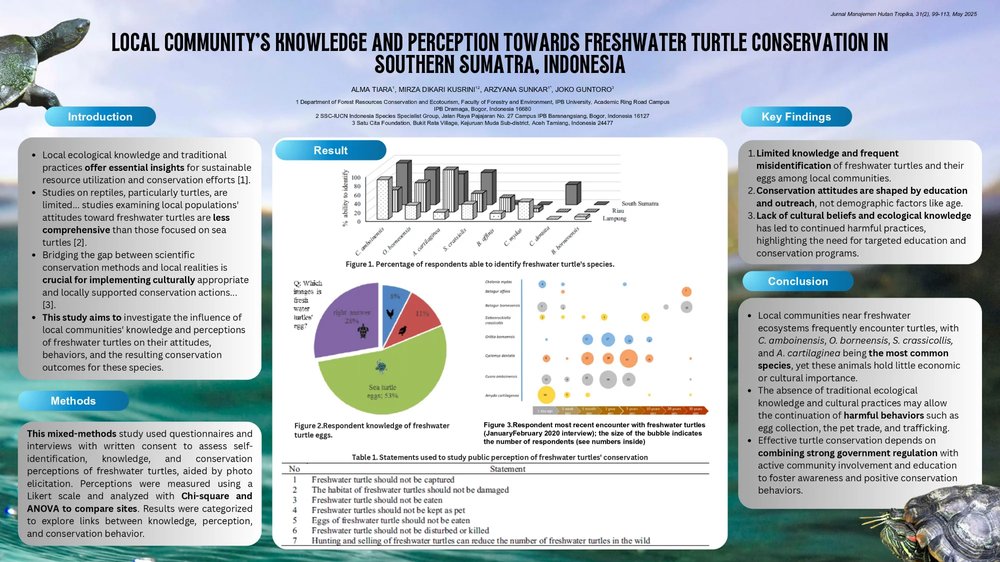
The conservation of freshwater turtles relies on local knowledge and perceptions. This phenomenon is especially significant for communities located near turtle habitats. This study aims to investigate the influence of local communities' knowledge and perceptions of freshwater turtles on their attitudes, behaviors, and the resulting conservation outcomes for these species. Knowledge encompasses the empirical understanding of turtle species, their ecological roles, and conservation statuses. Perceptions encompass the subjective beliefs, attitudes, and values influenced by culture that communities hold regarding these species. The research was carried out in three river systems of southern Sumatra, involving interviews with 133 participants through a semi-structured approach that included closed and semi-open questionnaires, alongside a recollection method utilizing photographs as a tool. Identification was successful for only 8 of the 12 depicted turtle species, and merely one-third of the freshwater turtle eggs were identifiable. The most widely recognized species include the ambiona box turtle (Cuora amboinensis), Malaysian giant turtle (Orlitia borneensis), soft-shelled turtle (Amyda cartilaginea), and black marsh turtle (Siebenrockiella crassicollis). While most perceptions indicated a favorable attitude towards freshwater turtle conservation, negative behaviors persist that may adversely affect turtle populations.
Full text article
References
Arifin, B., Yuwono, S. B., & Ismono, H. (2018). Pengendalian risiko lingkungan di DAS Sekampung Lampung. Lampung: UNILA.
As-singkily, M., Guntoro, J., Kusrini, M. D. & Schoppe, S. (2021). Cyclemys dentata. The IUCN Red List of Threatened Species, 2021, Article e.T195849722A2929066. https://doi.org/10.2305/IUCN.UK.2021-1.RLTS.T195849722A2929066.en
Awabdi, D. R., Tavares, D. C., Bondioli, A. C. V., Zappes, C. A., & Di Beneditto, A. P. M. (2018). Influences of conservation action on attitudes and knowledge of fishermen towards sea turtles along the southeastern Brazil. Marine Policy, 95, 57–68. https://doi.org/10.1016/j.marpol.2018.06.024
Barkes, F. (2007). Community-based conservation in a globalized world. Proceedings of the National Academy of Sciences of the United States of America, 104(39), 15188–15193. https://doi.org/10.1073/pnas.0702098104
Batt, S. (2009). Human attitudes towards animals in relationto species similarity to humans: A multivariate approach. Bioscience Horizons: The International Journal of Student Research, 2(2), 180–190. https://doi.org/10.1093/biohorizons/hzp021
Berliani, K., Alikodra, H. S., Masy’ud, B., & Kusrini, M. D. (2016). Social, economic, cultural and community perception on Sumatran elephant (Elephas maximus sumatranus) conflict areas in Aceh Province. International Journal of Sciences: Basic and Applied Research, 27, 170–181.
Burgess, E. A., & Lilley, R. (2014). Assessing the trade in pig-nosed turtles Carettochelys insculpta in Papua, Indonesia. TRAFFIC. Petaling Jaya, Selangor, Malaysia.
Buta, N., Brennan, M. A., & Holland, S. M. (2013). Citizen differences in attitudes toward the environment and pro-environmental engagement: Findings from rural Romania. Journal of Park and Recreation Administration, 31(2), 6–27.
Convention on International Trade in Endangered Species. (2017). Convention on International Trade in Endangered Species of wild fauna and flora 2017. Retrieved from https://cites.org/sites/default/files/eng/app/2023/E-Appendices-2023-02-23.pdf
Clark-Ibáñez, M. (2004). Framing the social world with photo-elicitation interviews. American Behavioral Scientist, 47(12), 1507–1527. https://doi.org/10.1177/0002764204266236
Courchamp, F., Angulo, E., Rivalan, P., Hall, R. J., Signoret, L., Bull, L., & Meinard, Y. (2006). Rarity value and species extinction: The anthropogenic Allee effect. PLoS Biology, 4(12), Article e415. http://doi.org/10.1371/journal.pbio.0040415
Cristancho, S., & Vining, J. (2009). Perceived intergenerational differences in the transmission of traditional ecological knowledge (TEK) in two indigenous groups from Colombia and Guatemala. Culture & Psychology, 15(2), 229–254. https://doi.org/10.1177/1354067X09102892
Departemen Kehutanan. (1999). Peraturan Pemerintah No. 7 tahun 1999 tentang Pengawetan jenis tumbuhan dan satwa. Jakarta: Departemen Kehutanan RI.
Departemen Kesehatan. (2009). Sistem kesehatan nasional. Jakarta: Departemen Kesehatan RI.
Dhenge, S. A., Ghadge, S. N., Ahire, M. C., Gorantiwar, S. D., & Shinde, M. G. (2022). Gender attitude towards environmental protection: A comparative survey during COVID-19 lockdown situation. Environment, Development and Sustainability, 24(12), 13841–13886. https://doi.org/10.1007/s10668-021-02015-6
Díaz, S., Settele, J., Brondízio, E. S., Ngo, H. T., Agard, J., Arneth, A., Balvanera, P., Brauman, K. A., Butchart, S. H., Chan, K. M., Garibaldi, L. A., Ichii, K., Liu, J., Subramanian, S. M., Midgley, G. F., Miloslavich, P., Molnár, Z., Obura, D., Pfaff, A., ..., & Zayas, C. N. (2019). Pervasive human-driven decline of life on earth points to the need for transformative change. Science, 366(6471), Article eaax3100. https://doi.org/10.1126/science.aax3100
Drew, J. A. (2005). Use of traditional ecological knowledge in marine conservation. Conservation Biology, 19(4), 12861293. https://doi.org/10.1111/j.1523-1739.2005.00158.x
Dufour, P. C., Miot, E. F., So, T. C., Tang, S. L., Jones, E. E., Kong, T. C., Yuan, F. L., Sung, Y.-H., Dingle, C., & Bonebrake, T. C. (2022). Home and hub: Pet trade and traditional medicine impact reptile populations in source locations and destinations. Proceedings of the Royal Society B: Biological Sciences, 289(1982), Article 20221011. https://doi.org/10.1098/rspb.2022.1011
Ens, E. J., Pert, P., Clarke, P. A., Budden, M., Clubb, L., Doran, B., Douras, C., Gaikwad, J., Gott, B., Leonard, S., Locke, J., Packer, J., Turpin, G., & Wason, S. (2015). Indigenous biocultural knowledge in ecosystem science and management: Review and insight from Australia. Biological Conservation, 181, 133–149. https://doi.org/10.1016/j.biocon.2014.11.008
Fauzi, M. A., Hamidy, A., & Kurniawan, N. (2020a). Harvesting trends of Amboina box turtles (Cuora amboinensis) seventeen years after listing in Appendix II CITES. Biodiversitas, 21, 1142–1148. https://doi.org/10.13057/biodiv/d210339
Fauzi, M. A., Hamidy, A., Mumpuni, & Kurniawan, N. (2020b). The threat of appendix CITES-listed turtles harvesting in Central Borneo and South Sumatra. Journal of Tropical Life Science, 10, 215–222. https://doi.org/10.11594/jtls.10.03.05
Fauzi, M. A., Riyanto, A., Hamidy, A., & Kurniawan, N. (2021). A recent harvest monitoring of Cuora amboinensis in Sumatra and Kalimantan. Jurnal Pembangunan Alam Lestari, 12, 5–13. https://doi.org/10.21776/ub.jpal.2021.012.02.02
Fernández-Llamazares, Á., & Cabeza, M. (2018). Rediscovering the potential of indigenous storytelling for conservation practice. Conservation Letters, 11(3), Article e12422. https://doi.org/10.1111/conl.12422
Gandiwa, E., Zisadza-gandiwa, P., Muboko, N., Libombo, E., Mashapa, C., & Gwazani, R. (2014). Local people’s knowledge and perceptions of wildlife conservation in Southeastern Zimbabwe. Journal of Environmental Protection, 5, 475–481. https://doi.org/10.4236/jep.2014.56050
Gökmen, A. (2021). The effect of gender on environmental attitude: A meta-analysis study. Journal of Pedagogical Research, 5(1), 243–257. https://doi.org/10.33902/JPR.2021167799
Gould, R. K., Klain, S. C., Ardoin, N. M., Satterfield, T., Woodside, U., Hannahs, N., Daily, G. C., & Chan, K. M. (2015). A protocol for eliciting nonmaterial values through a cultural ecosystem services frame. Ecosystem Services, 13, 116–127. https://doi.org/10.1016/j.ecoser.2014.12.012
Guntoro, J., Wirdateti, & Riyanto, A. (2020). The very low genetic variability on Aceh Tamiang’s (Indonesia) population of painted terrapin (Batagur borneoensis) inferred by cytochrome oxidase I (CO I) and D-loop (control region). Biodiversitas, 21(6), 2514–2520. https://doi.org/10.13057/biodiv/d210624
Gurung, B., & Thapa, A. (2023). Exploring the impact of community engagement, including mental health, on the efficacy of environmental education and biodiversity conservation: A systematic literature review. Journal of Empirical Social Science Studies, 7(4), 16–50.
Hamzaoui, M., Ould-Elhassen Aoueileyine, M., Romdhani, L., & Bouallegue, R. (2023). An improved deep learning model for underwater species recognition in aquaculture. Fishes, 8(10), Article 514. https://doi.org/10.3390/fishes8100514
Horne, B. D., McCormack, T., & Timmins, R. J. (2021). Malayemys subtrijuga. The IUCN Red List of Threatened Species, 2021, Article e.T123770834A2929454. https://doi.org/10.2305/IUCN.UK.2021-1.RLTS.T123770834A2929454.en
Hu, S., Lee, T. M., & Shi, H. -T. (2022). Strict laws fail to deter illegal trade of China’s largest and most endangered freshwater turtle. Nature Conservation, 48, 95–97. https://doi.org/10.3897/natureconservation.48.84287
Idu, A. J. (2020). Local ecological knowledge, cultural beliefs, and natural resource management in rural communities of Nigeria. Journal of Tropical Forest Science, 32(2), 96–106.
International Union for Conservation of Nature. (2020). The IUCN red list of threatened species 2022-2. Retrieved from https://www.iucnredlist.org/en
Ives, I. E., Plat, S. G., Tasirin, J. S., Hunowu, I., Siwu, S., & Rainwater, T. R. (2008). Field surveys, natural history observations, and comments on the exploitation and conservation of Indotestudo forstenii, Leucocephalon yuwonoi, and Cuora amboinensis in Sulawesi, Indonesia. Chelonian Conservation and Biology, 7(2), 240–248. https://doi.org/10.2744/CCB-0718.1
Kato, E., Yano, Y., & Ohe, Y. (2019). Investigating gaps in perception of wildlife between urban and rural inhabitants: Empirical evidence from Japan. Sustainability, 11, Article 4516. https://doi.org/10.3390/su11174516
Katuwal, H. B., Zhang, M., Baral, H. S., Sharma, H. P., & Quan, R-C. (2021). Assessment of farmers’ knowledge and perceptions towards farmland birds show the need of conservation interventions. Global Ecology and Conservation, 27, Article e01563. https://doi.org/10.1016/j.gecco.2021.e01563
Kellert, S. R. (1980). Contemporary values of wildlife in American society. In W. W. Shaw, & E. H. Zube (Eds.), Wildlife values (pp. 31–60). Center for Assessment of Noncommodity Natural Resource Values, Institute of Government, University of Arizona.
Kinnebrew, E., Shoffner, E., Farah‐Pérez, A., Mills‐Novoa, M. & Siegel, K. (2021). Approaches to interdisciplinary mixed methods research in land‐change science and environmental management. Conservation Biology, 35(1), 130–141. https://doi.org/10.1111/cobi.13642
Kementerian Kehutanan (2008). Peraturan Menteri Kehutanan No. P.57/MenHut-II/2008 tentang arahan strategis konservasi spesies nasional. Jakarta: Kementerian Kehutanan RI.
Kementerian Lingkungan Hidup dan Kehutanan. (2018). Peraturan Menteri Lingkungan Hidup dan Kehutanan No 20 tahun 2018 tentang jenis satwa dan tumbuhan yang dilindungi. Dirjen Kementerian Hukum dan Hak Asasi Manusia RI. Jakarta: Kementerian Lingkungan Hidup dan Kehutanan RI.
Kong, T. M., Kellner, K., Austin, D. E., Els, Y., & Orr, B. J. (2015). Enhancing participatory evaluation of land management through photo elicitation and photovoice. Society & Natural Resources, 28(2), 212–229. https://doi.org/10.1080/08941920.2014.941448
Kusrini, M. D., Mardiastuti, A., Mumpuni, M., Riyanto, A., Ginting, S. M., & Badiah, B. (2014). Asiatic soft-shell turtle Amyda cartilaginea in Indonesia: A review of its natural history and harvest. Journal of Indonesian Natural History, 2, 26–34.
LaHart, D. E. (1978). The influence of knowledge on young people's perceptions about wildlife. Florida: The Florida State University, College of Education.
Lee, T. M., Sigouin, A., Pinedo-vasquez, M., & Nasi, R. (2014). The harvest of wildlife for bushmeat and traditional medicine in East, South and Southeast Asia: Current knowledge base, challenges, opportunities and areas for future research. Bogor: CIFOR.
Lovich, J. E., Ennen, J. R., Agha, M., & Gibbons, J. W. (2018). Where have all the turtles gone, and why does it matter? BioScience, 68, 771–781. https://doi.org/10.1093/biosci/biy095
Luiselli, L., Diagne, T., & Mcgovern, P. (2021). Prioritizing the next decade of freshwater turtle and tortoise conservation in West Africa. Journal for Nature Conservation, 60, Article 125977. https://doi.org/10.1016/j.jnc.2021.125977
Mardiastuti, A., Masy’ud, B., Ginoga, L. N., Sastranegara, H., & Sutopo. (2021). Overview of the traditional Indonesian knowledge on the use of reptiles. IOP Conference Series: Earth and Environmental Science, 716(1), Article 012066. https://doi.org/10.1088/1755-1315/716/1/012066
McCormick, T. H., Lee, H., Cesare, N., Shojaie, A., & Spiro, E. S. (2017). Using twitter for demographic and social science research: Tools for data collection and processing. Sociological Methods & Research, 46(3), 390–421. https://doi.org/10.1177/0049124115605339
Mistry, J., & Berardi, A. (2016). Bridging indigenous and scientific knowledge. Science, 352(6291), 1274–1275. https://doi.org/10.1126/science.aaf1160
Moll, E. O., Platt, S. G., Chan, E. H., Horne, B. D., Platt, K., Prascha, G. P., Chen, P. N., & van Dijk, P. P. (2015). Batagur affinis (Cantor 1847)–Southern river terrapin, Tuntong. Chelonian Research Monographs, 5, 1–17.
Mota, M. R. L., Lauer-Leite, I. D., & Novais, J. S. (2023). Intergenerational transmission of traditional ecological knowledge about medicinal plants in a riverine community of the Brazilian Amazon. Polibotánica, 56, 311–329. https://doi.org/10.18387/polibotanica.56.16
Mutalib, A. H. A., Fadzly, N., & Foo, R. (2013) Striking a balance between tradition and conservation: General perceptions and awareness level of local citizens regarding turtle conservation efforts based on age factors and gender. Ocean & Coastal Management, 78, 56–63. https://doi.org/10.1016/j.ocecoaman.2013.03.015
Nadasdy, P. (2020). The politics of TEK: Power and the "integration" of knowledge. Arctic Anthropology, 36(1/2), 1–18.
Nurazizah, H., Kusrini, M. D., & Mardiastuti, A. (2022). Bycatch of amboina box turtle (Cuora amboinensis) by fishermen in Rawa Aopa, Southeast Sulawesi. Journal of Tropical Biodiversity and Biotechnology, 7(2), Article jtbb72113. https://doi.org/10.22146/jtbb.72113
Oktaviani, D., Andayani, N., Kusrini, M. D., & Nugroho, D. (2008). Identifikasi dan distribusi jenis labi-labi (Famili: Trionychidae) di Sumatera Selatan. Jurnal Penelitian Perikanan Indonesia, 14, 145–157.
Oktaviani, D., Schoppe, S., & Kusrini, M. D. (2006). Kura-kura air tawar sebagai komoditas perikanan di Sumatra Selatan. Dalam Prosiding seminar nasional: Forum Perairan Umum Indonesia III (hal. 72–79).
Owen-Smith, N., Chirima, G. J., Macandza, V., & Le Roux, E. (2012). Shrinking sable antelope numbers in Kruger National Park: What is suppressing population recovery? Animal Conservation, 15, 195–204. https://doi.org/10.1111/j.1469-1795.2011.00504.x
Pasaribu, J., Ruyani, A., & Suhartoyo, H. (2019). Studi perbandingan adaptasi kura-kura pipi putih (Siebenrockiella crassicollis) jantan dan betina di area Kolam Konservasi Universitas Bengkulu. PENDIPA Journal of Science Education, 3, 33–39. https://doi.org/10.33369/pendipa.v3i1.6923
Permatasari, N., Yovi, E. Y., & Kuncahyo, B. (2024). Mitigating heat exposure: Exploring the role of knowledge, risk perception, and precautionary behavior. Jurnal Sylva Lestari, 12(1), 11–26. https://doi.org/10.23960/jsl.v12i1.773
Pranyoto, Ekowanti, M. R. L., Soenyoto, & Suhardono, E. (2024). Multilevel environmental governance in Indonesia: analysis of implementation pathways and institutional dynamics. International Journal of Multidisciplinary Research and Analysis, 7(10), 4951–4961. https://doi.org/10.47191/ijmra/v7-i10-46
Putra, F. D., Yovi, E. Y., & Kuncahyo, B. (2024). Heat-resilient workforce: Unveiling the relationships between heat-related knowledge, risk perception, and precautionary behavior in Indonesian pine forest workers. European Journal of Forest Engineering, 10(1), 67–77. https://doi.org/10.33904/ejfe.1374811
Rahayu, D. A., Ambarwati, R., Faizah, U., Khaleyla, F., Nugroho, E. D., & Kurniawan, A. (2021). Knowledge and perception of paser local community in East Kalimantan on critically endangered River Biuku/Beluku (Batagur borneoensis) conservation. Advances in Engineering Research, 209, 172–178.
Rai, S., & Dhyani, S. (2023). Is validation of traditional ecological knowledge for natural resources management and climate change adaptations against Western science a wise idea: Exploring relevance and challenges. In S. C. Rai, & P. K. Mishra (Eds.), Traditional ecological knowledge of resource management in Asia (pp. 289–302). Springer, Cham. https://doi.org/10.1007/978-3-031-16840-6_17
Regodos, I. C., & Schoppe, S. (2005). Local knowledge, use, and conservation status of the malayan softshell turtle Dogania subplana (Geoffroy 1809) (Testudines: Trionychidae) in Southern Palawan, Philippines. Sylvatrop, 15, 65–79.
Reyes-García, V., Fernández-Llamazares, Á., Guèze, M., Garcés, A., Mallo, M., Vila-Gómez, M., & Vilaseca, M. (2020). A social-ecological analysis of biocultural diversity: Long-term trends and future projections in northwestern Amazonia. Ambio, 49(11), 1707–1718. https://doi.org/10.1007/s13280-019-01305-w
Schoppe, S. (2009). Status, trade dynamics and management of the southeast asian box turtle in Indonesia. Petaling Jaya: TRAFFIC Southeast Asia.
Sentosa, A. A., Wijaya, D., & Suryandari, A. (2013). Karakteristik populasi labi-labi Amyda cartilaginea (Boddaert, 1770) yang tertangkap di Sumatera Selatan. Jurnal Biologi Indonesia, 9(2), 175–182.
Shafie, N. J., Sah, S. A. M., Mutalib, A. H. A., & Fadzly, N. (2017). General perceptions and awareness level among local residents in Penang Island toward bats conservation efforts. Tropical Life Sciences Research, 28, 31–44. https://doi.org/ 0.21315/tlsr2017.28.2.3
Shepherd, C. R. (2000). Export of live freshwater turtles and tortoises from North Sumatra and Riau, Indonesia: A case study. In P. P. van Dijk, B. L. Stuart, & A. G. J. Rhodin (Eds.), Asian turtle trade: Proceedings of a workshop on conservation and trade of freshwater turtles and tortoises in Asia. Chelonian research monographs (pp. 112–119).
Sigouin, A., Pinedo‐vasquez, M., Nasi, R., Poole, C., Horne, B., & Lee, T. M. (2017). Priorities for the trade of less charismatic freshwater turtle and tortoise species. Journal of Applied Ecology, 54, 345–350. https://doi.org/10.1111/1365-2664.12797
Stanford, C. B., Iverson, J. B., Rhodin, A. G. J., van Dijk, P. P., Mittermeier, R. A., Kuchling, G., Berry, K. H., Bertolero, A., Bjorndal, K. A., Blanck, T. E. G., Buhlmann, K. A., Burke, R. L., Congdon, J. D., Diagne, T., Edwards, T., Eisemberg, C. C., Ennen, J. R., Forero-Medina, G., Frankel, M., …, & Walde, A. D. (2020). Turtles and tortoises are in trouble. Current Biology, 30(12), R721–R735. https://doi.org/10.1016/j.cub.2020.04.088
Sterling, E. J., Filardi, C., Toomey, A., Sigouin, A., Betley, E., Gazit, N., Newell, J., Albert, S., Alvira, D., Bergamini, N., Blair, M., Boseto, D., Burrows, K., Bynum, N., Caillon, S., Caselle, J. E., Claudet, J., Cullman, G., Dacks, R., ..., & Wali, A. (2017). Biocultural approaches to well-being and sustainability indicators across scales. Nature Ecology & Evolution, 1(12), 1798–1806. https://doi.org/10.1038/s41559-017-0349-6
Stevens, M., & Norris, D. R. (2022). A mixed methodology for evaluating use of evidence in conservation planning. Conservation Biology, 36(4), Article e13876. https://doi.org/10.1111/cobi.13876
Sunkar, A., Kusrini, M. D., & Ramadhani, F. S. (2020). Role of culture in the emotional response towards Komodo dragon in Komodo and Rinca Islands of Komodo National Park. BIO Web of Conferences, 19, Article 00021. https://doi.org/10.1051/bioconf/20201900021
Sunyoto. (2012). Konservasi labi-labi Amyda cartilagenea (Boddaert, 1770) di Desa Belawa, Kecamatan Lemah Abang, Kabupaten Cirebon, Provinsi Jawa Barat [thesis]. Bogor: IPB University.
Tengö, M., Hill, R., Malmer, P., Raymond, C. M., Spierenburg, M., Danielsen, F., Elmqvist, T., & Folke, C. (2017). Weaving knowledge systems in IPBES, CBD and beyond–lessons learned for sustainability. Current Opinion in Environmental Sustainability, 26–27, 17–25. https://doi.org/10.1016/j.cosust.2016.12.005
Timmins, R. J., Hoang, H., & McCormack, T. (2021). Cyclemys oldhamii. The IUCN Red List of Threatened Species 2021: e.T163415A1006544. https://doi.org/10.2305/IUCN.UK.2021-1.RLTS.T163415A1006544.en
Triantoro, R. G. N. (2016). Wilayah adat pemanenan telur labi-labi moncong babi dan pemanfaatan sumber makanan alami oleh suku lokal di Sungai Vriendschap Kabupaten Asmat, Papua. Prosiding Symbion (Symposium on Biology Education) (hal. 257–268).
Triantoro, R. G. N., & Tuharea, A. (2017). Pemanfaatan tradisional dan tataniaga kura-kura di Merauke Provinsi Papua. Jurnal Penelitian Kehutanan Faloak, 3, 117–125. https://doi.org/10.20886/jpkf.2019.3.2.117-125
Triantoro, R. G. N., Kusrini, M. D., & Prasetyo, L. B. (2017). Intensitas perburuan dan pola perdagangan kura-kura moncong babi di Sungai Vriendschap, Kabupaten Asmat, Papua. Prosiding Seminar Nasional Masyarakat Biologi Indonesia, 3, 339–334.
Uyeda, L. T., Iskandar, E., Purbatrapsila, A., Pamungkas, J., Wirsing, A., & Kyes, R. C. (2016). The role of traditional beliefs in conservation of herpetofauna in Banten, Indonesia. Oryx, 50, 296–301. https://doi.org/10.1017/S0030605314000623
Vallejo-Betancur, M. M., Páez, V. P., & Quan-young, L. I. (2018). Analysis of people’s perceptions of turtle conservation effectiveness for the magdalena river turtle Podocnemis lewyana and the Colombian slider Trachemys callirostris in Northern Colombia: An ethnozoological approach. Tropical Conservation Science, 11, Article 194008291877906. https://doi.org/10.1177/1940082918779069
Widagti, N. (2007). Studi populasi kura-kura jenis Cuora amboinensis di kawasan dilindungi (Taman Nasional Rawa Aopa Watumohai) dan kawasan tereksploitasi (Riau) [thesis]. Jakarta: Universitas Indonesia.
Authors
Copyright (c) 2025 Jurnal Manajemen Hutan Tropika

This work is licensed under a Creative Commons Attribution 4.0 International License.
Jurnal Manajemen Hutan Tropika is an open access journal which means that all contents is freely available without charge to the user or his/her institution. Users are allowed to read, download, copy, distribute, print, search, or link to the full texts of the articles in this journal without asking prior permission from the publisher or the author. This is in accordance with the Budapest Open Access Initiative (BOAI) definition of open access.Article Details
How to Cite



