
Community Support for Forest Conservation Policies in the Komodo Subdistrict

Article Sidebar
-
forest conservation, community support, policy analysis, Komodo Subdistrict
Abstract
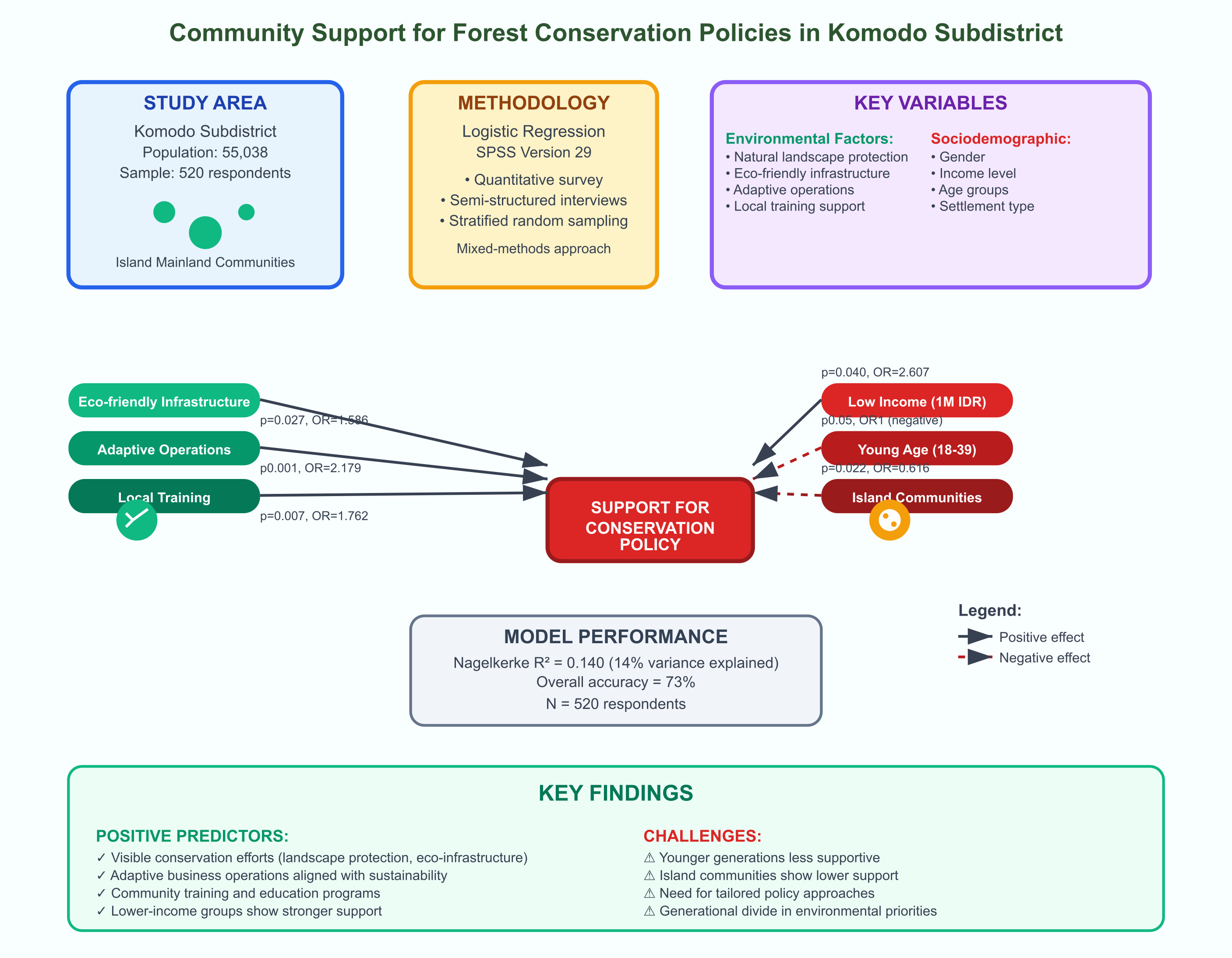
This study delves into the critical determinants that influence community support for forest conservation policies within the Komodo District, utilizing a logistic regression analysis to dissect the impact of various socioeconomic and demographic factors on local residents' attitudes toward conservation. A detailed questionnaire was administered to 520 residents to capture perceptions of conservation measures, infrastructure development, and community involvement. Binary logistic regression revealed that the visibility of conservation efforts, including natural landscape protection and eco-friendly infrastructure, significantly influences public support for policies. There was a strong positive correlation between the visibility of conservation actions and community support. This includes visible protection of natural landscapes and eco-friendly infrastructure, which has significantly bolstered public approval. Adaptive business operations and local training initiatives were positively correlated with support for conservation policies, suggesting that economically beneficial conservation strategies are more likely to win public favor. Lower income levels were unexpectedly associated with more significant support for conservation policies, which could indicate a reliance on the benefits derived from conservation efforts. Conversely, younger demographic groups and island residents displayed a lower propensity to support existing policies. By aligning conservation efforts with the community's economic and social priorities, policymakers can ensure broader support and sustainable engagement.
Full text article
References
Abbass, K., Qasim, M. Z., Song, H., Murshed, M., Mahmood, H., & Younis, I. (2022). A review of the global climate change impacts, adaptation, and sustainable mitigation measures. Environmental Science and Pollution Research, 29, 42539–42559. https://doi.org/10.1007/s11356-022-19718-6
Abubakar, A. A., Al-Mamary, Y. H., Singh, H.P., Singh, A., Alam, F., & Agrawal, V. (2024). Exploring factors influencing sustainable human capital development: Insights from Saudi Arabia. Heliyon, 10(16), Article e35676. https://doi.org/10.1016/j.heliyon.2024.e35676
Abukari, H., & Mwalyosi, R. B. (2020). Local communities’ perceptions about the impact of protected areas on livelihoods and community development. Global Ecology and Conservation, 22, Article e00909. https://doi.org/10.1016/j.gecco.2020.e00909
Afioma, G. (2024). Political dimensions of livelihood transformation of the indigenous Ata Modo people in Komodo National Park, Indonesia [thesis]. Colorado: Colorado State University.
Ainsworth, G. B., Redpath, S. M., Wilson, M., Wernham, C., & Young, J. C. (2020). Integrating scientific and local knowledge to address conservation conflicts: Towards a practical framework based on lessons learned from a Scottish case study. Environmental Science and Policy, 107, 46–55. https://doi.org/10.1016/j.envsci.2020.02.017
Ajibade, I., & Boateng, G. O. (2021). Predicting why people engage in pro-sustainable behaviors in Portland Oregon: The role of environmental self-identity, personal norm, and socio-demographics. Journal of Environmental Management, 289, Article 112538. https://doi.org/10.1016/j.jenvman.2021.112538
Alcaraz, K. I., Wiedt, T. L., Daniels, E. C., Yabroff, K. R., Guerra, C. E., & Wender, R. C. (2020). Understanding and addressing social determinants to advance cancer health equity in the United States: A blueprint for practice, research, and policy. CA: A Cancer Journal for Clinicians, 70, 31–46. https://doi.org/10.3322/caac.21586
Angessa, A. T., Lemma, B., Yeshitela, K., & Endrias, M. (2022). Community perceptions towards the impacts of ecotourism development in the central highlands of Ethiopia: The case of Lake Wanchi and its adjacent landscapes. Heliyon, 8(2), Article e08924. https://doi.org/10.1016/j.heliyon.2022.e08924
Armitage, D., Mbatha, P., Muhl, E. -K., Rice, W., & Sowman, M. (2020). Governance principles for community-centered conservation in the post-2020 global biodiversity framework. Conservation Science and Practice, 2, Article e160. https://doi.org/10.1111/csp2.160
Authelet, M., Subervie, J., Meyfroidt, P., Asquith, N., & Ezzine-de-Blas, D. (2021). Economic, pro-social and pro-environmental factors influencing participation in an incentive-based conservation program in Bolivia. World Development, 145, Article 105487. https://doi.org/10.1016/j.worlddev.2021.105487
Badan Pusat Statistika Kabupaten Manggarai Barat. (2024). Kabupaten Manggarai Barat dalam angka 2024. BPS Kabupaten Manggarai Barat.
Balezentis, T., Ribasauskiene, E., Morkunas, M., Volkov, A., Streimikiene, D., & Toma, P. (2020). Young farmers’ support under the Common Agricultural Policy and sustainability of rural regions: Evidence from Lithuania. Land Use Policy, 94, Article 104542. https://doi.org/10.1016/j.landusepol.2020.104542
Beh, A., Bruyere, B. L., & Lolosoli, S. (2013). Legitimizing local perspectives in conservation through community-based research: A photovoice study in Samburu, Kenya. Society & Natural Resources, 26(12), 1390–1406. https://doi.org/10.1080/08941920.2013.805858
Bethmann, S., Simminger, E., Baldy, J., & Schraml, U. (2018). Forestry in interaction. Shedding light on dynamics of public opinion with a praxeological methodology. Forest Policy and Economics, 96, 93–101. https://doi.org/10.1016/j.forpol.2018.08.005
Bhattarai, B. R., Morgan, D., & Wright, W. (2021). Equitable sharing of benefits from tiger conservation: Beneficiaries’ willingness to pay to offset the costs of tiger conservation. Journal of Environmental Management, 284, Article 112018. https://doi.org/10.1016/j.jenvman.2021.112018
Bhushan, S., Dincă, I., & Shikha, S. (2024). Evaluating local livelihoods, sustainable forest management, and the potential for ecotourism development in Kaimur Wildlife Sanctuary, India. Frontiers in Forests and Global Change, 7, Article 1491917. https://doi.org/10.3389/ffgc.2024.1491917
Bushell, R., & Bricker, K. (2017). Tourism in protected areas: Developing meaningful standards. Tourism and Hospitality Research, 17(1), 106–120. https://doi.org/10.1177/1467358416636173
Büchs, M. (2014). The role of environmental organisations in supporting carbon reduction: Comparing direct and indirect involvement. Environmental Politics, 23, 1003–1022. https://doi.org/10.1080/09644016.2014.921456
Chawla, L. (2020). Childhood nature connection and constructive hope: A review of research on connecting with nature and coping with environmental loss. People and Nature, 2, 619–642. https://doi.org/10.1002/pan3.10128
DiBella, J., Forrest, N., Burch, S., Rao-Williams, J., Ninomiya, S. M., Hermelingmeier, V., & Chisholm, K. (2023). Exploring the potential of SMEs to build individual, organizational, and community resilience through sustainability-oriented business practices. Business Strategy and the Environment, 32, 721–735. https://doi.org/10.1002/bse.3171
Domínguez, L., & Luoma, C. (2020). Decolonising conservation policy: How colonial land and conservation ideologies persist and perpetuate indigenous injustices at the expense of the environment. Land, 9(3), Article 65. https://doi.org/10.3390/land9030065
Downes, T., & Marchant, T. (2016). The extent and effectiveness of knowledge management in Australian community service organisations. Journal of Knowledge Management, 20, 49–68. https://doi.org/10.1108/JKM-11-2014-0483
Edwards, R. C., & Larson, B. M. H. (2020). When screens replace backyards: Strategies to connect digital-media-oriented young people to nature. Environmental Education Research, 26, 950–968. https://doi.org/10.1080/13504622.2020.1776844
Ermekbaeva, I., & Kang, S. (2024). What encourages pro-environmental behavior by tourists? Insights from the protection motivation theory. Environment, Development and Sustainability, 2024. https://doi.org/10.1007/s10668-024-05419-2
Gasa, F. M., Chandra, P. H., Ngalu, R., & Luru, M. N. (2023). The jurassic park project in Rinca Island is a hyperreality for the government of Indonesia. AIP Conference Proceedings, 2680(1), Article 020108. https://doi.org/10.1063/5.0126505
Greiner, R., & Gregg, D. (2011). Farmers’ intrinsic motivations, barriers to the adoption of conservation practices and effectiveness of policy instruments: Empirical evidence from northern Australia. Land Use Policy, 28(1), 257–265. https://doi.org/10.1016/j.landusepol.2010.06.006
Hasanah, M., & Bayo, L. N. (2024). Twin brothers: Claim-making strategies by the Ata Modo in the tourism development project of Komodo National Park, West Manggarai. International Quarterly for Asian Studies (IQAS), 55(2), 173–195.
Hegab, H., Shaban, I., Jamil, M., & Khanna, N. (2023). Toward a sustainable future: Strategies, indicators, and challenges for implementing sustainable production systems. Sustainable Materials and Technologies, 36, Article e00617. https://doi.org/10.1016/j.susmat.2023.e00617
Hernández-Delgado, E. A. (2024). Coastal restoration challenges and strategies for small island developing states in the face of sea level rise and climate change. Coasts, 4(2), Article 65. https://doi.org/10.3390/coasts4020014
Hidyarko, A. I. F., Gayatri, A. C., Rifa, V. A., Astuti, A., Kusumaningrum, L., Mau, Y. S., & Setyawan, A. D. (2021). Reviews: Komodo National Park as a conservation area for the komodo species (Varanus komodoensis) and sustainable tourism (ecotourism). International Journal of Tropical Drylands, 5(1), 27–40. https://doi.org/10.13057/tropdrylands/t050105
Holland, K. K., Larson, L. R., Powell, R. B., Holland, W. H., Allen, L., Nabaala, M., Tome, S., Seno, S., & Nampushi, J. (2021). Impacts of tourism on support for conservation, local livelihoods, and community resilience around Maasai Mara National Reserve, Kenya. Journal of Sustainable Tourism, 30(11), 2526–2548. https://doi.org/10.1080/09669582.2021.1932927
Idris, Adi, K. R., Firmansyah, R., Nadhianty, A., Mobaroq, M. H., Putri, P. G., Pratama, A. S., & Wahono, E. R. (2021). Developing smart tourism using virtual reality as a tourism promotion strategy in Indonesia. GeoJournal of Tourism and Geosites, 35(2), 332–337. https://doi.org/10.30892/gtg.35210-656
Imelda, I. M. S., Lee, C. -H., Wang, H. -J., & Kim, D. -C. (2024). Unraveling factors influencing local willingness to participate in sustainable komodo conservation and protected area tourism. Forest and Society, 8(2), 350–371. https://doi.org/10.24259/fs.v8i2.32880
Iqbal, S., Ashraf, H. A., Ali, T., & Khalid, M. (2025). Green intellectual capital and environmental and social sustainability: The mediating effects of financial condition. Social Science Review Archives, 3(1), 1607–1618. https://doi.org/10.70670/sra.v3i1.465
Kabir, R. S., & Wiium, N. (2021). Positive youth development and environmental concerns among youth and emerging adults in Ghana. In R. Dimitrova, & N. Wiium (Eds.), Handbook of positive youth development: Advancing research, policy, and practice in global contexts (pp. 81–94). Springer, Cham. https://doi.org/10.1007/978-3-030-70262-5_6
Kadykalo, A. N., Cooke, S. J., & Young, N. (2021). The role of western-based scientific, Indigenous, and local knowledge in wildlife management and conservation. People and Nature, 3, 610–626. https://doi.org/10.1002/pan3.10194
Lasso, A. H., & Dahles, H. (2021). A community perspective on local ecotourism development: Lessons from Komodo National Park. Tourism Geographies, 25(2–3), 634–654. https://doi.org/10.1080/14616688.2021.1953123
Leal Filho, W., et al. (2021). Climate change adaptation on small island states: An assessment of limits and constraints. Journal of Marine Science and Engineering, 9, Article 602. https://doi.org/10.3390/jmse9060602
Lee, H. (2024). Strategic types, implementation, and capabilities: Sustainability policies of local governments. Public Administration, 102(1), 264–284. https://doi.org/10.1111/padm.12917
Liang, X., Lu, Y., & Martin, J. (2021). A review of the role of social media for the cultural heritage sustainability. Sustainability, 13(3), Article 1055. https://doi.org/10.3390/su13031055
Lo, C. W. H., Fryxell, G. E., & Wong, W. W. H. (2006). Effective regulations with little effect? The antecedents of the perceptions of environmental officials on enforcement effectiveness in China. Environmental Management, 38(3), 388–410. https://doi.org/10.1007/s00267-005-0075-8
Martyr-Koller, R., Thomas, A., Schleussner, C.-F., Nauels, A., & Lissner, T. (2021). Loss and damage implications of sea-level rise on Small Island Developing States. Current Opinion in Environmental Sustainability, 50, 245–259. https://doi.org/10.1016/j.cosust.2021.05.001
McGinnis, G., Harvey, M., & Young, T. (2020). Indigenous knowledge sharing in Northern Australia: Engaging digital technology for cultural interpretation. Tourism Planning and Development, 17, 96–125. https://doi.org/10.1080/21568316.2019.1704855
Miao, N., Sharif, A., Ozturk, I., & Razzaq, A. (2023). How do the exploitation of natural resources and fiscal policy affect green growth? Moderating role of ecological governance in G7 countries. Resources Policy, 85, Article 103911. https://doi.org/10.1016/j.resourpol.2023.103911
Ministry of Environment and Forestry. (2010). Peraturan Menteri Kehutanan Nomor P.48/menhut-II/2010 tahun 2010 tentang Pengusaha Pariwisata Alam di Suaka Margasatwa, Taman Nasional, Taman Hutan Raya dan Taman Wisata Alam.
Ministry of Environment and Forestry. (2019). Peraturan Menteri Lingkungan Hidup dan Kehutanan Nomor P.8/menlhk/setjen/kum.1/3/2019 tahun 2019 tentang Pengusahaan Pariwisata Alam di Suaka Margasatwa, Taman Nasional, Taman Hutan Raya, dan Taman Wisata Alam.
Nepal, S. K., Lai, P. -H., & Nepal, R. (2022). Do local communities perceive linkages between livelihood improvement, sustainable tourism, and conservation in the Annapurna Conservation Area in Nepal? Journal of Sustainable Tourism, 30, 279–298. https://doi.org/10.1080/09669582.2021.1875478
Newman, R. J., Capitani, C., & Courtney-Mustaphi, C. (2020). Integrating insights from social-ecological interactions into sustainable land use change scenarios for small islands in the Western Indian Ocean. Sustainability, 12(4), Article 41340. https://doi.org/10.3390/su12041340
Nguyen, V. V., Nguyen, H. T. T., Phan, T. T. T., & Lee, C. -H. (2023). Determinants of locals’ willingness to participate in human–elephant conflict management: Evidence from Dong Nai Biosphere Reserve, Vietnam. Trees, Forests and People, 14, Article 100435. https://doi.org/10.1016/j.tfp.2023.100435
Nie, M. (2008). The underappreciated role of regulatory enforcement in natural resource conservation. Policy Sciences, 41(2), 139–164. https://doi.org/10.1007/s11077-008-9060-4
Ningrum, D., Raven, R., Malekpour, S., & Moallemi, E. A. (2023). Transformative potential in sustainable development goals engagement: Experience from local governance in Australia. Global Environmental Change, 80, Article 102670. https://doi.org/10.1016/j.gloenvcha.2023.102670
Nyaupane, G. P., Poudel, S., & York, A. (2022). Governance of protected areas: An institutional analysis of conservation, community livelihood, and tourism outcomes. Journal of Sustainable Tourism, 30, 2686–2705. https://doi.org/10.1080/09669582.2020.1858089
Oduor, A. M. O. (2020). Livelihood impacts and governance processes of community-based wildlife conservation in Maasai Mara ecosystem, Kenya. Journal of Environmental Management, 260, Article 110133. https://doi.org/10.1016/j.jenvman.2020.110133
Rahman, A., Sofiyah, E. S., Sianipar, I. M. J., Edwisafira, A., Suhardono, S., Lee, C. -H., Nguyen, V. V., & Suryawan, I. W. K. (2025). Evaluating tourist importance-performance and support for development in Komodo National Park. Environmental Challenges, 20, Article 101229. https://doi.org/10.1016/j.envc.2025.101229
Rosenstock, T. S., Lubberink, R., Gondwe, S., Manyise, T., & Dentoni, D. (2020). Inclusive and adaptive business models for climate-smart value creation. Current Opinion in Environmental Sustainability, 42, 76–81. https://doi.org/10.1016/j.cosust.2019.12.005
Parker, B. G., Jacobsen, K. S., & Vucetich, J. A. (2022). Towards equitable conservation: Social capital, fear, and livestock loss shape perceived benefit from a protected area. Journal of Environmental Management, 319, Article 115676. https://doi.org/10.1016/j.jenvman.2022.115676
Plummer, R., & Fennell, D. A. (2009). Managing protected areas for sustainable tourism: Prospects for adaptive co-management. Journal of Sustainable Tourism, 17(2), 149–168. https://doi.org/10.1080/09669580802359301
Ponte, S., Noe, C., & Mwamfupe, A. (2021). Private and public authority interactions and the functional quality of sustainability governance: Lessons from conservation and development initiatives in Tanzania. Regulation & Governance, 15(4), 1270–1285. https://doi.org/10.1111/rego.12303
Purwandani, J. A., & Michaud, G. (2021). What are the drivers and barriers for green business practice adoption for SMEs? Environmental Systems and Decisions, 41, 577–593. https://doi.org/10.1007/s10669-021-09821-3
Shandas, V., & Messer, W. B. (2008). Fostering green communities through civic engagement: Community-based environmental stewardship in the Portland area. Journal of the American Planning Association, 74(4), 408–418. https://doi.org/10.1080/01944360802291265
Short, J. L. (2021). The politics of regulatory enforcement and compliance: Theorizing and operationalizing political influences. Regulation & Governance, 15(3), 653–685. https://doi.org/10.1111/rego.12291
Sianipar, I. M. J., Lee, C. -H., Wang, H. -J., & Kim, D. -C. (2024). Unraveling factors influencing local willingness to participate in sustainable Komodo conservation and protected area tourism. Forest and Society, 8, 350–371. https://doi.org/10.24259/fs.v8i2.32880
Sockhill, N. J., Dean, A. J., Oh, R. R., & Fuller, R. A. (2022). Beyond the ecocentric: Diverse values and attitudes influence engagement in pro‐environmental behaviours. People and Nature, 4(6), 1500–1512. https://doi.org/10.1002/pan3.10400
Sofiyah, E. S., Sianipar, I. M. J., Rahman, A., Caesarina, N. P., & Suhardono, S. (2025). Adaptive governance in the water-energy-food-ecosystem nexus for sustainable community sanitation. World Development Sustainability, 6, Article 100220. https://doi.org/10.1016/j.wds.2025.100220
Stone-Johnson, C., & Weiner, J. (2022). Theorizing school leadership as a profession: A qualitative exploration of the work of school leaders. Journal of Educational Administration, 60(4), 386–402. https://doi.org/10.1108/JEA-05-2021-0112
Suryawan, I. W. K., Gunawan, V. D., & Lee, C. -H. (2024). Assessing the importance-performance analysis of adaptive capacity programs for sustainable mangrove conservation in the Taman Nasional Bali Barat conservation area. Ocean and Coastal Management, 257, Article 107345. https://doi.org/10.1016/j.ocecoaman.2024.107345
Suryawan, I. W. K., Rahman, A., Suhardono, S., Nguyen, V. V., & Lee, C. H. (2025a). Green-blue workforce readiness for mangrove conservation: Community competency clusters and participatory drivers in Indonesia. Forest Policy and Economics, 178, 103593. https://doi.org/10.1016/j.forpol.2025.103593
Suryawan, I. W. K., Suhardono, S., Gunawan, V. D., Lee, C. H., Nguyen, V. V., & Rahman, A. (2025b). Factors influencing community segmentation and participation in ecotourism of Bali Barat National Park. Pertanika Journal of Social Sciences & Humanities, 33(3), 1287–1316 . https://doi.org/10.47836/pjssh.33.3.16
Sutrisno, A. D., Lee, C.-H., & Suryawan, I. W. K. (2024). Examining community desire to change for adaptive transition in post-mining ecological sustainability. The Extractive Industries and Society, 20, Article 101537. https://doi.org/10.1016/j.exis.2024.101537
Thakur, A., & Kumar, A. (2024). Community engagement and education for Eco-Conscious health. In P. K. Prabhakar, & W. Leal Filho (Eds.), Preserving health, preserving earth: The path to sustainable healthcare (pp. 81–102). Springer, Champ. https://doi.org/10.1007/978-3-031-60545-1_5
Tranter, S. N., Estradivari, Ahmadia, G. N., Andradi-Brown, D. A., & Muenzel, D. (2022). The inclusion of fisheries and tourism in marine protected areas to support conservation in Indonesia. Marine Policy, 146, Article 105301. https://doi.org/10.1016/j.marpol.2022.105301
Utomo, S. H., Wulandari, D., Narmaditya, B. S., Ishak, S., Prayitno, P. H., Sahid, S., & Qodri, L. A. (2020). Rural-based tourism and local economic development: Evidence from Indonesia. GeoJournal of Tourism and Geosites, 31(3), 1161–1165. https://doi.org/10.30892/gtg.31330-553
Wamsler, C., Mundaca, L., & Osberg, G. (2022). Rethinking political agency: The role of individuals’ engagement, perceptions and trust in transitioning to a low-carbon transport system. Journal of Cleaner Production, 360, Article 132197. https://doi.org/10.1016/j.jclepro.2022.132197
Western, D., Wright, R. M., & Strum, S. C. (Eds.). (1994). Natural connections: perspectives in community-based conservation. Island Press.
Wiredu, J., Yang, Q., & Sampene, A. K. (2024). The effect of green supply chain management practices on corporate environmental performance. Business Strategy and the Environment, 33, 2578–2599. https://doi.org/10.1002/bse.3606
Yamane, T., & Kaneko, S. (2021). Is the younger generation a driving force toward achieving the sustainable development goals? Journal of Cleaner Production, 292, Article 125932. https://doi.org/10.1016/j.jclepro.2021.125932
Zhang, S., & Zhu, D. (2020). Have countries moved towards sustainable development or not? Definition, criteria, indicators, and empirical analysis. Journal of Cleaner Production, 267, Article 121929. https://doi.org/10.1016/j.jclepro.2020.121929
Authors
Copyright (c) 2025 Jurnal Manajemen Hutan Tropika

This work is licensed under a Creative Commons Attribution 4.0 International License.
Jurnal Manajemen Hutan Tropika is an open access journal which means that all contents is freely available without charge to the user or his/her institution. Users are allowed to read, download, copy, distribute, print, search, or link to the full texts of the articles in this journal without asking prior permission from the publisher or the author. This is in accordance with the Budapest Open Access Initiative (BOAI) definition of open access.Article Details
How to Cite



