
Avicennia alba, an Additional Potential Carbon Sequester in Mangrove Ecosystems

Article Sidebar
-
Blue carbon, climate change, growth rate, elevated CO2
Abstract
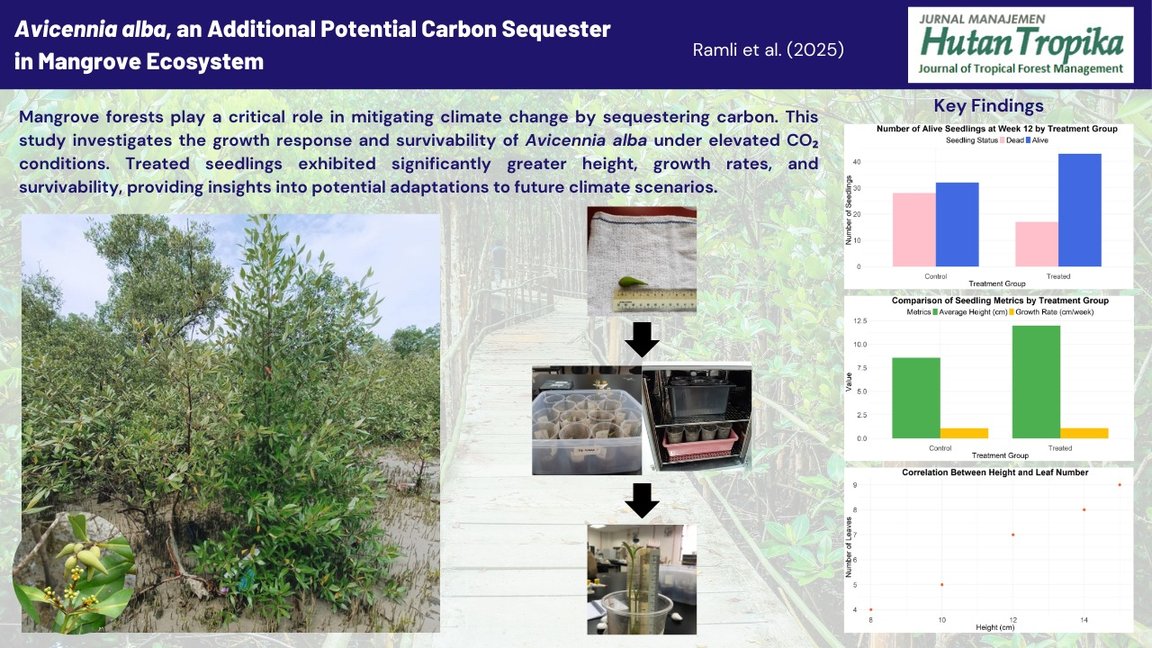
Mangrove forests have exceptional carbon sequestration capacity for mitigating climate change impacts. Increased atmospheric CO2 can accelerate crops growth, improves water-use efficiency, and disrupt soil-plant balance. The performance of Avicennia alba in terms of morphometrics and biomass under environmental stresses such as elevated CO2 was poorly understood. Thus, this study aims to determine the growth response and survivability of A. alba by examining height, leaf number, and growth rate under elevated CO2 from the early stages of development. A number of 120 seed samples of A. alba was divided into two groups; 60 germinated seeds placed in a CO2 incubator and 60 in a shade house as control. The growth rate, plant height, leaf number, and mortality were compared between the two groups and statistical analyses were conducted. Increased concentrations of CO₂ enhance the development and survival of seedlings by promoting greater photosynthesis and more effective water use. The decrease in leaf production is most likely due to a shift in resource allocation, where plants prioritize the accumulation of total biomass over leaf formation. An understanding of this trade-off elucidates the potential response of plants to increasing CO₂ levels in climate change scenarios.
Full text article
Authors
Copyright (c) 2025 Jurnal Manajemen Hutan Tropika

This work is licensed under a Creative Commons Attribution 4.0 International License.
Jurnal Manajemen Hutan Tropika is an open access journal which means that all contents is freely available without charge to the user or his/her institution. Users are allowed to read, download, copy, distribute, print, search, or link to the full texts of the articles in this journal without asking prior permission from the publisher or the author. This is in accordance with the Budapest Open Access Initiative (BOAI) definition of open access.Article Details
How to Cite



