
Big Data-Driven Risk Analysis of Environmental Grievances in the Palm Oil Industry for Sustainable Decision-Making

Article Sidebar
-
big data-driven risk analysis, deforestation, environmental sustainability, grievance reports, palm oil industry
Abstract
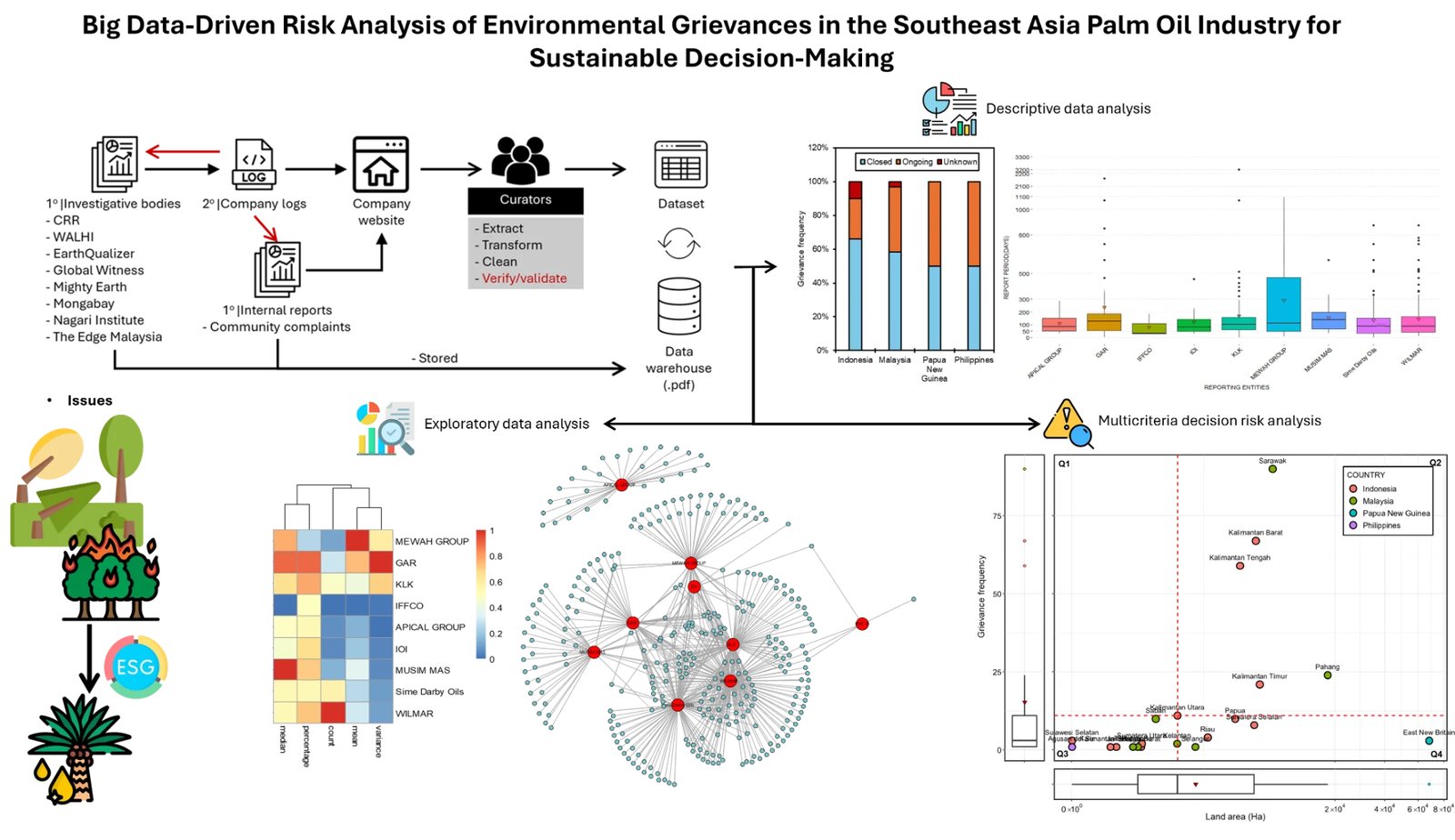
The expansion of the palm oil industry affects environmental sustainability. This study aims to assess palm oil's environmental grievances reported pre- and post-Covid-19. A hybrid of data-driven and multicriteria decision-making analyses was used to analyze unstructured data from nine companies' grievance logs. A total of 884 cases with the trend peaking in 2019. Predominantly deforestation, a total of 564 cases affecting ~66,716.23 ha in Indonesia, 312 cases affecting ~49,704.97 ha in Malaysia, 6 cases affecting ~43,500 ha in Papua New Guinea, and 2 cases in the Philippines. Network analysis reveals that the environmental grievances affected multiple companies, with WILMAR suppliers at the center. On average, companies take ~100 days to resolve. Clustering analysis shows Sime Darby Oil, WILMAR, KLK, and Mewah Group have influences on addressing grievances in high-risk provinces. Quantile-quadrant analysis reveals that provinces in Kalimantan, Pahang, and Sarawak are in the high-risk quadrant and therefore require immediate mitigation plans. This finding points toward the need for the formation of a private consortium among identified key players and local government in the high-risk region as a new strategy to improve management of environmental sustainability issues that predominantly involve deforestation.
Full text article
Authors
Copyright (c) 2025 Jurnal Manajemen Hutan Tropika

This work is licensed under a Creative Commons Attribution 4.0 International License.
Jurnal Manajemen Hutan Tropika is an open access journal which means that all contents is freely available without charge to the user or his/her institution. Users are allowed to read, download, copy, distribute, print, search, or link to the full texts of the articles in this journal without asking prior permission from the publisher or the author. This is in accordance with the Budapest Open Access Initiative (BOAI) definition of open access.Article Details
How to Cite



