
Home Range and Habitat Use of the Endangered Flores Hawk-eagle (Nisaetus floris) in Ende, Flores, East Nusa Tenggara

Article Sidebar
-
Nisaetus floris, home range, habitat use, threat, conservation
Abstract
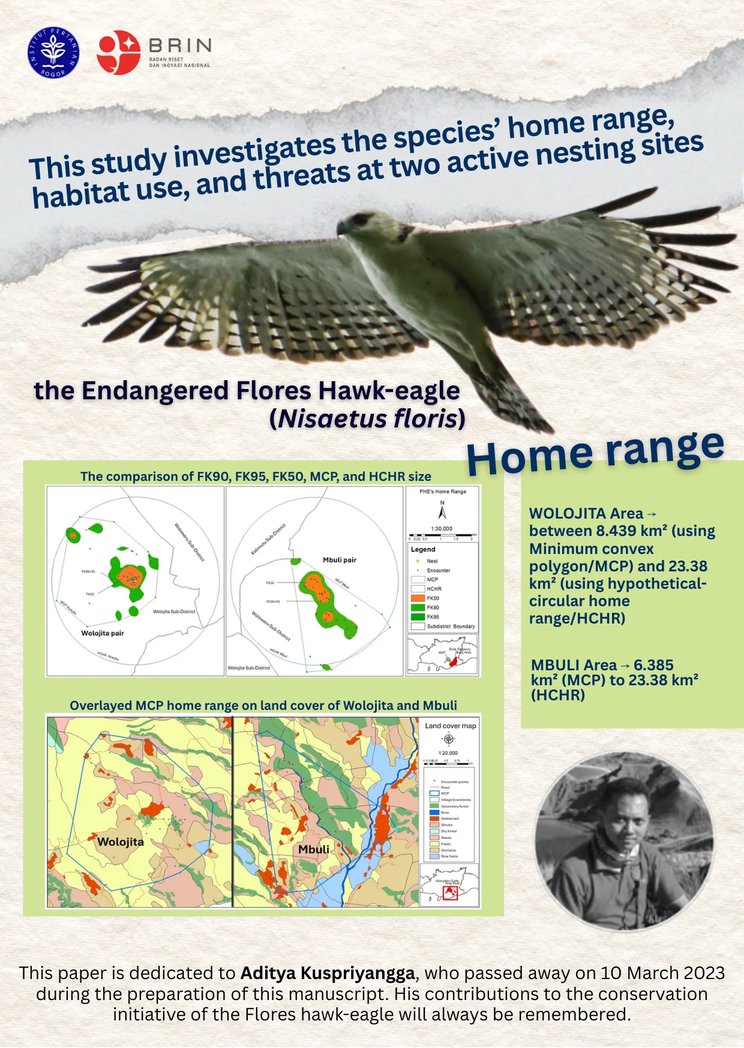
The Flores hawk-eagle (Nisaetus floris) is an endangered raptor endemic to the Lesser Sunda region and remains understudied, hindering effective conservation planning. This study investigates the species’ home range, habitat use, and threats at two active nesting sites in Ende District, Flores Island. Home range estimates varied between 8.439 km² (using minimum convex polygon/MCP) and 23.38 km² (using hypothetical-circular home range/HCHR) in Wolojita and from 6.385 km² (MCP) to 23.38 km² (HCHR) in Mbuli. Intensive use areas were relatively small, measuring 0.449 km² in Wolojita and 0.494 km² in Mbuli. Habitat use analysis revealed that in Wolojita, the eagles favored secondary forests, settlements, and shrublands, while in Mbuli, they primarily utilized grasslands and secondary forests, actively avoiding agricultural lands, rice fields, and areas near sulfuric rivers. Secondary forests appear to provide essential resources such as nesting trees and prey availability. However, competition with other raptor species, coupled with anthropogenic threats such as habitat degradation, land-use change, and persecution driven by livestock predation, poses significant risks to the species’ survival. Conservation should focus on preserving secondary forests, promoting sustainable land-use practices, and mitigating human-wildlife conflict to ensure the long-term viability of the population.
Full text article
References
Anderson, S. H., & Gutzwiller, K. J. (1994). Habitat evaluation methods. In T. A. Bookhout (Eds.), Research and management techniques for wildlife and habitats (pp. 254–271). Bethesda: The Wildlife Society.
BirdLife International. (2024). Nisaetus floris. The IUCN red list of threatened species 2024: e.T22732096A229714191. https://doi.org/10.2305/IUCN.UK.2024-2.RLTS.T22732096A229714191.en
Blackburn, J. K., Hadfield, T. L., Curtis, A. J., & Hugh-Jones, M. E. (2014). Spatial and temporal patterns of anthrax in white-tailed deer, Odocoileus virginianus, and hematophagous flies in West Texas during the summertime anthrax risk period. Annals of the Association of American Geographers, 104(5), 939–958. https://doi.org/10.1080/00045608.2014.914834
Börger, L., Franconi, N., De Michele, G., Gantz, A., Meschi, F., Manica, A., Lovari, S., & Coulson, T. (2006). Effects of sampling regime on the mean and variance of home range size estimates. Journal of Animal Ecology, 75(6), 1393–1405.
Börger, L., Dalziel, B. D., & Fryxell, J. (2008). Are there general mechanisms of animal home range behaviour? A review and prospects for future research. Ecology Letters, 11, 637–650. https://doi.org/10.1111/j.1461-0248.2008.01182.x
Bosch, R., Real, J., Tintó, A., Zozaya, E. L., & Castell, C. (2010). Home-ranges and patterns of spatial use in territorial Bonelli’s Eagle Aquila fasciata. Ibis, 152(1), 105–117. https://doi.org/10.1111/j.1474-919X.2009.00985.x
Boyle, S. A., Lourenço, W. C., da Silva, L. R., & Smith, A. T. (2009). Home range estimates vary with sample size and methods. Folia Primatologica, International Journal of Primatology, 80(1), 33–42. https://doi.org/10.1159/000201092
Badan Pusat Statistik (2022). Kecamatan Wolojita dalam angka. Ende: Badan Pusat Statistik Kabupaten Ende.
Cardador, L., Mañosa, S., Varea, A., & Bertolero, A. (2009). Short communication: Ranging behaviour of Marsh Harrier Circus aeruginosus in agricultural landscapes. Ibis, 151(4), 766–770. https://doi.org/10.1111/j.1474-919X.2009.00963.x
Collaerts, P., Collaerts, E., Verbelen, P., & Trainor, C. R. (2013). Discovery of the critically endangered Flores hawk-eagle Nisaetus floris on Alor Island, Indonesia. Birding ASIA, 19, 48–51.
Eaton, J. A., van Balen, B., Brickle, N. W., & Rheindt, F. E. (2016). Birds of the Indonesian Archipelago. Greater Sundas and Wallacea. Barcelona: Lynx Edicions.
Franklin, W. L., Mossmann, A. S., & Dole, M. (1975). Social organisation and home range of Roosevelt elk. Journal of Mammalogy, 56, 102–118. https://doi.org/10.2307/1379610
Fotheringham, A. S., Brunsdon, C., & Charlton, M. (2000). Quantitative geography: Perspective on spatial data analysis. Thousand Oaks: Sage.
Gaibani, G., & Csermely, D. (2007). Behavioral studies. In Raptor research and management techniques (pp. 117–128). Blaine: Hancock House Publishers.
Getz, W. M., Fortmann-Roe, S., Cross, P. C., Lyons, A. J., Ryan, S. J., & Wilmers, C. C. (2007). LoCoH: Nonparametrics kernel methods for constructing home ranges and utilization distributions. PLoS ONE, 2(2), Article e207. https://doi.org/10.1371/journal.pone.0000207
Gjershaug, J. O., Kvaloy, K., Rov, N., Prawiradilaga, D. M., Suparman, U., & Rahman, Z. (2004a). The taxonomic status of Flores hawk eagle Spizaetus floris. Forktail, 20, 55–62.
Gjershaug, J. O., Røv, N., Nygård, T., Prawiradilaga, D. M., Afianto, M. Y., Hapsoro, & Supriatna, A. (2004b). Home-range size of the Javan hawk-eagle (Spizaetus bartelsi) estimated from direct observations and radiotelemetry. Journal of Raptor Research, 38(4), 343–349.
Harness, R. E. (2007). Mitigation. In Raptor research and management techniques (pp. 365–382). Blaine: Hancock House Publishers.
IUCN. 2022. The IUCN red list of threatened species. Version 2022-2.
Jacobs, J. (1974). Quantitative measurement of food selection. Oecologia, 14, 413–417. https://doi.org/10.1007/BF00384581
Kaneda, H., Prawiradilaga, D. M., & Yamagishi, S. (2007). Home range and habitat use of an individual Javan hawk-eagle (Spizaetus bartelsi). Short communications. Journal of Raptor Research, 41(1), 68–71. https://doi.org/10.3356/0892-1016(2007)41[68:HRAHUO]2.0.CO;2
Kennedy, P. L., Ward, J. M., Rinker, G. A., & Gessaman, J. A. (1994). Post-fledging areas in Northern Goshawk home ranges. Studies in Avian Biology, 16, 75–82.
Krebs, C. J. (1989). Ecological methodology. New York: Harper and Row Publishers.
Krüger, S. C., Allan, D. G., Jenkins, A. R., & Amar, A. (2014). Trends in territory occupancy, distribution, and density of the Bearded Vulture Gypaetus barbatus meridionalis in southern Africa. Bird Conservation International, 24(2), 162–177. https://doi.org/10.1017/S0959270913000440
Margalef, R. (1967). Some concepts relative to the organization of plankton. Oceanography and Marine Biology-An Annual Review, 5, 257–289. https://doi.org/10261/166489
Margalida, A., Pérez-García, J. M., Afonso, I., & Moreno-Opo, R. (2016). Spatial and temporal movements in Pyrenean bearded vultures (Gypaetus barbatus): Integrating movement ecology into conservation practice. Scientific Reports, 6, Article 35746. https://doi.org/10.1038/srep35746
McClure, C. J. W., Westrip, J. R. S., Johnson, J. A., Schulwitz, S. E., Virani, M. Z., Davies, R., Symes, A., Wheatley, H., Thorstrom, R., Amar, A., Buij, R., Jones, V. R., Williams, N. P., Buechley, E. R., & Butchart, S. H. M. (2018). State of the world's raptors: Distributions, threats, and conservation recommendations. Biological Conservation, 227, 390–402. https://doi.org/10.1016/j.biocon.2018.08.012
Ministry of Environment and Forestry. (2022). Decree of Minister of Environment and Forestry Number: SK.77/Menlhk/Setjen/KSA.2/1/2022 regarding Flores Hawk-eagle (Nisaetus floris) Conservation Strategy and Action Plan for 2021–2030. Jakarta: Ministry of Environment and Forestry.
Nijman, V., van Balen, S. B., & Sözer, R. (2000). Breeding biology of Javan hawk-eagle Spizaetus bartelsi in West Java, Indonesia. Emu-Austral Ornithology, 100(2), 125–132. https://doi.org/10.1071/MU9826
Norris, K. (2004). Managing threatened species: The ecological toolbox, evolutionary theory and declining-population paradigm. Journal of Applied Ecology, 41, 413–426. https://doi.org/10.1111/j.0021-8901.2004.00910.x
O’Bryan, C. J., Allan, J. R., Suarez-Castro, A. F., Delsen, D., M., Buij, R., McClure, C. J. W., Rehbein, J. A., Virani, M. Z., McCabe, J. D., Peter, T., Negret, P. J., Greig, C., Peadar, B., & Kissling, W. D. (2022). Human impacts on the world’s raptors. Frontiers in Ecology and Evolution, 10, Article 624896. https://doi.org/10.3389/fevo.2022.624896
Oliveira-Santos, L. G. R., Zucco, C. A., & Agostinelli, C. (2013). Using conditional circular kernel density functions to test hypotheses on animal circadian activity. Animal Behaviour, 85, 269–280. https://doi.org/10.1016/j.anbehav.2012.09.033
Peery, M. Z. (2000). Factors affecting interspecies variation in home-range size of raptors. The Auk, 117(2), 511–517. https://doi.org/10.1093/auk/117.2.511
Pérez-García, J. M., Margalida, A., Afonso, I., Ferreiro, E., Gardiazabal, A., Botella, F., & Sanchez-Zapata, J. A. (2013). Interannual home range variation, territoriality and overlap in breeding Bonelli’s Eagle (Aquila fasciata) tracked by GPS satellite telemetry. Journal of Ornithology, 154, 63–71. https://doi.org/10.1007/s10336-012-0871-x
Raharjaningtrah, W., & Rahman, Z. (2004). Study on the distribution, habitat and ecology of Flores hawk-eagle Spizaetus cirrhatus floris in Lombok, Sumbawa, Flores, Komodo and Rinca Islands, Nusa Tenggara, Indonesia. Annual Report of Pro Nature Fund, 13(1).
Rahman, D. A. (2021). Dasar-dasar ekologi kuantitatif: Teori dan aplikasi. Bogor: IPB Press.
Raptor Conservation Society. (2011). Study on distribution, population, habitats and ecological aspect of Flores hawk-eagle (Nisaetus floris) on Rinjani National Park and other protected area in Lombok Island West Nusa Tenggara, Indonesia. Final Report for the Mohammed bin Zayed Species Conservation Fund. Cianjur: Raptor Conservation Society.
Raptor Conservation Society. (2012). Continued a survey of distribution, population, habitats and ecological aspects of Flores hawk-eagle (Nisaetus floris) in and around Flores Island, East Nusa Tenggara-Indonesia. Final Report for the Mohammed bin Zayed Species Conservation Fund. Cianjur: Raptor Conservation Society.
Septiana, W., Munawir, A., Pairah, P., Sodahlan, M. E., Irawan, Y., Santosa, Y., & Prasetyo, L. B. (2020). Distribution and characteristics of Javan hawk eagle nesting trees in Gunung Halimun Salak National Park, Indonesia. Jurnal Biodjati, 5(2), 182–190. https://doi.org/10.15575/biodjati.v5i2.8481
Sözer, R., & Nijman, V. (1995). Behavioural ecology, distribution and conservation of the Javan hawk-eagle Spizaetus bartelsi Stresseman, 1924. Verslagen en Technische Gegevens, 62(1), 1–122.
Subedi, T. R., Pérez-García, J. M., Sah, S. A. M., Gurung, S., Baral, H. S., Poudyal, L. P., Lee, H., Thomsett, S., Virani, M. Z., & Anadón, J. D. (2020). Spatial and temporal movement of the Bearded Vulture using GPS telemetry in the Himalayas of Nepal. Ibis, 162, 563–571. https://doi.org/10.1111/ibi.12799
Syartinilia, Makalew, A. D. N., Mulyani, Y. A., & Higuchi, H. (2015). Landscape characteristics derived from satellite-tracking data of wintering habitats used by oriental honey buzzards in Borneo. Landscape and Ecological Engineering, 11, 61–71. https://doi.org/10.1007/s11355-013-0237-4
Syartinilia, Al Farisi, G. A., & Higuchi, H. (2017). Landscape characteristics of oriental honey buzzards wintering in western part of Flores Island based on satellite-tracking data. IOP Conference Series: Earth and Environmental Science, 91, Article 012031. https://doi.org/10.1088/1755-1315/91/1/012031
Syartinilia, & Setiawan, R. M. K. (2021). Spatial distribution and landscape characteristics of Flores hawk-eagle (Nisaetus floris) habitat in Flores Island. Journal of Natural Resources and Environmental Management, 11(4), 542–549. https://doi.org/10.29244/jpsl.11.4.542-549
Tapia, L., Kennedy, P. L., & Mannan, R. W. (2007). Habitat sampling. In Raptor research and management techniques (pp. 153–169). Blaine: Hancock House Publishers.
Titus, K., & Mosher, J. A. (1981). Nest site habitat selected by woodland hawks in the central Appalachians. Auk, 98, 270–281. https://doi.org/10.1093/auk/98.2.270
van Balen, B., Nijman, V., & Prins, H. H. T. (2000). The Javan hawk-eagle: Misconceptions about rareness and threat. Biological Conservation, 96(3), 297–304. https://doi.org/10.1016/S0006-3207(00)00092-6
Village, A. (1982). The home range and density of kestrels in relation of vole abundance. Journal of Animal Ecology, 51, 413–428. https://doi.org/10.2307/3974
Withaningsih, S., Parikesit, & Alham, R. F. (2020). Diversity of bird species in the coffee agroforestry landscape: Case study in the Pangalengan Sub-district, Bandung District, West Java, Indonesia. Biodiversitas, 21(6), 2467–2480. https://doi.org/10.13057/biodiv/d210619
Worton, B. J. (1989). Kernel methods for estimating the utilization distribution in home-range studies. Ecology, 70(1), 164–168. https://doi.org/10.2307/1938423
Authors
Copyright (c) 2025 Jurnal Manajemen Hutan Tropika

This work is licensed under a Creative Commons Attribution 4.0 International License.
Jurnal Manajemen Hutan Tropika is an open access journal which means that all contents is freely available without charge to the user or his/her institution. Users are allowed to read, download, copy, distribute, print, search, or link to the full texts of the articles in this journal without asking prior permission from the publisher or the author. This is in accordance with the Budapest Open Access Initiative (BOAI) definition of open access.Article Details
How to Cite



