
Distribution of Stingless Bee (Trigona spp.) from Meliponiculture in South Sumatra Province, Indonesia

Article Sidebar
-
diversity, meliponini, entrance, nest characteristic
Abstract
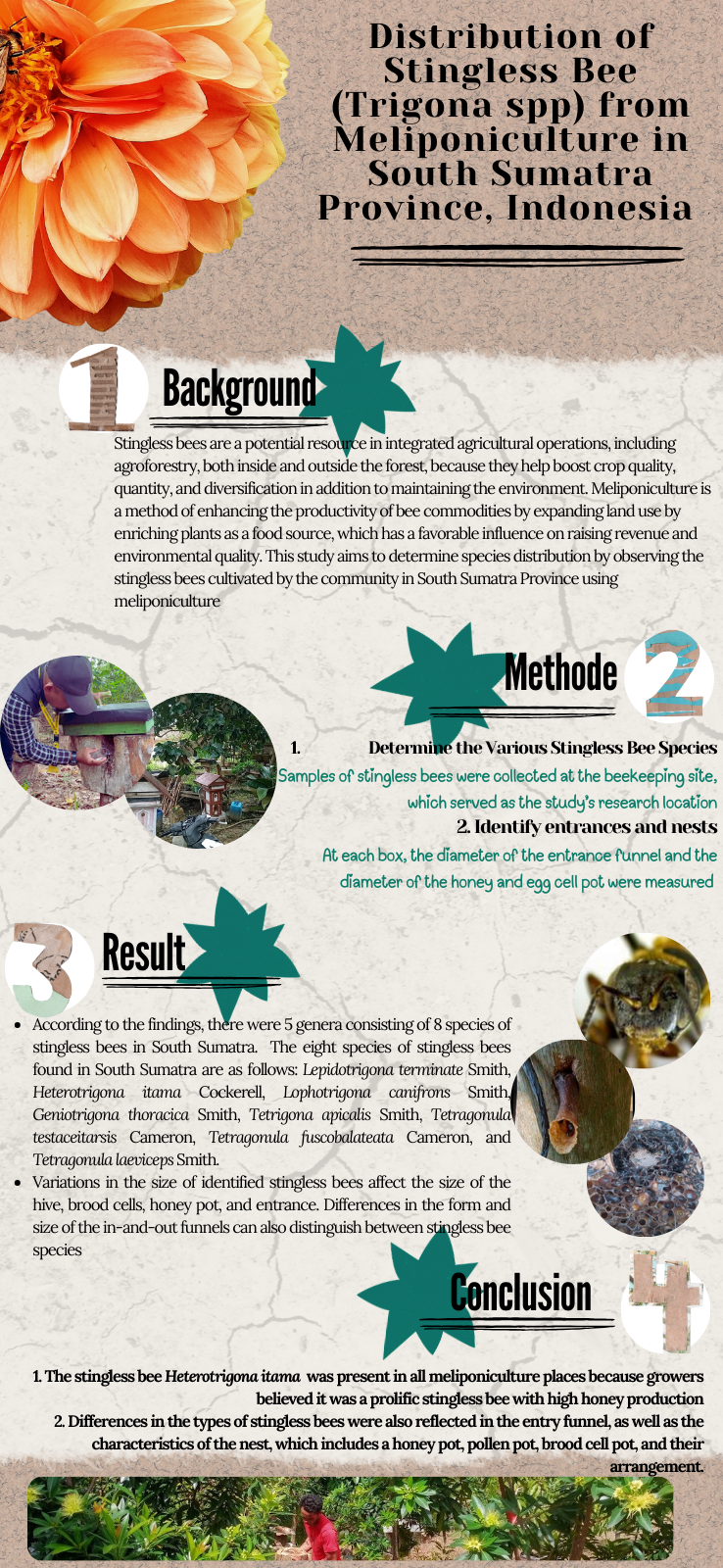
This study aims to determine species distribution by observing the stingless bees cultivated by the community in South Sumatra Province using meliponiculture. By visiting boxes and studying the entrance and characteristics of stingless bee hives at each research location, bee samples were obtained in six districts or cities where beekeepers exist. The study was conducted from January 2023 to May 2023. The type of bee species was identified in each culture box, the diameter of the entrance was measured, and the diameters of the honey pot and brood cell pot were measured. A descriptive analysis was performed to gain an overview of each entrance and nest. Based on the identification results, eight different varieties of stingless bees were discovered. Each research site had an unequal distribution of the eight varieties of bees. Lepidotrigona terminata, Heterotrigona itama, Lophotrigona canifrons, Geniotrigona thoracica, Tetrigona apicalis, Tetragonula testaceitarsis, Tetragonula fuscobalateata, and Tetragonula laeviceps are examples of stingless bees. Variations in the size of identified stingless bees affect the size of the hive, brood cell, honey pot, and entrance. The nest, brood cells, honey pot, and entrance grow in proportion to the size of the stingless bee. Differences in the form and size of the entrance can also distinguish between species.
Full text article
References
Astiani, D., & Indrayani, Y. (2022). Inventarisasi potensi sarang kelulut (Trigona spp.) dan deskripsi habitatnya di kawasan RTH Kampus Universitas Tanjungpura Pontianak. Jurnal Hutan Lestari, 10(4), 949–961.
Atmowidi, T., Prawasti, T. S., Rianti, P., Prasojo, F. A. & Pradipta, N. B. (2022). Stingless bees pollination increases fruit formation of strawberry (Fragaria x annanassa Duch) and melon (Cucumis melo L.). Tropical Life Sciences Reserach, 33(1), 43–54. https://doi.org/10.21315/tlsr2022.33.1.3
Basari, N., Ramli, S. R., Abdul-Mutalid, N. A., Shaipulah, N. F. M., & Hashim, N. A. (2021). Flower morphology and nectar concentration determine the preferred food source of stingless bee Heterotrigona itama. Journal of Asia-Pacific Entomology, 24(2), 232–236. https://doi.org/10.1016/j.aspen.2021.02.005
Buchori, D., Rizali, A., Priawandiputra, W., Raffiudin, R., Sartiami, D., Pujiastuti, Y., Jauharlina, Pradana, M. G., Meilin, A., Leatemia, J. A., Sudiarta, I. P., Rustam, R., Nelly, N., Lestari, P., Syahputra, E., Hasriyanti, Watung, J. F., Daud, I. D. A., Hariani, N., Jihadi, A., & Johannis, M. (2022). Beekeeping and managed bee diversity in Indonesia: Perspective and preference of beekeepers. Diversity, 14(1), 52. https://doi.org/10.3390/d14010052
Bueno, F. G. B., Kendall, L., Alves, D. A., Tamara, M. L., Heard, T., Latty, T., & Gloag, R. (2023). Stingless bee floral visitation in the global tropics and subtropics. Global Ecology and Consevation, 43, e02454. https://doi.org/10.1016/j/gecco.2023.e022454
Chuttong, B., Burgett, M., Sangjaroen, P., Yavilat, J. (2020). Fist report of hovering guard bees of the Paleotropical stingless bee Tetrigona apicalis (Hymenoptera:Apidae:Meliponini). Apidologie, 51, 88–93. https://doi.org/10.1009/s13592-019-00717-5
Carvalho-Zilse, G. A., & Nunes-Silva, C. G. (2012). Threats to the stingless bees in the Brazilian Amazon: How to deal with scarce biological data and an increasing rate of destruction. In R. M. Florio (Ed.), Bees: Biology, threats and colonies (pp 14–168). Nova Science Publishers, Inc.
Chinh, T. X., Sommeijer, M. J., Boot, W. J., & Michener, C. D. (2005). Nest and colony characteristics of three stingless bee species in Vietnam with the first description of the nest of Lisotrigona carpenteri (Hymenoptera:Apidae:Meliponini). Journal of the Kansas Entomological Society, 78(4), 363–372. https://doi.org/10.2317/0409.14.1
Purwanto, H., Soesilohadi, R. H., & Trianto, M. (2022). Stingless bees from meliponiculture in South Kalimantan, Indonesia. Biodiversitas, 23(3), 1254–1266. https://doi.org/10.13057/biodiv/d230309
Iqbal, M., Yoza, D., & Budiani, E. S. (2016). Karakteristik habitat Trigona spp. di hutan larangan adat Desa Rumbio Kabupaten Kampar. Jurnal Online Mahasiswa Fakultas Pertanian Universitas Riau, 3(2), 1–5.
Jalil, A. H., & Shuib, I. (2012). Indo-malayan stingless bee. Retrieved from https://ses.library.usyd.edu.au/bitstream/2123/11356/4/Poster166.pdf
Michener, C. D. (2007). The bees of the world (2nd ed.). Baltimore: The Johns Hopkins University Press.
[Pemprov Sumsel] Pemerintah Provinsi Sumatera Selatan. (2017). Peraturan Gubernur Nomor 21/2017 tentang Rencana Induk Pertumbuhan Ekonomi Hijau Provinsi Sumatera Selatan.
Rasmussen, C., Thomas, J. C., & Engel, M. S. (2017). A new genus of eastern hemisphere stingless bees (Hymenoptera:Apidae), with a key to the supraspecific groups of Indomalayan and Australasian Meliponini. American Museum Novitates, 2017(3888), 1-33. https://doi.org/10.1206/3888.1
Sakagami, S. F., Ōgushi, R., & Roubik, D. W. (Eds.). (1990). Natural history of social wasps and bees in equatorial Sumatra (pp. 132–137). Sapporo: Hokkaido University Press.
Samsudin, S. F., Mamat, M. R., & Hazmi, I. R. (2018). Taxonomic study on selected species of stingless bee (Hymenoptera:Apidae:Meliponini) in Peninsular Malaysia. Serangga, 23(2), 203–258.
Sanjaya, V., Astiani, D., & Sisilia, L. (2019). Studi habitat dan sumber pakan lebah kelulut di kawasan Cagar Alam Gunung Nyiut Desa Pisak Kabupaten Bengkayang. Jurnal Hutan Lestari, 7(2), 786–798. https://doi.org/10.26418/jhl.v7i2.34072
Sanches-Famoso, V., & Etxegarai-Legarreta, O. (2022). The role of beekeeping in the generation of goods and services: The interrelation between environmental, socioeconomic and sociocultural utilities. Agriculture, 12, 551. https://doi.org/10.3390/agriculture12040551
Schrader, J., Wetsphal, C., Sattler, C., Ferderer, P., & Franze, M. (2017). Woody habitats promote pollinators and complexity of plant–pollinator interactions in homegardens located in rice terraces of the Philippine Cordilleras. Paddy and Water Environment, 16, 253–263. https://doi.org/10.1007/s10333-017-0612-0
Smith, D. R. (2012). Key to workers of Indo-malayan stingless bees. Lawrence Kansas: University of Kansas.
Soraye, P., Newbold, T., & Kerr, J. (2020). Climate change contributes to widespread decline among bumble bees across continents. Science, 367, 685–688. https://doi.org/10.1126/science.aax8591
Syafrizal, Ramadhan, R., Kusuma, I. W., Egra, S., Shimizu, K., & Kanzaki, M. (2020). Diversity and honey properties of stingless bees from meliponiculture in East and North Kalimantan, Indonesia. Biodiversitas, 10, 4623–4630. https://doi.org/10.13057/biodiv/d211021
Suprianto, M. T., Trianto, M., Alam, N., & Kirana, N. G. A. G. C. (2020). Morphological character and conserved region of elongation factors 1α (EF1α) gene analysis in Lepidotrigona terminata. Metamorfosa: Journal of Biological Sciences, 7(2), 30–39. https://doi.org/10.24843/metamorfosa.2020.v07.i02.p05
Toni, C. H., Djossa, B. A., Yedomonhan, H., Zannou, E. T., & Mensah, G. A. (2018). Western honey bee management for crop pollination. African Crop Science Journal, 26(1), 1–17. https://doi.org/10.4314/acsj.v26i1.1
Authors
Article Details
How to Cite



