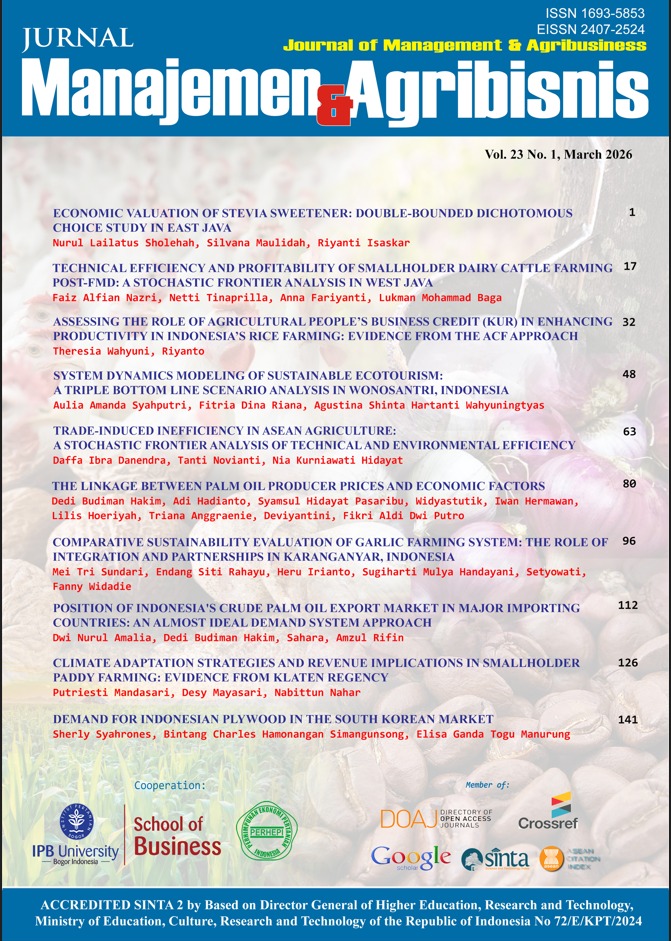
Comparative Sustainability Evaluation of Garlic Farming System: The Role of Integration and Partnerships in Karanganyar, Indonesia
DOI:
https://doi.org/10.17358/jma.23.1.96Abstract
Background: Garlic is a strategic horticultural commodity in Indonesia with diverse benefits and high market demand. However, the sustainability of garlic farming faces several structural challenges, including low productivity, limited market access, weak institutional support, low technology adoption, and poor quality seeds.
Purpose: This study aimed to evaluate the sustainability status of garlic farming, analyze performance differences, and identify sensitive attributes that influence sustainability.
Design/methodology/approach: This study was conducted in Karanganyar Regency with 120 respondents in total. This study used a Rapid Appraisal (RAP) method with a Multidimensional Scaling (MDS) approach.
Findings/Results: The results indicate that the multidimensional sustainability index of garlic farming is categorized as moderately sustainable (50–70). Farms adopting integrated farming with partnerships achieved the highest index (58.43), followed by non-integrated farms with partnerships (57.96), integrated farms without partnerships (54.61), and non-integrated farms without partnerships (54.17). The social dimension ranked the highest, followed by the ecological, economic, institutional, and technological dimensions. Leverage analysis identified 11 sensitive attributes, including farming experience, farmer group membership, water availability and conservation, marketing management, marketing institutions, seed availability, seed technology, bulb productivity, supporting policies, and organic fertilizer use. The simulation showed that improving these attributes could increase the multidimensional sustainability index by up to 26.76% in all categories.
Conclusion: Enhancing sustainability should focus on technology adoption, strengthening marketing institutions, improving seed access, and developing adaptive policies.
Originality/value (State of the art): This study shows that integrated interventions targeting these sensitive attributes are expected to facilitate the transition of garlic farming from “moderately sustainable” to “fully sustainable”.
Keywords: garlic, multidimensional scaling, RAP Analysis, influence sustainability, integrated farming
Downloads
Downloads
Published
Issue
Section
License
Authors who publish with this journal agree to the following terms:
- Authors retain copyright and grant the journal right of first publication with the work simultaneously licensed under a Creative Commons Attribution License that allows others to share the work with an acknowledgement of the work's authorship and initial publication in this journal.
- Authors are able to enter into separate, additional contractual arrangements for the non-exclusive distribution of the journal's published version of the work (e.g., post it to an institutional repository or publish it in a book), with an acknowledgement of its initial publication in this journal.
- Authors are permitted and encouraged to post their work online (e.g., in institutional repositories or on their website) prior to and during the submission process, as it can lead to productive exchanges, as well as earlier and greater citation of published work (See The Effect of Open Access).
.png)