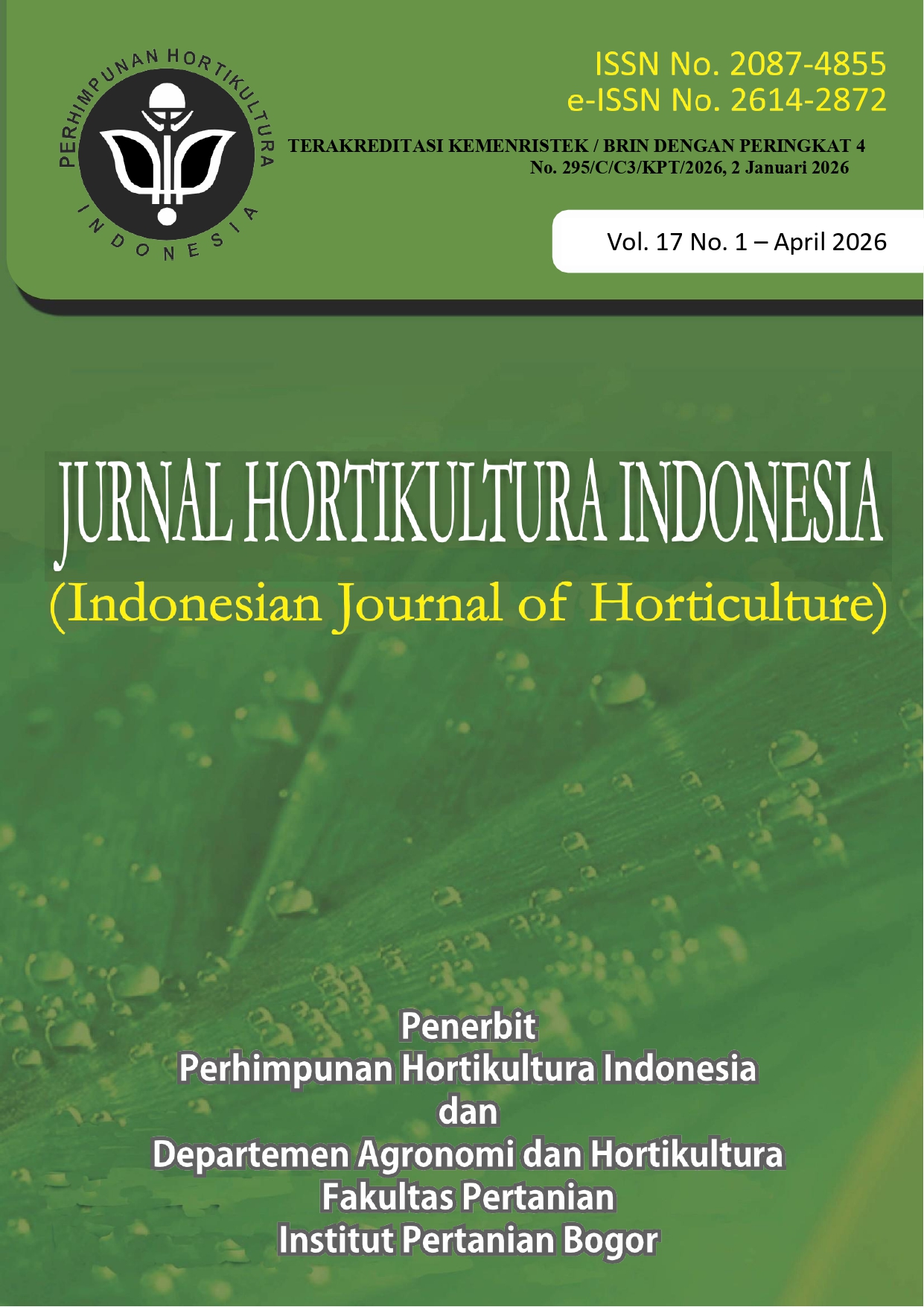
Pematahan Dormansi Benih Okra (Abelmoschus esculentus L.) Menggunakan Skarifikasi Kimia
DOI:
https://doi.org/10.29244/jhi.17.1.13-21Abstract
Okra plants are generally propagated generatively, but one of the main obstacles to propagating this plant is seed dormancy (hardseedness), which can inhibit germination. Hardseedness is a type of exogenous dormancy that can be overcome through H2SO4 treatment, wich increases the seeds permeability to water and gases. While chemical scarification using H2SO4 has been widely utilized, there has been limited testing on the permeability and mechanical resistance of okra seed coats. This study aimed to obtain the correct technique for breaking dormancy in okra seeds. The study was conducted in April-November 2022 at the Cikarawang experimental field and the IPB Seed Laboratory. The two-factor experiment was structured using a Completely Randomized Design . The first factor: the concentration of the H2SO4 solution consists of four levels, namely control aquadest without H2SO4, 60, 70 and 80%. The second factor: soaking time consists of four levels, namely control, 3, 5, and 8 minutes. The results showed that H2SO4 treatment increased okra seed germination from 61% (control) to 98.1%. The most effective treatment for breaking dormancy based on average sprout dry weight from 0.7 g to 1.93 g is 80% of H2SO4 with a soaking duration of 8 minutes, seedling vigor from 1.5% to 92.5%, and speed of germination from 17.4% to 22.7% is 70% H2SO4 with a soaking duration of 8 minutes.
Keywords: seed coat, sulfuric acid, viability, vigor
Downloads
Downloads
Published
Issue
Section
License
You are free to:
- Share — copy and redistribute the material in any medium or format for any purpose, even commercially.
- Adapt — remix, transform, and build upon the material for any purpose, even commercially.
- The licensor cannot revoke these freedoms as long as you follow the license terms.
Under the following terms:
- Attribution — You must give appropriate credit, provide a link to the license, and indicate if changes were made. You may do so in any reasonable manner, but not in any way that suggests the licensor endorses you or your use.
- ShareAlike — If you remix, transform, or build upon the material, you must distribute your contributions under the same license as the original.
- No additional restrictions — You may not apply legal terms or technological measures that legally restrict others from doing anything the license permits.
Notices:
You do not have to comply with the license for elements of the material in the public domain or where your use is permitted by an applicable exception or limitation.
No warranties are given. The license may not give you all of the permissions necessary for your intended use. For example, other rights such as publicity, privacy, or moral rights may limit how you use the material.