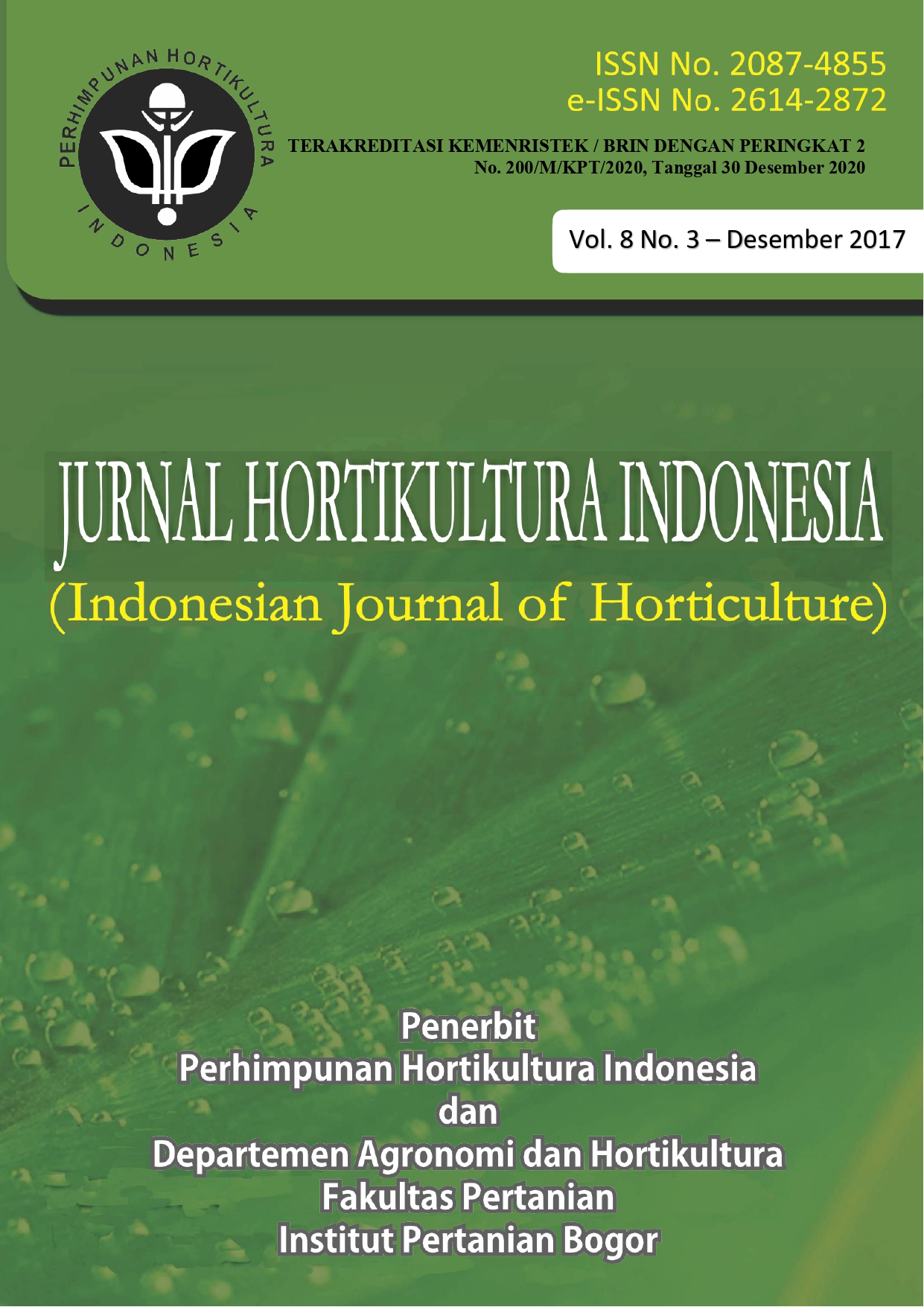
Efektivitas Seed Coating dan Biopriming dengan Rizobakteri dalam Mempertahankan Viabilitas Benih Cabai dan Rizobakteri selama Penyimpanan
DOI:
https://doi.org/10.29244/jhi.8.3.192-202Abstract
ABSTRACT
The objective of the study was to obtain the best coating formula for hot pepper seeds, and evaluate the effect of seed coating and biopriming with rhizobacteria on viability of hot pepper seeds and rhizobacteria during storage. Experiment 1 was arranged in a completely randomized design with one factor i.e. 11 coating formula. Experiment 2 was arranged in a nested plot design with two factors, storage period (0, 4, 8, 12, 16, 20, and 24 weeks) as main factor and seed treatment consisted of 11 treatments (control, seed coating with E1+F2B1, ST116B, CM8; biopriming 24 h with E1+F2B1, ST116B, CM8; biopriming 48 h with E1+F2B1, ST116B, and CM8; priming metalaxyl) as nested factor. Result of experiment 1 indicated that the best coating formula for hot pepper seed was sodium alginate 2.5% and was used in experiment 2. Experiment 2 showed that seed coating and biopriming with rhizobacteria were able to maintain seed viability (79-89%) for 24 weeks of storage at 27-30 0C as compared to priming metalaxyl (54%). Biopriming E1+F2B1 24 h or CM8 48 h resulted in the highest index of seed vigor after 24 weeks of storage. Population of rhizobacteria in seed tissue decreased in bioprimed seeds from 105-107 cfu g-1 to 104 cfu g-1 after being stored for 24 weeks.
Keywords: rhizobacteria isolates, seed treatment, seed vigor, sodium alginate
ABSTRAK
Penelitian ini bertujuan mendapatkan formula coating terbaik pada benih cabai dan mengevaluasi pengaruh seed coating dan biopriming dengan rizobakteri dalam mempertahankan viabilitas benih cabai dan rizobakteri selama penyimpanan. Percobaan 1 menggunakan rancangan acak lengkap satu faktor yang terdiri atas 11 formula coating. Percobaan 2 menggunakan rancangan petak tersarang dua faktor, periode simpan (0, 4, 8, 12, 16, 20, dan 24 minggu) sebagai faktor utama dan perlakuaan benih yang terdiri atas 11 perlakuan (kontrol, seed coating dengan E1+F2B1, ST116B, CM8; biopriming 24 jam dengan E1+F2B1, ST116B, CM8; biopriming 48 jam dengan E1+F2B1, ST116B, dan CM8; priming metalaksil) sebagai faktor tersarang. Hasil Percobaan 1 menunjukkan bahwa formula coating terbaik untuk benih cabai ialah natrium alginat 2.5% dan digunakan pada percobaan 2. Percobaan 2 menunjukkan bahwa seed coating dan biopriming dengan rizobakteri mampu mempertahankan viabilitas benih (78-89%) selama 24 minggu penyimpanan pada suhu 27-30 0C dibandingkan priming metalaksil (54%). Biopriming E1+F2B1 24 jam atau biopriming CM8 48 jam menghasilkan indeks vigor paling tinggi setelah disimpan selama 24 minggu. Populasi rizobakteri di dalam jaringan benih menurun pada benih yang diberi perlakuan biopriming dari 105-107 cfu g-1 menjadi 104 cfu g-1 setelah disimpan selama 24 minggu.
Kata kunci: isolat rizobakteri, natrium alginat, perlakuan benih, vigor
Downloads
Downloads
Published
Issue
Section
License
You are free to:
- Share — copy and redistribute the material in any medium or format for any purpose, even commercially.
- Adapt — remix, transform, and build upon the material for any purpose, even commercially.
- The licensor cannot revoke these freedoms as long as you follow the license terms.
Under the following terms:
- Attribution — You must give appropriate credit, provide a link to the license, and indicate if changes were made. You may do so in any reasonable manner, but not in any way that suggests the licensor endorses you or your use.
- ShareAlike — If you remix, transform, or build upon the material, you must distribute your contributions under the same license as the original.
- No additional restrictions — You may not apply legal terms or technological measures that legally restrict others from doing anything the license permits.
Notices:
You do not have to comply with the license for elements of the material in the public domain or where your use is permitted by an applicable exception or limitation.
No warranties are given. The license may not give you all of the permissions necessary for your intended use. For example, other rights such as publicity, privacy, or moral rights may limit how you use the material.