
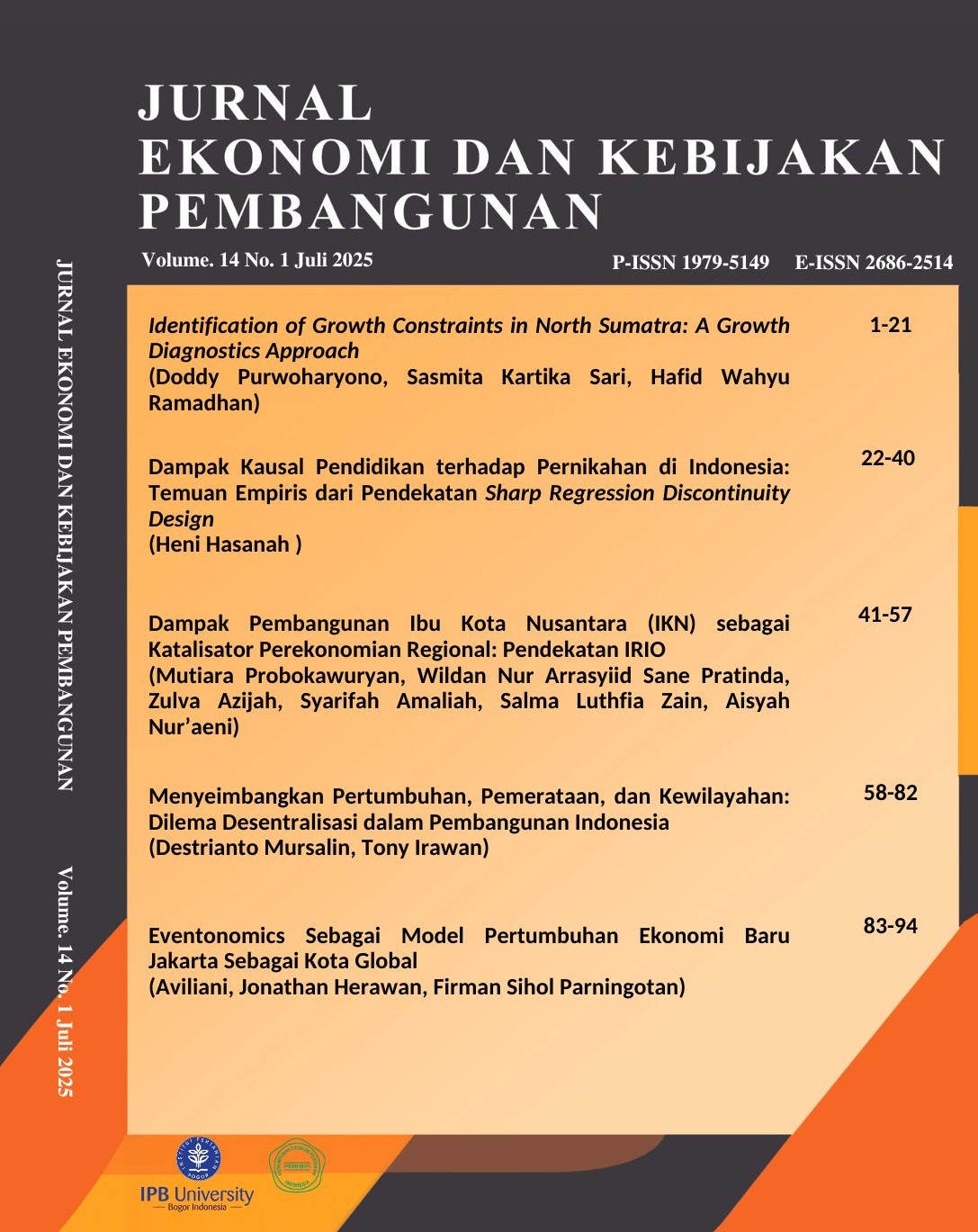
Eventonomics As a New Economic Growth Model Jakarta as a Global City Indonesia

Article Sidebar
-
Eventonomics, Input-Output Table, Jakarta
Abstract
Jakarta, as a global city, must seek a distinctive economic growth model to provide unique experiences for visiting tourists. The relocation of the capital to Nusantara will require Jakarta to prepare a new economic model filled with stability to avoid spillover effects on Jakarta’s economy since it will no longer function as the center of government. The concept of eventonomics is the study of the economic impact of hosting major events, including red-hot industries, MICE (Meetings, Incentives, Conferences, and Exhibitions) events, and multisport events, which can become sources of economic growth packaged within the concept of urban tourism. This can generate foreign exchange as a form of service export and the potential for foreign direct investment that drives economic growth. By replicating Swiftonomics in Singapore, analyzed using the 2016 input-output table and iterated with the RAS Partial Survey to produce the 2023 input-output table, the study examines impacts on output, employment effects, income multipliers, output multipliers, and linkages. The research results show a potential output increase of Rp65.85 trillion and an additional 8.3 million jobs. The sectors with the highest multipliers are wholesale and retail trade; repair of motor vehicles and motorcycles, while the income multiplier is highest in the manufacturing sector, which is labor-intensive.
Full text article
References
DeSind, S., Geerling, W., Mateer, G., & Halfen, K. (2023). The Economics Behind the Billions: How Taylor Swift and MrBeast Can Be Used to Teach Economics. SRSN Electric Journal.
Dewind, S., Geerling, W., Mateer, G. D., Dahlberg, K. H., & Green, A. (2023.). Swiftonomics: Using Taylor Swift to Teach Supply and Demand, Exchange Rates, and Preference Reversals. Retrieved from https://www.bu.edu/articles/2023/what-makes-taylor-swift-the-pop-icon-she-is/
Dian Revindo, M., Hanum Siregar, C., Tarisha Yuliana, M., Yusuf Reza Kurniawan, S., Ekonomi Penyelenggaraan Pertunjukan Musik, D., & Taylor Swift dan, K. (n.d.). Trade and Industry Brief Special Report, Maret 2024.
Go, F. M., & Govers, R. (2000). Integrated Quality Management for Tourist Destination: A European Perspective On Achieving Competitiveness. Tourism Management, 21(1), 79–88.
Hall, C. Michael, & Page, S. J. (2014). The Geography of Tourism and Recreation: Environment, Place and Space. In The Geography of Tourism and Recreation: Environment, Place and Space. Taylor and Francis. https://doi.org/10.4324/9780203796092
Hall, Colin Michael, & Gossling, S. (2016). Food Tourism and Regional Development: Networks, products and trajectories. Routledge.
Kulit, G. (n.d.). TABEL INPUT OUTPUT INDONESIA 2010 BADAN PUSAT STATISTIK, INDONESIA Dicetak oleh: Boleh dikutip dengan menyebut sumbernya.
Manfull, Q. (2023). Swiftonomics: The Economics of Taylor Swift & Swifties .
Matematika, J., dan Statistika Volume, K., Matematika, J., Matematika Dan Ilmu Pengetahuan Alam, F., Muhtar, N., & Gubu, L. (2023). PENERAPAN MODEL EKONOMI LEONTIEF MENGGUNAKAN METODE DEKOMPOSISI LU PADA SEKTOR EKONOMI PROVINSI SULAWESI TENGGARA Nur Alam Akbar. Retrieved from http://jmks.uho.ac.id/index.php/JMKS
Miller, R. E., & Blair, P. D. (2009). Input-Output Analysis: Foundations and Extensions. Cambridge: Cambridge University Press.
Moscati, I. (2019). Not a behaviorist: Samuelson’s contributions to utility theory in the Harvard years, 1936–1940. London.
Pendit, S. N. (2002). Ilmu Pariwisata. Jakarta: Pradnya Pramita.
Porter, M. (1980). Competitive Advantage: Creating and Sustaining Superior Performance; and Competitive Strategy: Techniques for Analyzing Industries and Competitors.
siac_annual_report_2012_new. (n.d.).
Smith, A., & Pappalepore, I. (2015). Exploring attitudes to edgy urban destinations: the case of Deptford, London. Journal of Tourism and Cultural Change, 13(2), 97–114. https://doi.org/10.1080/14766825.2014.896371
Sonis, M., & Hewings, G. J. D. (1992). Coefficient Change in Input-Output Models: Theory and Applications. Economic Systems Research, 4(2), 143–158. https://doi.org/10.1080/09535319200000013
TABEL INPUT-OUTPUT I N D O N E S I A 2016. (n.d.). Retrieved from www.freepik.com
Thaler, R. H. (2016). Behavioral Economics: Past, Present, and Future. American Economic Review, 106(7), 1577–1600.
Todaro, M. P., & Smith, S. C. (n.d.). Economic development.
TOURISM SECTOR PERFORMANCE. (n.d.).
Wooten, J., Al-Bahrani, A. A., Holder, K., & Patel, D. (2020). The Role of Relevance in Economics Education: A Survey. SSRN Electronic Journal. https://doi.org/10.2139/ssrn.3606301
Wyss-Gallifent, J. (2023). Leontief Input-Output Models.
Authors
Copyright (c) 2025 JURNAL EKONOMI DAN KEBIJAKAN PEMBANGUNAN

This work is licensed under a Creative Commons Attribution-NonCommercial 4.0 International License.
The authors who publis article(s) in Jurnal Ekonomi and Kebijakan Pembangunan have to understand and agree that the copyright of article published is owned by Jurnal ekonomi and Kebijakan pembangunan including to reproduce, distribute and sell this journal to public.
Article Details
How to Cite



