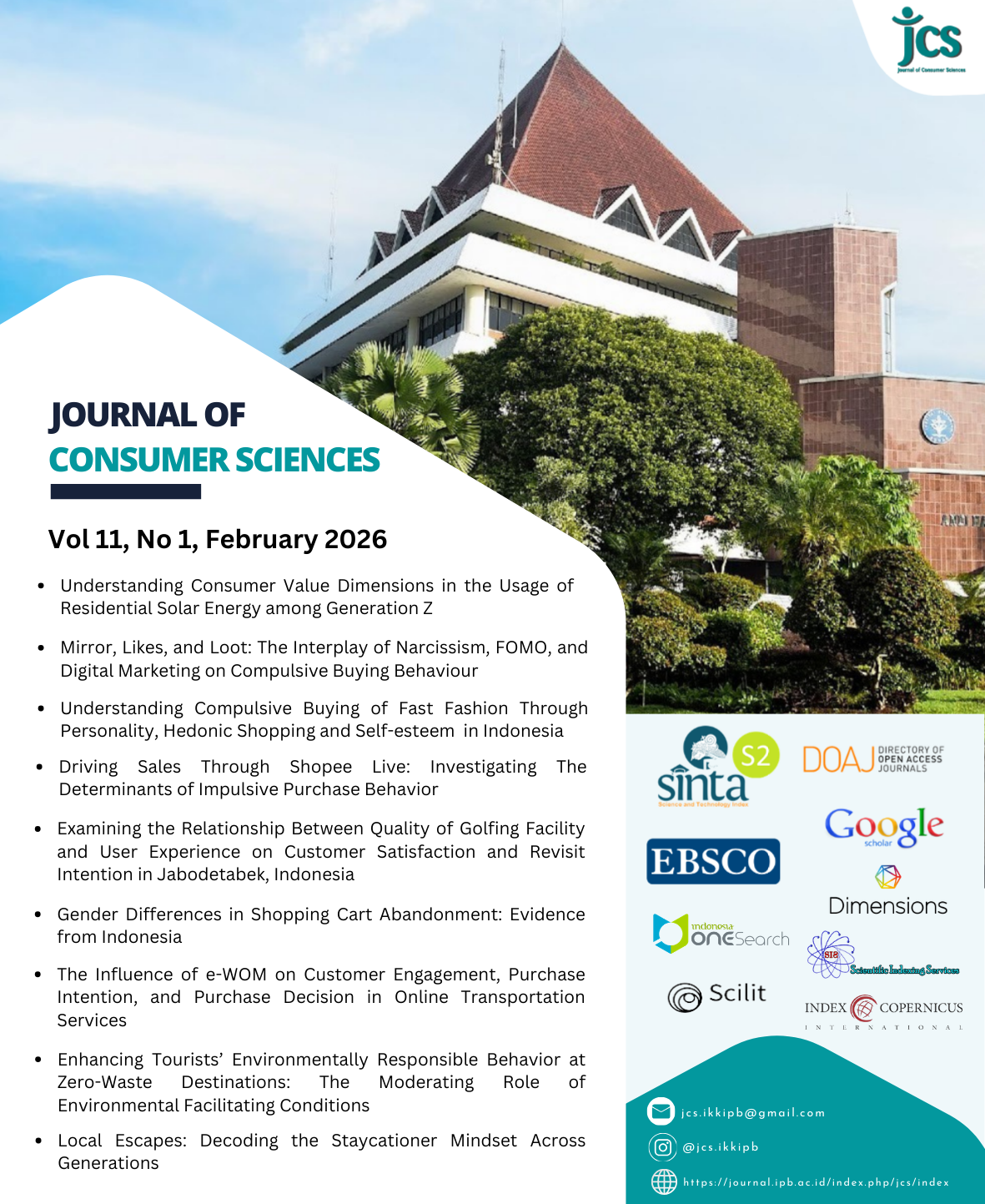
Mirror, Likes, and Loot: The Interplay of Narcissism, FOMO, and Digital Marketing on Compulsive Buying Behavior
DOI:
https://doi.org/10.29244/jcs.11.1.27-49Keywords:
affiliate marketing, compulsive buying, Fear of Missing Out (FOMO), gamification, narcissism, user-generated content (UGC)Abstract
Background: The growth of fashion e-commerce has intensified the use of affiliate marketing, user-generated content, and gamification to improve engagement. These strategies influence consumer psychology, particularly narcissism, increasing susceptibility to Fear of Missing Out (FOMO) and compulsive shopping.
Purpose: This study aimed to investigate the effects of digital strategies on narcissism and their role in driving FOMO as well as compulsive fashion purchases in e-commerce.
Method: This study conducted a quantitative online survey of 458 e-commerce customers selected via purposive sampling, and analyzed the data using structural equation modeling (SEM) in SmartPLS.
Findings: The results showed that affiliate marketing, user-generated content (UGC), and gamification significantly impacted narcissism. Furthermore, narcissism could trigger FOMO and compulsive buying behavior, and FOMO significantly affected compulsive buying. Both narcissism and FOMO played significant roles as positive mediators and moderators in the relationship between exogenous variables and compulsive buying.
Conclusions: This study concluded that affiliate marketing, UGC, and gamification significantly increased narcissism, triggering FOMO and compulsive fashion buying in Indonesian e-commerce. The results identified narcissism as a key psychological link between digital marketing strategies and excessive consumption, underscoring the need for ethical marketing practices and stronger consumer self-control.
Research implication: This study theoretically showed that affiliate marketing, UGC, and gamification triggered narcissism, leading to FOMO and compulsive buying. Practically, it emphasized the need for the ethical use of these strategies to foster sustainable consumer relationships.
References
Ah Fook, L., & McNeill, L. (2020). Click to buy: The impact of retail credit on over-consumption in the online environment. Sustainability, 12(18), 7322. https://doi.org/10.3390/su12187322
Al Mutanafisa, T., & Retnaningsih, R. (2021). The effect of sales promotion and knowledge on impulsive buying of online platform consumers. Journal of Consumer Sciences, 6(1), 77-91. https://doi.org/10.29244/jcs.6.1.77-91
Alamyar, I. H. (2025). The role of user-generated content in Shaping Consumer Trust: A communication psychology approach to e-commerce. Medium, 12(2), 175–191. https://doi.org/10.25299/medium.v12i2.19963
Anggarawati, S., Armelly, A., Salim, M., Odilawati, W., Saputra, F. E., & Atmaja, F. T. (2023). The mediating role of narcissistic behavior in the relationship between materialistic orientation and conspicuous online consumption behavior on social media. Cogent Business & Management, 10(3). https://doi.org/10.1080/23311975.2023.2285768
Anjum, S. (2024). Narcissism fear of missing out and phubbing the moderating role of mindfulness. CARC Research in Social Sciences, 3(3). https://doi.org/10.58329/criss.v3i3.158
Aparicio, M., Costa, C. J., & Moises, R. (2021). Gamification and reputation: Key determinants of e-commerce usage and repurchase intention. Heliyon, 7(3). https://doi.org/10.1016/j.heliyon.2021.e06383
Banerjee, S., Dellarocas, C. N., & Zervas, G. (2018). Interacting user-generated content technologies: How questions and answers affect consumer reviews. SSRN Electronic Journal. https://doi.org/10.2139/ssrn.3240885
Barta, ., Belanche S, D., Fernández, A., & Flavián, M. (2023). Influencer marketing on TikTok: The effectiveness of humor and followers’ hedonic experience. Journal of Retailing and Consumer Services, 70, 103149. https://doi.org/10.1016/j.jretconser.2022.103149
Barberis, N., Sanchez-Ruiz, M. J., Cannavò, M., Calaresi, D., & Verrastro, V. (2023). The dark triad and trait emotional intelligence as predictors of problematic social media use and engagement: the mediating role of the fear of missing out. Clinical neuropsychiatry, 20(2), 129.
Bentall, R. P., Lloyd, A., Bennett, K., McKay, R., Mason, L., Murphy, J., McBride, O., Hartman, T. K., Gibson-Miller, J., Levita, L., Martinez, A. P., Stocks, T. V., Butter, S., Vallières, F., Hyland, P., Karatzias, T., & Shevlin, M. (2021). Pandemic buying: Testing a psychological model of compulsive buying and panic buying using data from the United Kingdom and the Republic of Ireland during the early phase of the COVID-19 pandemic. PLOS ONE, 16(1). https://doi.org/10.1371/journal.pone.0246339
Brailovskaia, J., & Margraf, J. (2024). From fear of missing out (FoMO) to addictive social media use: The role of social media flow and mindfulness. Computers in Human Behavior, 150, 107984
Cai, H., Shi, Y., Fang, X., & Luo, Y. L. (2022). Narcissism predicts impulsive buying: Phenotypic and genetic evidence. Frontiers in Psychology, 6. https://doi.org/10.3389/fpsyg.2015.00881
Cantone, G. G., & Tomaselli, V. (2022). Hybrid Probabilistic-Snowball Sampling. arXiv Preprint arXiv:2204.01887.
Charandas, B. R., & Tiwari, D. (2022). Social media marketing strategies and their effects on consumer engagement and buying behavior in the fashion industry. Innovative Research Thoughts, 8(1), 174–180. https://doi.org/10.36676/irt.v8.i1.1431
Chauhan, S., Banerjee, R., & Dagar, V. (2023). Analysis of impulse buying behavior of consumer during COVID-19: An empirical study. Millennial Asia, 14(2), 278-299.
Chen, S., van Tilburg, W. A., Mahadevan, N., & Leman, P. J. (2024). Narcissists don’t care about approval: The role of narcissism and status motives in explaining the relationship between self-objectification and approval motivation. Current Psychology, 43(31), 25809–25819. https://doi.org/10.1007/s12144-024-06141-y
Cheng, E. W. (2019). Choosing between the theory of planned behavior (TPB) and the technology acceptance model (TAM). Educational Technology Research and Development, 67(1), 21-37.
Colaljo, J. M., Moreno, D. E. L., Dalisay, R., Casas, P. S., & Santos, J. L. D. (2024, August). The Role of User-Generated Content on Customers' Purchase Intent and Behavior: A Basis for E-Commerce Content Strategy for Micro and Small Enterprises. In 2024 8th International Conference on Business and Information Management (ICBIM) (pp. 59-63). IEEE.
Crusius, J., Corcoran, K., & Mussweiler, T. (2022). Social comparison: Theory, research, and applications. Theories in Social Psychology, Second Edition, 165-187.
Dhewi, T. S., Sumarsono, H., Narmaditya, B. S., & Ridzuan, A. R. (2024). Narcissism, self-esteem, and compulsive buying: Unraveling the role of social media usage. Journal of Management World, 2024(4), 146–151. https://doi.org/10.53935/jomw.v2024i4.310
Doan, L. T. M., Rahman, M., & Vo, X. V. (2024). Mitigating overconsumption through mindfulness: The role of cashless payments in impulsive buying and sustainable consumer behavior. Journal of Chinese Economic and Business Studies, 1–24. https://doi.org/10.1080/14765284.2024.2415728
Du, Y. (2024). Study on the psychological motivations of Chinese queer individuals who dare to expose and come out under the guise of identity concealment: Centered on social media. Advances in Education, Humanities and Social Science Research, 12(1), 496. https://doi.org/10.56028/aehssr.12.1.496.2024
Dwivedi, YogeshK., Rana, NripendraP., & Alryalat, M. A. (2017). Affiliate marketing: An overview and analysis of emerging literature. The Marketing Review, 17(1), 33–50. https://doi.org/10.1362/146934717x14909733966092
Esperanza, C., Amatuloh, D. N., Utama, I. D., Nathaniel, K., & Sudirman, I. D. (2024, December). How Affiliate Marketing Impacts Buying Behavior in E-Commerce. In 2024 International Conference on Information Technology Systems and Innovation (ICITSI) (pp. 138-144). IEEE.
Fegan, R. B., & Bland, A. R. (2021). Social media use and vulnerable narcissism: The differential roles of oversensitivity and egocentricity. International journal of environmental research and public health, 18(17), 9172.
Gandrita, D. M., Gandrita, A., & Rosado, D. P. (2024). Challenges and strategies of gamification in family businesses: The moderating effects of supervision and engagement. European Business Review, 37(3), 397–416. https://doi.org/10.1108/ebr-06-2024-0187
Gubik, A. S., & Vörös, Z. (2023). Why narcissists may be successful entrepreneurs: The role of entrepreneurial social identity and overwork. Journal of Business Venturing Insights, 19. https://doi.org/10.1016/j.jbvi.2022.e00364
Gupta, M., & Sharma, A. (2021). Fear of missing out: A brief overview of origin, theoretical underpinnings and relationship with Mental Health. World Journal of Clinical Cases, 9(19), 4881–4889. https://doi.org/10.12998/wjcc.v9.i19.4881
Hagerborn, Cecilia, Ivarsson, Isabella, & Linde, Samuel. (2024). Trending towards overconsumption: The role of social media in shaping Swedish gen Z’s buying patterns. Jönköping University, IHH, Företagsekonomi.
Hair, J., & Alamer, A. (2022). Partial Least Squares Structural Equation Modeling (PLS-SEM) in second language and education research: Guidelines using an applied example. Research Methods in Applied Linguistics, 1(3), 100027.
Henseler, J., Ringle, C. M., & Sarstedt, M. (2015). A new criterion for assessing discriminant validity in variance-based structural equation modeling. Journal of the Academy of Marketing Science, 43(1), 115–135. https://doi.org/10.1007/s11747-014-0403-8
Hodkinson, C. (2019). ‘Fear of Missing Out’(FOMO) marketing appeals: A conceptual model. Journal of Marketing Communications, 25(1), 65-88.
Hu, G., Can, M., Paramati, S. R., Doğan, B., & Fang, J. (2020). The effect of import product diversification on carbon emissions: New Evidence for Sustainable Economic Policies. Economic Analysis and Policy, 65, 198–210. https://doi.org/10.1016/j.eap.2020.01.004
Huang, Y., & Suo, L. (2021). Factors affecting Chinese consumers’ impulse buying decision of live streaming e-commerce. Asian Social Science, 17(5), 16. https://doi.org/10.5539/ass.v17n5p16
Hungara, A., & Nobre, H. (2021). A consumer culture theory perspective of the marketplace: An integrative review and agenda for research. International Journal of Consumer Studies, 45(4), 805-823
Hsu, C. L., & Chen, M.-C. (2018). How does gamification improve user experience? an empirical investigation on the antecedences and consequences of user experience and its mediating role. Technological Forecasting and Social Change, 132, 118–129. https://doi.org/10.1016/j.techfore.2018.01.023
Ismail, S., & Siddiqui, D. A. (2025). How intrinsic stimuli affect consumers’ impulsive and compulsive buying behavior in e-commerce live streaming marketing: The role of regret and rejoice emotions complemented by scarcity message. Social Science Review Archives, 3(2). https://doi.org/10.2139/ssrn.5074604
Jia, F., & Yu, J. (2024). Disentangling e-commerce gamification affordances on recommendation acceptances from a perceived value perspective. Information Technology & People, 38(4), 1843–1870. https://doi.org/10.1108/itp-03-2023-0242
Kao, C.-Y., & Huang, C. (2024). Investigating the impact of fear of missing out on inaction inertia in live streaming purchase intention. Aslib Journal of Information Management. https://doi.org/10.1108/ajim-01-2024-0030
Karahan, M. O. (2024). Online impulsive buying behavior of mobile site shoppers in Turkey: A mediation analysis. Revista de Gestão Social e Ambiental, 18(4). https://doi.org/10.24857/rgsa.v18n4-131
Kaur, H. (2024). The influence of user-generated content on e-commerce sales: a meta-analysis. Innovative Research Thoughts, 10(3), 33–40. https://doi.org/10.36676/irt.v10.i3.1418
Kayser, R., & Simpson, H. (2024). Treatment of obsessive-compulsive disorder. The American Psychiatric Association Publishing Textbook of Psychopharmacology. https://doi.org/10.1176/appi.books.9781615375523.as52
Koren, M. (2024). The influence of social network on forecasting in Fashion Industry. Journal of Textile Science & Fashion Technology, 11(1). https://doi.org/10.33552/jtsft.2024.11.000752
Lau, D. (2024, December 27). The convenience and the curse of online shopping: How e-commerce is fuelling addiction, wastage. CNA. https://www.channelnewsasia.com/today/big-read/online-shopping-convenience-addiction-wastage-4826366
Lee, D., & Wan, C. (2023). The impact of mukbang live streaming commerce on consumers’ overconsumption behavior. Journal of Interactive Marketing, 58(2–3), 198–221. https://doi.org/10.1177/10949968231156104
Lee, H. (2024). The effect of narcissism on intention to purchase green products: The dual mediating effect of materialism and green conspicuousness and the moderating effect of need for uniqueness. Korean Corporation Management Review, 31(4), 63–87. https://doi.org/10.21052/kcmr.2024.31.4.63
Lim, W., Lee, Y., & Mamun, A. A. (2021). Delineating competency and opportunity recognition in the Entrepreneurial Intention Analysis Framework. Journal of Entrepreneurship in Emerging Economies, 15(1), 212–232. https://doi.org/10.1108/jeee-02-2021-0080
Liu, X., Lai, I. K., Zhang, Y., Lu, Y., & Wang, X. (2025). How four aspects of narcissism prompt tourists to make landmark check-in: The mediating role of perceived enjoyment and perceived status attainment. Asia Pacific Journal of Marketing and Logistics. https://doi.org/10.1108/apjml-11-2024-1723
Mardhiana, H. R. (2024). Gen Z’s impulse buying behavior of shopping through live-streaming social commerce platforms: Journal Of Social Sciences And Humanities, 29–50. https://doi.org/10.56943/jssh.v3i3.588
Martiza, S. R., & Hadi, E. D. (2025). Why do k-pop fans buy impulsively? a study on perceived scarcity, fomo, and self-control. Journal of Consumer Sciences, 10(2), 299-316. https://doi.org/10.29244/jcs.10.2.299-316
Mert, M., & Tengilimoğlu, D. (2023). The mediating role of Fomo and the moderating role of narcissism in the impact of social exclusion on compulsive buying: A cross-cultural study. Psicologia: Reflexão e Crítica, 36(1). https://doi.org/10.1186/s41155-023-00274-y
Merdiaty, N., & Aldrin, N. (2022). Effect of brand experience on customer engagement through Quality Services of online sellers to students in Bekasi. Frontiers in Psychology, 12. https://doi.org/10.3389/fpsyg.2021.801439
Mulyono, K. B., & Rusdarti, R. (2020). How psychological factors boost compulsive buying behavior in digital era. International Journal of Social Economics, 47(3), 334–349. https://doi.org/10.1108/ijse-10-2019-0652
Nasr, S., Sunitiyoso, Y., & Suhaimi, H. (2023). The effect of fear of missing out on buying and post-purchasing behavior toward Indonesia’s Generation Z Online Shoppers (Case Study: E-commerce indonesia). International Journal of Current Science Research and Review, 06(09). https://doi.org/10.47191/ijcsrr/v6-i9-15
Net Impact. (2024, August 9). Consequences of overproduction and overconsumption. https://www.netimpact.org/blog/overproduction-overconsumption-consequences
Ni’mah, Z., & Hasan, I. (2024). The influence of Diversity Product, tagline, and store atmosphere on impulsive buying through positive emotion as a mediation variable (study on Gen z and Millennial customers of mr. DIY products in Malang). Social, Humanities, and Educational Studies (SHES): Conference Series, 7(2). https://doi.org/10.20961/shes.v7i2.84521
Oktavia, D. Y. (2024). The effect of fear of missing out (FOMO), hedonic shopping, and online shopping anxiety on purchasing decisions. International Conference of Business and Social Sciences, 1233–1241. https://doi.org/10.24034/icobuss.v4i1.607
Ozuem, W., Willis, M., Ranfagni, S., Rovai, S., & Howell, K. (2024). The nature and determinants of user-generated content for dissatisfied customers: Evidence from second-hand luxury fashion brands. Qualitative Market Research: An International Journal, 27(5), 866–891. https://doi.org/10.1108/qmr-01-2024-0016
Panasea, I. G. N. O. (2024). The Effect of Fashion Involvement, Peer Pressure, and Self-Esteem on Compulsive Buying:(Study on Generation Z as Consumers of H&M Stores in Badung Regency, Bali). American Journal of Economic and Management Business (AJEMB), 3(8), 254-271.
Paridar, M., Ameri, M., & Honka, E. (2023). More, faster, and better? effects of rewards on incentivizing the creation of user-generated content. SSRN Electronic Journal. https://doi.org/10.2139/ssrn.4580732
Podsakoff, P. M., MacKenzie, S. B., Lee, J.-Y., & Podsakoff, N. P. (2003). Common method biases in behavioral research: A critical review of the literature and recommended remedies. Journal of Applied Psychology, 88(5), 879–903. https://doi.org/10.1037/0021-9010.88.5.879
Poushneh, A., Vasquez-Parraga, A., & Gearhart, R. S. (2024). The effect of empathetic response and consumers’ narcissism in voice-based Artificial Intelligence. Journal of Retailing and Consumer Services, 79, 103871. https://doi.org/10.1016/j.jretconser.2024.103871
Putri, N. S., Widyastuti, U., & Mahfirah, T. F. (2024). Unraveling the interplay between financial knowledge and Fomo in shaping adolescent consumptive behavior in Jakarta. International Student Conference on Business, Education, Economics, Accounting, and Management (ISC-BEAM), 1(1), 20–36. https://doi.org/10.21009/isc-beam.011.02
Rastogi, N., & Chandra Kumari. (2024). “the way you feel can either get in the way or get you on the way” a systematic review of Emotional Intelligence. International Journal of Scientific Research in Science and Technology, 11(2), 491–499. https://doi.org/10.32628/ijsrst52411293
Reed, L. I., Cooke, L., Kasaba, I., Harrison, E., & Hooley, J. M. (2024). Narcissistic and dependent traits and behavior in four archetypal 2-person, 2-choice games. Frontiers in Psychiatry, 14. https://doi.org/10.3389/fpsyt.2023.1275403
Sagotra, V., & Panwar, Dr. D. (2025). A study on the influence of Fomo (fear of missing out) on consumer spending. International Journal of Research Publication and Reviews, 6(4), 404–409. https://doi.org/10.55248/gengpi.6.0425.1352
Servidio, R., Griffiths, M. D., & Demetrovics, Z. (2021). Dark Triad of personality and problematic smartphone use: A preliminary study on the mediating role of fear of missing out. International Journal of Environmental Research and Public Health, 18(16), 8463. https://doi.org/10.3390/ijerph18168463
Sijabat, R. (2024). The impact of parasocial relationships and self-congruity on online purchasing decisions: The mediating role of fear of missing out. Journal of Ecohumanism, 3(7), 437–450. https://doi.org/10.62754/joe.v3i7.4215
Somtawinpongsai, C., Abdul Hamid, A. B., Raza, M., Sawangchai, A., & Leonardo Cavaliere, L. P. (2022). Impact of brand experience, narcissism and materialism on luxury purchase behavior mediated by online buying intentions. Advanced Series in Management, 65–80. https://doi.org/10.1108/s1877-636120220000029005
Syrdal, H. A., Myers, S., Sen, S., Woodroof, P. J., & McDowell, W. C. (2023). Influencer marketing and the growth of affiliates: The effects of language features on engagement behavior. Journal of Business Research, 163, 113875. https://doi.org/10.1016/j.jbusres.2023.113875
Stratopoulos, T. C., & Ye, H. (Jonathan). (2024). Engagement and crowding-out effects of leaderboard gamification on medical crowdfunding. SSRN Electronic Journal. https://doi.org/10.2139/ssrn.4890880
Tan, C. N.-L., & Fauzi, M. A. (2024). Unravelling late adolescents’ addiction to social media: A unified theory perspective. Global Knowledge, Memory and Communication. https://doi.org/10.1108/gkmc-02-2024-0099
Veny, V., Budiharjo, R., Hariani, S., & Samee Malik, H. A. (2024). Evaluating the impact of social media on consumers’ online shopping behavior: A mediated-moderation model. International Journal of Social Science Research and Review, 7(9), 112–131. https://doi.org/10.47814/ijssrr.v7i9.2298
Wagan, S. M., & Sidra, S. (2024). Unraveling purchase intentions: The interplay of cognitive dissonance, seller reputation, and user-generated content in social e-commerce. International Journal of Business Reflections, 5(2), 169–199. https://doi.org/10.56249/ijbr.03.01.56
Williams, A. D. (2012). Evaluation of the mood repair hypothesis of compulsive buying. Open Journal of Psychiatry, 2(2), 83-90
Wu-Ouyang, B. (2023). More mobile connectedness, less well-being? Journal of Media Psychology, 35(5), 291–302. https://doi.org/10.1027/1864-1105/a000388
Xu, P., & Chen, Y. (2024). The impact of avatar identification on impulsive buying tendency in mobile games:The Serial Mediation Effect of mindfulness and self-control. Proceedings of the 2nd International Conference on Educational Knowledge and Informatization, 473–479. https://doi.org/10.1145/3691720.3691802
Yoo, S., Lee, D.-J., & Atamja, L. (2023). Influence of online information quality and website design on user shopping loyalty in the context of e-commerce shopping malls in Korea. Sustainability, 15(4), 3560. https://doi.org/10.3390/su15043560
Zhang, N., & Hu, W. (2024). Do psychological ownership and communicative presence matter? examining how user-generated content in e-commerce live streaming influences consumers’ purchase intention. Behavioral Sciences, 14(8), 696. https://doi.org/10.3390/bs14080696
Zhang, M., & Luo, L. (2023). Can consumer-posted photos serve as a leading indicator of restaurant survival? evidence from yelp. Management Science, 69(1), 25–50. https://doi.org/10.1287/mnsc.2022.4359
Zhang, X., & Rosli, N. (2025). Fomo, social validation and impulse buying in live streaming e-commerce. Journal of Ecohumanism, 4(1). https://doi.org/10.62754/joe.v4i1.6278
Downloads
Published
Issue
Section
License
Copyright (c) 2026 Journal of Consumer Sciences

This work is licensed under a Creative Commons Attribution 4.0 International License.
Authors who publish with this journal agree to the following terms:
- Authors retain copyright and grant the journal right of first publication with the work simultaneously licensed under a

This work is licensed under a Creative Commons Attribution 4.0 International License. that allows others to share the work with an acknowledgement of the work's authorship and initial publication in this journal. - Authors are able to enter into separate, additional contractual arrangements for the non-exclusive distribution of the journal's published version of the work (e.g., post it to an institutional repository or publish it in a book), with an acknowledgement of its initial publication in this journal.
- Authors are permitted and encouraged to post their work online (e.g., in institutional repositories or on their website) prior to and during the submission process, as it can lead to productive exchanges, as well as earlier and greater citation of published work (See The Effect of Open Access).
How to Cite