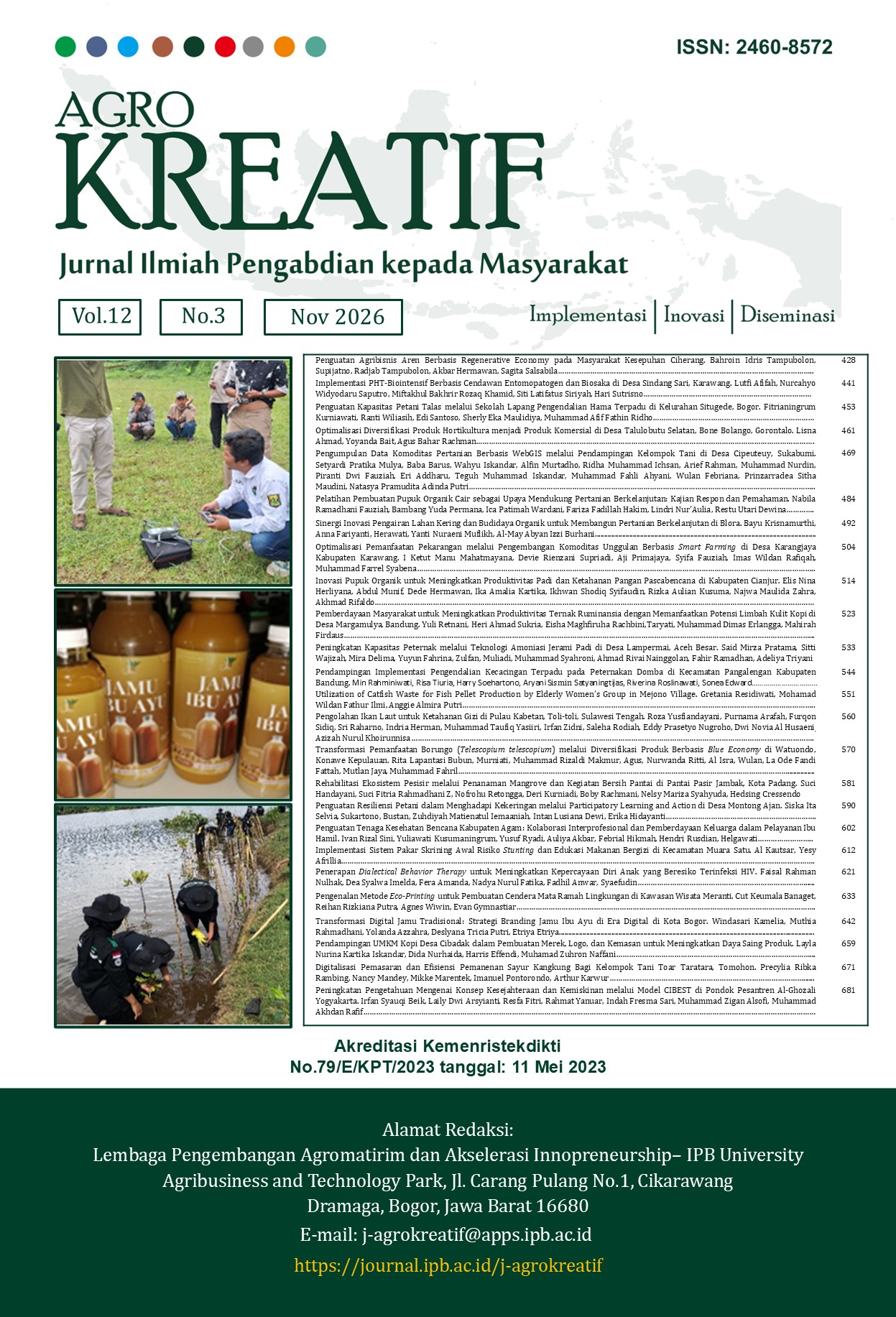
Penguatan Tenaga Kesehatan Bencana Kabupaten Agam: Kolaborasi Interprofesional dan Pemberdayaan Keluarga dalam Pelayanan Ibu Hamil
DOI:
https://doi.org/10.29244/agrokreatif.12.3.602-611Keywords:
Agam District, disaster, family, interprofessional collaboration, pregnant womenAbstract
Disaster situations increase the vulnerability of pregnant women due to disrupted access to healthcare services, limited referral systems, and deteriorating environmental conditions. This community service program aimed to strengthen interprofessional collaboration, enhance the early detection of pregnancy risks, improve maternal referral system coordination, and empower families in maternal healthcare services in Agam Regency, West Sumatra, Indonesia. The program was implemented through five stages: socialization, training, service implementation, monitoring, and evaluation, involving interprofessional healthcare providers, the Agam Regency Health Office, healthcare facilities, and families as active partners. Data were collected through participatory observation, pregnancy risk screening forms, interviews, and activity documentation, and were analyzed descriptively by integrating quantitative and qualitative findings. The results demonstrated improved interprofessional and cross-sectoral coordination, enhanced healthcare workers' capacity, and increased family involvement in the early identification of pregnancy risks and referral decision-making. Among the 70 pregnant women who received antenatal care (ANC), 16 (22.9%) were identified as having high-risk pregnancies and were successfully referred to higher-level healthcare facilities, indicating the effectiveness of systematic risk screening and referral mechanisms. Program sustainability was strengthened through the establishment of maternal healthcare networks, the development of interprofessional collaboration modules and standard operating procedures (SOPs), and continuous capacity-building for healthcare providers and families. This program demonstrates that integrating interprofessional collaboration with family empowerment is an effective strategy for improving the quality of maternal healthcare services in disaster-prone areas while strengthening the resilience and sustainability of the maternal healthcare system.
Downloads
References
Beier L, Thaqi Q, Luyben A, Kimmich N, Naef R. 2024. Predicting collaborative practice between midwives and obstetricians: A regression analysis. European Journal of Midwifery. 8: article 56. https://doi.org/10.18332/ejm/192696
Bustnes KA, Schäfer S, Held L, Wessels H, Friehs MA. 2025. Risks to the unborn: An umbrella review on the effects of prenatal maternal stress caused by natural disasters. Stress and Health. 41(5): e70108. https://doi.org/10.1002/smi.70108
Cummins A, Booth C, Lennon K, McLaughlin K, Prussing E, Newnham E. 2025. Exploring maternity managers' views and experiences of implementing a MAPS continuity of care model in NSW: A qualitative study. Journal of Nursing Management. 2025(1): 1144496. https://doi.org/10.1155/jonm/1144496
Devi DK, Yuliwulandari R, Fahira A, Ayulanda M, Wardhani FK, Nayla F, Aryan F, Felicia Q, Candra A, Syahroni M, Tsary W, Agung D, Ismail M, Elfreda J, Krishna M. 2024. Interprofessional collaboration in disaster medicine during disaster situations. The Journal of Academic Science. 1(5): 511–517.
Dey D, Haque MS, Islam M, Aishi UI, Shammy SS, Mayen MSA, Noor STA, Uddin MJ. 2025. The proper application of logistic regression model in complex survey data: A systematic review. BMC Medical Research Methodology. 25: 15. https://doi.org/10.1186/s12874-024-02454-5
Ersianti YL, Fernandez V, Aulia R, Ladjar YFL, Adnani QES. 2025. Determinants of interprofessional collaboration in implementing Basic Emergency Obstetric and Neonatal Care (BEmONC) services. Majalah Obstetri & Ginekologi. 33(1): 53–64. https://doi.org/10.20473/mog.V33I12025.53-64
Gribble KD. 2026. Pregnant women and new mothers’ experiences and needs in Australian natural disasters: A narrative review. Australian Journal of Emergency Management. 41(1): 13–25. https://doi.org/10.47389/41.1.13
Hamrosi M, Gribble K. 2025. General practitioner disaster support for pregnant women, new mothers, infants and young children. Australian Journal of General Practice. 54(1–2): 34–40. https://doi.org/10.31128/AJGP-06-24-7311
Hidayat N, Suryanto S, Hidayat R. 2023. Ketahanan keluarga dalam menghadapi keguncangan ekonomi selama pandemi. Jurnal Ilmu Keluarga dan Konsumen. 16(2): 105–118. https://doi.org/10.24156/jikk.2023.16.2.120
Hine RH, Mitchell E, Whitehead Annett L, Duncan Z, McArdle A. 2024. Natural disasters and perinatal mental health. Journal of Public Health. 32(5): 805–812. https://doi.org/10.1007/s10389-023-01855-y
Jayaratnam S, Kua S, deCosta C, Franklin R. 2018. Maternal ‘near miss’ collection. BMC Pregnancy and Childbirth. 18: 221. https://doi.org/10.1186/s12884-018-1862-6
[Kemenkes RI] Kementerian Kesehatan Republik Indonesia. (2020). Pedoman pelayanan antenatal, persalinan, nifas, dan bayi baru lahir di era adaptasi kebiasaan baru. [Internet]. [Diakses pada:]. Tersedia pada: https://repository.kemkes.go.id/book/873/download/pdf
[Kemenkes RI] Kementerian Kesehatan Republik Indonesia. (2020). Pedoman rujukan maternal neonatal. [Internet]. [Diakses pada:]. Tersedia pada: https://keslan.kemkes.go.id/unduhan/fileunduhan1761089338_586375.pdf
[Kemenkes RI] Kementerian Kesehatan Republik Indonesia. (2024). Buku kesehatan ibu dan anak (Buku KIA). [Internet]. [Diakses pada:]. Tersedia pada: https://kesprimkom.kemkes.go.id/assets/uploads/contents/others/Buku_KIA_2024.pdf
Lafortune S, Laplante DP, Elgbeili G, Li X, Lebel S, Dagenais C, King S. 2021. Effect of Natural Disaster-Related Prenatal Maternal Stress on Child Development and Health: A Meta-Analytic Review. International Journal of Environmental Research and Public Health. 18(16): 8332. https://doi.org/10.3390/ijerph18168332
Li Q, Kanduma E, Ramiro I, Xu D. (Roman), Cuco, R. M. M., Chaquisse, E., Yang, Y., Wang, X., & Pan, J. (2024). Spatial Access to Continuous Maternal and Perinatal Health Care Services in Low-Resource Settings: Cross-Sectional Study. JMIR Public Health and Surveillance. 10: e49367. https://doi.org/10.2196/49367
Madisa M, Filmalter CJ, Heyns T. 2023. Healthcare professionals and pregnant and post-natal women's perceptions of interprofessional collaboration in a maternity care facility: A qualitative study from Botswana. Midwifery. 125: 103768. https://doi.org/10.1016/j.midw.2023.103768
Make Mothers Matter. 2021. Maternal health care in the EU. Report. [Internet]. [Diakses pada:]. Tersedia pada: https://makemothersmatter.org/wp-content/uploads/2021/12/2021.05.06-Maternal-Health-Care-in-the-EU-FINAL.pdf
McLelland G, McKenna L, Morgans A, Smith K. 2018. Epidemiology of unplanned out-of-hospital births attended by paramedics. BMC Pregnancy and Childbirth. 18: 15. https://doi.org/10.1186/s12884-017-1638-4
Peters DH, Adam T, Alonge O, Agyepong IA, Tran N. 2013. Implementation research. British Journal of Sport Medicine. 48(8): 731‒736. https://doi.org/10.1136/bmj.f6753
Rigby AK, Richards JN, Greenhill J. 2019. Emergency rural obstetric transfers. Rural and Remote Health. 19: 4634. https://doi.org/10.22605/RRH4634
Samosir Y, ulistyaningsih. 2023. Interprofessional Collaboration Practices in Integrated ANC Services: Scoping Review. Poltekita: Jurnal Ilmu Kesehatan. 17(2): 445‒458. https://www.jurnal.poltekkespalu.ac.id/index.php/JIK/article/download/2488/829
Schoenmakers S, Verweij EJT, Beijers R, Bijma HH, Been JV, Steegers EAP, Steegers-Theunissen RPM, Koopmans CM, Koster MPH. 2022. The Impact of Maternal Prenatal Stress Related to the COVID-19 Pandemic during the First 1000 Days: A Historical Perspective. International Journal of Environmental Research and Public Health. 19(8): 4710. https://doi.org/10.3390/ijerph19084710
Schulz AA, Wirtz MA. 2025. Interprofessional collaboration in obstetric care. Healthcare. 13(15): 1798. https://doi.org/10.3390/healthcare13151798
Schulz AA, Wirtz MA. 2023. Assessment of interprofessional obstetric and midwifery care from the midwives' perspective using the Interprofessional Collaboration Scale (ICS). Frontiers in Psychology. 14: 1143110. https://doi.org/10.3389/fpsyg.2023.1143110
Setia MS. 2016. Cross-sectional studies module. Indian Journal of Dermatology. 61(3): 261–264. https://doi.org/10.4103/0019-5154.182410
Sphere Association. 2018. The Sphere handbook: Humanitarian charter and minimum standards in humanitarian response. Geneva: Practical Action Publishing.
Sudirman S, Puspitawati H, Muflikhati I. 2019. Peran suami dalam kesejahteraan subjektif istri. Jurnal Ilmu Keluarga dan Konsumen. 12(1): 26–37. https://doi.org/10.24156/jikk.2019.12.1.26
Sumarni S, Ulfiana E, Octaviani DA, Kumorowulan S. 2024. One Team One Family: Interprofessional Collaboration in Supporting Pregnant Women to Reduce Anxiety. Media Karya Kesehatan. 7(2). 288‒308. https://doi.org/10.24198/mkk.v7i2.46551
van Zijl AL, Vermeeren B, Koster F, Steijn B. 2021. Interprofessional teamwork in primary care: The effect of functional heterogeneity on performance and the role of leadership. Journal of Interprofessional Care. 35(1): 10–20. https://doi.org/10.1080/13561820.2020.1715357
Wariri O, Dotse-Gborgbortsi W, Agbla SC, Jah H, Cham M, Jawara BF, Bittaye M, Nyassi MT, Marena M, Sanneh S, Janneh M, Kampmann B, Banke-Thomas A, Lawn JE, Okomo U. 2025. Beyond proximity: An observational study of stillbirth rates and emergency obstetric and newborn care accessibility in The Gambia. BMJ Global Health. 10(4): e016579. https://doi.org/10.1136/bmjgh-2024-016579
Wicaksono B, Kuncoro WA, Wardani WK. 2024. Kolaborasi profesi/tenaga kesehatan dalam manajemen bencana meliputi fase pra bencana, siaga darurat, dan tanggap darurat. Journal of Evidence-Based Nursing and Public Health. 1(1): 25–35. https://doi.org/10.61511/jevnah.v1i1.2024.512
[WHO] World Health Organization. (2010). Framework for action on interprofessional education & collaborative practice. [Internet]. [Diakses pada:]. Tersedia pada: https://www.who.int/publications/i/item/framework-for-action-on-interprofessional-education-collaborative-practice
[WHO] World Health Organization. (2015). Standards for improving quality of maternal and newborn care. [Internet]. [Diakses pada:]. Tersedia pada: https://www.who.int/publications/i/item/9789241511216
[WHO] World Health Organization. (2019). Maternal mortality. [Internet]. [Diakses pada:]. Tersedia pada: https://apps.who.int/iris/bitstream/handle/10665/329886/WHO-RHR-19.20-eng.pdf
[WHO] World Health Organization. (2019). WHO recommendations on antenatal care for a positive pregnancy experience. [Internet]. [Diakses pada:]. Tersedia pada: https://apps.who.int/iris/bitstream/handle/10665/250796/9789241549912-eng.pdf
[WHO] World Health Organization. (2024). Networks of care for maternal and newborn health: Implementation guidance. Geneva: World Health Organization. [Internet]. [Diakses pada:]. Tersedia pada: https://apps.who.int/iris/handle/10665/379031
Xyrichis A, Vilanova GC, Meffe F. 2025. Advancing collaboration in maternity care. Journal of Interprofessional Care. 39(4): 533–536. https://doi.org/10.1080/13561820.2025.2532995
Downloads
Published
Issue
Section
License
Copyright (c) 2026 Ivan Rizal Sini, Yuliawati Kusumaningrum, Yusuf Ryadi, Auliya Akbar, Febrial Hikmah, Hendri Rusdian, Helgawati Helgawati (Author)

This work is licensed under a Creative Commons Attribution-NonCommercial 4.0 International License.

This work is licensed under a Creative Commons Attribution-NonCommercial 4.0 International License.