
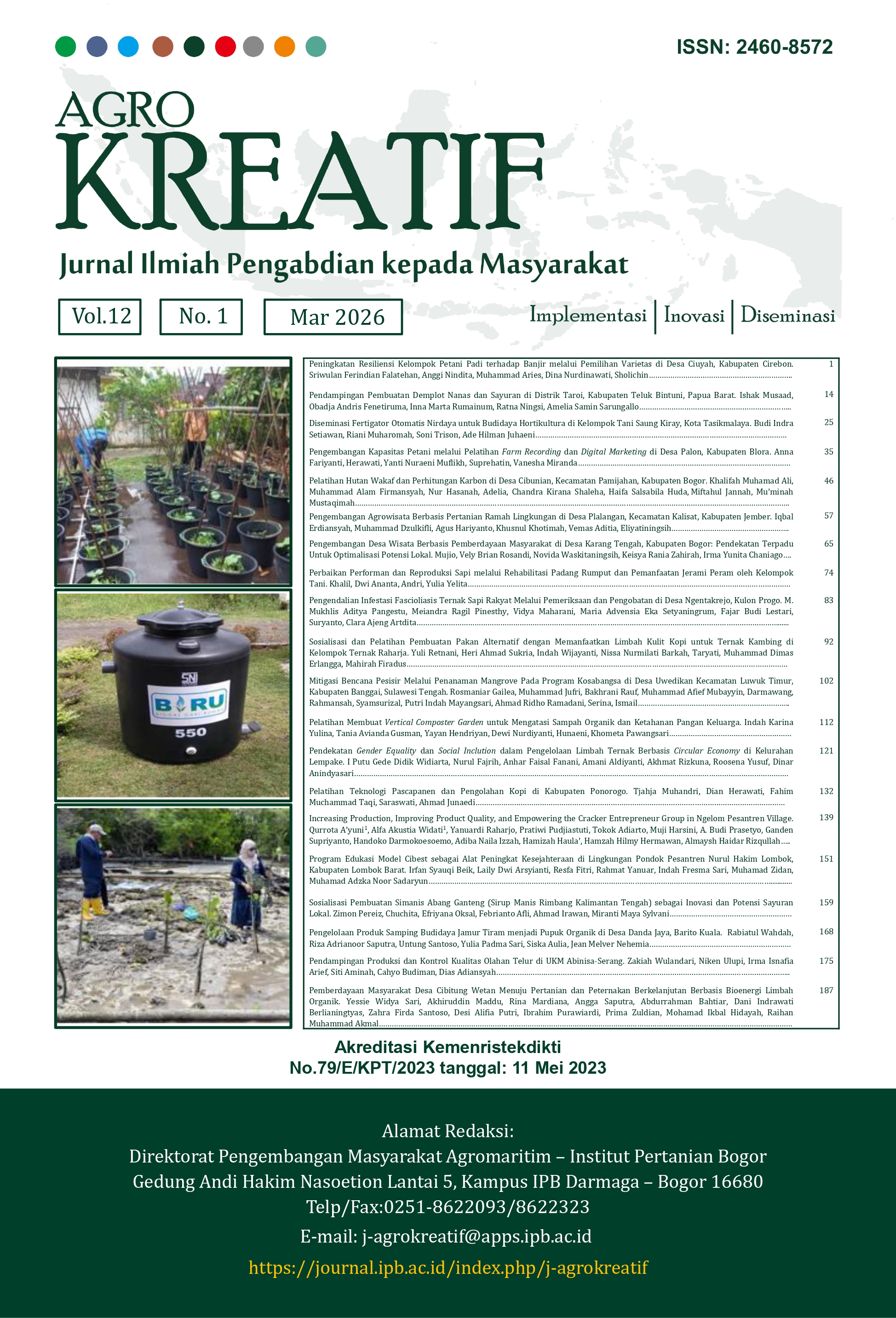
Peningkatan Resiliensi Kelompok Petani Padi terhadap Banjir melalui Pemilihan Varietas di Desa Ciuyah, Kabupaten Cirebon
DOI:
https://doi.org/10.29244/agrokreatif.12.1.1-13Keywords:
climate change, ecological pressure, food security, IPB-9G, technology transferAbstract
Flood disasters, as one of the major impacts of climate change, often exert significant pressure on rice-farming communities, particularly in sustaining production and ensuring food security. Strengthening the resilience of farmer groups in flood-prone areas requires targeted learning processes and well-structured social organization. These two aspects are essential in enhancing resilience through: a) The selection of rice varieties adaptive to climate change and b) The utilization of social institutions to address flood challenges. The Dosen Pulang Kampung (Dospulkam) program of IPB University was implemented in Ciuyah Village, Cirebon regency, to facilitate resilience improvement among rice farmer groups through an integrated training program. The training encompassed the selection of rice varieties and the enhancement of farmer group capacity in managing irrigation resources. The integrated training was conducted from 7‒9 July 2025. The method was conducted through focus group discussions (FGDs), small group discussions, lectures, field surveys, and the distribution of stimulus assistance in the form of IPB 9G seeds, IPB 13S seeds, and IPB 9G rice. Training participants were organized at two levels: group and village. At the community level, 23 community participants represented eight groups from the village; meanwhile, decision-makers, including the village government, the Combined Farmers Group, and village extension workers, were also involved. The results indicated that farmer groups developed a strong understanding of the use of IPB 9G as a climate-smart variety and optimized collective action through social institutions to address irrigation channel constraints. This program has contributed to enhancing the adaptive capacity of rice farmer groups to flood disasters caused by climate change.
Downloads
References
Adger WN, Arnell NW, Tompkins EL. 2005. Successful adaptation to climate change across scales. Global Environmental Change. 15(2): 77–86. https://doi.org/10.1016/j.gloenvcha.2004.12.005
Badan Ketahanan Pangan. 2022. Indeks Ketahanan Pangan.
Berkes F, Colding J, Folke C. 2003. Introduction. Di dalam: Berkes F, Colding J, Folke C, editor. Navigating Social-Ecological Systems. Building Resilience for Complexity and Change. New York: Cambridge University Press.
[BNPB]. 2022 Jan 24. [Update] – Banjir Wilayah Cirebon Berangsur Surut, Warga Mengungsi 115 Jiwa.
BNPB. 2025. Geoportal data bencana Indonesia Tahun 2017-2025. [diunduh 2025 Jul 22]. Tersedia pada: https://gis.bnpb.go.id/arcgis/apps/sites/?fromEdit=true#/public/pages/data-bencana
BPS Kabupaten Cirebon. 2024. Kecamatan Waled dalam Angka tahun 2024. Kabupaten Cirebon.
BRIN. 2023 Mar 30. Periset BRIN Paparkan Data Perubahan Iklim, 10 Tahun Terakhir Musim Hujan di Indonesia Lebih Panjang. [diunduh 2023 Jul 11]. Tersedia pada: https://www.brin.go.id/news/112114/periset-brin-paparkan-data-perubahan-iklim-10-tahun-terakhir-musim-hujan-di-indonesia-lebih-panjang
Budhi S, Hidayah S, Safitri M, Aprilia R, Salamah, Diyana DL. 2022. Strategi Ketahanan Pangan Petani Lahan Basah menghadapi Perubahan Iklim di Kecamatan Martapura Barat Kabupaten Banjar. Di dalam: Prosiding Seminar Nasional Lingkungan Lahan Basah. Vol. 7.
Creswell JW. 2009. Research Design. Qualitative, Quantitative, and Mixed Methods Approaches. 3rd Ed. SAGE Publication Ltd.
Cutter SL, Ash KD, Emrich CT. 2014. The geographies of community disaster resilience. Global Environmental Change. 29:65–77. https://doi.org/10.1016/j.gloenvcha.2014.08.005
Frankenberger T, Mueller M, Spangler T, Alexander S. 2013. Community Resilience: Conceptual Framework and Measurement Feed the Future Learning Agenda.
Gandure S, Walker S, Botha JJ. 2013. Farmers’ perceptions of adaptation to climate change and water stress in a South African rural community. Environ Dev. 5(1):39–53. https://doi.org/10.1016/j.envdev.2012.11.004
Junaedi A, Aswidinnoor H, Purnamawati H, Kurniawati F, Maulidiya SE, Syukur M. 2025. Diseminasi Teknologi Padi IPB untuk Memperkuat Desa Lumbung Padi di Desa Pangumbahan Kabupaten Sukabumi. Agrokreatif: Jurnal Ilmiah Pengabdian kepada Masyarakat. 11(2):207–217. https://doi.org/10.29244/agrokreatif.11.2.207-217
Maguire B, Cartwright S. 2008. Assessing a community’s capacity to manage change : A resilience approach to social assessment. Social Science Program.(May):1–27.
Norris FH, Stevens SP, Pfefferbaum B, Wyche KF, Pfefferbaum RL. 2008. Community resilience as a metaphor, theory, set of capacities, and strategy for disaster readiness. Am J Community Psychol. 41(1–2):127–150. https://doi.org/10.1007/s10464-007-9156-6
Pemerintah Desa Ciuyah. 2025. Monografi Desa Ciuyah Tahun 2025.
Pusat Data dan Sistem Informasi Pertanian Kementerian Pertanian. 2022. Analisis Ketahanan Pangan Tahun 2022.
Ruzek, Joseph I. 2025. Social group interventions to increase resilience and stress resistance in an era of increasing adversity. Journal of Agression, Maltreatment & Trauma. 34 (67). https://doi.org/10.1080/10926771.2025.2460017
Turasih, Kolopaking LM, Wahyuni ES. 2016. Strategi Adaptasi Perubahan Iklim Pada Petani Dataran Tinggi (Studi Petani di Dataran Tinggi Dieng, Kabupaten Banjarnegara). Sodality: Jurnal Sosiologi Pedesaan. 4(1). https://doi.org/10.22500/sodality.v4i1.14408
Walker B, Holling CS, Carpenter SR, Kinzig A. 2004. Resilience, adaptability and transformability in social-ecological systems. Ecology and Society. 9(2). https://doi.org/10.5751/ES-00650-090205
Downloads
Published
Issue
Section
License
Copyright (c) 2026 Anggi Nindita, Sriwulan Ferindian Falatehan, Muhammad Aries, Dina Nurdinawati, Sholichin Sholichin (Author)

This work is licensed under a Creative Commons Attribution-NonCommercial 4.0 International License.

This work is licensed under a Creative Commons Attribution-NonCommercial 4.0 International License.