
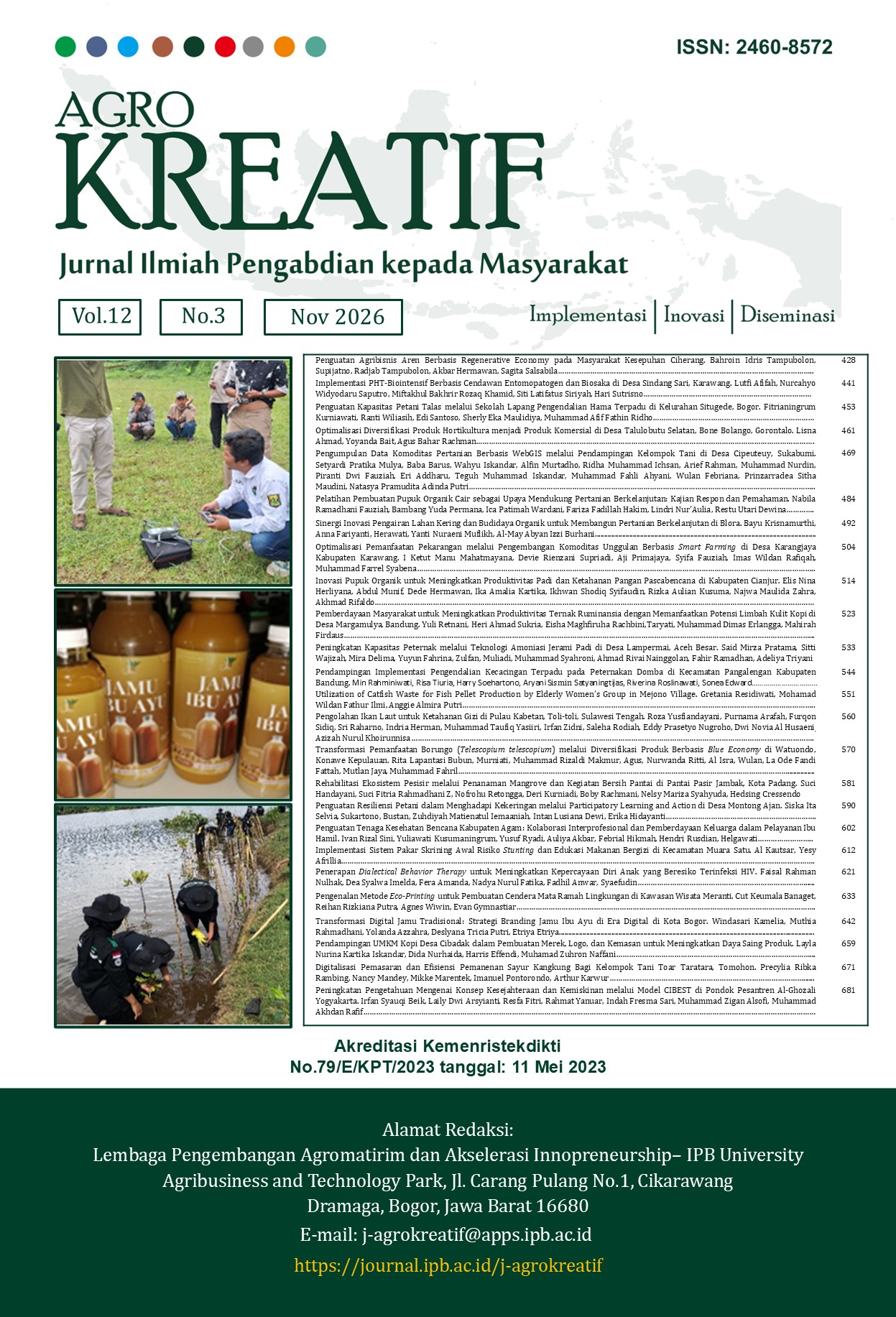
Implementasi PHT-Biointensif Berbasis Cendawan Entomopatogen dan Biosaka di Desa Sindang Sari, Karawang
DOI:
https://doi.org/10.29244/agrokreatif.12.3.441-452Keywords:
Beauveria bassiana, biointensive IPM, biosaka, entomopathogenic fungi, pest controlAbstract
The continuous use of synthetic pesticides for rice pest management can lead to pest resistance and adverse environmental impacts. This community service program aimed to improve farmers' knowledge and skills in implementing Bio-Intensive Integrated Pest Management (IPM) through the use of the entomopathogenic fungus Beauveria bassiana and Biosaka as environmentally friendly alternatives for pest management. The program was conducted with the Sekar Mulya Farmers' Group in Sindang Sari Village, Kutawaluya Subdistrict, Karawang Regency, involving 35 farmers. The activities included outreach, training, demonstrations, field practice, and mentoring, which were evaluated using pre-tests and post-tests. The results showed that the average knowledge score increased from 47 in the pre-test to 79 in the post-test. In addition, 80% of the farmers were able to produce Beauveria bassiana independently and apply Biosaka as a plant biostimulant. The program also improved farmers' understanding of Bio-Intensive IPM and encouraged a reduction in their reliance on synthetic pesticides. Overall, the training and mentoring activities enhanced farmers' capacity to apply biological control technologies that support more environmentally friendly and sustainable rice cultivation.
Downloads
References
Afifah L, Afifah DM, Surjana T, Kurniati A, Maryana R. 2022. Produksi Cendawan Entomopatogen Beauveria bassiana Menggunakan Substrat Kaya Pati dan Infektifitasnya terhadap Tribolium castaneum. Ilmu Dasar. 23(2): 139–148. https://doi.org/10.19184/jid.v23i2.21435
Afifah L, Saputro NW. 2020. Growth and viability of entomopathogenic fungus Beauveria bassiana (Balsamo) Vuillemin in different alternative media. IOP Conference Series: Earth and Environmental Science. 468(1). https://doi.org/10.1088/1755-1315/468/1/012037
Afifah L, Saputro WN. 2024. Strategi Hijau: Pengendalian Hama Terpadu Padi Bio-Intensif untuk Pertanian Berkelanjutan. Bandung: Unpad Press.
Amelia N, Afifah L, Sugiarto, Kurniati A. 2023. Invektivitas cendawan entomopatogen Beauveria bassiana untuk mengendalikan hama boleng Cylas formicarius F. Jurnal Agrotech. 13(1): 11–17. https://doi.org/10.31970/AGROTECH.V13I1.108
Arif A. 2015. Pengaruh Bahan Kimia Terhadap Penggunaan Pestisida Lingkungan. Jurnal Farmasi UIN Alauddin. 3(4): 134–143.
[BPS]. Badan Pusata Statistik. 2025. Kecamatan Kutawaluya dalam angka. BPS Kabupaten Karawang. https://karawangkab.bps.go.id/id/publication/2025/09/26/7946bb87570707cbc80f92c3/kutawaluya-district-in-figures-2025.html
Haryati, Situmeang ND. 2024. Testing seed quality and vegetative growth yield of rice paddy (Oryza sativa L.) production results treated with NPK and biosaka for sustainable agriculture. IOP Conference Series: Earth and Environmental Science. 1413(1): 012044. https://doi.org/10.1088/1755-1315/1413/1/012044
Ihsan AK, Afifah L, Sugiarto, Kurniati A. 2023. Virulensi Cendawan Entomopatogen Beauveria bassiana Terhadap Wereng Batang Coklat Nilaparvata lugens Stal. Jurnal Agrotech. 13(1): 63–70. https://doi.org/10.31970/AGROTECH.V13I1.136
Mishra M. 2023. The Potential Application of Entomopathogenic Fungi (EF) in Insect Pest Management. Microorganisms for Sustainability. 49: 323–347. https://doi.org/10.1007/978-981-99-3947-3_16
Pradana AP, Hariyati Y, Winarso S, Sudarko S, Sofia S, Jadmiko MW, Savitri DA. 2023. Implementasi Teknologi Biointensif dalam Rangka Meningkatkan Kesehatan Tanaman dan Menekan Residu Pestisida pada Produk Hortikultura di Desa Ngadisari, Probolinggo. SELAPARANG: Jurnal Pengabdian Masyarakat Berkemajuan. 7(1): 353‒359. https://doi.org/10.31764/jpmb.v7i1.13312
Santos ACDS, da Silva Lopes R, de Oliveira LG, Diniz AG, Shakeel M, de Luna Alves Lima EÁ, da Costa AF, de Menezes Lima VL. 2022. Entomopathogenic Fungi: Current Status and Prospects. New and Future Development in Biopesticide Research: Biotechnological Exploration. 55–91. https://doi.org/10.1007/978-981-16-3989-0_2
Senja SN, Afifah L, Sugiarto S, Kurniati A. 2023. Growth of Metarhizium rileyi with the addition of soursop seeds and gadung tubers to support the growth rate of entomopathogenic fungi. Jurnal Agrotropika. 22(1): 63‒71. https://doi.org/10.23960/ja.v22i1.7452
Sharma A, Srivastava A, Shukla AK, Srivastava K, Srivastava AK, Saxena AK. 2020. Entomopathogenic Fungi: A Potential Source for Biological Control of Insect Pests. Phytobiomes: Current Insights and Future Vistas. 225–250. https://doi.org/10.1007/978-981-15-3151-4_9
Wilyus W, Ratna Y, Yunita W. 2017. Pengendalian Hama Terpadu (PHT) Biointensif Pada Tanaman Padi Di Desa Senaning. Jurnal Karya Abdi Masyarakat. 1(1): 35–42. https://doi.org/10.22437/jkam.v1i1.3726
Wiyono S, Widodo, Triwidodo H. 2015. Mengelola Ledakan Hama Dan Penyakit Padi Sawah Pada Agroekosistem Yang Fragil Dengan Pengendalian Hama Terpadu Biointensif. Risalah Kebijakan Pertanian dan Lingkungan: Rumusan Kajian Strategis Bidang Pertanian Dan Lingkungan. 1(2): 116‒120. https://doi.org/10.20957/jkebijakan.v1i2.10303
Downloads
Published
Issue
Section
License
Copyright (c) 2026 Lutfi Afifah, Nurcahyo Widyodaru Saputro, Miftakhul Bakhrir Rozaq Khamid, Siti Latifatus Siriyah, Hari Sutrisno (Author)

This work is licensed under a Creative Commons Attribution-NonCommercial 4.0 International License.

This work is licensed under a Creative Commons Attribution-NonCommercial 4.0 International License.