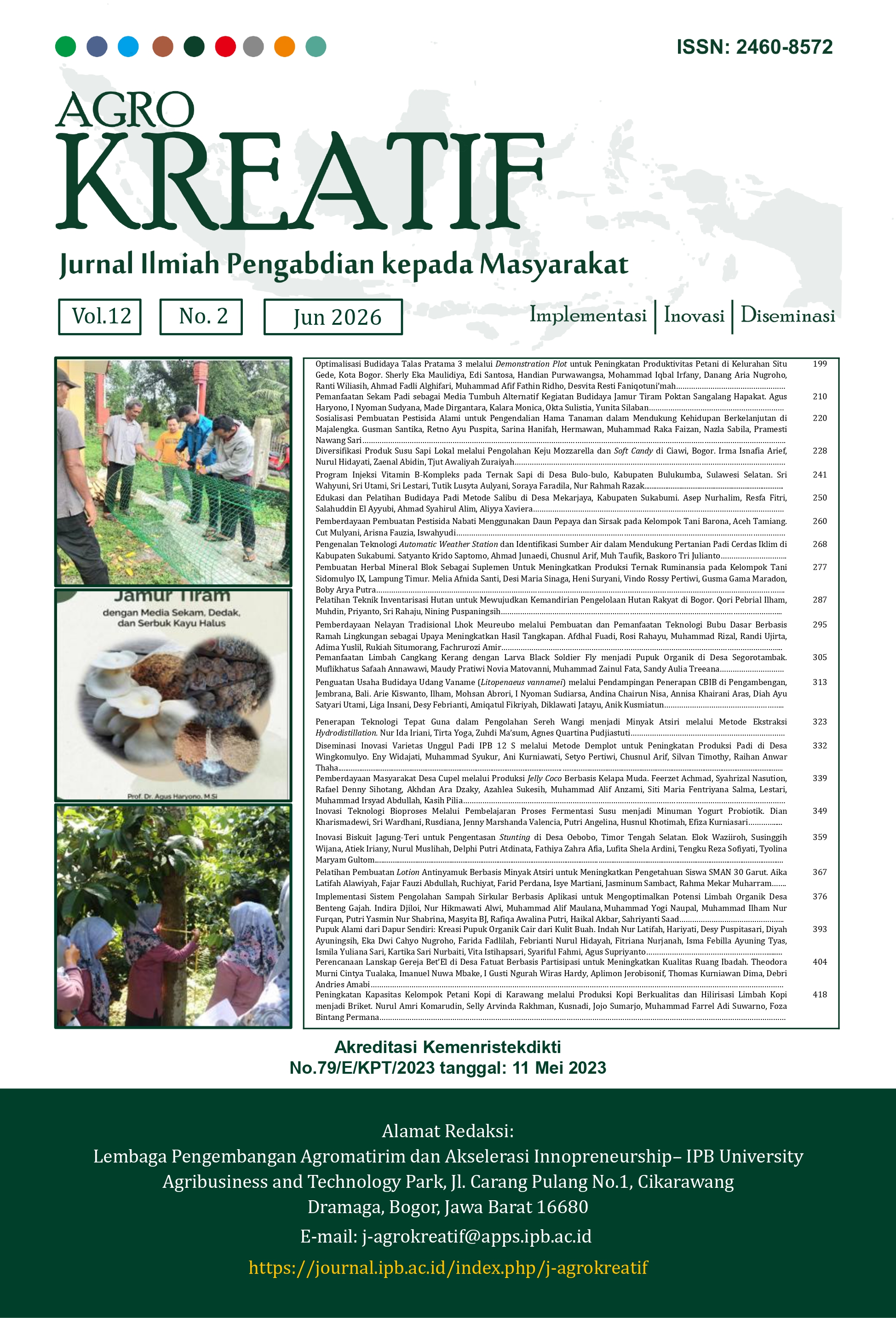
Pelatihan Pembuatan Lotion Antinyamuk Berbasis Minyak Atsiri untuk Meningkatkan Pengetahuan Siswa SMAN 30 Garut
DOI:
https://doi.org/10.29244/agrokreatif.12.2.367-375Keywords:
essential oils, lotion, mosquito, natural product, trainingAbstract
Mosquitoes are considered vectors responsible for dengue fever, malaria, and chikungunya. Applying anti-mosquito lotion is a precaution to avoid mosquito bites. Certain commercial items contain diethyltoluamide (DEET), which can be harmful to health and contaminate the environment when used for extended periods. Utilizing essential oils in a anti-mosquito lotion is more eco-friendly. This community service aimed to improve students’ understanding and ability to produce anti-mosquito lotion using essential oils. The training took place at SMAN 30 Garut, involving 35 students from classes X and XII. The training approach involves preparation; implementation (pre-test and post-test to evaluate participants’ knowledge levels, delivering material interactively, and practicing); and evaluating activities through satisfaction questionnaires. A paired t-test analysis of the pre-test and post-test results showed that a t-value of 3,25 with a p-value of 0,012 (< 0,05), indicating a significant improvement in the pupils’ knowledge of the subject matter and their skills in making mosquito-repellent lotion. The percentage of correct answers has increased from 68,57% (pre-test) to 86,35% (post-test). The results indicated that participants responded positively to the activities conducted. The results of the training showed an improvement in students’ understanding of the subjectand their ability to make anti-mosquito lotions. This activity not only provides insight into the use of natural products but also raises students’ interest in entrepreneurial oppoturnities and innovation within schools and the community.
Downloads
References
Alawiyah AL, Sidiqoh S, Rohaeni I, Savitri DY, Widana R. 2024. Characterization of Volatile Compounds of Selected Aromatic Plants from West Java. Al-Kimia. 12(2): 8‒18. https://doi.org/10.29244/agrokreatif.9.3.355-361
Ariyanto E, Herawati N, Robiah R, Juniar H, Kharismadewi D. 2023. Peningkatan pengetahuan Masyarakat melalui pelatihan pembuatan minyak atsiri di kelurahan plaju darat kota Palembang. Agrokreatif Jurnal Ilmaiah Pengabdian Kepada Masyarakat. 9(3): 355–361.
Arpiwi NL, MUksin IK, Kartini NL. 2020. Essential oil from Cymbopogon nardus and repellant activity against Aedes aegypti. Biodiversitas. 21(8): 3873–3878. https://doi.org/10.13057/biodiv/d210857
Effendy I, Abi Hamid M. 2016. Pengaruh pemberian pre-test dan post-test terhadap hasil belajar mata diklat hdw. dev. 100.2. a pada siswa smk negeri 2 lubuk basung. VOLT Jurnal Ilmiah Pendidikan Teknik Elektro. 1(2): 81–88.
Kadang Y, Hasyim MF. 2019. Formulasi Dan Uji Mutu Fisik Lotion Antinyamuk Minyak Sereh Wangi (Cymbopogon nardus L Rendle.) dengan Kombinasi Minyak Nilam (Pogostemon cablin Benth.). Jurnal Farmasi Sandi Karsa. 5(1): 38–42. https://doi.org/10.36060/jfs.v5i1.39
Laith A-E, Alnemri M, Ali H, Alkhawaldeh M, Mihyar A. 2024. Mosquito-borne diseases: assessing risk and strategies to control their spread in the Middle East. Journal Biosaf Biosecurity. 6(1): 1–12. https://doi.org/10.1016/j.jobb.2023.12.003
Luker HA, Salas KR, Esmaeili D, Holguin FO, Bendzus-Mendoza H, Hansen IA. 2023. Repellent efficacy of 20 essential oils on Aedes aegypti mosquitoes and Ixodes scapularis ticks in contact-repellency assays. Scientific Report. 13(1): 1705. https://doi.org/10.1038/s41598-023-28820-9
Ogbonna UFS, Divine CC. 2023. Repellence of Aedes aegypti with oils from Citrus sinensis and Citrus paradisi fruit peelsi from Nsukka. Journal of Biological Research & Biotechnology. 21(3): 2099–2112. https://doi.org/10.4314/br.v21i3.4
Oktanti S, Trisagi NG, Soetjipto STSH, flih Muflih M, Widaryanti R, Indrawati FL. 2022. Uji Efektivitas Sediaan Anti Nyamuk Menggunakan Ekstrak Serai Wangi (Cymbopogon Nardus L.) Terhadap Nyamuk Aedes Aegypti. Dalam: Prosiding Seminar Nasional Multidisiplin Ilmu. 4: 250–260.
Syafii I. 2023. Meningkatkan Keterampilan Kolaborasi Siswa melalui Model Pembelajaran berbasis Proyek: Materi Hakikat Ilmu Kimia dan Metode Ilmiah. Jurnal Pendidikan Indonesia: Teori, Penelitian, dan Inovasi. 3(1): 55‒60. https://doi.org/10.59818/jpi.v3i1.439
Taupik M, Madania M, Mursyidah A, Latif MS. 2023. Produk Spray Antinyamuk Ramah Lingkungan Berbahan Dasar Tanaman Lidah Buaya dan Sereh Sebagai Upaya Menangkal Penyakit Demam Berdarah. Jurnal Pengabdian Masyarakat Farmasi Pharmacare Society. 2(3): 156–163. https://doi.org/10.37905/phar.soc.v2i3.22149
Yanti CA, Sari M, Triana A. 2021. Daya Proteksi Serai Wangi (Cymbopogon winterianus Jowitt) sebagai Repelen dari Nyamuk Aedes aegypti. Jurnal Vektor Penyakit. 15(2): 99–106. https://doi.org/10.22435/vektorp.v15i2.5126
Zareen S, Khan SN, Adnan M, Ur H, Rehman MA, Saeed K, Ahmad W, Ali M. 2016. Mixture of olive oil and Aloe vera gel: A natural mosquito repellent and a skin moisturizer. International Journal of Mosquito Research. 3(4): 48–49.
Downloads
Published
Issue
Section
License
Copyright (c) 2026 Aika Latifah Alawiyah, Fajar Fauzi Abdullah, Ruchiyat, Farid Perdana, Isye Martiani, Jasminum Sambact, Rahma Mekar Muharram (Author)

This work is licensed under a Creative Commons Attribution-NonCommercial 4.0 International License.

This work is licensed under a Creative Commons Attribution-NonCommercial 4.0 International License.