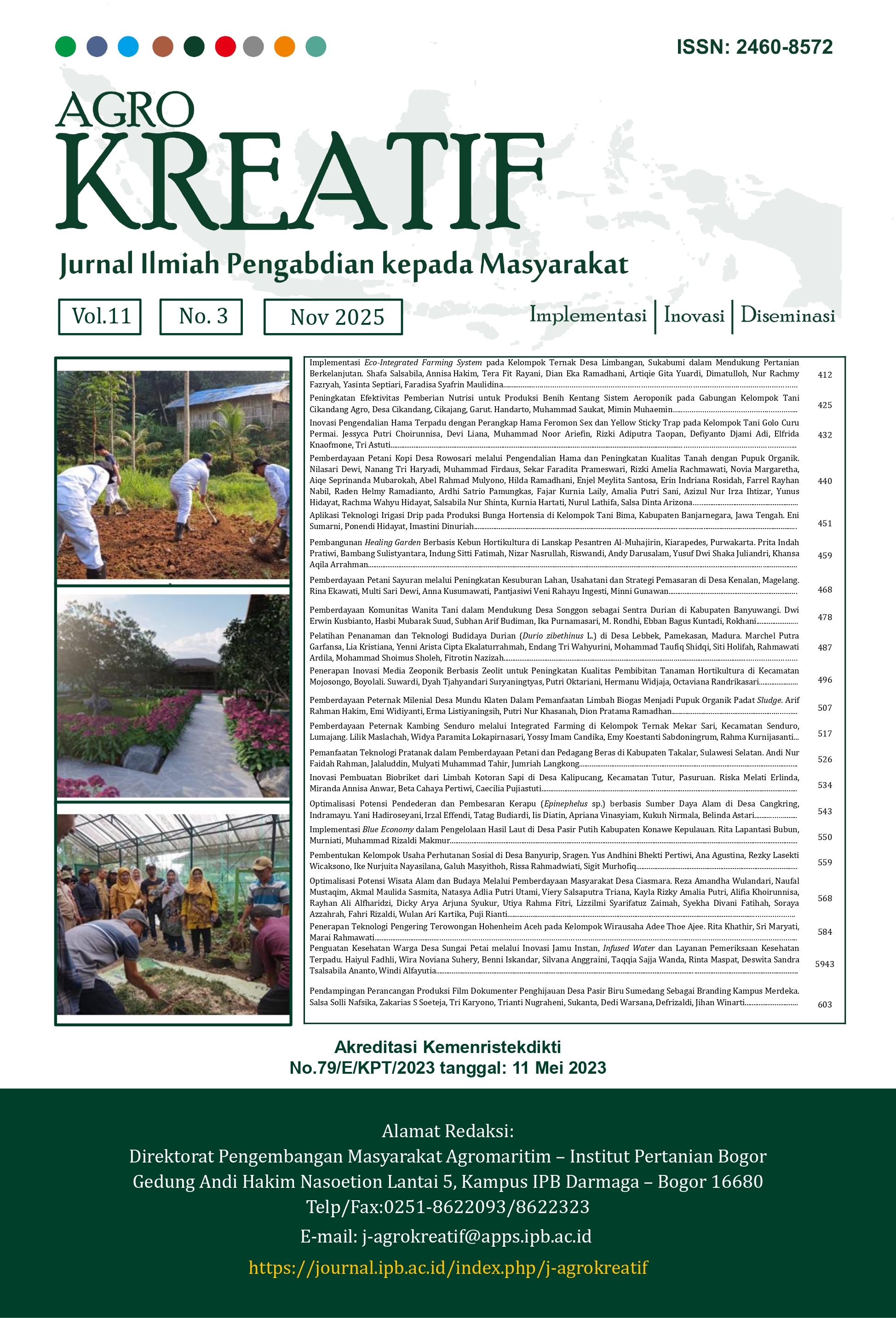
Aplikasi Teknologi Irigasi Drip pada Produksi Bunga Hortensia di Kelompok Tani Bima, Kabupaten Banjarnegara, Jawa Tengah
DOI:
https://doi.org/10.29244/agrokreatif.11.3.451-458Keywords:
Dieng, flower, greenhouse, hydroponic, irrigationAbstract
Bima Farmer Group of Dieng Kulon Village, Banjarnegara is a micro-enterprise in the agricultural sector and a center for exotic ornamental plants, particularly Hydrangea flowers. Hydrangea is a leading commodity within the Bima Farmer Group and supports the development of tourism in Dieng Kulon, Banjarnegara. Some of the challenges faced by the group in maintaining productivity include the topography of Banjarnegara, which has a land slope of 45.04%, posing risks to effective and efficient irrigation and fertilization technologies. This research-based community service activity aims to transfer drip irrigation technology to assist in the management of water and nutrients for Hydrangea flower production. The methods used in this technology transfer activity are as follows: 1) Providing assistance and hands-on practice in nutrient management for Hortensia flower production, 2)Establishing demonstration plots using drip irrigation technology for Hortensia flower cultivation, and 3) Conducting activity evaluations to assess the farmers group's level of understanding. Results from this activity show a significant improvement in the farmer’s understanding of the technology transfer, increasing from 3–5% to 85–87%. The average number of Hydrangea flower heads per plant per season before drip irrigation was 6–9, which increased to 11–13 flower heads per plant after implementation. Fertilization became more controlled with the use of drip irrigation, and water usage was reduced by 30–55% compared to conventional methods. Nutrient and water supply remained stable due to the drip irrigation technology. The sustainability of this technology transfer has been well received by the Bima Farmer Group, which plans to expand drip irrigation to other cultivation areas.
Downloads
References
Department of Agriculture, Forestry and Fisheries. 2009. Lavender production. Republika of Shout Africa. Pretoria: South Africa
Hadiutomo K. 2012. Mekanisasi Pertanian. Bogor: IPB Press.
Lamm FR. 2015. Cotton, tomato, corn, and onion production with subsurface drip Irrigation. A review. ASABE Irrigation Symposium Paper. Emerging Technologies for Sustainable Irrigation Proceedings of the 10‒12 November. Long Beach: California USA.
Marlina N. 2009. Teknik Perbanyakan Lili Dengan Kultur Jaringan. Buletin Teknik Pertanian. 14(1): 6‒8.
Mechram S. 2006. Aplikasi T eknik Irigasi Tetes dan Komposisi Media Tanam pada Selada (Lactuva sativa). Jurnal Teknologi Pertanian. 7(1): 27‒36.
Pompelli MF, De Brito GG, Otoni WC, Guerra WP. 2007. Biotechnologies for ornamental plants: some insights to the Brazilian productive chain. International Journal of Horticultural Science. 13(1): 51‒59. https://doi.org/10.31421/IJHS/13/1/695
Simonne EH, Dukes MD, Zotarelli L. 2010. Principles and Practices of Irrigation Management for Vegetables. Chapter 3. IFAS. Extension. Florida.
Siregar M, Wahyuni D. 2024. Evaluasi Efisiensi Pemupukan pada Lahan Berlereng di Dataran Tinggi Sumatera Barat. Jurnal Ilmu Tanah dan Lingkungan. 26(1): 12–20.
Sumarni E, Farid N. 2016. Produksi sayuran bebas pestisida dengan hidroponik dalam greenhouse. Buku Teknologi Tepat Guna. LPPM Unsoed.
Sumarni E, Farid N. 2019. Nutrisi aeroponik benih kentang untuk daerah tropika basah. Paten granted. No. Sertifikat: IDP000065162 tertanggal 10 Desember 2019. Dirjen HKI. Jakarta.
Sumarni E, Masrukhi, Suroso. 2009. Rekayasa irigasi drip dan kontrol nutrisi otomatis untuk meningkatkan hasil dan kualitas stroberi serta pengembangan krisan di Serang, Kabupaten Purbalingga. Laporan Hasil Penelitian Riset Unggulan Nasional. UNSOED. 58 Halaman.
Sumarni E, Margiwiyatno A. 2006. Modifikasi atmosfer bawang merah dengan irigasi drip di dataran rendah. Laporan Penelitian Hibah A2. Unsoed. 40 halaman.
Sumarni E, Soesanto L, Farid N, Baroroh HN. 2018. Potensi pertumbuhan purwoceng dengan teknik irigasi tetes, nutrient film technique dan penanaman di lahan terbuka. Jurnal Litbang Provinsi Jawa Tengah. 16(2): 175‒182. https://doi.org/10.36762/litbangjateng.v16i2.763
Sumarni E, Juansyah J, Darjanto. 2020. Aplikasi irigasi tetes pada uji pertumbuhan fase vegetatif benih kentang hasil aeroponik dataran rendah dengan variasi ukuran benih. Journal of Agricultural and Biosystem Engineering Research. 1(1): 1‒7.
Sumarni E, Farid N, Sugiarto AN, Sudarmadji A. 2016. G0 Seed Potential of The Aeroponics Potatoes Seed In The Lowlands With A Root Zone Cooling Into G1 In The Highlands. Rona Teknik Pertanian. 9(1): 1‒10. https://doi.org/10.17969/rtp.v9i1.4380
Sumarni E, Mustofa A, Nurchasanah S, Utami DS. 2021. Transfer teknologi aplikasi nutrisi untuk produksi kentang di lahan di desa Sidomulyo, Banjarnegara. Makalah Seminar Nasional. LPPM Unsoed. Purwokerto. 7 halaman.
Yanto H, Tusi A, Triyono S. 2014. Aplikasi sistem irigasi tetes pada tanaman kembang kol (Brassica Oleracea Var. Bot ryt is L. Subvar. Caulifl ora DC) dalam greenhouse. Jurnal Teknik Pertanian Lampung. 3(2): 141‒154.
Zhang Y, Li C, Wang H. 2024. Impact of slope gradient on soil nutrient loss and fertilizer efficiency in terraced agriculture systems. Agricultural Water Management. 292: 108815. https://doi.org/10.1016/j.agwat.2024.108815
Downloads
Published
Issue
Section
License
Copyright (c) 2025 Erni Sumarni (Author); Ponendi Hidayat, Imastini Dinuriah

This work is licensed under a Creative Commons Attribution-NonCommercial 4.0 International License.

This work is licensed under a Creative Commons Attribution-NonCommercial 4.0 International License.